
Beyond the Minarets and Tobacco Fields: Why Radoviš Holds the Soul of Eastern Macedonia (2026)
On a sweltering August afternoon in 1924, a young schoolteacher named Dimitar talked his way into the archives of the old Ottoman municipal building and discovered documents proving that Radoviš had been a thriving settlement since at least the 13th century. He emerged blinking into the sunlight, holding a parchment that mentioned “Radovišta” in a decree by Tsar Dušan—proof that this valley town was far older than anyone had suspected. Today, that parchment is lost, but the feeling of uncovering hidden layers never leaves you here.
The Story Behind Radoviš, North Macedonia
You will find Radoviš cradled in the valley of the same name, a natural corridor that has funneled armies, traders, and wandering shepherds for millennia. The Romans knew this route well, building a modest waystation they called “Tranupara” somewhere near the present-day town center. But Radoviš truly entered written history in the 14th century, when the Serbian Emperor Stefan Dušan granted the area to the Hilandar Monastery on Mount Athos in 1345. That monastic connection meant Radoviš was not just a market town—it was a spiritual crossroads long before the Ottomans arrived.
When the Ottoman Empire swept through in the late 14th century, Radoviš adapted rather than resisted. The town grew into a typical Ottoman kasaba, with a cobbled čaršija, a bedesten (covered market), and no fewer than seven mosques by the 17th century. Travelers often discover that the Ottoman legacy still defines the town’s rhythm—the morning call to prayer drifting over tobacco-drying sheds, the Turkish coffee brewed in copper pots at family-run cafés. What surprises many visitors is that Radoviš was also a center of the tobacco trade under Ottoman rule, a crop that made local merchants wealthy enough to build stone mansions that still dot the old quarter.
The most transformative moment in modern Radoviš came in 1975, when the Bučim copper mine opened just 12 kilometers north of town. Suddenly, this quiet agricultural center became a mining hub, drawing workers from across Yugoslavia. Locals recommend you visit the Mining Museum on Marshal Tito Street to understand this chapter—it houses maps, tools, and photographs that show how Radoviš doubled in population between 1975 and 1990. The mine still operates today, and you will notice the subtle copper-red tint in the soil as you approach the town from the north. It’s not pollution, locals will tell you with a shrug; it’s the earth declaring what it has always held.
Neighborhood by Neighborhood
The Old Bazaar (Stara Čaršija)
Your best bet is to begin at the heart of the old bazaar, which radiates from the small square where the Ottoman clock tower once stood—it collapsed in the 1931 earthquake, but locals still call the intersection “Sahat Kule” in its honor. Here, you will step into a street network that has barely changed since the 18th century: narrow lanes of whitewashed stone buildings, many with overhanging wooden eaves designed to shade the walkways beneath. The tobacco merchants’ shops still line the main drag, though most now sell household goods, fabrics, or the local specialty—handmade copper pots called “kazani” that distillers use for rakija. Stop at the café Cezar, where the owner Ilija has been brewing Turkish coffee since 1978, and you’ll notice the quiet hum of commerce that hasn’t changed in centuries: bargaining in Macedonian and Turkish, the clink of coffee cups, the scent of dried paprika hanging in braids from shop awnings.
Nova Mahala (The New Quarter)
A ten-minute walk east along Marshal Tito Street brings you to Nova Mahala, the neighborhood built for the miners and their families in the 1970s and 1980s. This is where Radoviš becomes recognizably Yugoslav—those identical three-story socialist apartment blocks, called “kolektivno stanuvanje,” arranged around grassy courtyards where laundry flaps in the breeze and old men play chess on concrete tables. What gives Nova Mahala its character is the contrast: here, you will find the Church of St. Cyril and Methodius, a neo-Byzantine structure completed in 1997 with a copper dome that gleams like a green jewel against the gray apartments. On Sunday mornings, the courtyard fills with families dressed in their finest, and the sound of the church choir mixes with Turkish pop music drifting from open windows. Your best Turkish roast chicken in town comes from Restaurant Turist, tucked under an apartment block on Partizanska Street—the owner, Hüseyin, has been slow-roasting birds over charcoal since the neighborhood was built.
Bučim Mining Settlement (Rudarsko Naselje)
Travelers who venture 12 kilometers north of town along the road to the mine discover a raw, unvarnished side of local life. Rudarsko Naselje is a company town built entirely by the mining enterprise—dormitories, a school, a clinic, a cultural center, and a sports hall, all painted in the mustard-yellow that the mining company favored in the 1980s. The population here swells at shift changes, when buses disgorge men in orange work suits heading home to their modest apartments. What makes this neighborhood worth your time is the Mining Workers’ Club, on the main square, where on Friday evenings you can join locals for a drink at the bar and hear stories of the 1984 strike, when workers demanded higher wages and brought production to a standstill for 47 days. The museum here, though small, contains a fascinating collection of mineral samples from the mine, including pieces of malachite and azurite that glow under black light.
The Local Table: What Denizens Actually Eat

Подареш – пошта, Radoviš, North Macedonia
Radoviš denizens live by the rhythm of the land, and the land here grows tobacco, peppers, and plums. You will notice that every home has a plum tree in the yard—not for eating fresh, but for distillation into rakija, the fruit brandy that fuels social life. In autumn, the scent of fermenting plums hangs over every neighborhood. The local rakija is called “radoviška slivovica,” and it’s stronger and more aromatic than what you find elsewhere in Macedonia because of the valley’s particular microclimate. Locals recommend you taste it at the home of the Gjorgjievski family on the third Sunday of October, during the annual Rakija Festival, when the main square fills with copper stills and the mayor judges the strongest and smoothest batches.
Your essential food experience in Radoviš is a meal at Restaurant Platan, a family-run institution on the banks of the Radoviška River that has been serving the same dishes since 1962. The specialty here is “jagnjetina pod sač,” a whole lamb slow-cooked under a metal lid covered with embers for five hours until the meat falls from the bone. You will need to order it at least a day in advance, and you’ll notice that the Platan family keeps the recipe locked in a safe—literally, the owner will show you the safe if you ask politely. For a quicker meal, head to the Market Centar on Tuesday or Saturday mornings, when farmers from the surrounding villages set up stalls selling “mekici” (fried dough) and “ajvar” (roasted red pepper spread) alongside copper drying frames still bearing this season’s tobacco leaves. The secret to Radoviš cuisine, you soon understand, is patience: the slow-cooking, the months-long fermentation, the generations-old recipes that no one writes down.
The food culture here is deeply seasonal. In late September, you will see entire families shelling walnuts under the grape arbors in their courtyards, the shells cracking open with a sound like tiny castanets. In winter, the clay pots known as “grneta” emerge from pantries, filled with beans slow-cooked overnight on wood stoves. The local cheese, “radoviška bela korpa,” is a soft white cheese aged in willow baskets that you must try at the home of any cheese maker—it’s not sold in shops. When you leave a restaurant, the owner will likely send you off with a small jar of honey from his own hives, because generosity here is not a gesture; it is the local definition of hospitality.
Art, Music & Nightlife
Radoviš does not have a flashy nightlife scene, and that is precisely its charm. The creative energy here flows through the Cultural Center “Svetlina,” a socialist-era building on Marshal Tito Street that hosts everything from poetry readings to folk dance rehearsals. You will discover that despite its small size—just over 16,000 people—Radoviš produces a disproportionate number of Macedonia’s best folk musicians. Every August, the “Radoviš Folk Festival” brings together tapan drummers, zurla players, and elegant dancers from across the Balkans for a three-day competition. The highlight is Saturday evening, when the main square fills with dancers in traditional white costumes embroidered with red and black geometric patterns, and you will watch grandmothers teaching grandchildren the steps that have been passed down through generations.
The nightlife alternative to folk music is found not in clubs but in the kafanas of the old bazaar. Kafana “Čaršija” on Ilindenska Street is the place where from 10 PM onward, tables are pushed aside, a clarinet and drum set emerges from a back room, and for the next four hours, the music shifts from Macedonian folk to Turkish pop to Serbian rock without any sense of contradiction. The crowd ranges from 18-year-old students home for the weekend to veteran miners, and the drink of choice is “radoviška rakija” mixed with honey and hot water—a concoction locals call “medovina.” If you are still standing past 2 AM, you will be invited to sing, and you should accept, because the worst you can do is please no one and the best you can do is become a local legend.
Practical Guide

Aerial view of a dome building in Skopje’s urban landscape., Radoviš, North Macedonia
- Getting There: Fly into Skopje International Airport (SKP), 125 km northwest, with connections from Vienna, Istanbul, Zurich, and other major hubs via Wizz Air and Turkish Airlines. Book at Skyscanner
- Getting Around: From Skopje, take a bus from the main bus station to Radoviš (3 hours, approximately 500 MKD or 8 EUR). Buses run hourly until 6 PM. Within town, everything is walkable; taxis cost about 100 MKD (1.60 EUR) for any trip inside the city limits
- Where to Stay: The best option is Hotel Dojran in the center (double rooms from 2,500 MKD/40 EUR). For an authentic experience, book a room at Guesthouse Makedonski Biser in Nova Mahala. Check Booking.com
- Best Time: September is ideal—the summer heat has softened, the tobacco leaves are golden in the fields, and the Rakija Festival falls on the third weekend of the month. April to October is the broader window for comfortable travel
- Budget: You can eat well for 400 MKD (6.50 EUR) per meal, a decent hotel room costs 2,500 MKD (40 EUR), and a bus from Skopje to Radoviš is about 500 MKD (8 EUR). Daily budget for a comfortable trip: approximately 4,000 MKD (65 EUR)
What Surprises First-Time Visitors
The first thing that catches travelers off guard is the sheer volume of green. Arriving from the dusty hills of central Macedonia, you descend into the Radoviš valley and suddenly find yourself surrounded by lush vineyards, orchards, and fields of tobacco so thick and tall they look like a green sea. The microclimate here is noticeably different—cooler, more humid, the air carrying the scent of wet earth even in summer. You will find yourself taking deep, involuntary breaths, as if your lungs understand before your brain does that this air is different.
The second surprise is the multilingual reality of everyday life. You will hear Macedonian, Turkish, and Romani spoken in the same conversation at a sidewalk café, with speakers switching between languages mid-sentence. The town is roughly 60% Macedonian, 30% Turkish, and 5% Romani, but those numbers don’t capture how seamlessly these communities intertwine. At the bakery “Mira” in the old bazaar, the owner, a Macedonian woman named Zorica, greets every customer in Turkish if they start with “Merhaba” and switches to Macedonian if they respond in kind. For visitors, this fluidity is a lesson in coexistence that feels both ancient and deeply modern.
Finally, visitors are surprised by the silence of Radoviš at night. After the bustle of the kafanas fades—usually by midnight on weeknights—the town falls into a stillness so profound you can hear the river flowing through the valley and, on clear nights, the distant low hum of the Bučim mine’s machinery. It is the kind of quiet that unsettles city dwellers at first, then becomes addictive. You realize that in Radoviš, night is not a pause in the action; it is the real thing, the secret soul of the place, when the tobacco leaves glisten with dew under the moon and the plum trees wait patiently for autumn.
Your Radoviš, North Macedonia Questions
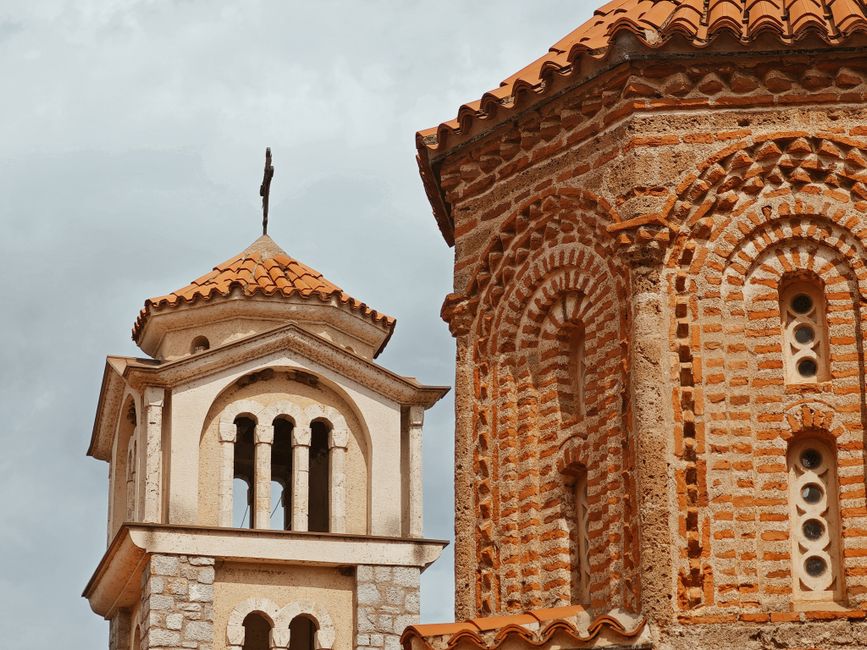
Close-up of Byzantine-style church with orange brick and tile roof., Radoviš, North Macedonia
Is Radoviš safe for solo travelers, especially women? Yes, and in fact, many solo travelers discover that Radoviš is safer than most Balkan towns of its size. Violent crime is virtually nonexistent, and the biggest concern you will face is the occasional gypsy child enthusiastically offering to guide you to the best rakija—it’s a hustle, not a danger. Women traveling alone will find that local men are respectful to the point of formality, and the main square remains lively until late evening. That said, you should take the same basic precautions you would anywhere: avoid walking alone at 2 AM down unlit streets, keep your valuables out of sight, and trust your instincts.
How much Turkish do I need to know for Radoviš? You can get by with English in the main bazaar and at the hotels, but learning even three Turkish phrases—”Merhaba” (hello), “Tešekkür ederim” (thank you), and “Bir kahve lütfen” (one coffee, please)—will transform your experience. About a third of Radoviš residents speak Turkish as their first language, and many others speak it fluently. When you order coffee in Turkish at Kafe Buke on the main square, the elderly men playing backgammon will nod approvingly. Most signs are in Macedonian and some in Turkish, so you will navigate fine without knowing either language fully.
Can I visit the Bučim copper mine? Yes, but you must arrange it in advance through the Mining Museum on Marshal Tito Street (call ahead at +389 34 222 100). Tours are given on Tuesdays and Thursdays at 10 AM and cost 300 MKD (5 EUR) per person. You will be given a hard hat, safety goggles, and an orange jumpsuit, then driven into the open-pit mine on a minibus. The scale is breathtaking: the pit is 800 meters across and 200 meters deep, and the copper-rich rock walls are veined in green and blue. The tour lasts about two hours and includes a visit to the underground tunnels, where you can see the drills and loaders that have been operating since the 1970s. Wear sturdy shoes and a long-sleeved shirt—the dust is fine and copper-toned, and it does not wash out easily.

