
Beyond the Mangroves: Why Timbiquí, Colombia Rewrites What You Know About the Pacific Coast (2026)
In 1540, Spanish conquistador Sebastián de Belalcázar pushed deeper into the Pacific lowlands of what is now Cauca, chasing rumors of a river so rich in gold that local indigenous peoples wore the metal as casually as you might wear a cotton shirt. He found the Timbiquí River, and within decades, enslaved Africans were forced into its treacherous currents, panning for flecks of gold that would bankroll an empire. What Belalcázar never anticipated was that the descendants of those enslaved people would forge one of Colombia’s most resilient, musically rich, and culturally unbroken communities—a place where the river still sings, and where your understanding of Colombia will be fundamentally reshaped.
The Story Behind Timbiquí, Colombia
Timbiquí’s history is not written in cathedrals or grand plazas. It is written in the calloused hands of the barequeros—the traditional gold panners who have worked the river for nearly five centuries. After the Spanish colonial mining operations collapsed in the early 1800s, freed Africans and their descendants established self-governing settlements, or “palenques,” along the river’s tributaries. By 1875, Timbiquí had become a municipio, but its real sovereignty was never administrative. Locals will tell you that power here belonged to the river and to the women who guarded ancestral knowledge of healing plants and the rhythms of the Pacific.
The 20th century brought a devastating blow. In the 1950s and 1960s, industrial mining companies and later armed groups descended on the region, exploiting gold deposits and displacing communities. By the 1990s, Timbiquí was caught in the crossfire of Colombia’s internal conflict, with paramilitaries and guerrilla groups fighting for control of both the gold and the cocaine routes that snake through the mangroves. Yet what travelers discover today is a place that refused to be erased. In 2016, after the peace accords, Timbiquí began to cautiously open to the outside world. The pace of change is slow, deliberate, and entirely on local terms. You will not find chain hotels or tour buses here. You will find something far more valuable: a living museum of Afro-Pacific culture.
The defining turning point came not from politics but from music. In 2018, UNESCO recognized the marimba music and traditional songs of the Colombian South Pacific as Intangible Cultural Heritage of Humanity. For Timbiquí, this was a declaration that its cultural DNA—forged in resistance and joy—was finally being seen. Locals recommend you understand this before you arrive: Timbiquí is not a destination you simply visit. It is a place you listen to.
Neighborhood by Neighborhood

Timbiquí, Pacífico, Cauca, RAP Pacífico, Colombia, Timbiquí, Colombia
El Centro: The Waterfront Heart
You’ll begin your exploration in El Centro, the compact riverside core that hugs the Timbiquí River like a village that grew into a town but never forgot its origins. The main thoroughfare, Calle Primera, runs parallel to the river and is where you’ll find the town’s modest municipal buildings, the brick Iglesia San José built in 1952, and the malecón—a simple concrete walkway where locals gather at dusk to watch the light change over the water. The air here smells of river silt, wood smoke, and fried fish. Vendors set up plastic tables under corrugated roofs selling fresh coconut water and arepas de choclo. Your best bet for orientation is to arrive early morning, around 7:00 AM, when the river taxis known as “pangas” arrive from upstream villages, unloading sacks of rice, outboard motors, and children in pressed school uniforms. The architecture is utilitarian—wooden houses on stilts painted in faded yellows and blues—but the life that spills out of them is anything but ordinary. Savvy visitors know that the real center of town is not the central park but the dock, where everything and everyone eventually passes.
San José de la Plata: The Artisan Enclave
Fifteen minutes upstream by panga—a trip that costs around 5,000 COP (about $1.25 USD)—you’ll reach San José de la Plata, a hamlet of roughly 400 people that functions as Timbiquí’s creative heart. Travelers often discover with surprise that this tiny settlement produces some of the finest gold filigree jewelry on the Pacific coast. The technique, known as filigrana, was taught by Spanish colonists to African goldsmiths in the 17th century, and the tradition has passed through generations entirely by oral instruction. You’ll find the taller of the Arellano family, who have been working gold since 1889, tucked behind a stand of banana trees. Doña María Arellano, now 73, still works the tiny anvil in her doorway, turning nuggets of locally panned gold into earrings shaped like mangrove leaves and hummingbirds. She charges between 30,000 and 150,000 COP ($7 to $35 USD) per piece—prices that seem impossibly low for work this intricate. The homes here are raised higher than in El Centro, some on stilts of nato wood that rise three meters above the floodplain. Walking the single dirt path that divides the settlement, you’ll pass women weaving petates (palm mats) and children playing soccer with a ball made of rags. The quiet is punctuated only by the ringing of goldsmith hammers and the distant sound of marimba practice drifting from a wooden house.
Bocas de Guapi: Where the River Meets the Sea
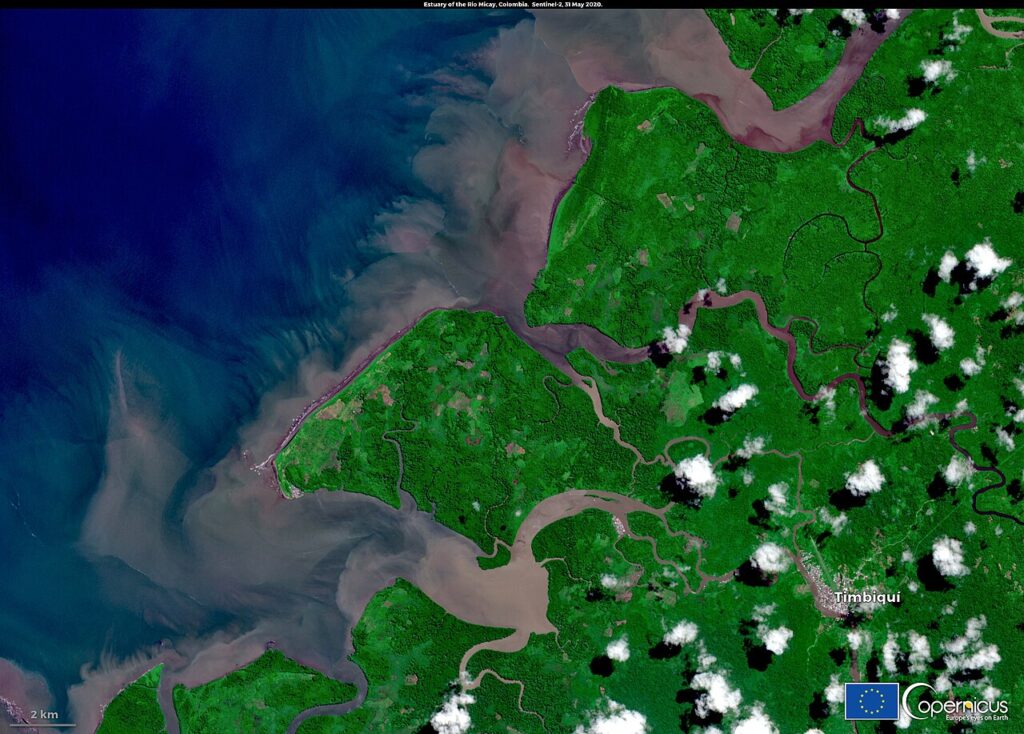
For the traveler willing to push further, Bocas de Guapi is the reward. Located a two-hour boat ride downriver—a journey that costs roughly 30,000 COP ($7 USD) one-way—this is not a neighborhood in the traditional sense but a constellation of scattered riverside homes and a school that doubles as a community center. What makes it essential is the landscape. Here, the brown Timbiquí River mixes with the saltwater of the Pacific, creating an ecosystem of mangroves, mudflats, and tidal channels that feels prehistoric. You’ll see red mangroves rising on roots like stilts, their branches alive with herons, kingfishers, and the occasional howler monkey. Locals recommend hiring Don Evelio, a wiry fisherman in his sixties who charges 50,000 COP ($12 USD) for a two-hour tour of the mangrove channels. He will point out the spots where his grandfather fished for róbalo and sierra, and will likely stop to pull a crab from the mud and crack it open with his teeth. The community here subsists almost entirely on fishing and small-scale agriculture. There are no restaurants, no shops, and no internet. You will need to arrange accommodation with a local family—Don Evelio’s wife, Doña Rosa, rents a simple room in their stilt house for 40,000 COP ($10 USD) per night, including meals of fresh fish, rice, and coconut milk. This is not a place for comfort. It is a place for transformation.
The Local Table: What Timbiquireños Actually Eat
You will not find a menu with English translations in Timbiquí, and that is precisely the point. The local diet is a direct expression of the river and the mangrove. Every meal centers on fish—róbalo (snook), sierra (kingfish), and pargo (snapper)—prepared in ways that reflect Afro-Pacific culinary traditions stretching back to the original palenques. The dominant cooking method involves encocao, a thick sauce made from pressing fresh coconut milk into a paste with onion, garlic, and achiote, then simmering fish in it for hours until the flavors become a rich, almost caramelized gravy. Locals recommend you seek this out at the Restaurante Doña Yolima, a two-table operation run from a home kitchen on Calle 2 in El Centro. For 12,000 COP ($3 USD), you get a plate of encocao de pescado served with patacones (twice-fried green plantains), white rice, and a small bowl of coconut water to drink. Doña Yolima, who has been cooking from this same stove since 1993, will tell you that the secret is to use only fresh coconut milk pressed that morning.
Drone capture of Guatapé’s iconic church and surrounding townscape in Colombia., Timbiquí, Colombia
The other dish you must track down is viche, a raw-tradition fermented drink made from sugar cane and herbs that predates Spanish arrival. In Timbiquí, viche is not a beachside cocktail; it is a medicinal and ceremonial beverage consumed at community gatherings, funerals, and celebrations. You will find bottles sold informally at the dock for around 15,000 COP ($3.50 USD). The herbolarios who prepare it—usually older women who guard the recipes as family heirlooms—infuse the sugar cane spirit with locally gathered leaves like jengibre (wild ginger) and sábila (aloe). The taste is earthy, slightly medicinal, and surprisingly smooth.
On Saturday mornings, the market that springs up around the municipal dock is where you’ll see the full spectrum of ingredients that define Timbiquí’s table. Women arrive by panga by 6:00 AM with woven baskets of fresh cocos, bunches of green plantains, fat river shrimp still twitching, and bundles of hierba buena (mint used for teas). You’ll also find plates of tapado—a soup made from fish cooked in plantain leaves with coconut and chilies—which vendors ladle out for 5,000 COP ($1.20 USD) from enormous aluminum pots balanced on charcoal fires. The market is chaotic, loud, and essential.
Art, Music & Nightlife
If you arrive in Timbiquí expecting nightclubs with DJs, you will be disappointed. But if you arrive expecting music that will rearrange the architecture of your soul, you will find it in spades. Timbiquí is one of the few places in Colombia where the marimba de chonta—the traditional xylophone carved from chonta palm wood and fitted with bamboo resonators—is not a museum piece but a living instrument played in homes and community halls. The best place to experience this is at a “bunde,” an Afro-Pacific celebration that blends music, dance, and community storytelling. These happen spontaneously but are most common during the Festival de la Marimba, held every year in the last week of July. For five days, musicians from the entire Pacific coast converge on Timbiquí’s central court, playing marimba, cununos (drum), and guasá (a shaker made from bamboo and seeds). You’ll see dancers—usually older women who learned the steps from their grandmothers—moving in hypnotic circles, their feet slapping the packed earth in a rhythm called currulao. Locals recommend you attend the Saturday night “velorio” session, which starts at 10:00 PM and can last until sunrise. Admission is free; you are expected only to respect the space and, if moved, join the circle.

Explore a picturesque Colombian town surrounded by lush mountains and histo…, Timbiquí, Colombia
In El Centro, you’ll find Casa de la Cultura, a faded yellow building on Carrera 3 that functions as Timbiquí’s only arts hub. Here, you can see exhibitions of naif-style painting by local artists, the most famous being Manuel Sinisterra, who paints scenes of gold panning and river life using pigments he grinds from local minerals. The gallery is open Monday to Friday from 9:00 AM to 5:00 PM, and admission is free, though donations are accepted. You can also purchase original Sinisterra paintings for between 80,000 and 200,000 COP ($20 to $50 USD). For evening entertainment, your options are limited to the bars along the malecón, which serve cold Aguila beer (4,000 COP per bottle) and play a mix of salsa and Pacific folk music. The most reliably lively is Bar El Manglar, open nightly until the owner decides to close—usually around midnight. It is more of a covered outdoor patio than a traditional bar, with plastic chairs, a single speaker, and a view of the dark river.
Practical Guide
- Getting There: You fly into Cali’s Alfonso Bonilla Aragón International Airport (CLO), then take a 45-minute domestic flight to Guapi’s airport on SATENA airlines (flights run Tuesday, Thursday, and Saturday; round-trip costs approximately $120–$180 USD). From Guapi, you’ll take a river panga for 2–3 hours down the Guapi and Timbiquí rivers, costing 35,000–50,000 COP ($8–$12 USD). Book flights at Skyscanner.
- Getting Around: Within Timbiquí town, everything is walkable in under 20 minutes. For riverside villages, you use pangas (motorized canoes) that depart from the main dock. Fares range from 5,000–30,000 COP ($1.25–$7 USD) depending on distance. Hire Don Evelio (ask for him at the dock) for custom river tours at 50,000 COP per hour.
- Where to Stay: In El Centro, try Hotel Timbiquí Real, the town’s only dedicated hotel, on Calle 3. Basic rooms with private bathroom and fan cost 65,000 COP ($16 USD) per night. For a deeper experience, arrange a homestay in San José de la Plata with the Arellano family—contact them through Casa de la Cultura. Check Booking.com for Guapi options if you need more infrastructure.
- Best Time: Visit between December and March, the region’s “dry” season—you’ll still get rain, but it comes in brief afternoon showers rather than the biblical downpours of April through November. July is also excellent for the Festival de la Marimba.
- Budget: Plan for 150,000–200,000 COP ($38–$50 USD) per day for a midrange traveler, including food, accommodation, and transport. This is one of the cheapest destinations in Colombia.
What Surprises First-Time Visitors
Most travelers arrive in Timbiquí expecting tropical heat—and they get it—but few anticipate the cold. At night, especially during the December-to-March dry season, the temperature drops to as low as 18°C (64°F), and the humidity makes the air feel damp and penetrating. You’ll want a light jacket, especially if you’re sleeping in a stilt house with the breeze coming off the river. Locals, who often wear multiple layers of thick clothing even during the day, will find your shivering amusing and will likely offer you a cup of aguapanela caliente—hot cane sugar water with lemon—which they consider a cure for everything.
The other surprise is silence. If you arrive from Cali, Bogotá, or Medellín, you are accustomed to sound—traffic, music, conversation, the constant hum of city life. In Timbiquí, after 9:00 PM, the only noise is the river. The absence of artificial light, traffic, and digital distraction can feel almost unsettling at first. Travelers often discover that within 48 hours, their internal pace slows, their sleep deepens, and the constant mental chatter that modern life cultivates begins to quiet. Locals will tell you that the river has a way of “washing” the mind. They are not being poetic; they are being literal.
Finally, visitors are surprised by the formal dignity of Timbiquireños. In a town where most people live on less than $200 a month, you will be greeted with a level of warmth and respect that can feel overwhelming. People look you in the eye when they speak, shake your hand formally, and will walk you personally to wherever you need to go rather than simply pointing. This is not tourist service; it is the cultural code of the Pacific coast, where hospitality is a sacred obligation. You will be invited into homes, offered food even if the family has little, and asked sincere questions about your life. The surprise is how much you will receive, and how little you will know

