
Beyond the Jungle Walls: Why Koh Ker Captivates Travelers Who Seek Cambodia’s Lost Empire (2026)
In the year 921, King Jayavarman IV stunned the Khmer Empire by abandoning the grand capital of Angkor and moving his court deep into the northern wilderness. There, in a remote clearing now called Koh Ker, he raised a seven-tiered sandstone pyramid—Prasat Thom—that still pierces the jungle canopy today. When you stand before it, you feel the audacity of a ruler who dared to build a rival city where only monkeys and wild orchids had thrived.
The Story Behind Koh Ker, Cambodia
Koh Ker served as the capital of the Khmer Empire for just two decades, from 921 to 944 AD, under Jayavarman IV and his son Harshavarman II. The king’s decision to relocate remains one of the great mysteries of Khmer history. Some scholars believe a dynastic struggle forced him away from Angkor; others suggest he simply preferred the untamed forests of his mother’s homeland. What you can see today—more than 40 temples scattered across 81 square kilometers—was built in an astonishingly short time. The scale of the enterprise is humbling: workers quarried millions of sandstone blocks, dragged them from the Phnom Kulen hills, and stacked them into a pyramid that rises 36 meters high, each tier narrowing as it climbs toward the sky.
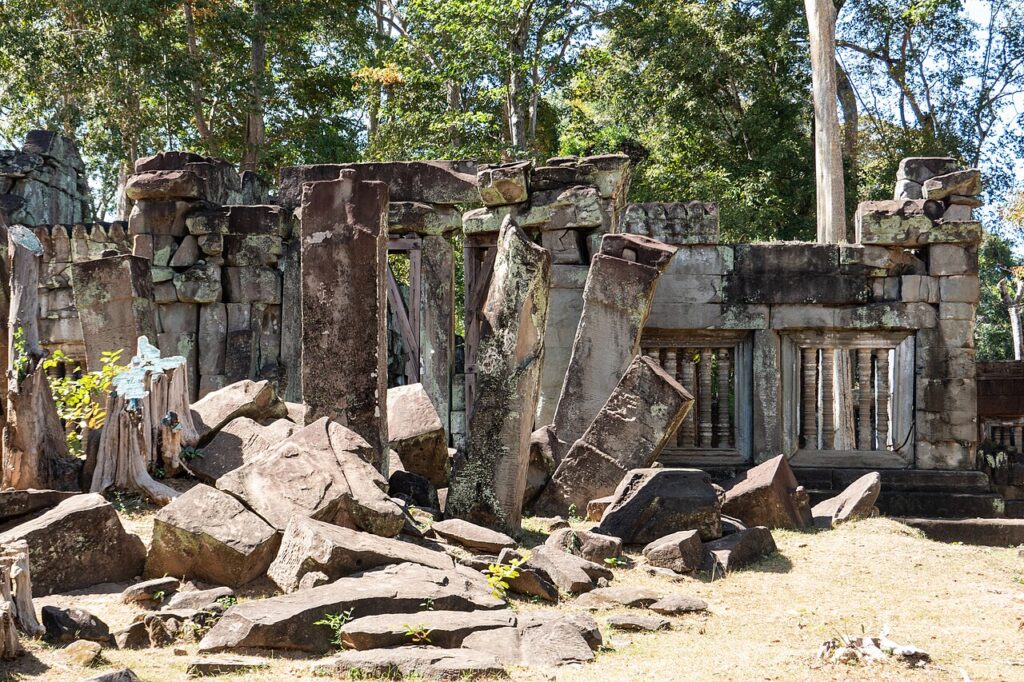
When the capital moved back to Angkor after Jayavarman’s death, Koh Ker fell into the grip of the jungle. Trees burst through temple walls, roots swallowed courtyards, and the name itself faded from memory. For centuries, it remained a ghost city, known only to local hunters and the occasional French explorer. During the 1970s and 1980s, the area became a stronghold of the Khmer Rouge, and landmines made large sections dangerous to visit. Only in the 2000s did clearance efforts open Koh Ker to travelers. Today, you walk paths that few have trod in a thousand years—a raw, uncurated ruin that feels more like an archaeological discovery than a polished tourist attraction.
Neighborhood by Neighborhood
The Main Temple Complex
Your journey begins at the heart of Koh Ker: the central group of temples dominated by Prasat Thom. As you approach through a dirt road lined with towering dipterocarp trees, you’ll see the pyramid rising ahead like a forgotten ziggurat. The climb up the steep wooden steps to the top is not for the faint of heart—each step is nearly knee-high, and the handrail feels reassuringly solid—but the reward is a view that stretches over unbroken forest to the Dangrek Mountains on the Thai border. At the base, you’ll find the remains of long galleries, a royal palace enclosure, and a giant lingam pedestal carved from a single block of stone. Locals recommend arriving at 8:00 AM, when the sun angles low through the trees, casting dramatic shadows across the sandstone. Most tourists spend an hour here; seasoned travelers linger until the heat forces them into the shade.
The Outer Temples and Baray
About two kilometers east of the pyramid, a straight causeway leads you to Rahal Baray, the massive reservoir that once supplied water to the entire capital. You can still see the red-earth embankments that held 100 million cubic meters of water—a feat of engineering that rivals anything in Angkor. Scattered around the baray are dozens of smaller temples, each with its own character. Prasat Krachap features a well-preserved sandstone lintel carved with a scene from the Churning of the Ocean of Milk; Prasat Banteay Pean has a central tower still adorned with traces of original stucco. Savvy visitors rent a bicycle from the ticket office to explore these sites, as the distances between them are too far to walk comfortably under the midday sun. The paths are sandy and rutted, so your best bet is a sturdy mountain bike—you’ll find them for $5–8 per day at the visitor center.
The Village of Sra Yong
About six kilometers south of the temple complex lies the small settlement of Sra Yong, where most travelers spend the night. This is not a town in the conventional sense—there are no paved streets, no streetlights, no coffee shops. What you’ll find is a cluster of wooden houses on stilts, a few basic guesthouses, and a handful of family-run restaurants serving Khmer staples. The real draw is the proximity to the temples at dawn and dusk, when the crowds (if you can call a dozen people a crowd) have vanished. Stay at the Sra Yong Guesthouse, a simple but clean property with ceiling fans and mosquito nets; a double room costs about $15 per night. The owners, a local family, will cook you dinner—ask for the fish amok, a creamy coconut curry steamed in banana leaves, which they prepare with fresh catch from the baray. In the evening, you’ll hear geckos chirping and the distant hoot of an owl; the silence here is so complete that your own footsteps sound loud.
The Local Table: What Locals Actually Eat

Koh Ker, Cambodia
Koh Ker is far from Cambodia’s culinary capitals, but the food here is honest and deeply tied to the land. The staple is rice, of course, but the real star is the river fish from the Stung Sen and the reservoirs. Locals eat simply: grilled fish with sour soup (samlor machu), stir-fried morning glory with garlic, and the pungent fermented fish paste called prahok that gives Khmer cooking its distinctive funk. You’ll find a small market in Sra Yong each morning, where farmers sell fresh herbs, lemongrass, and tiny wild eggplants. The secret to eating well here is to order at the guesthouse 24 hours in advance—they don’t keep a menu, so you tell them what you want, and they’ll source it from the market that morning.
The one dish you must seek out is khor ko—a slow-braised beef stew flavored with star anise, cinnamon, and palm sugar, served with steamed rice and a side of pickled mustard greens. At the Prasat Thom Restaurant (the only proper eatery near the temples), Mrs. Srey Nuch cooks her khor ko for three hours over a charcoal fire, until the meat falls apart at the touch of a fork. A bowl costs $3.50 and is the best meal you’ll have between Siem Reap and the temple. Pair it with a fresh coconut—the seller outside the restaurant will hack one open for you with a machete, and the water is miraculously cold even in the heat of noon.
Art, Music & Nightlife
Let’s be clear: there is no nightlife in Koh Ker. There are no bars, no clubs, no live music venues. After sunset, the jungle takes over—frogs croak, cicadas buzz, and the stars appear with a clarity you’ve likely never seen. This is the nightlife of silence, and it’s precisely why many travelers come. For those who crave a cultural performance, you’ll need to return to Siem Reap, where the Apsara Theatre on Pub Street puts on traditional dance shows every evening at 7:30 PM ($15 per person, including dinner). But if you stay in Sra Yong, you may be lucky enough to witness a spontaneous village ceremony—a wedding blessing or a Buddhist chanting session in the local pagoda—which feels infinitely more authentic than any staged show. Locals recommend visiting during the Pchum Ben festival in late September or early October, when the village hosts a solemn offering to ancestors, and you can observe rituals that have barely changed since Angkorian times.
Practical Guide
- Getting There: Koh Ker has no airport. The nearest major gateway is Siem Reap–Angkor International Airport (REP), served by Cambodia Angkor Air, Bangkok Airways, and Asian Wings from Bangkok, Hanoi, and Ho Chi Minh City. Book flights at Skyscanner. From Siem Reap, it’s a two-hour drive north on National Highway 67. Taxis cost $60–80 round trip; most drivers wait for you while you explore.
- Getting Around: Car or taxi is the only practical option. A private car with driver from Siem Reap costs about $80–100 for a full day, including fuel. If you’re adventurous, you can rent a motorbike for $20/day, but the last 10 kilometers are unpaved and can be rutted after rain. Bicycles are available at the Koh Ker ticket office for $5.
- Where to Stay: For the full jungle experience, stay at Sra Yong Guesthouse ($15/night) in Sra Yong village. For more comfort, base yourself in Siem Reap (30 minutes south, near Preah Vihear town) or at the Tarrang Villa Resort ($45/night, with air conditioning and pool). Compare options at Booking.com.
- Best Time: November to February, when temperatures hover around 25°C (77°F) and humidity is low. March to May is scorching—you’ll be drenched in sweat by 9 AM. The rainy season (June–October) brings occasional downpours but also vibrant green foliage and fewer tourists; just be prepared for muddy paths.
- Budget: You can survive on $30–40 per day: $15 accommodation, $10 meals, $5 water and snacks, plus $15 for the entrance ticket (valid for one day). Add another $20 if you’re splitting a taxi from Siem Reap.

Green palm trees on beach shore during daytime, Koh Ker, Cambodia
What Surprises First-Time Visitors
The first surprise is the sheer emptiness of Koh Ker. Unlike Angkor Wat, where you jostle with hundreds of visitors for a clear photo, here you might be the only person in the entire complex. The silence is so profound you can hear your own heartbeat. Travelers often discover that the solitude amplifies the spiritual weight of the place—standing alone before Prasat Thom, you feel like an explorer from the 19th century, seeing these ruins for the first time.
The second surprise is the size of the pyramid. From the ground, it looks modest, but as you climb, its true scale reveals itself. Each tier is taller than you expect, and the top platform offers a vantage point that makes you realize how isolated Koh Ker really is. You can see for miles in every direction: just green forest, the silver glint of the baray, and the blue haze of the Dangrek Mountains. Most tourists overlook the fact that the pyramid is not a temple in the conventional sense—it was likely a funerary monument, perhaps a royal mausoleum, and the lingam at the top was a symbol of the king’s power.
Third, visitors are surprised by the warmth of the local people in Sra Yong. Despite the poverty—there is no electricity grid; guesthouses rely on solar panels—the villagers greet you with genuine smiles. Children will wave and shout “Hello!” in English, and the women who sell silk scarves at the temple entrance will haggle good-naturedly but never push you to buy. If you accept an invitation into a home, you’ll be offered sweet tea and perhaps a plate of fresh pineapple, and you’ll leave with a deeper understanding of rural Cambodia than any guidebook can provide.
Your Koh Ker, Cambodia Questions

A beach with palm trees and a body of water, Koh Ker, Cambodia
Is it safe to visit Koh Ker, especially given the history of landmines? Yes, it is safe. The main temple areas and all tourist paths have been thoroughly cleared by international demining organizations, most notably the Cambodian Mine Action Centre. You can walk anywhere within the marked zones without worry. However, you should never stray off the beaten path into the jungle—some areas outside the cleared perimeter remain hazardous. Stick to the trails you see other tourists using, and you’ll have no problems. The site is also patrolled by rangers who can assist if you have any concerns.
How much time should I plan for Koh Ker? A full day is ideal. You’ll need about two hours to explore the main pyramid and central temples, another two hours to bike or drive to the outer temples and the baray, and an hour to eat lunch at the Prasat Thom Restaurant. If you want to photograph the ruins in the golden light, plan to arrive at 8:00 AM and stay until 4:00 PM. Many travelers combine Koh Ker with a visit to the nearby Beng Mealea temple (a jungle-engulfed ruin 40 minutes south) for a full-day loop from Siem Reap.
Can I climb to the top of Prasat Thom? Yes, you can. The original stone steps are too steep and worn for safe climbing, but a wooden staircase has been built for visitors. It is not for the dizzy or the unfit—the steps are steep, the handrails are rustic, and there is no shade. Once you reach the top, you’ll find a small platform and a replica lingam (the original is in the National Museum of Phnom Penh). The view is breathtaking, and you’ll be alone 90% of the time. Take water, a hat, and a steady pair of shoes. The climb takes about 15 minutes round trip, but you’ll want to linger on the platform for at least 20 minutes to soak in the silence.

