
Beyond the Fortress Walls: Why Cuyo Islands Rewrite the Palawan Story (2026)
In 1680, a band of Augustinian Recollect friars huddled on a rocky outcrop in the Sulu Sea, watching Moro pirate sails vanish over the horizon. They had just laid the cornerstone of a fortress that would become the heart of an island world—Fuerza de la Inmaculada Concepción. For the next three centuries, this fort would shelter mission, trade, and rebellion, leaving behind a town of cobblestone alleys and coral-stone churches that feels more like colonial Mexico than the tropical Philippines you expect.
The Story Behind Cuyo Islands, Philippines
You’ll find Cuyo not in the glossy pages of travel magazines, but in the quiet corners of Philippine history books. The archipelago, part of northern Palawan, was a crucial outpost of Spanish power long before Puerto Princesa became a city. In 1622, the Recollects established the first mission here, and by 1680 the fortress—named after the Immaculate Conception—was complete. It withstood sieges, served as a prison for revolutionary leaders like General Mariano Riego de Dios during the Philippine Revolution, and later became a municipal jail. Walk its ramparts today, and you’ll see cannon embrasures still facing the sea, a silent testimony to centuries of vigilance.
But Cuyo’s story isn’t just Spanish fortresses. The islands were a stopping point for Chinese traders and Muslim sultans long before Magellan. The Cuyonon language, still spoken by locals, carries traces of Tagalog, Visayan, and indigenous roots—a linguistic map of centuries of migration. When the American colonial period arrived in 1903, Cuyo became the seat of Palawan’s provincial government for a time, and later, during World War II, its people endured Japanese occupation with quiet resilience. Travelers who dig deeper discover that these islands have always been a crossroads, not a backwater.
Locals will tell you that the fortress’s red walls aren’t just stone—they’re the color of the earth itself, mixed with lime and coral from the sea. That same soil now grows the coconuts and root crops that sustain Cuyo’s 22,000 residents across ten barangays. The history you touch here is not a museum piece; it’s lived in every fiesta, every fishing boat launch, every Mass at the San Augustín Church built inside the fort’s walls.
Neighborhood by Neighborhood

Cuyo_Islands_map with elevations in feet., Cuyo Islands, Philippines
Cuyo Poblacion (Fort District)
Your journey begins in the Poblacion, the heart of Cuyo town on the main island. As you step off the ferry, the first thing you notice is the quiet—no blaring tricycle horns, no tourist hawkers. Instead, you’ll walk along Rizal Street, lined with century-old Spanish-era houses built from coral stone and capped with red clay tiles. Many have second-story wooden balconies where grandmothers shell peas or watch the afternoon pass. At the end of this street, the fortress looms—its massive walls, known locally as Kuta, rise 15 feet high and enclose a grassy plaza. Inside, you’ll find the San Augustín Church, built in 1680, its baroque façade weathered by typhoons. A small museum (free entry) displays old priest vestments, a 19th-century piano, and shards of Ming dynasty porcelain found in local waters. Most tourists overlook the Municipal Hall next door—an elegant 1930s Art Deco building that now houses the post office and tourism office. On Saturdays, the Public Market spills into the streets just outside the fort, with vendors selling fresh fish, bananas, and the iconic Cuyo longganisa—a garlicky sausage flavored with sugarcane vinegar.
Barangay Bancuang (Fisherman’s Haven)
Head southeast along the coast for about 15 minutes on foot, and the Poblacion’s colonial order gives way to the working waterfront of Bancuang. This is where Cuyo’s real pulse beats. Narrow alleys lead to a cluster of stilt houses built over the sea, their bamboo platforms creaking with each low tide. You’ll see fishermen mending nets under the shade of palm thatching, and children diving for sagingsing—tiny silver fish that locals dry on racks. The Bancuang Community Center hosts a daily fish auction at 4:30 a.m.—you’ll want to join if you’re an early riser. The catch—tuna, mackerel, red snapper—is all brought in by outrigger boats called bangkas. Women sit in circles weaving pandan leaves into mats and baskets, a skill passed down for generations. There are no restaurants here, but a sari-sari store sells cold sago’t gulaman (tapioca drink) for PHP 10. The best surprise: the lack of motorized traffic; Bancuang is a world of footsteps and water sounds.
Barangay Catabagan (The Farming Interior)
Leave the coast behind and walk inland along the unpaved Catabagan Road, and you’ll discover Cuyo’s agricultural soul. This barangay, about 2 kilometers from the Poblacion, is a patchwork of coconut groves, cassava fields, and small rice paddies. The houses are mostly nipa huts on stilts, surrounded by chickens and carabaos. At the center of the barangay stands the Catabagan Chapel, a simple structure built in 1928 with limestone walls and a corrugated iron roof. Locals gather here every May 3 for the Santa Cruzan festival, a colorful procession where young girls in flowered dresses carry hand-carved wooden crosses—a tradition unchanged for a century. If you’re curious about Cuyo’s farming heritage, stop by the Catabagan Multi-Purpose Cooperative (open weekdays 8 a.m.–5 p.m.), where farmers sell organic honey and coconut oil pressed from trees that have stood since the 1950s. The view from the barangay’s highest point, a gentle hill called Mount Cuyo (elevation 95 meters), offers a 360-degree panorama of the entire island group—on clear days you can spot the blue silhouette of the Calamianes to the northeast.
The Local Table: What Cuyonons Actually Eat
Forget the standard adobo or sinigang you’ve eaten elsewhere. Cuyo has its own culinary language, shaped by the sea and the coconut palm. You’ll find that the staple is linapet, a sticky rice cake cooked in coconut milk and wrapped in banana leaves. Locals eat it for breakfast, lunch, and merienda—paired with ripe mangoes or a dollop of latik (coconut caramel). But the dish you must seek out is kinilaw na tanigue, a raw mackerel ceviche marinated in coconut vinegar, ginger, and chili. The secret is the vinegar—Cuyo’s local sukang tuba (palm vinegar) is less sharp and more fruity than any you’ll find in Manila.
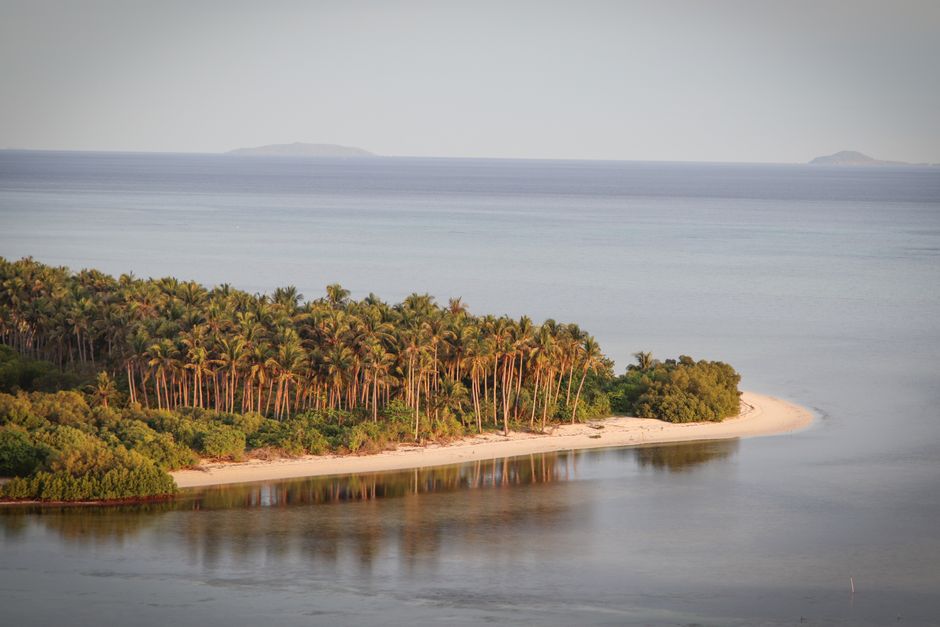
Explore the serene palm-lined shores of a remote island in Cuyo, Cuyo Islands, Philippines
Your best bet for an authentic meal is Kusina ni Nanay, a family-run eatery at 13 Rizal Street, just outside the fort’s main gate. Open daily from 6 a.m. to 8 p.m., they serve a changing menu based on the morning’s catch. Try the pancit Cuyo (stir-fried rice noodles with shredded chicken and toasted garlic) and the lumpia hubad (literally “naked spring roll”—the filling without the wrapper, served with a spicy palm vinegar dip). A full meal costs PHP 120–180. For dessert, head to Nena’s Delicacies at the Public Market, where you can buy plastic tubs of sampayna—a gelatinous dessert made from seaweed and coconut cream. Locals recommend it chilled, eaten with a spoon, as the afternoon sun climbs high.
If you want to eat like a true Cuyonon, visit the Bancuang Fish Port at dawn. You’ll see women grilling whole mackerel over charcoal right on the beach, selling them with rice and a side of ensaladang papaya (green papaya salad with vinegar). A grilled fish plus rice and salad costs just PHP 60. You’ll sit on a bench, eat with your hands, and watch the sun rise over the Sulu Sea—a meal that defines Cuyo’s simplicity and soul.
Art, Music & Nightlife
Cuyo’s creative scene is subtle but deeply rooted. You won’t find galleries or nightclubs; instead, artistry lives in everyday crafts. The most visible tradition is pandan weaving, practiced by women in every barangay. At the Cuyo Handicraft Cooperative (open 8 a.m.–5 p.m., near the Poblacion church), you can buy handwoven bags, placemats, and hats, each taking three days to complete. A small bag costs PHP 250. During the Cuyo Fiesta, held annually from August 28 to 30, the streets fill with a rigodon de honor—a Spanish-influenced formal dance where couples in barong and Filipiniana gowns dance the waltz inside the fort’s parade ground. Local musicians play folk songs on bandurria (a 14-stringed instrument) and guitarra, the notes echoing off the coral walls.

Tranquil view of a tropical island with distant figures walking along a san…, Cuyo Islands, Philippines
For music, your destination is the Cuyo Community Center on Rizal Street. On Friday nights, a rondalla group of ten to fifteen musicians gathers to play traditional pieces like “Cuyo Hymn” and “Dandansoy.” There’s no cover charge—just sit on the wooden benches and enjoy the acoustic melodies. Travelers often discover that the real nightlife is not bars but the “sound of the sea”—locals gather on the seawall opposite the fort to chat, eat roasted peanuts, and watch the stars. If you’re lucky, you’ll be invited to a backyard videoke session, where the standard repertoire includes everything from Elvis to Filipino ballads. Expect to be handed the microphone. Say yes—it’s how you become a guest, not a tourist.
Practical Guide
- Getting There: Most travelers fly into Puerto Princesa International Airport (PPS). From there, take a van to the San Jose Terminal (1.5 hours, PHP 200), then a ferry to Cuyo. The boat, operated by Montenegro Shipping Lines or 2GO Travel, departs Monday, Wednesday, Friday, and Saturday at 7 p.m. for an overnight crossing (8–10 hours, PHP 500–700 for economy). For a faster option, charter a small plane from Puerto Princesa to Cuyo Airport—contact Royal Air Charter (regular fares from PHP 8,000 per person one way). Book flights at Skyscanner.
- Getting Around: On the main island, walking is your best bet—the Poblacion is compact. For longer trips (e.g., to Bancuang or Catabagan), hire a tricycle. A one-way ride anywhere within the main island costs PHP 20–30 per person. Arrange with your driver for a half-day tour (PHP 400) to see all three barangays. For island hopping to the outer islets (like Ditay or Camotes), rent a bangka from Bancuang Port—PHP 1,500 for a full day, includes the boatman and fuel.
- Where to Stay: For convenience, stay in Cuyo Poblacion. Fort Lodge (2 Rizal Street) offers basic fan rooms from PHP 500/night; air-conditioned doubles cost PHP 800. For a more atmospheric option, try Lola’s Inn at 7 Bonifacio Street, a restored Spanish-era house with high ceilings and wooden floors (PHP 1,200/night). Budget travelers prefer Bancuang Beach Cottages (PHP 400/night, shared bathroom). Check Booking.com for current rates.
- Best Time: December to May is the dry season, with February to April being the most balmy and calm seas. Avoid June to October—typhoons and heavy rain are common. The Cuyo Fiesta in late August is a cultural highlight despite possible rain.
- Budget: A comfortable daily budget of PHP 1,200–1,500 includes meals (PHP 300–400), accommodation (PHP 500–800), and transport (PHP 100). A backpacker can get by on PHP 800/day.
What Surprises First-Time Visitors
The first surprise is the silence. You step off the boat and the city noise vanishes—no blaring jeepney horns, no construction, no shouting vendors. Instead, the dominant sound is the rustle of palm fronds and the soft lap of water on the coral shore. Travelers often comment that Cuyo feels like the Philippines as it was fifty years ago. Even the Wi-Fi is limited (only in a few cafés and the municipal building), which forces you to disconnect. Savvy visitors carry a physical map and a sense of adventure.
The second surprise is how genuinely welcoming the locals are

