
Beyond the Falaj: Why Misfat Al Abriyeen Whispers Secrets of an Ancient Oman (2026)
In the summer of 1624, as the imam Nasir bin Murshid al-Ya’rubi unified the tribes of interior Oman against Portuguese coastal incursions, a weary traveler stopped at the edge of a terraced mountain village. He wrote of “water that sings through channels of stone” and “houses that grow from the mountain itself.” That village was Misfat Al Abriyeen, and nearly four centuries later, you will find that same song of water and stone still echoing through its alleyways.
The Story Behind Misfat Al Abriyeen, Oman
Misfat Al Abriyeen’s history is written not in grand palaces or battlefields, but in the patient labor of irrigation. The village’s soul is the falaj system, an ingenious network of underground and surface channels that dates back over 1,500 years to the pre-Islamic period. These channels, some tunneling through solid rock for kilometers, transformed a harsh mountain slope into a lush oasis of date palms, bananas, and citrus. You will see the main channel, Falaj Al Misfat, as it emerges from the mountainside near the village entrance, its cool water flowing past homes that have stood for centuries.
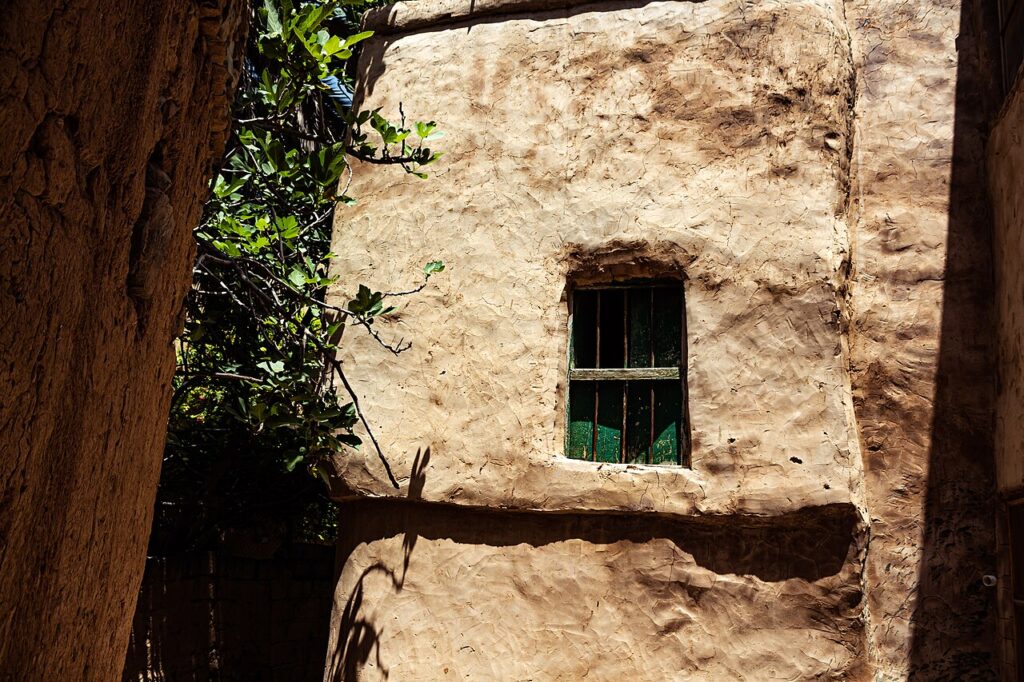
The “Abriyeen” in the village’s name refers to the Al Abri tribe, who settled this area in the 16th century after migrating from the nearby town of Bahla. They built their homes directly into the cliffside, using mudbrick and stone, creating a labyrinth of interconnected dwellings that offered both defense against raiders and shelter from the sun. By 1750, Misfat had become a key stop on the frankincense and copper trade routes linking the interior to the coast at Sohar. Travelers often discover that the village’s strategic position—perched on the edge of the Hajar Mountains—allowed it to control access to the fertile valleys below, a fact that local elders still recount with quiet pride.
The 1970s brought change. Sultan Qaboos’s modernization drive saw many families leave for the cities of Muscat and Nizwa. But unlike many abandoned villages, Misfat experienced a revival. In the 1990s, the Omani government, recognizing its heritage, began restoration projects. Today, you walk a place where ancient and modern coexist: satellite dishes perch on mudbrick roofs, and the falaj still irrigates gardens that supply village kitchens. The secret is that Misfat never truly died—it simply learned to welcome the world without losing itself.
Neighborhood by Neighborhood
Al Aqr (The Old Quarter)
This is the heart of Misfat, where you’ll find the densest concentration of historic homes. The narrow alleyways—barely wide enough for two people—are shaded by overhanging upper floors and crisscrossed by exposed falaj channels that run alongside the walls. Your best bet is to arrive at dawn, around 5:30 AM, when the light slants through the palm fronds and the only sound is water trickling and roosters crowing. Look for the Al Aqr Mosque, built in 1723, its simple minaret made of local stone. Most tourists overlook the small majlis (sitting room) just south of the mosque, where locals gather each morning to drink kahwa (Omani coffee) and discuss village affairs. You can knock and ask to join—a gesture of hospitality that travelers often discover is rarely refused.
Al Hada (The Terrace)
Climb the stone steps that wind upward from Al Aqr, and you’ll reach Al Hada, the neighborhood that clings to the cliff’s edge. Here, the architecture shifts: homes have wide verandas overlooking the wadi below, and the falaj channels become open aqueducts that you can walk beside. The views are staggering—you can see the entire village spread below, a patchwork of green terraces against the brown mountain. This is where you’ll find Misfat House, a restored 18th-century home now serving as a boutique guesthouse. Plan to spend an hour here, simply sitting on the terrace with a cup of tea, watching the light change. Seasoned travelers prefer Al Hada for its relative quiet; the tour groups tend to stay lower down.
Al Ghafat (The Gardens)
Descend the eastern path from the village center, and you’ll enter the agricultural heart of Misfat. Al Ghafat is not a neighborhood of homes but of terraced gardens, each plot fed by its own branch of the falaj. The system is communal: water flows to each garden on a strict schedule, a practice unchanged for centuries. You’ll walk between rows of date palms, banana trees, and lime trees, the air heavy with the scent of earth and ripening fruit. In March and April, the gardens explode with pink and white blossoms from the sidr trees. Locals recommend visiting in the late afternoon, around 4 PM, when farmers are harvesting and you can buy fresh dates directly from the groves—a kilo of khalas dates costs about 2 OMR ($5 USD).
The Local Table: What Denizens Actually Eat
Food in Misfat is a direct expression of the land. The falaj system makes year-round agriculture possible, so meals are built around what grows within walking distance: dates, limes, bananas, pomegranates, and wheat. Locals eat communally, seated on the floor around a large platter, and you’ll find that the most important meal is lunch, served between 1 and 2 PM.

Ruins in Misfah (Oman), Misfat Al Abriyeen, Oman
The dish you must seek out is shuwa, Oman’s national dish, but prepared here in a way unique to the mountain villages. A whole goat or lamb is marinated for 48 hours in a paste of dried limes, garlic, coriander, cumin, and local honey, then wrapped in banana leaves and buried in a sand oven heated by palm wood. The meat cooks for 24 hours, emerging so tender it falls apart at a touch. Your best bet is to arrange a meal at Misfat Traditional Restaurant (open daily 11 AM–9 PM), where the owner, Mohammed Al Abri, still cooks shuwa in the traditional underground oven. A full meal for two, including rice, salad, and fresh juice, costs around 15 OMR ($39 USD). Order the shuwa 24 hours in advance—it’s worth the planning.
For something lighter, try harees, a comforting porridge of wheat and slow-cooked chicken, served at breakfast. You’ll find it at the village’s small bakery, Al Misfat Bread & Sweets, near the main parking area. A bowl costs 1.5 OMR ($4 USD). Savvy visitors know to buy a bag of fresh khubz (flatbread) here for 0.5 OMR—perfect for picnicking in the gardens.
Art, Music & Nightlife
Misfat’s creative life is subtle but deep. The village has no galleries or concert halls, but art here is woven into daily life. You’ll notice the intricate geometric patterns carved into wooden doors and window frames—a tradition passed down through generations. The Al Abri Crafts Center, located in a restored home near the village entrance, showcases local artisans weaving palm fronds into baskets, mats, and fans. You can watch them work on Fridays from 9 AM to 1 PM, and buy pieces directly. A handwoven basket costs 5-10 OMR ($13-26 USD).
Music is the heartbeat of Misfat, especially during festivals. The Al Razha, a traditional sword dance performed by men in white dishdashas, accompanies weddings and religious holidays. If you visit during Eid al-Fitr (dates vary, typically April or May), you’ll see this dance in the village square. The rhythm is hypnotic: drums beat a steady pulse while men chant poetry about bravery and hospitality. For a more intimate experience, ask at Misfat House if they can arrange a private al-ayala performance—a stick dance accompanied by tambourines. It costs about 50 OMR ($130 USD) for a group of 10, and includes traditional snacks. Nightlife, in the Western sense, doesn’t exist here. Instead, evenings are for sitting on rooftops, talking under the stars, and listening to the falaj—a soundtrack that travelers often discover is more memorable than any club.
Practical Guide
- Getting There: Fly into Muscat International Airport (MCT) from major hubs like Dubai, Doha, or London. From Muscat, drive 2.5 hours southwest on Route 15 toward Nizwa, then follow signs to Al Hamra and Misfat. Book flights at Skyscanner
- Getting Around: You need a car. Rent one from Muscat airport for 20-30 OMR ($52-78 USD) per day. The road to Misfat is paved, but the village itself is only walkable. Parking costs 1 OMR ($2.60 USD) at the lot near the entrance.
- Where to Stay: For authenticity, book Misfat House in Al Hada (doubles from 80 OMR/$208 USD, includes breakfast). For budget options, try Al Misfat Guesthouse near the parking area (doubles from 35 OMR/$91 USD). Check Booking.com
- Best Time: October to March. Days are warm (25-30°C) and nights cool (15-18°C). Avoid June to August when temperatures exceed 45°C.
- Budget: Plan for 50-80 OMR ($130-208 USD) per day per couple, including accommodation, meals, and transport.

People walking near beige concrete building during daytime, Misfat Al Abriyeen, Oman
What Surprises First-Time Visitors
The first surprise is the silence. After the chaos of Muscat’s traffic, you’ll step out of your car and hear nothing but water and wind. It’s disorienting at first—your brain expects noise. But within an hour, you’ll find yourself attuned to the village’s rhythms: the call to prayer from the mosque, the clatter of a farmer’s footsteps on stone, the laughter of children playing in the falaj.
The second surprise is how alive the village is. Many travelers expect a museum piece, a preserved relic. Instead, you’ll see goats wandering through alleys, women hanging laundry on rooftops, and men repairing irrigation channels. Misfat is not a show for tourists—it’s a home. Locals recommend you treat it as such: greet everyone with “As-salamu alaykum,” accept offers of coffee, and never photograph people without permission. The third surprise is the falaj‘s complexity. You’ll realize that every stone channel, every sluice gate, every tiny diversion is part of a system that has been managed by community consensus for centuries. It’s a lesson in cooperation that you’ll carry long after you leave.
Your Misfat Al Abriyeen, Oman Questions
Is Misfat safe for solo female travelers? Absolutely. Oman is one of the safest countries in the Middle East, and Misfat is particularly welcoming. You’ll find that locals are respectful and helpful. Dress modestly—cover shoulders and knees—and you’ll feel comfortable walking alone even at dusk. The village is small and easy to navigate, and the guesthouse owners are accustomed to solo guests. Trust your instincts, but know that crime is virtually nonexistent here.

A large building with a tower and a clock on it, Misfat Al Abriyeen, Oman
How much time should I spend in Misfat? Plan for at least one full day and one night. Arrive by 10 AM, explore the neighborhoods and gardens, eat lunch at the traditional restaurant, and then hike the Wadi Al Muaydin trail (a 2-hour loop starting from the village) in the late afternoon. Stay overnight to experience the village after the day-trippers leave—that’s when Misfat truly reveals itself. If you have two nights, you can also visit nearby Al Hamra’s abandoned mudbrick village and the ancient beehive tombs at Jebel Shams.
Can I swim in the falaj? No, and you should not try. The falaj is a working irrigation system and a source of drinking water for the village. Swimming or wading is considered disrespectful and unhygienic. Instead, visit the small natural pools in Wadi Al Muaydin, about a 30-minute walk from the village. The water is cool and clear, and locals swim there themselves. Pack a towel and modest swimwear (shorts and a t-shirt for women).

