
Beyond the Desert Wind: How Sechura’s Ancient Sands Whisper Stories of Conquest, Fishing, and Fiesta (2026)
In 1728, a cataclysmic earthquake and subsequent tsunami swallowed much of the original Spanish settlement of San Miguel de Sechura, leaving only the adobe church of San Martín de Tours standing. For the survivors, the surrounding Sechura Desert became both a grave and a cradle. Today, as you walk the sunbaked Plaza de Armas, you can still feel that tremble in the earth—a reminder that this coastal town, perched between the Pacific and the world’s driest desert, has been reborn from ashes more than once.
The Story Behind Sechura, Peru
Long before the Spanish arrived, the Tallán people thrived here, building irrigation canals that turned the arid river valleys into fertile fields. By the time Viceroy Francisco de Toledo ordered the official foundation of “San Miguel de Sechura” in 1572, the settlement was already a vital node for trade between the highlands and the coast. You’ll notice the name “Sechura” itself comes from the Quechua word sechura (meaning “dry land”)—a fitting label for a region that receives less than 30 mm of rain annually.
The turning point came in the late 19th century, when guano and cotton booms transformed Sechura into a bustling port. But it was the 1728 earthquake that truly defined the town’s character: after the disaster, residents rebuilt using local materials—cane, mudbrick, and algarrobo wood—giving Sechura its distinctive desert architecture. You’ll see these low, thick-walled houses with small windows designed to keep out the relentless sun. As you explore, keep an eye out for the plaques on colonial-era homes that survived, such as the Casa de la Cultura on Calle Grau, which dates back to the 18th century.
In the 1950s, the discovery of the Sechura Desert oil field brought a rush of workers, and the town’s population swelled. But oil wealth never eroded the core identity: fishing and faith. Locals will tell you that the smell of the sea and the scent of burning algarrobo wood are the true perfumes of Sechura.
Neighborhood by Neighborhood
Sechura Centro Histórico (The Old Town)
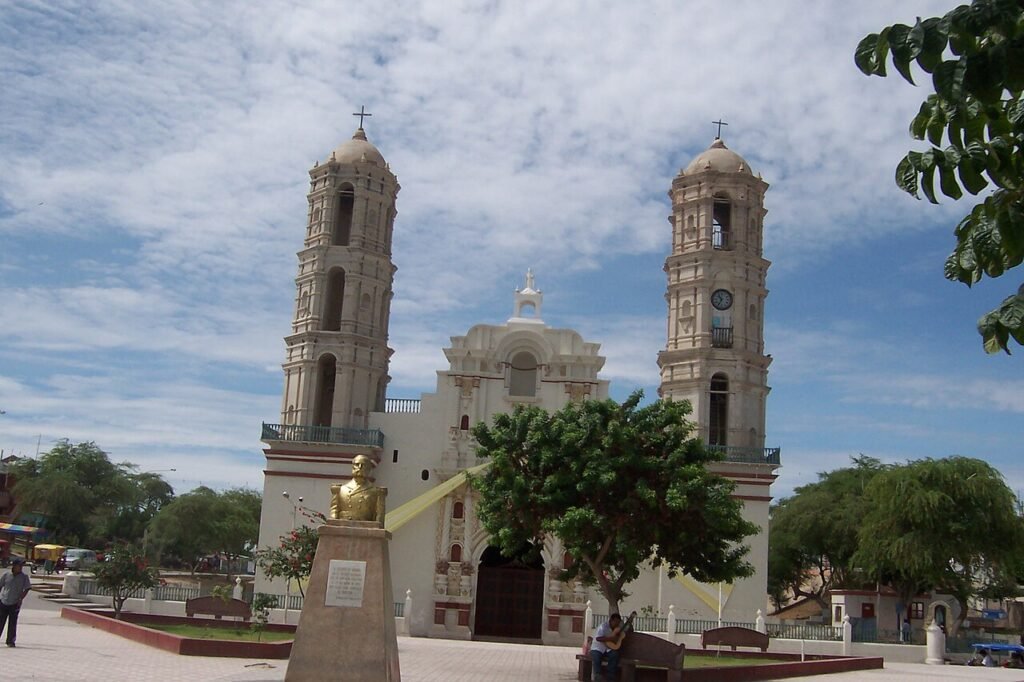
Your journey begins at the Plaza de Armas, a shaded square anchored by the Iglesia San Martín de Tours, a simple whitewashed church with twin bell towers. Inside, the high altar is carved from local algarrobo wood, darkened by centuries of candle smoke. Wander the narrow grid of streets named after saints and liberators—Calle San Martín, Calle Grau, Calle Bolívar. Here, the pace is slow: men gather on benches to play dominoes, women sell fresh lime juice from carts, and the constant drone of mototaxis weaves through the afternoon heat. Look for the old municipal theater (Teatro Municipal) on Calle Comercio, a faded gem that occasionally hosts folkloric performances. The real charm lies in the corners—a mural of a fisherman, a herb stall, a doorway that opens into a courtyard full of chirping parakeets. Plan to spend at least an hour simply walking the blocks around the plaza, ducking into the small shops selling handwoven straw hats (tejidos de paja) made from the local jipijapa palm.
El Puerto de Sechura (The Port)
About 15 minutes south of the center by mototaxi (costing you just 3 soles), the working port neighborhood hums with a different energy. This is where the morning catch comes in—thousands of chita, lenguado, and corvina glistening on ice. The air smells of brine, diesel, and frying fish. You’ll see the colorful fishing boats, known as lanchas artesanales, tied up at the pier, their hulls painted in bright blues and yellows. The main artery is Avenida La Marina, lined with open-air cevicherías where you can watch women expertly slice fish for ceviche de conchas negras (black shell ceviche). The most authentic spot is Cebichería Doña Rosa, a no-frills family-run place where a heaping plate of ceviche mixto with sweet potato, choclo, and a shot of chicha de jora costs just 12 soles. Savvy visitors know to come at 11 a.m. when the catch is still cold from the sea. If you walk all the way to the end of the pier, you’ll find a small lighthouse and a viewpoint over the Sechura Bay—perfect for a sunset that turns the desert dunes on the horizon a deep rose.
Parachique (The Mangrove Village)
Fifteen kilometers northwest of the city, the village of Parachique offers a complete contrast. This is a sleepy fishing community nested among the Manglares de San Pedro, a protected wetland. You’ll leave paved roads behind as you enter on a sandy track lined with thatched-roof homes on stilts. Travelers often discover that the best way to explore is by hiring a boat (around 40 soles per hour) to glide through the narrow channels, where egrets, herons, and even the occasional crocodile sun themselves on the mudbanks. The real highlight is the crianza de conchas negras—black shell farms that produce the region’s prized mollusks. Stop at the simple restaurant of Doña Elvira on the waterfront, where she serves a spectacular arroz con conchas negras (rice with black shells) for 18 soles, accompanied by a refreshing limonada de cocona. The pace here is so slow that you may feel you’ve stepped back a century—no Wi-Fi, just the sound of water lapping and children playing on the beach.
The Local Table: What Sechurans Actually Eat
Sechura’s cuisine is an ode to the sea. Locals start their day with a bowl of sopa de pescado (fish soup) loaded with chunks of fresh corvina, yucca, and achiote-infused broth. For lunch, the undisputed hero is arroz con mariscos—a saffron-tinged rice dish packed with squid, shrimp, mussels, and the local black shells. You’ll find it everywhere, but the best is at the Mercado Central de Sechura, where the second-floor food court, known as “La Picantería,” buzzes with families sharing massive platters. Go to stall #23, run by the Vásquez family, where they’ve been serving the same recipe since 1972. A generous portion costs 8 soles.
The ingredient that defines Sechura is the concha negra (Anadara tuberculosa), a black-shelled clam found only in the mangrove estuaries. It has a briny, almost metallic flavor that locals swear is an aphrodisiac. You must try conchas negras al horno—baked with butter, garlic, and a squeeze of lime—at the family-run restaurant La Ola, just off the Plaza de Armas (calle San Martín 456). The owner, Señora María, will happily explain how the shells are farmed and served with toasted cancha corn. For a sweet finish, look for manjar blanco de algarrobo, a caramel-like spread made from the pods of the algarrobo tree, sold by street vendors near the church after mass on Sunday.
Drinking culture centers on chicha de jora, a fermented corn beer with a sour, yeasty tang, served in giant clay glasses at the chicherías scattered around the port. These are unmarked establishments, usually a woman’s home with a red flag on the door. You’ll be welcomed like family—just sip slowly and listen to the stories of the sea.

This is a photo of a monument in Peru, identified by ID, Sechura, Peru
Art, Music & Nightlife
Sechura’s creative pulse beats strongest during the Fiesta de la Virgen de las Mercedes, held every September 24. For a week, the town erupts with marineras (the national dance of Peru), pasacalles, and nightly concerts of cumbia selvática. You’ll see women in embroidered cotton dresses dancing with men wielding handkerchiefs, while brass bands play under strings of colored lights. The main stage is erected on the Plaza de Armas, and the air fills with the scent of anticuchos and burnt sugar. Beyond the festival, local art is showcased at the Museo de Sitio de Sechura (open Tuesday–Sunday, 9 a.m.–4 p.m., entry 5 soles), where you can see Moche pottery fragments and a haunting collection of photographs documenting the 1728 earthquake.
For nightlife, your options are low-key but authentic. The discoteca “El Faro” on Calle Grau opens around 10 p.m. on weekends, with a mix of salsa, reggaetón, and cumbia. Expect a dark room, a mirror ball that barely spins, and locals who dance with abandon. For a quieter evening, head to the rooftop bar of the Hotel Brisas del Mar on Avenida La Marina—you can sip a cold Cusqueña beer while watching the lights of fishing boats twinkle on the dark bay.
Practical Guide
- Getting There: The nearest airport is Piura (PIU), 45 minutes away by taxi (80 soles). From Piura, you can take a shared colectivo (15 soles, one hour) from the Terminal Terrestre. Book flights at Skyscanner
- Getting Around: Mototaxis are your best bet within town—standard fare is 3-4 soles for any destination. To reach Parachique, take a combi from the corner of Avenida Grau and La Marina (5 soles, 30 minutes). Bargain if needed.
- Where to Stay: Stay in the Centro Histórico for walkability (Hotel San Martín, double room from 60 soles) or at the port for sea views (Hostal Brisas del Mar, double from 80 soles). Check Booking.com
- Best Time: Visit from May to October (the dry season) when skies are clear and temperatures hover around 27°C. Avoid January–March when the summer heat can be oppressive.
- Budget: A traveler can get by on 100–120 soles per day (about $30 USD) including accommodation, three meals, and local transport. A budget of 150 soles allows for a boat tour and a nicer dinner.
A bustling Plaza Mayor in Lima showcasing the historic Cathedral of Lima un…, Sechura, Peru
What Surprises First-Time Visitors
Most tourists arrive expecting a typical Peruvian coastal town—but Sechura confounds that expectation. The first surprise is the sheer emptiness of the desert behind the town. You can walk five minutes from the plaza and find yourself surrounded by sand dunes that stretch to the horizon, with no sound but the wind. Many visitors are also caught off guard by the friendliness of strangers. You’ll be greeted with a cheerful “¡Buenos días!” in every shop, and a local waiting for a bus might offer you a slice of fresh papaya. The second surprise is the quality of the seafood. Sure, you’ve had ceviche in Lima, but here it’s so fresh that the fish still trembles on the plate—and it costs a third of the price.
Another misconception: that Sechura is only for the adventurous. While there’s no luxury tourism, the town is safe, easy to navigate, and full of simple pleasures like watching the pelicans dive from the pier. Travelers often discover that the most memorable experiences are unplanned—an invitation to a family’s Sunday lunch, a spontaneous dance lesson in the plaza, or a shared bottle of chicha under a straw roof. The secret to Sechura is that it rewards those who slow down and let the desert rhythm take over.
Your Sechura, Peru Questions
Is Sechura safe for solo travelers, especially women? Yes, Sechura is generally safe, with a low crime rate compared to bigger Peruvian cities. Locals are protective of visitors, and you’ll feel comfortable walking the central streets even after dark. That said, exercise normal caution: keep valuables out of sight, avoid the darkened edges of the port after 10 p.m., and always negotiate mototaxi fares upfront. Solo women often report feeling welcomed rather than harassed—just dress modestly (cover shoulders and knees) out of respect for the conservative community.
What’s the best way to experience the Sechura Desert? The most rewarding day trip is to the Illescas Peninsula, a protected area with cliffs, beaches, and sea lions. You’ll need a 4×4 taxi (around 200 soles, including wait time) from Sechura. Alternatively, join a guided tour with EcoSechura (ask at the tourist office on the plaza) that takes you by boat to see penguins and dolphins—departs at 7 a.m., costs 90 soles per person. Bring plenty of water, sunscreen, and a hat; the desert sun is intense even in winter.
Do I need to speak Spanish to enjoy Sechura? While a few phrases help (especially “gracias” and “la cuenta, por favor”), you’ll get by with gestures and smiles. The tourist office on the Plaza de Armas has a staff member who speaks basic English, and younger people in restaurants often know a little. However, most markets and chicherías are Spanish-only. Download an offline translation app before you arrive—it’ll make ordering that plate of conchas negras much smoother.
Majestic ancient temple with bridge over a tranquil river in a rustic landscape., Sechura, Peru

