
Beyond the Ash and the Coral: Where the Volcano Meets the Sea in Isangel, Vanuatu (2026)
In 1774, when Captain James Cook first sighted Tanna Island from the deck of the Resolution, he noted a “vast column of fire” rising from the island’s interior—Mount Yasur, one of the world’s most accessible active volcanoes. He named the island “Tanna,” likely derived from the local word for “land,” but the people he met already had a word for the phenomenon: Yasur means “the home of the spirits.” That collision of celestial observation and deep-rooted belief still defines Isangel, the administrative heart of Tanna, where you’ll find modern bureaucracy humming beneath the constant, low rumble of the earth.
The Story Behind Isangel, Vanuatu
Isangel’s story is not one of grand colonial cities or epic battles. It’s a quieter, more resilient tale of indigenous life meeting European empire. After Cook’s visit, whalers, sandalwood traders, and missionaries arrived. The most famous among the latter was the Scottish Presbyterian John G. Paton, who landed on Tanna in 1858 and faced such hostility from locals that he nearly lost his life. His mission station on the coast, at the site now called Port Resolution, was abandoned after repeated attacks. Yet by the 1880s, the Anglo-French Condominium of the New Hebrides had established a nominal presence on Tanna, and Isangel grew as a minor administrative post.
What truly shaped Isangel, however, was the volcanic soil and the cargo cults. The John Frum movement, which began in the late 1930s, predicted a messianic delivery of Western goods and independence from colonial rule. Its followers built symbolic airfields and warehouses in the jungle—practices that still endure in remote villages like Yakel. When Vanuatu achieved independence in 1980, Tanna’s leaders chose Isangel as the provincial capital, largely because it was the site of the old district office and a small airstrip. Today, you’ll find a town of about 1,200 people, where grass-thatched bungalows sit beside concrete government buildings, and the roar of Mount Yasur’s eruptions is the clock by which daily life runs.
Neighborhood by Neighborhood

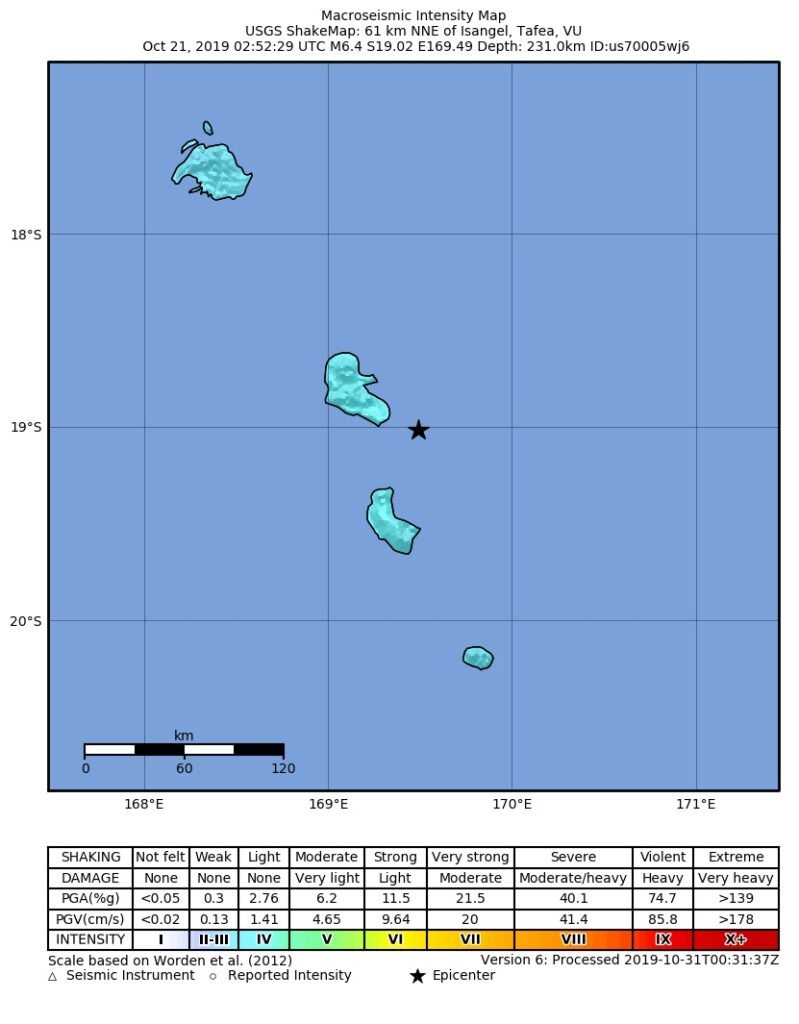
Shakemap from USGS for the magnitude 6, Isangel, Vanuatu
Isangel Town Center
Your first impression of Isangel’s town center is one of surprising efficiency. The main road, called simply the Ring Road, loops through a cluster of single‑storey corrugated‑iron and weatherboard buildings. At its heart lies the white‑washed Presbyterian Church, built in the 1960s, whose bell rings for Sunday services and also, locals say, as a gentle warning when the wind shifts and volcanic ash blows toward town. Opposite the church, the Isangel Market opens every morning from 6 a.m. until around 11 a.m. You can smell it before you see it—ripe papaya, fresh tuna, and the earthy scent of taro and yams. The market is a meeting point for villagers from the bush and coastal settlements. Most visitors overlook the tiny post office next to the market; its hand‑painted sign and slow‑turning ceiling fan make it a charming spot to buy a stamp and watch the town’s unhurried rhythm. Along the Ring Road, you’ll find the Tanna Provincial Government Headquarters, a low concrete block where officials process land titles and birth certificates. The buzziest spot in town is the Kava Bar at the Corner (no official name, but everyone knows it), where men sip kava from halved coconut shells under a thatched awning from around 5 p.m. Don’t be shy—you are welcome to try the muddy, numbing drink for about 100 vatu (roughly $1 USD).
Lenakel
About three kilometres west of Isangel, the village of Lenakel spreads along the beach. This is the port district, where the inter‑island ships from Port Vila and Santo dock every week or so. Lenakel feels grittier than Isangel, with a working harbour, a few small guesthouses, and a dog‑eared supply shop. The strip of white sand here is not the pristine picture you might expect—it’s used by fishermen who haul in their outrigger canoes in the late afternoon. But that’s precisely its charm: you can watch locals mend nets under the shade of a rain tree, while children play soccer with a deflated ball. The Lenakel Fresh Food Market is smaller than Isangel’s but offers the best catch of the day—usually tuna, wahoo, and lobsters. If you’re lucky, a fisherman will sell you a whole fish for 500 vatu and point you to a nearby household that will grill it for a small fee. Lenakel’s dirt streets are flanked by breadfruit and coconut palms, and you can easily spend an evening listening to the waves and the occasional guitar strum from a thatched bungalow. Most tourist infrastructure—the small resorts and lodges that cater to volcano‑chasers—lies beyond Lenakel, on the road toward Mount Yasur, but Lenakel itself is where you’ll get the unvarnished Tanna.
Imaio – The Kastom Village
Twenty minutes by bumpy track south of Isangel, the village of Imaio offers a deliberate step back in time. This is a kastom (custom) village, where around 40 families live without electricity or running water, following pre‑contact traditions. You can walk there from the main road, but your best bet is to arrange a trip through the Tanna Trekking office in Isangel (book a half‑day tour for about 3,000 vatu per person including a guide). Imaio is not a tourist theme park; it’s a living community. The houses are bungalows of bamboo and palm thatch, set around a central clearing. Men wear nambas (penis sheaths) and women wear grass skirts. Visitors are led by a village elder who explains the meaning of the intricate patterns painted on their bodies—each symbol linked to an ancestor or a volcano spirit. You will be invited to join a sand drawing session, where a storyteller traces figures in the ash with a single continuous line, reciting the tale as he draws. Cameras are allowed, but always ask permission first. The most profound moment comes when the elder points to the plume of smoke rising from Mount Yasur and says, simply, “Our grandfather is speaking today.” Imaio leaves travelers with the understanding that in Isangel, the volcano is not a tourist attraction; it is a living member of the family.
The Local Table: What Natives Actually Eat
Forget any romantic notions of Polynesian feasts or elaborate sauces. In Isangel, food is a matter of survival and ritual, centred on what grows in the volcanic soil. The staple is laplap—grated yam, taro, or Manioc, mixed with coconut cream, wrapped in banana leaves, and baked in an earth oven for two to three hours. Families will flatten the mixture into a large circle, sometimes layering it with pork, chicken, or flying fox (a local delicacy). You can find laplap at any ceremony, but for the best daily version, head to Auntie Rose’s Kitchen just off the Ring Road, next to the school. For 200 vatu, she serves a slice of laplap with a boiled egg and a handful of watercress—simple, filling, and deeply satisfying. Breakfast is almost always sweet potato or leftover laplap, reheated.
The Isangel Market is where you should buy provisions: bright yellow papayas, tiny finger‑length bananas, and the prized Tanna coffee. Locally grown and roasted, Tanna coffee has a smooth, earthy flavour with almost no acidity. A bag of whole beans costs about 500 vatu at the market. For a proper lunch, look for kumala (sweet potato) vendors frying chunks in coconut oil—a rustic street snack. And you cannot leave without drinking tanna pineapple, a spun‑gold fruit so sweet it tastes candied. Most restaurants in Isangel serve a plate‑of‑the‑day for around 1,000 vatu—fish or chicken with rice, laplap, and fresh salad. The best is at the Isangel Nakamal (the traditional kava bar), which also serves simple meals. But the secret many travelers discover is to ask a local if you can buy a whole coconut and drink the water while watching the market close at 11 a.m. It costs 30 vatu and is the most refreshing thing you’ll ever taste.
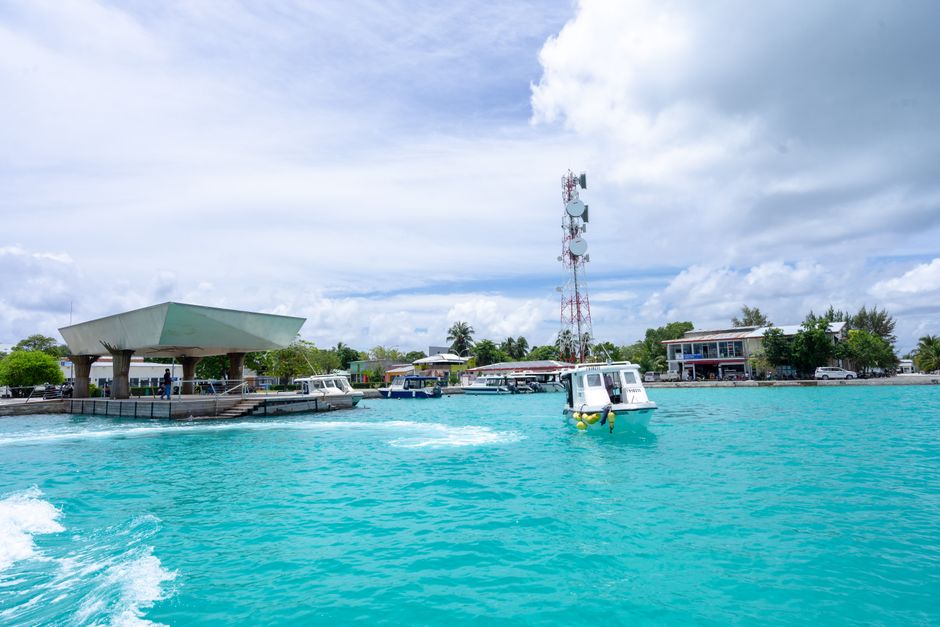
A tranquil tropical island scene featuring a dock, Isangel, Vanuatu
Art, Music & Nightlife
Nightlife in Isangel is less about clubs and more about community gatherings. Every Friday evening, the Isangel Catholic Church Hall hosts a string‑band concert—local men playing ukulele, guitar, and a bamboo stamping tube called a tamboo. It starts around 7 p.m. and goes on until the last coconut is drunk. The songs are in Bislama and English, often improvised to poke fun at village characters or praise the volcano. Admission is free, but a 500‑vatu donation for the musicians is appreciated. Travelers often discover that the best dancing happens during the Tok Tok festival in mid‑August, when villages from across Tanna converge on Isangel’s sports field for three days of singing, drumming, and story‑telling. You’ll see traditional body painting, pig exchanges, and mock battles with bamboo spears.
The visual art scene is minimal in galleries, but rich in the everyday. Sand drawings, as seen in Imaio, are a UNESCO‑recognised intangible cultural heritage. For a more permanent souvenir, visit Kastom Art Studio near the market, where Willie, a local carver, sells coconut‑shell masks and miniature outrigger canoes. His studio is open 9 a.m. to 1 p.m., but if you knock on his door most afternoons, he will show you his tools. The only dedicated music venue is the Isangel Niteclub (a slightly misleading name for a concrete room with a sound system), which opens on Saturday nights from 8 p.m. to midnight, playing a mix of reggae, pop, and local string‑band music. The cover charge is 200 vatu, and the atmosphere is lively without being rowdy. You should definitely go—just don’t expect a polished night out. Expect instead to be the only foreigner, which makes you a minor celebrity for the evening.
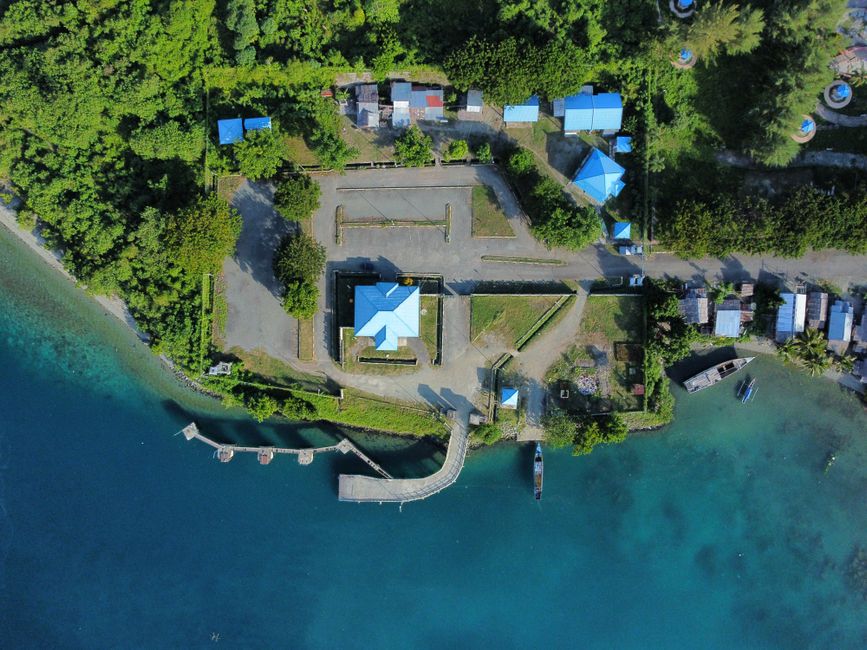
Stunning aerial shot of a coastal area with pier, buildings, and lush greenery., Isangel, Vanuatu
Practical Guide
- Getting There: Isangel is served by White Grass Airport (IATA: TAH), with daily flights from Port Vila’s Bauerfield Airport on Air Vanuatu. Flights take about 45 minutes and cost around 15,000 vatu one way. Book at Skyscanner.
- Getting Around: The main road in Isangel is walkable. For trips to Lenakel, the volcano, or Imaio, take a shared truck (pickup with benches) from the Isangel truck stop. A ride within town costs 100 vatu; to Mount Yasur’s entrance, you’ll pay about 1,500 vatu. Negotiate before boarding.
- Where to Stay: For convenience, stay at Tanna Lodge on the Ring Road in Isangel (single room from 4,000 vatu/night). For beachfront tranquility, try Lenakel Guesthouse (from 5,000 vatu, with meals). Check Booking.com.
- Best Time: The dry season, from April to October, offers clear skies for volcano viewing and comfortable hiking. November to March is wet and humid, with possible cyclones.
- Budget: A realistic daily cost for a mid‑range traveler is 8,000–12,000 vatu ($70–$105 USD), including accommodation, two meals, one activity, and transport.
What Surprises First-Time Visitors
Many travelers arrive in Isangel expecting a tropical paradise of white sand and palm trees. Instead, they find a town that looks like a hardworking frontier settlement—dusty streets, corrugated iron roofs, and the constant presence of ash. The first surprise is the volcano’s sound. You don’t just see Mount Yasur; you hear it. The low, rhythmic thunder is like a giant breathing, and locals barely notice it. You, however, will wake at night wondering if the world is ending. It’s not—it’s just the earth’s heartbeat.
The second surprise is the pace. Isangel moves on “Tanna time.” A meeting scheduled for 9 a.m. might start at 10.15. A bus that is leaving now may depart in 40 minutes. Savvy visitors learn to loosen their schedule. Respect the rhythm—bring a book, chat with a shopkeeper, sit on the beach. The impatience you feel will dissolve into a gentle acceptance that time, like the volcano, has its own plans.
Finally, visitors are surprised by the generosity. In the market, a stranger will hand you a piece of papaya and refuse payment. Walking past a house, a family may invite you in for a bowl of laplap. This is not a tourist performance; it’s the way of a culture where visitors are rare and treated as honoured guests. By the time

