
Bakadji, Guinea-Bissau for Adventurers: 7 Mangrove Missions That Put the Amazon to Shame (2026)
The pirogue lurches as you dig your paddle into the chocolate-brown water, and suddenly the mangrove canopy closes above you like a green cathedral ceiling. A troop of red colobus monkeys shrieks in the branches overhead, their calls ricocheting through the tangled roots. The air smells of brine, wet earth, and something floral you can’t name. Your guide points silently—a crocodile slide enters the water twenty meters ahead. This is Bakadji, and your adventure has just begun.
The Main Event: Pirogue Exploration Through the Cacheu River Mangroves
Your best bet for the purest adrenaline hit in Bakadji is a multi-hour pirogue expedition through the Cacheu River mangroves, which form the heart of the Cacheu River Natural Park. You’ll launch at dawn—5:30 AM ideally—from the small jetty in Bakadji village, where local fishermen named Mamadu and his crew will have your wooden pirogue ready. The cost is around 15,000 CFA (about $25 USD) per person for a four-hour trip, including a guide. The difficulty is moderate technically—you’ll paddle through narrow channels where overhanging branches force you to duck—but the heat and humidity make it a physical challenge. Bring at least two liters of water, a wide-brimmed hat, and reef-safe sunscreen. The insider tip: request the “sunrise departure” and ask for guide Carlos Indami, a former fisherman who knows every channel and can identify bird calls from a kilometer away. You’ll navigate through tunnels of mangrove roots where the light filters green and gold, and you’ll emerge into open lagoons where West African manatees surface with a breathy sigh. The real thrill comes when you enter the narrowest passages—barely wide enough for the pirogue—and the tide pushes you through at surprising speed. Seasoned travelers prefer the outgoing tide (around 7 AM) when the current assists your return journey.
What makes this experience truly unforgettable is the wildlife density. Travelers often discover that the Cacheu mangroves host one of West Africa’s most intact populations of the vulnerable West African manatee, alongside hippopotamus, Nile crocodiles, and over 200 bird species including the iconic Goliath heron. Your guide will cut the outboard motor (yes, most pirogues have small motors for the main channels) and you’ll drift silently into a side creek. That’s when you hear it—the soft exhalation of a manatee surfacing ten feet away. Locals recommend bringing a waterproof camera in a dry bag, as you’ll want to capture the moment when a troop of chimpanzees appears on the riverbank. The full experience includes a stop at a floating fishing camp where you can sample freshly grilled barracuda and learn how to cast a traditional net. Plan to tip your guide 3,000–5,000 CFA for exceptional service.
Activity #1: Hiking to the Cacheu Fort
After your pirogue expedition, stretch your legs on a hike to the 17th-century Portuguese fort of Cacheu, located about 12 kilometers downstream from Bakadji. You’ll start from the village of Cacheu town, reachable by local taxi (2,000 CFA per person, 30 minutes). The fort, built in 1588 and expanded in 1641, sits on a grassy bluff overlooking the river and was a key hub in the transatlantic slave trade—a sobering but essential piece of history. The hike itself takes you through cashew orchards and alongside rice paddies where women in bright capulanas harvest by hand. The trail is flat but sandy, so wear closed-toe shoes and bring 1.5 liters of water per person. The best time to go is late afternoon, starting around 3 PM, when the heat eases and the light turns golden. The fort is free to enter, but you’ll want to hire a local guide named Senhor Domingos (find him at the Cacheu tourism office, 5,000 CFA for a 1-hour tour) who will show you the old slave dungeons, the original Portuguese cannons, and the tiny on-site museum with artifacts from the 16th century. The view from the fort’s ramparts at sunset—where the Cacheu River meets the Atlantic—is one of the most memorable in Guinea-Bissau. Travelers often combine this hike with a stop at the nearby Orango Island National Park ferry, which departs from Cacheu at 8 AM daily (3,000 CFA per person).
Activity #2: Night Crocodile Spotting
For a completely different adrenaline experience, book a night crocodile-spotting trip with guide Abdulai Sissé, who runs Bakadji Adventure Tours (reachable via WhatsApp at +245 966 456 789). You’ll meet at 7:30 PM at the Bakadji jetty, just as the sun sets and the mangrove frogs begin their chorus. Abdulai will hand you a high-powered LED flashlight and instruct you to scan the water’s surface for the red-orange glow of crocodile eyes. You’ll board a silent pirogue with a small electric trolling motor—no outboard noise to scare the reptiles. The cost is 12,000 CFA per person for a 2-hour trip, including headlamps and life jackets. The difficulty is easy physically but mentally intense: you’ll be inches from the water in near-total darkness, and when Abdulai shines his spotlight and reveals a 3-meter Nile crocodile lying motionless on the bank, your heart will pound. The best time for this activity is during the dry season (November to April) when water levels are lower and crocodiles concentrate in the deeper channels. Locals recommend wearing dark clothing and bringing insect repellent with at least 30% DEET—the mosquitoes at night are fierce. Most visitors describe the experience as simultaneously terrifying and mesmerizing. Abdulai will also point out the constellations overhead—the Southern Cross rises clearly in this latitude—and if you’re lucky, you’ll hear the distant splash of a manatee. You’ll return to the jetty by 9:30 PM, buzzing and wide-eyed, ready for a late dinner.

Aerial shot of a rural village in Africa with dirt roads and modest homes., Bakadji, Guinea-Bissau
Refuel: Where Adventurers Eat
After a day of paddling and hiking, you’ll need serious fuel. Your first stop should be Restaurante Baluarte in Cacheu town (about 15 minutes by taxi from Bakadji). This open-air spot on stilts overlooks the river, and locals recommend the grilled barracuda with onion-tomato sauce and fried plantains—a full plate costs 3,500 CFA. Owner Dona Maria will bring you a cold Africana beer (1,000 CFA) delivered by canoe from a floating cooler. For a quicker, dirt-cheap option, hit Barraca do Carlos right on Bakadji’s main path—Carlos grills chicken thighs over charcoal and serves them with “caldo de mancarra” (peanut sauce) and white rice for 2,000 CFA. He’s famous for his piri-piri sauce, made from local chillies and tamarind. For a splurge, book a table at Pousada Cacheu‘s restaurant (5,000 CFA for a three-course meal), where the chef prepares “jollof rice with smoked fish” and grilled prawns the size of your hand. The pousada is the only place in the area that reliably serves cold drinks—a godsend after a hot day. Adventurers quickly learn that meal times in Bakadji are flexible; you eat when the fish arrives and when the cook fires up the charcoal, usually around noon and 7 PM.
Base Camp: Where to Stay
For active travelers, the best base is Pousada Cacheu (from 35,000 CFA per night, book on Booking.com). This nine-room guesthouse sits on the river edge, offers early breakfast from 6 AM (crucial for dawn expeditions), and has a secure lock-up for bikes and gear. The owner, Senhor Alves, can arrange pirogue trips and guides directly. A more rustic and budget-friendly option is Camping Bakadji (5,000 CFA per person per night, bring your own tent and hammock), located on a sandy rise overlooking the mangroves. The caretaker, João, will provide drinking water for 500 CFA per liter and can cook you a simple dinner of rice and fish for 2,000 CFA. For travelers who want to be right in the action, Eco-Lodge Orango (from 50,000 CFA per night) on neighboring Orango Island is a 45-minute pirogue ride away—luxury tents with solar lighting and flushing toilets, plus a resident biologist who leads expeditions. Every accommodation in Bakadji operates on generator power from 6 PM to 10 PM; after that, you’ll rely on headlamps. Seasoned visitors pack a rechargeable fan and a power bank with at least 10,000 mAh capacity.
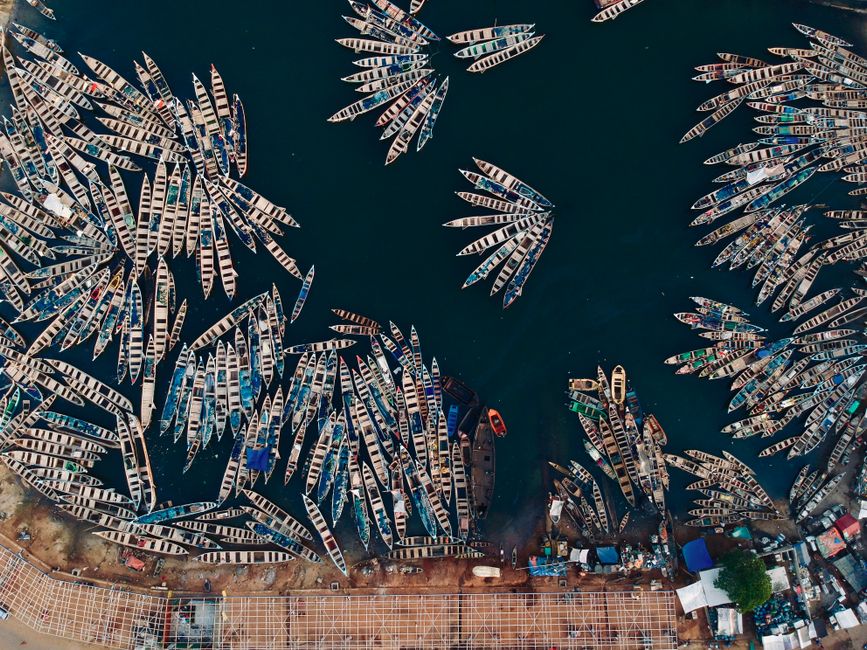
Top view of numerous fishing boats docked at Tema fishing harbour in Ghana., Bakadji, Guinea-Bissau
Gear & Prep Checklist
- Lightweight, quick-dry long-sleeved shirt and trousers (protects from sun and mosquitoes; you’ll be in mangroves for hours)
- Waterproof dry bag (at least 20 liters—your phone, camera, and passport will survive pirogue splashes)
- High-SPF sunscreen (reef-safe only—the mangroves and manatees depend on it; brands like Sun Bum or Stream2Sea work)
- Physical preparation: you should be comfortable walking 8 kilometers in sandy, humid heat and paddling for 90 minutes without a break
- Malaria prophylaxis mandatory—consult your doctor for atovaquone-proguanil or doxycycline, and bring mosquito repellent with 30%+ DEET
Getting There & Around
- Flights: You’ll fly into Osvaldo Vieira International Airport in Bissau (OXB). Book flights from Lisbon or Dakar on EuroAtlantic Airways or TACV Cabo Verde Airlines via Skyscanner. From Bissau, you’ll take a shared taxi (“toca-toca”) to Cacheu town (3.5 hours, 5,000 CFA per person) or hire a private 4×4 with driver for 75,000 CFA one-way
- Local Transport: From Cacheu town, local pirogues run to Bakadji village twice daily—8 AM and 3 PM—for 1,500 CFA per person, 25 minutes. Your guide can also arrange private transfer by pirogue for 5,000 CFA each way
- Best Season: November through April is the dry season, with lower humidity, clear skies, and peak wildlife viewing. Avoid August-October when the rains make trails impassable and crocodile spotting is dangerous

Aerial view of colorful fishing boats docked at Prampram beach in Ghana wit…, Bakadji, Guinea-Bissau
Is Bakadji, Guinea-Bissau Worth It?
Bakadji is not for the faint of heart—and that’s precisely its magic. If you’re the type of traveler who needs paved roads, 5-star WiFi, and restaurant menus with English translations, you should head to Senegal’s Casamance region instead. But if you crave raw, unfiltered adventure—where your guide navigates by stars, where the meal is whatever the fishermen caught that morning, and where the only sound at night is the splash of a crocodile—Bakadji will reward you in ways that the well-trodden tourist trails of West Africa cannot. Travelers who love remote, wildlife-rich destinations like the Okavango Delta or the Pantanal will find a raw, affordable alternative here, without the crowds. The secret is to come with flexibility, patience, and a spirit of curiosity. Your pirogue might break down, the power might cut at 9 PM, and the fish might not bite—but the manatees will surface, the chimpanzees will call, and you’ll watch a sunset over the mangroves that will recalibrate your sense of what a real adventure can be. For $50 a day, you can experience one of West Africa’s last true wilderness frontiers. Come for the adrenaline, stay for the silence. Book that pirogue, and go now—before the rest of the world discovers Bakadji.

