
Akyaka, Turkey Weekend: Azmak River Swims (2026)
The air carries a strange perfume here—pine resin from the ancient forest meets the mineral tang of the Azmak River, whose spring-fed waters stay a constant 10°C even when the August sun bakes the hillsides. You step off the wooden dock and your feet meet cold, glassy water so clear you can count every pebble six meters down. This is Akyaka, and your weekend begins with a gasp of pure, unspoiled coastal magic.
Quick Facts Before You Go
- Best Months: May-June and September-October—the water is warm enough for swimming, the crowds have thinned, and the temperatures stay between 24-30°C. July-August is peak season: expect full guesthouses and higher ferry prices but the liveliest atmosphere.
- Currency: Turkish Lira (TRY). As of early 2025, roughly 29 TRY = 1 USD; 32 TRY = 1 EUR. Many restaurants take cards, but bring cash for market stalls and small tea gardens.
- Language: Turkish. English is spoken in hotels, tourist restaurants, and the windsurfing school, but travelers discover that learning merhaba (hello) and teşekkür ederim (thank you) earns genuine smiles from shopkeepers and boat captains.
- Budget: 1,200-2,000 TRY per day for midrange comfort—includes a guesthouse room, three meals, a boat trip, and a few teas. Budget travelers can manage 700-900 TRY by sticking to local lokantas and staying a bit inland.
- Getting There: Fly into Dalaman Airport (DLM), about 80 minutes away by car. Direct flights from London take roughly 3 hours 45 minutes. Book through Skyscanner for the best rates. From Dalaman, the airport shuttle runs hourly for about 150 TRY; a taxi costs around 1,200 TRY.
Day 1: The Cold River & The Slow City Rhythm
You wake to the sound of roosters and the distant clatter of a tea glass being set on a saucer. Your guesthouse is one of those wooden-balconied Akyaka houses, built in the distinctive local style with wide eaves to catch the breeze. The morning light filters through plane trees as you walk toward the river, and you already feel the pace of life drop by half.
- Morning (8-11am): Head straight to the Azmak River. You can rent a kayak from Azmak Su Sporları (near the river’s mouth) for 100 TRY per hour, or join a guided boat trip for 250 TRY per person—these run hourly from 9am. The water is shockingly cold, so locals recommend you slide in slowly. You glide past weeping willows, water mint, and hidden tea gardens perched on the banks. The boatman will point out turtles basking on submerged logs and, if you’re lucky, a kingfisher darting past. The ultimate spot is the Azmak Kingfisher Café, accessible only by boat; your captain will pull up to its floating wooden deck, and you’ll sip black tea (15 TRY) with your feet hanging over the edge.
- Lunch: Walk to Fevzi’nin Yeri on the main riverfront road. Locals recommend the çipurası (sea bream) grilled over charcoal, served with a simple side of çoban salatası (shepherd’s salad) and fresh bread. A portion costs 280 TRY, and the fish arrives glistening with olive oil and a wedge of lemon. Your best bet is to sit on the upstairs balcony overlooking the river—the breeze carries the scent of thyme and salt.
- Afternoon (1-5pm): First, spend an hour wandering the Slow City streets. Akyaka was officially certified as a Cittaslow town in 2018, and you’ll feel it—no neon signs, no chain stores. Browse the Yarenler El Sanatları workshop on Atatürk Caddesi, where a local artisan named Leyla weaves traditional Gökova carpets on a wooden loom (small rugs start at 500 TRY). Then, join the 2pm public tour of the Akyaka Stone Houses (guided tour 50 TRY, departs from the municipal building)—the 150-year-old examples of this local architecture use no nails, rely on wooden pegs, and stay cool without air conditioning. Finally, walk the 1.2-kilometer Kadınlar Plajı (Women’s Beach), a protected stretch where families gather and the water is shallow and calm—no entrance fee, just a pebble-and-sand shore.
- Evening: Dinner at Sadıkoğlu Restaurant on the main square, where the specialty is testi kebabı (pottery kebab)—a clay pot sealed with dough that’s cracked open tableside—350 TRY per serving. Afterward, stroll to the Gökova Tea Garden just behind the mosque, where the garden is strung with fairy lights and locals gather over backgammon boards. A double apple shisha costs 120 TRY, and a glass of çay is just 10 TRY. The hum of conversation in Turkish, the clack of dice, and the soft night air make this the perfect place to linger until the muezzin’s call floats across the rooftops at dusk.

Houses of Akyaka, Muğla 2015, Akyaka, Turkey
Day 2: Cleopatra Island & The Pine-Forest Escape
The second day is for the sea. You wake early because the boats to Sedir Island—known locally as Cleopatra Island—depart at 9am sharp, and savvy visitors know that the first ferry gets you onto the ancient beach before the crowds. The engine hums as you pull away from the harbor, and the pine-covered hills of the Bodrum Peninsula slide past on your left.
- Morning (7:30-9am): Start with breakfast at Kahvaltı Evi, a family-run spot on the riverbank. For 150 TRY per person, you get a wooden tray loaded with menemen (scrambled eggs with peppers and tomatoes), local honey straight from the comb, kaymak (clotted cream), olives in herbed oil, and a stack of fresh gözleme (savory crepes stuffed with spinach and cheese). Your best bet is to arrive by 8am—the morning light hits the river, and you can watch turtles poking their heads up while you eat.
- Midday (9am-1pm): Take the Sedir Island ferry from Akyaka harbor (return ticket 350 TRY per person, departs 9am and 10:30am, returns by 2pm). The crossing takes 40 minutes. Sedir Island is famous for its beach of fine white sand made of tiny shell fragments—legend says it was imported from Egypt for Cleopatra and Mark Antony’s meetings. The beach is protected; you can’t wear shoes, and you must rinse off before entering. The 2nd-century ruins of the ancient city of Cedrae—a theater, a temple to Apollo, and a colonnaded street—scramble up the hillside behind. Insider tip to avoid crowds: take the 9am ferry, walk straight past the beach to the ruins first (they’ll be nearly empty), then swim from 11am when the morning excursion boats begin to arrive.
- Afternoon (1-4pm): Back in Akyaka, refuel at Çınaraltı Pide Salonu, a no-frills spot under a massive plane tree where a kiymalı pide (minced meat flatbread with cheese and egg, 90 TRY) arrives crisp and sizzling. Then walk the Yeniköy nature trail—the 2.5 km loop starts at the northern edge of town, climbs through Aleppo pine forest, and opens onto a viewpoint where you can see the entire Gökova Bay, the windsurfers sketching white lines on the turquoise water far below. The trail is shaded and the air is thick with the scent of thyme and lavender.
- Final Evening: Your farewell dinner deserves something special. Book a table at Köşk Garden Restaurant, hidden behind wooden gates on a side street off Atatürk Caddesi. The garden is a tangle of bougainvillea and lemon trees, lit by oil lamps. Order fırında keçi peyniri (baked goat cheese with honey, 130 TRY) as a starter, then domates soslu köfte (meatballs in tomato sauce with rice, 240 TRY). The owner, Mustafa, might bring you a complimentary glass of rakı if you ask about his grandfather’s history as a sponge diver in the Aegean. After dinner, walk down to the harbor—the water is black glass, the boats creak on their moorings, and a few fishermen clean nets by lamplight. It’s the kind of quiet that makes you want to cancel your flight home.

View of sea during daytime, Akyaka, Turkey
The Food You Can’t Miss
Akyaka’s cooking is pure, unfussy Aegean fare—olive oil, fresh herbs, and fish so recently caught it practically glistens. You eat with bread, you eat with family, and you almost always eat outside. Travelers often discover that the best meals come from the smallest kitchens. The local specialty is otlu börek—a flaky pastry stuffed with wild mountain greens like radika (dandelion) and ısırgan (nettle), which grow on the hillsides above town. You’ll find the best version at Abacı Börekçisi, a tiny shop near the mosque that sells them for 35 TRY each; they’re made fresh every morning, and they sell out by 11am.

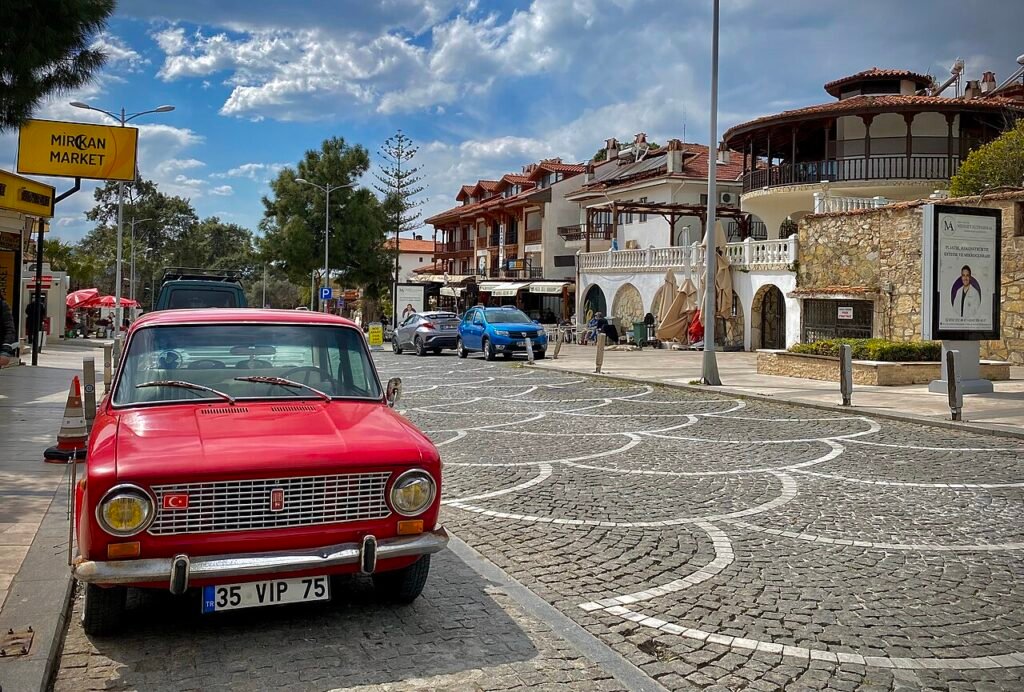
A motorcycle parked on a road, Akyaka, Turkey
Street food here is honest and unpretentious. At the harbor promenade, vendors sell balık ekmek—grilled mackerel fillets stuffed into half a crusty loaf with red onion and parsley, 80 TRY, squeezed and eaten standing up with the sea breeze in your hair. For a full sit-down meal, locals point you to Mavi Restaurant on the riverfront, where the dener güveci (shrimp casserole in a clay pot, 320 TRY) is cooked with garlic, tomato, and a hit of Aleppo pepper. The secret is the bread—you dip it into the simmering olive oil until the bowl is clean.
One meal you absolutely must not miss is the breakfast by the Azmak—a spread of local cheeses, olives, fresh walnuts, honeycomb, and farm eggs scrambled with butter. You can find this at Azmak Başı Kahvaltı Evi, where the tables are on a floating dock over the river; the total for two people with unlimited tea is about 300 TRY, and you’ll linger for two hours because no one rushes you. The owner, a grandmother named Nuriye, grows her own mint and basil in pots on the dock and will clip fresh sprigs into your glass of lemonade (25 TRY).
Where to Stay for the Weekend
The best areas to base yourself are the riverfront and the forest-hugged hill above the main square. The riverfront puts you steps from the Azmak’s boat hire and the best breakfast spots, while the hillside offers quieter lanes with sea views and more privacy. For a true Akyaka experience, choose a guesthouse built in the local style—wooden eaves, stone walls, and a garden shaded by pomegranate trees. Rates for a double room range from 600-1,200 TRY per night in shoulder season; during July-August, expect to pay 1,200-2,000 TRY.
The Köşk Guesthouse (3 rooms on a quiet side street, 900 TRY/night in June) feels like staying in your Turkish grandmother’s house—the owner Ayşe leaves a plate of figs and walnuts in your room every evening, and the balcony overlooks a garden full of oleander and jasmine. The Azmak Suites (7 apartments with kitchenettes, 1,100 TRY/night) sit right on the riverbank, with a private dock where you can slip into the water from your doorstep. For a splurge, the Gökova House in the hills above town (2 stone villas with private pools, 2,500 TRY/night) is set among olive trees and has a terrace that catches every sunset over the bay. Book through Booking.com for secure cancellations, or browse unique stays on Airbnb for small guesthouses with personal touches.
Before You Go: Practical Tips
- Getting Around: Akyaka is small enough to cover entirely on foot—the riverfront to the farthest beach is only 20 minutes walking. For Sedir Island, you’ll take the ferry. For exploring the Gökova coastline, the local minibuses (dolmuş) run along the main road every 30 minutes between 7am and midnight; a ride to anywhere in town costs 15 TRY. Taxis from the main square charge 50 TRY for any in-town ride. Most visitors never need a car—parking in summer is a nightmare anyway.
- What to Pack: A waterproof phone pouch for river and sea swims (you’ll be in and out of the water constantly); a light long-sleeved shirt and trousers for evening mosquitoes (they come out at dusk near the river); a swim shirt for women (local beaches are mixed but modest by Western standards); and a reusable water bottle—the Azmak’s spring-fed tap water is safe and delicious, and you’ll save money by filling up at your guesthouse.
- Common Tourist Mistakes: The biggest mistake visitors make is arriving without cash for the market stalls and small tea houses—many don’t take cards, and the nearest ATM is at the PTT post office on Atatürk Caddesi, which often runs out on weekends. Another is wearing only flip-flops for the forest trails—the pine-needle paths get slippery after any rain, and hiking sandals or trainers will save your ankles.
- Money-Saving Tip: Forgo the organized boat tour to Sedir Island—the public ferry is 350 TRY round-trip versus 600+ TRY for the “lunch included” excursions. Pack your own sandwiches and fruit from the morning market (open daily 7am-noon in the square behind the mosque) where a kilo of cherries costs 40 TRY and a slice of peynirli börek is 25 TRY. One couple can eat market lunch for under 80 TRY.

