
Erg Chigaga, Morocco Weekend: Sunrise Sand-Seas (2026)
You hear the sand sing before you see it. A low, serrated hiss as the wind combs over the crest of Erg Chigaga’s highest dune, and then nothing but the sound of your own boots sinking soft into gold. By 6am, the cold air smells of sun-baked clay and distant acacia smoke. This is the Sahara the way it was before postcards. A 48-hour escape from Marrakech’s clatter, where your only schedule is the sun and your radio is the hush of 300-foot dunes.
Quick Facts Before You Go
- Best Months: October through April. The winter days are warm (70-80°F) and the nights crisp enough for a fire. Avoid May-September when sand radiates 115°F heat that melts boot soles.
- Currency: Moroccan Dirham (MAD). Roughly 10 MAD to 1 USD, or 11 MAD to 1 EUR. Cash is king here; there are no ATMs past M’Hamid.
- Language: Arabic and Berber (Tachelhit) dominate. French is the commercial language, and English is spotty—learn “Shukran” (thank you) and you’ll go far. Your Berber guide will likely speak enough English for directions.
- Budget: Expect 700-1,500 MAD (roughly $70-$150) per person per day including transport, a mid-range camp, and meals. Luxe nights can push 2,500 MAD, but you can cap the whole weekend at ~3,500 MAD total.
- Getting There: Fly into Ouarzazate (OZZ) with Royal Air Maroc—about a 1-hour flight from Casablanca or 3 hours from Paris. Then a 4-hour shuttle/drive to M’Hamid, plus 1.5 hours off-road to the dunes. Book flights early on Skyscanner and expect round-trip flights from $120 if you snag deals.
Day 1: The Long Road to the Empty Quarter
You start your Friday morning not with a croissant, but with the diesel rumble of a 4×4 in M’Hamid, the last village before nothing. The paved road ends here, melting into gravel, then sand flats, then the giant, wave-like ridgelines of Erg Chigaga. Travelers often discover that the real journey is the approach—two hours of bouncing through dry riverbeds, past abandoned ksars (fortified villages), and the occasional shepherd with a herd of black goats. Your driver, a Berber who’s crossed these flats a thousand times, points at the horizon: “You see that? That is the beginning of your quiet.”
- Morning (8-11am): Grab a fuel-up breakfast at Café Restaurant La Gazelle in M’Hamid—fresh msemen (flaky fried bread), olive oil, and sweet mint tea for 30 MAD. Then depart at 9am sharp with your 4×4 (book through your camp; round-trip from M’Hamid costs ~1,200 MAD per vehicle, up to 4 people). You’ll stop at the ancient town of Tamegroute (30 min before M’Hamid) to see the famous green-glaze pottery kilns—free to wander, but a 20 MAD donation is polite.
- Lunch: Picnic in the shade of a lone camel thorn tree at the edge of the Chigaga flats. Your camp packs a basket of chicken tagine, crusty khobz bread, oranges, and a thermos of mint tea. It’s simple, warm, and somehow the best lunch of your autumn—cost included in your tour fee.
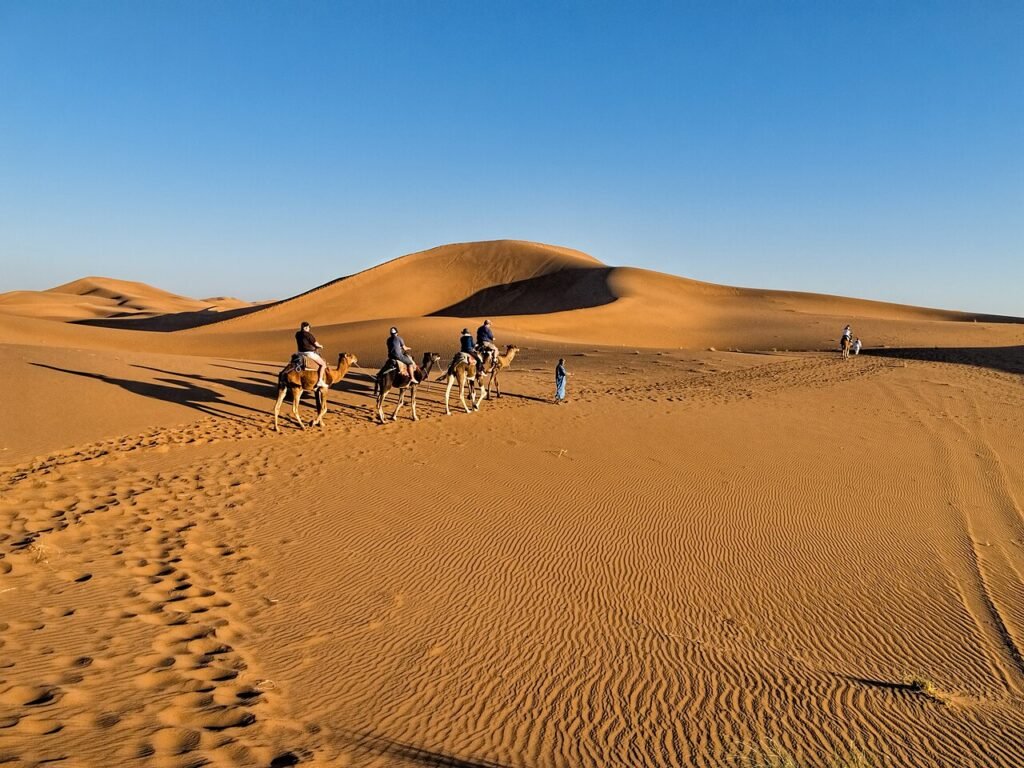
- Afternoon (1-5pm): Arrive at your camp around 2:30pm. After the dune-squint wears off, climb the 100-foot star dune directly behind the tents. Then take an hour-long camel trek (included in camp rates) along the dune’s crescent, laughing as the camels groan on every step. Pro tip: savvy visitors wear a scarf across the face—the 3pm wind flings sand like confetti. Finish with a sunset position on the highest dune—no two visitors leave with the same photo.
- Evening: Diner under a velvet sky at your camp. Local nomads cook a rustic couscous with root vegetables and slow-roast lamb that flakes with one fork. As the fire crackles, a Tuareg musician plays a gembri (three-stringed lute) and the rhythm mixes with the wind’s hum. You’ll try your hand at drumming; by 9pm, the Milky Way appears so close you’ll swear you can touch its dust. Sleep in a heavy-broidered Berber tent with a real mattress—bring earplugs, because the silence is so deep it almost rings.

Caravan in the desert. Morocco, Sahara., Erg Chigaga, Morocco
Day 2: The Dunes that Alter Your Sense of Time
If Day 1 is about the getting there, Day 2 is about the being there. You wake at 5:45am to the camp cook’s soft coals and a sky turning the color of peach sorbet. A short scramble up the main dune—about 20 minutes of heart-pumping sand—and you’re alone with the sun, rising orange across 30 miles of sculpted waves. Travelers often describe this as the most unplugged hour of their lives. Later, you’ll drift, explore, and learn the Berber art of slow living, before heading back to the modern world with sand in every seam of your luggage.
- Morning (6-9am): Sunrise dune climb, then a slow return to camp for breakfast of baghrir (honeycomb pancakes) with almond butter and fresh fruit. Your camp includes all this, but tip your guide 50-100 MAD.
- Midday (10am-1pm): The main attraction is simply walking the dune ridge—head south toward the small “salt lake” of Dayet Oum Lhana, about 40 minutes away by foot (bring 1.5 liters of water). Insider trick: the crowds all go north; you’ll find perfect solitude here. If you want action, your camp can arrange sandboarding for 120 MAD—a plastic board on a steep 300-footer, and you’ll get at least 8 runs before you’re hooked.
- Afternoon (2-5pm): Drive 15 minutes (included) to a small Bedouin encampment where a family brews tea in a soot-blackened kettle. You’ll drink and watch the matriarch weave goat-hair fabric. Locals recommend bringing a little sugar or flour as a gift—it’s the classic gesture of respect. Then visit the half-buried village of Saïd, a silent ruin of dried mud walls that dates to the 1600s, once a stop on the Timbuktu salt trade.
- Final Evening: Back in M’Hamid by 6pm, treat yourself to a farewell dinner at Restaurant El Hara (right near the main square). Order the Berber kebab—lamb, cumin, and charred peppers skewered over olive wood, served with hand-cut fries for 60 MAD. Then share a plate of shebakia (honey-soaked sesame cookies) and mint tea, listening to the local men’s muted radio crackle between songs. It’s a fittingly warm, human close to a weekend of vast, empty beauty.

Concrete structure standing amidst the vast Merzouga sand dunes under a cle…, Erg Chigaga, Morocco
The Food You Can’t Miss
Food in the Chigaga region isn’t a scene of street stalls—it’s a slow, generous ceremony. The day begins with amellou, a potent spread of roasted almonds, argan oil, and honey that you’ll smear on fresh khobz, while harira, a lentil-and-tomato soup dotted with coriander, fuels mornings and pre-sunset moments. Don’t miss rfissa, a Berber special of shredded crepes layered with onions, saffron, and slow-cooked chicken—your camp cook will make it for Friday lunch if you ask the night before. This dish came from old celebratory platters, and you’ll taste centuries in every bite. For street food, your best bet is in M’Hamid: Msemen with honey from the morning market stand near the mosque (5 MAD for two) and grilled corn-on-the-cob from a metal cart vendor (3 MAD) as you wait for your transfer.
Restaurant-wise, beyond El Hara, the courtyard of Dar M’Hamid is a hidden gem. They’ll serve you a modern twist on tagine with medjool dates and lamb, all for 90 MAD, under the shade of an ancient date palm. Travelers often underestimate how fresh the vegetables are here—carrots sweet as candy, tomatoes tasting of sunshine. One caution: avoid raw salads in rural spots, but all cooked dishes are fine. And always, always take the mint tea—not just for the flavor, but for the pause it forces you to take.
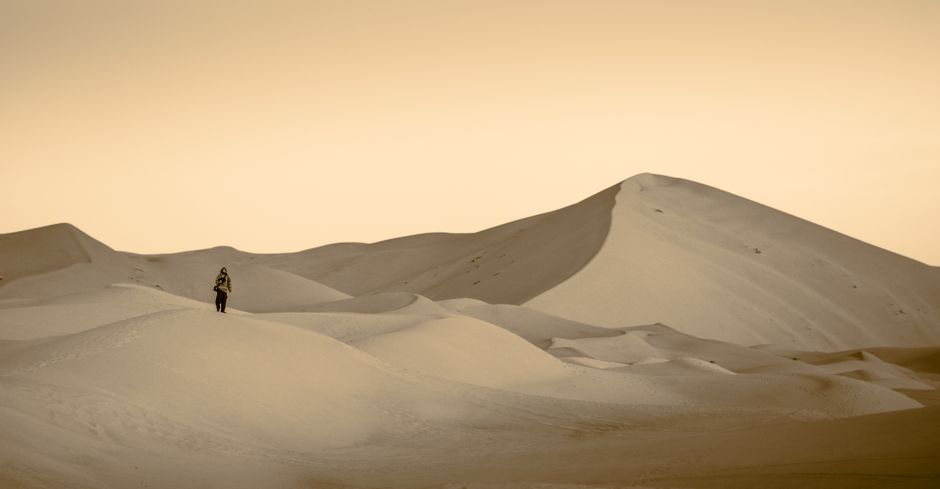
A lone traveler walks across the majestic dunes of Merzouga, Erg Chigaga, Morocco
Where to Stay for the Weekend
Your camp is essentially your home for this weekend, so choose wisely. For a splurge with epic comfort, Dar Tadelakt Luxury Camp (about 2,300 MAD per night, all meals) offers private plunge pools set between dunes, flowing Berber carpets, and a brass telescope for star-gazing. Travelers praise the glowing lantern-lit pathways and the outdoor shower (yes, with warm water) while staring at the Milky Way. For the middle range, Madu Luxury Camp runs around 1,300 MAD per night with beautiful, hand-stamped linens and a traditional hammam tent—everyone raves about the sunset aperitif served on the dune crest right above camp.
If you want a night on solid ground and a real bathroom, stay the first or last night at Gîte La Rose des Sables in M’Hamid (about 400 MAD per night, including breakfast). It’s a charming home with thick mud walls, a tiled central patio, and a roof terrace where you’ll watch the stars before your 4×4 day. All hikes and camels can be organized from there. For peace of mind, compare options on Booking.com or search for private tented camps on Airbnb—both offer flexible cancellation and verified reviews.
Before You Go: Practical Tips
- Getting Around: The only way to reach Erg Chigaga is by 4×4 from M’Hamid—there are no buses. You’ll pay 1,200-1,600 MAD for a private round trip; arrange it through your camp for the best price. Alternatively, join a shared jeep (3-6 people) from Ouarzazate for about 350 MAD per person, but you’ll lose flexibility. Inside the dunes, everything is on foot or camel.
- What to Pack: A very high SPF for your face and a buff for the sandstorms; thick socks for those soft, sinking dunes; a refillable bottle (your camp provides filtered water); and a warm down jacket or fleece—desert nights fall to 45°F even in March. Also, a small bag of sugar or dates to give as a gift to your hosts.
- Common Tourist Mistakes: First, assuming you can “just drive” the dunes—you’ll get stuck for hours without the local drivers. Second, forgetting that the sun is your scheduler: you walk at 7am or 5pm, not noon, and you’ll skip heatstroke if you respect that. Third, many visitors leave their headlamps behind—the camps’ solar lights can dim, and you’ll appreciate a pocket torch during late-night bathroom walks.
- Money-Saving Tip: Book a camp’s “basic” package and upgrade meals locally. The difference between a 1,200 MAD and a 1,800 MAD camp is often just imported wines and a fancier canopy—the sleep and stars are identical. Also, buy your water and snacks in M’Hamid before the last stop; duneside, a small bottle of water can cost 30 MAD, but in the village, it’s 5 MAD.

