
Where Tomorrow Begins: Life, Salt, and Memory on Tarawa Atoll (2026)
On November 20, 1943, the horizon off Tarawa’s northern shore erupted in a hellish symphony of naval bombardment, a prelude to one of the Pacific War’s bloodiest clashes. In just 76 hours, over 1,000 U.S. Marines and nearly 4,700 Japanese defenders would die on a coral island no larger than a modest county park. But if you walk the same beaches today, you’ll find a profound silence—only the hush of palm fronds and the gentle lapping of a turquoise lagoon over rusted, half-buried wrecks. This is Tarawa Atoll, a place where the echoes of a violent past are woven into the fabric of a serene, resilient present, and where travelers discover a genuine slice of the Pacific that few outsiders ever take the time to understand.
The Story Behind Tarawa Atoll, Kiribati
Your journey into Tarawa’s heart begins long before the guns of World War II. The atoll’s story is one of extraordinary navigation and survival, as Micronesian seafarers first settled these islets around 3000 BC, crossing vast expanses of open ocean in outrigger canoes. For centuries, Tarawa was home to a complex clan-based society known as the I-Kiribati, where lineage was traced through the mother’s line and power was held by chiefly families, or *unimwane*. The islanders’ lives were intimately tied to the sea and the breadfruit tree, creating a culture of remarkable resourcefulness—a fact you’ll see evidenced in their mastery of the *te katei* fishing techniques and the intricate construction of their sailing canoes.
The atoll first entered the European consciousness in 1788, when British Captain Thomas Gilbert sailed through the surrounding waters, although he did not land. It wasn’t until the 1820s that whalers and traders began to arrive, bringing with them a disruption of the old order. The true transformation came with the arrival of Protestant and Catholic missionaries in the mid-19th century, who rapidly converted the population and began the process of erasing older traditions. However, the most cataclysmic change arrived with the Japanese in 1941, who occupied the atoll and fortified Betio islet, turning it into a garrison. The brutal American counter-invasion in 1943, known as Operation Galvanic, left the island littered with debris and its communities scarred but the British colonial administration returned afterward, ruling until Kiribati achieved its independence in 1979. Today, you’ll find a nation that has taken that turbulent history and forged a quietly resilient national identity, dancing to the rhythm of a new era while never forgetting the bones buried in its sand.
Neighborhood by Neighborhood
Betio: The Hallowed and the Gritty
Your exploration must begin on the southern tip of South Tarawa, the islet of Betio. As you cross the causeway from Bairiki, you’ll immediately feel the shift in atmosphere. This is the epicenter of both Tarawa’s commercial life and its greatest historical tragedy. The streets are a chaotic ballet of *buses* (converted trucks with open-air cabins), motorbikes, and pedestrians. The air is thick with the smell of reef, diesel, and the sweet smoke of burning coconut husks. Start your time here at the Red Beach, the site of the main landing in 1943. You’ll find the sand still stained a faint rust color—not from a miracle, but from the crushed coral mixed with iron oxide. You’ll also see the infamous “Betio Landing” bunkers, vast concrete behemoths that still scar the beachfront, their gun ports staring sightlessly at the horizon. To fully grasp the scale of the conflict, visit the scattered remains of the USS *Monegan* wreck in the lagoon and the memorial to the fallen Marines. But don’t just wallow in history; Betio is also a raw, vibrant market hub. Meander through the central market near the causeway for the freshest lagoon fish and drifting melodies of local radio, and you’ll find the heart of this neighborhood is not in its past, but in its stubborn, lively present.
Bairiki: The Seat of Power and Pacific Grace
Drive north on the only road and you’ll cross the causeway from Betio into Bairiki, the nation’s political and administrative capital. Here, your surroundings lighten considerably. The architecture is a mix of simple concrete government buildings, airy raised houses with corrugated iron roofs, and the lush greenery of *te buka* trees. The most prominent landmark is the Kiribati National Government building, “the State House,” perched on the lagoon edge, its design reflecting a blend of modern and traditional thatch elements. Just a short walk away is the Ambo, the primary wharf where inter-island ferries arrive and depart, connecting Tarawa to the far-flung atolls of the Line and Phoenix groups. Bairiki is a walkable area, and you’ll enjoy strolling along the lagoon-side promenade, where local families gather in the cool of the late afternoon to play volleyball or simply sit and watch the *kora* (wooden sailing canoes) glide across the water. The street life is less frantic than Betio, but it is here you’ll see the true rhythm of the I-Kiribati day: the prayers from church services echoing on Sunday mornings, the men attending to their fishing nets, and the women weaving pandanus mats. For a sense of civic pride, pause at the Kiribati National Stadium, often buzzing with football matches and training sessions, the country’s sporting passion on display.
Teaoraereke to Bikenibeu: The Cultural Corridor of the North
As you continue your journey east, the road thins and the atoll reveals its authentic village character. The stretch from Teaoraereke through Bikenibeu is the cultural nerve center of South Tarawa. Here, you’ll find the heart of traditional life, where the most significant structure is not a government office, but the *maneaba*—the traditional meeting house. Visiting one is essential. You’ll spot these magnificent structures often constructed with high-pitched thatched roofs and open sides. If you approach respectfully and ask the village elders, they may invite you to sit inside with them on the woven floor mats, and you’ll be treated to the foundation of I-Kiribati democracy—a communal discussion that could last for hours about matters as mundane as local water tanks or as profound as clan land rights. It’s an unmissable cultural immersion. A short drive further is the Kiribati National Museum and Cultural Centre in Bikenibeu, a small but rich repository of the nation’s history. Inside, you’ll see artifacts of the war and the remarkable craftsmanship of traditional *te kawawa* (armor made of coconut fiber). The highlight, however, is the reconstructed *maneaba* and the opportunity to see the spectacular *te kautu* (dancing skirts) woven from white and brown pandanus. Keep an eye out for practiced women stringing the hundreds of tiny shells that jangle with hypnotic rhythm during dance performances—you’ll often find these cultural practices happening in the open, with the whole village a living, breathing workshop.

The Copernicus Sentinel-2 mission takes us over the Tarawa Atoll in the Rep…, Tarawa Atoll, Kiribati
The Local Table: What the I-Kiribati Actually Eat
Your palate will undergo a transformation on Tarawa, where the focus is on freshness, the bounty of the sea, and the unassuming generosity of the land. The daily meal here is built around a few foundational pillars: fish, coconut, breadfruit, and swamp taro (*babai*), a giant root vegetable that is an integral part of any formal feast. In local homes, you’ll rarely find a formal dining table; instead, people eat on mats, using their hands to scoop up food from woven baskets or on a shared leaf. The most iconic dish you must hunt down is *te bua toro*, a raw fish salad (similar to ceviche) marinated in citrus juice and mixed with rich coconut cream, diced onion, and sometimes chopped chili. Another staple is *te ika n te botaki*—grilled reef fish cooked over an open fire until perfectly flaky, then dipped into a small bowl of coconut sap or a fiery, pasty chili sauce.
To see all this in action, you must visit the food stalls at the Bairiki Wharf or the larger Eita Market. Arrive before 8 AM for the best catch—you’ll see snapper, tuna, and grouper laid out on crushed ice, their colors still shimmering. Locals recommend you go to the famous spot known as “Te Meeri’s Kitchen” near the hospital in Nawerewere, where you’ll be served a home-cooked plate of land crab cooked in coconut milk and rice, an experience that feels like dining in a family home. For a more authentic culinary experience, try to get invited to a *te karanga*—a community feast held in a *maneaba* to celebrate a significant event. You’ll be expected to sit cross-legged on the mat, share food from a communal plate, and, crucially, finish every morsel as a sign of respect. The flavors are simple, but the cultural payload is immense. You’ll be presented with *babai* paste, taro leaves cooked in coconut cream, and suckling pig—a timeless expression of the island’s abundance.
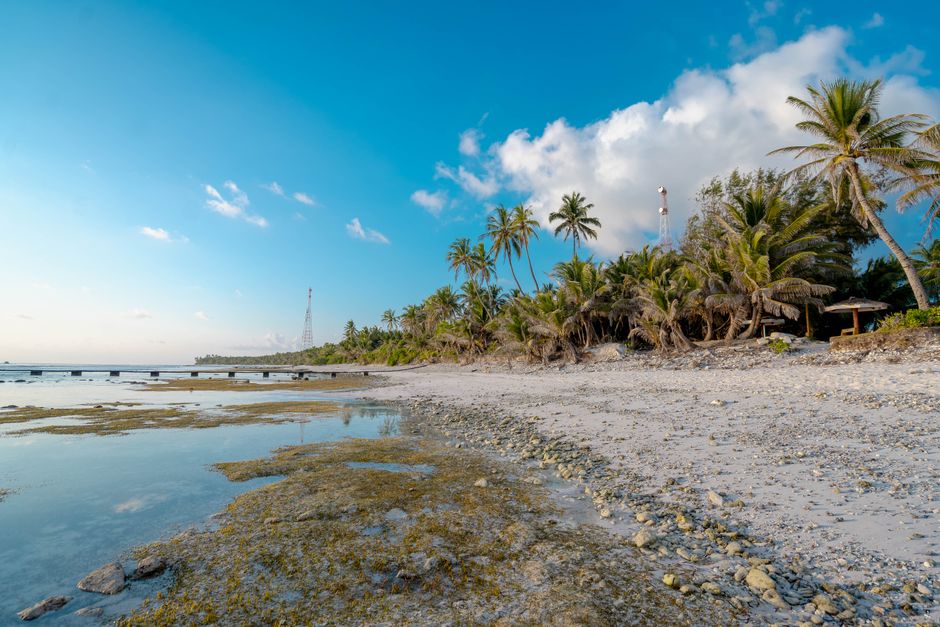
Tranquil view of a tropical beach with palm trees and clear skies on Fuvahm…, Tarawa Atoll, Kiribati
Art, Music & Nightlife
The creative soul of Tarawa beats strongest in its music and dance, which are not mere performances but the very marrow of I-Kiribati identity. The national dance, the *te kaimatoa*, is a breathtaking spectacle of controlled strength and grace. You won’t find a nightclub scene here; instead, the “nightlife” is a cultural performance held with intense passion and frequency. The men pound their chests in powerful percussive bursts, while the women move with astonishingly fluid hand and hip gestures, striking a balance between seductive and warrior-like. The dance is accompanied by group singing and the rhythm of the *teenei*, a wooden box beaten with sticks—a sound you’ll recognize as the heartbeat of the atoll. If you’re lucky to be on Tarawa during the National Dance Festival, typically held in early December, you’ll witness an explosion of colors and sound as troupes from across the archipelago compete, each performing their own local variations.
Beyond the traditional, contemporary art thrives in unexpected places.
The Kiribati National Museum is a good start, but you’ll find more expressive work in small, ad-hoc workshops and hotel lobbies where local artists sell wood carvings and stunning canvases depicting lagoon scenes in vibrant blues and greens. The government-run handicraft centre in Bairiki is the best place to see the intricate craftsmanship of *te kaitara* (coconut shell ornaments) and, most famously, the detailed, handwoven mats and man-catching *te kautu* skirts. There is a nascent but passionate film scene, too, with the annual Kiribati Film Festival held in April in Bairiki, spotlighting short documentaries about local life. For an evening out, your only real options are the bars attached to the few hotels, like the open-air bar at the Edgewater Hotel on the lagoon, but even there, the music tends to be gentle Kiribati folk songs, the stars overhead brighter than any neon sign.

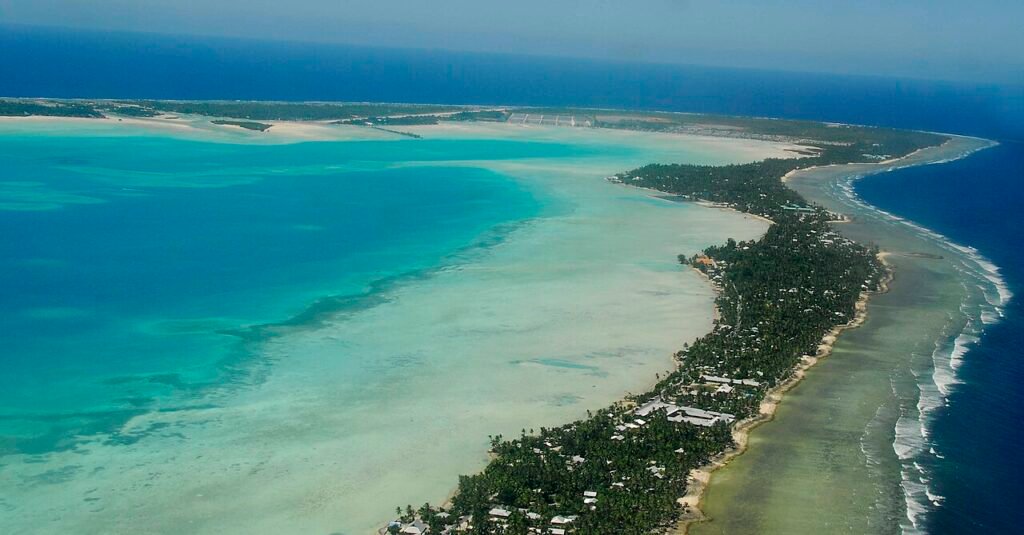
Captivating aerial view of a lush tropical island surrounded by turquoise w…, Tarawa Atoll, Kiribati
Practical Guide
- Getting There: Your main entry point is Brisbane and Nadi to Bonriki International Airport (TRW) on South Tarawa. The national carrier, Air Kiribati, operates flights from Fiji and Brisbane, but schedules can be fluid. For searching multi-route options, always check with Skyscanner.
- Getting Around: The most authentic and cost-effective way is by the privately owned “buses”—flatbed trucks with canopies that travel the main South Tarawa road. Fares are a flat $0.50 AUD (approximately $0.35 USD) for a ride. Taxis are scarce; rent a 4×4 or scooter from guesthouses or the airport for around $40–$60 AUD/day.
- Where to Stay: Your best choices are the Edgewater Hotel in Bikenibeu (nice lagoon views), the Mary’s Motel in Betio for a more local feel, or the budget-friendly Tarawa Hotel in Bairiki. Always book ahead as capacity is limited—check Booking.com for availability.
- Best Time: The dry season runs from November to April, with the driest and most pleasant months being January to March. The weather is less oppressive and there are fewer mosquitoes.
- Budget: A realistic daily budget for a traveler is around $80–$130 AUD (~$55–$90 USD). This covers a mid-range hotel, all meals from local restaurants and markets, and transport. You’ll find a lack of premium options, making this an ideal place to simplify your spending.
What Surprises First-Time Visitors
The first surprise is the sheer flatness and horizontality of the landscape. Travelers often arrive expecting a lush, tropical paradise like Tahiti, but Tarawa is a low-lying coral atoll, a skinny ribbon of land barely a few feet above sea level. There are no hills, no dramatic sunsets over mountains—just an endless sky over a thin, trembling line of land, with the ocean on one side and a mirror-calm lagoon on the other. The silence is another unexpected gift. In the absence of noisy urban traffic, the dominant sounds are the wind rustling in the palms, the distant crash of surf on the reef, and the joyful shouts of children playing in the shallows.
Another shock for many visitors is the pervasive and robust sense of Christian faith. The mission churches of the 19th century succeeded profoundly

