
Beyond the Oubangui: Finding Life, the Central African Republic’s Quiet Frontier (2026)
On a November morning in 1889, a French explorer named Émile Gentil paddled his steamboat up the slow brown current of the Oubangui River and noted in his journal a cluster of fishing villages guarded by mango trees and tall elephant grass. The local Banda fishermen called the place “Bimbo,” a name some say refers to the curved bend in the river where women gathered to wash and trade. For decades, this river frontier remained a sleepy edge of the colonial outpost that would become Bangui. Today, as you stand on the sandy bank watching pirogues glide across the water to the Democratic Republic of Congo, you will feel the same unhurried rhythm that caught Gentil’s attention—yet Bimbo has quietly become the buzzing second city of the Central African Republic, a place where resilience, faith, and river commerce converge.
The Story Behind Bimbo, Central African Republic
Bimbo’s story is inseparable from the river that shaped it. As a territory within the French colony of Ubangi-Shari—named after the very waterways you will see today—the area remained a loose collection of agricultural villages until the early twentieth century. The colonial administration, struggling to pacify the interior, established trading posts along the Oubangui, and Bimbo’s position just downstream from the new capital city gave it a practical advantage. By the 1920s, French cotton and coffee plantations appeared in the surrounding hills, and the village began to attract migrant workers from the interior who built homes along the dirt tracks that ran parallel to the river.
The turning point came with independence in 1960. While David Dacko and later Jean-Bédel Bokassa filled the headlines in Bangui, Bimbo grew quietly on the capital’s margins. During Bokassa’s flamboyant reign (1966–1979), many of his officials built weekend villas and retreats in Bimbo, drawn by the river breezes and the relative peace away from the courtly intrigues of the capital. Colonial-era researchers also left a lasting mark: the Botanical Garden of Bimbo, established in the 1950s to test exotic tree species, still survives today, a lush green laboratory of towering teak and mahogany that many visitors wander through in total serenity. When the country’s recurring political crises pushed refugees toward Bangui, Bimbo absorbed them, doubling its population between 2000 and 2015. What you find now, then, is a city built on layers—a pre-colonial fishing culture, colonial experimentation, post-independence ambition, and grassroots survival—stacked together like the colorful tin roofs you will see from the main avenue.
Today, Bimbo is officially the second-largest city in the Central African Republic, but it wears its status softly. The national government administers it as part of the Ombella-M’Poko prefecture, and in 2020 the mayor’s office inaugurated a new market complex designed to accommodate the hundreds of sellers who once spilled onto the streets. Yet the soul of the city remains the river. As you watch the fishermen haul in their nets at dawn, or strike up a conversation with a grandmother frying beignets by the roadside, you will discover that Bimbo’s true history is written not in official documents but in the daily persistence of its people.
Neighborhood by Neighborhood

Berge bimbo pk9 en RCA, Bimbo, Central African Republic
Boulevard de la Révolution: The Corridor of Commerce
The arterial road that connects Bimbo to Bangui—formally Avenue des Martyrs but still called by many its colonial-era nickname, Boulevard de la Révolution—is your first introduction to the city. Here, the streets hum with the insistent beeping of clando motorbike taxis threading between hand-pushed wooden carts piled high with pineapple and plantain. In the early morning, the air carries the sweet, earthy smell of drying cassava and the throaty call of street vendors announcing fresh manioc bread. Locals recommend that you stop at the Marché Combattant, a sprawling open-air market where you can buy everything from Secondhand Parisian dresses to hand-woven raffia baskets for 1,500 to 3,000 FCFA. The architecture along the boulevard is a pragmatic mix—concrete storefronts painted with faded Coca-Cola and MTN advertisements, shaded by broad mango trees. You will find internet cafés, small pharmacies, and, tucked between hardware shops, a growing number of mobile money kiosks that signal the city’s quiet modernization.
Le Quartier de la Rivière: Where the Oubangui Sets the Pace
Turn off the boulevard toward the water, and you enter the oldest part of Bimbo. The Quartier de la Rivière is a maze of sandy lanes fringed by bamboo fences and flowering hibiscus, where life unfolds on porches and under the shade of avocado trees. This is the city’s beating heart, where fishing families have lived for generations. Women in brightly patterned pagnes balance enamel basins of smoked fish on their heads as they walk toward the road; children chase a football made of plastic bags in the late afternoon glow. The riverbank itself, a broad stretch of pale sand, serves as both market and meeting point. At sunrise, you can hire a dugout pirogue for 1,000 to 2,000 FCFA for a forty-minute paddle along the reedy shore, watching waterbirds and the forested DRC coastline across the river. Locals recommend returning in the evening, when the sky turns molten gold and the riverside becomes a rustic social club—men play quiet games of checkers, women grill fish over open fires, and the smell of smoke and wood melds with the cool river air. Take your time here; this is the Bimbo that endures.
Le Quartier Bas: The Garden Suburb on the Heights
Inland, on the gentle slopes that rise from the river plain, lies Le Quartier Bas, a name that ironically belies its elevated location. This is the Bimbo that emerges at dusk: gated villas painted in warm ochre and pale blue, framed by jacaranda and flame trees. Many of these homes were built by civil servants and merchants in the 1970s and 80s, and the neighborhood retains a melancholic, faded elegance. The roads here are quieter, punctuated by the clanging of gate bells and the chattering of birds in overgrown gardens. Your best bet is to walk the stretch near the Botanical Garden, a 25-hectare green sanctuary where towering Indian teak trees planted decades ago form cathedral-like aisles. You can pick up a pass for 1,000 FCFA from the on-site caretaker, who will happily share the garden’s history. The neighborhood also hosts a handful of small artisanal workshops where skilled carvers turn ebony and iroko wood into masks and figurines—visitors often find these pieces at a fraction of the price in Bangui. Worth seeking out is the workshop of Paul Moké, a renowned carver whose studio, tucked behind the Catholic mission, is as much a gallery as a workspace. He may not be there every day, but if you find him, you will have encountered one of Bimbo’s most gifted living artists.
The Local Table: What Bimbo’s Denizens Actually Eat
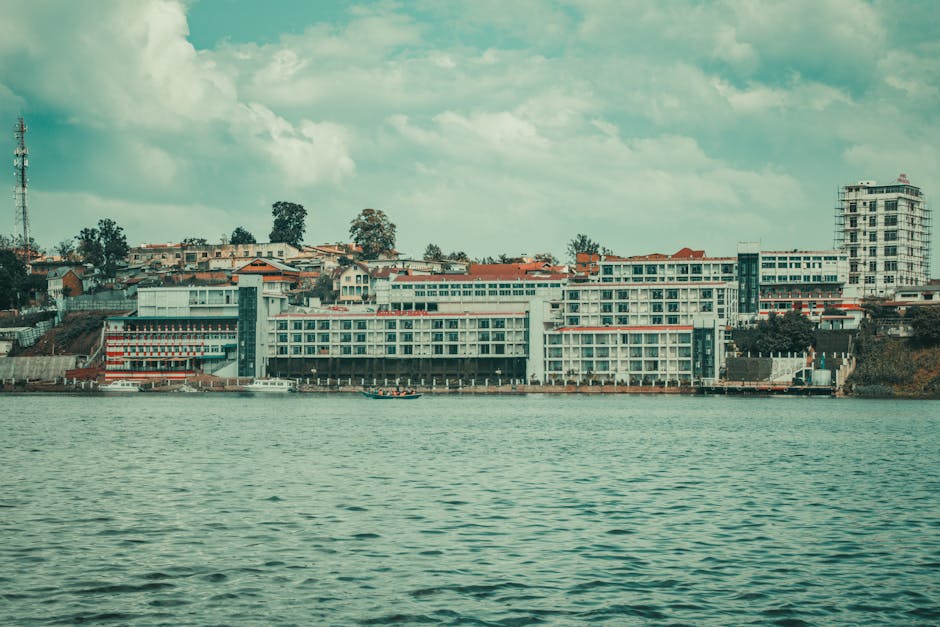
Tranquil view of the Bukavu waterfront with modern architecture and lake in…, Bimbo, Central African Republic
Life in Bimbo revolves around the communal meal, cooked over charcoal on courtyards or in the tiny kitchens of maquis—the local street-side restaurants—where prices are counted in hundreds of FCFA. The staple is gozo, a smooth, sticky paste made from cassava flour, which you will eat with your hands, rolling the soft dough into balls that you dip into aromatic sauces. You will soon discover that the cuisine here changes with the river’s moods. When the fishing is good, you will be offered maboké, river fish cooked in aromatic leaves with tomatoes, onions, and a whisper of smoked chili. During the agricultural season, you will find saka-saka, a rich stew of pounded cassava leaves cooked slowly with palm oil, garlic, and often goat meat or smoked fish.
One dish you must seek out is kanda, the beloved peanut balls that are Bimbo’s signature snack. Made from ground peanuts, salt, and a hint of dried fish, these crunchy spheres are sold everywhere—at bus stops, outside schools, and on riverbank blankets. Locals recommend buying them fresh from Maman Cécile’s stall at the Marché Combattant, where she has prepared the same recipe for twenty-five years. Her kanda cost 750 FCFA a bag and are best savored with a bottle of local ginger juice or a cold Castel beer. For a sit-down meal, follow the sound of music to Chez Mamadou au Bord de l’Eau, a riverside maquis reachable by a short clando ride. Here, for about 3,500 FCFA, you will get a heaping plate of grilled capitaine fish, gozo, saka-saka, and a beer delivered to your table under a thatched shelter, with the Oubangui glinting just meters away. Go early on Sunday, when families pack the place after Mass and the atmosphere reaches its warmest.
Art, Music & Nightlife

Stunning aerial shot of Basílica Catedral Nuestra Señora de la Altagracia i…, Bimbo, Central African Republic
Bimbo does not have the galleries or cultural centers of a major city, but its creative pulse is unmistakable. On any given weekend, you will hear the hypnotic beat of the balafon—the wooden marimba—accompanied by drums and the high-pitched singing of women’s choirs. The ngbandi and Gbaya musical traditions remain deeply alive, particularly at weddings and mourning ceremonies, which travelers may occasionally find themselves invited to attend. For more structured entertainment, the parish halls and church compounds of Le Quartier Bas often host evening concerts and theatrical performances, especially during the Christmas season when every church in Bimbo sponsors a nativity play performed to packed crowds. The Catholic mission at the edge of the botanical garden is the cultural anchor: its courtyard, shaded by mango trees, is used for rehearsals of the parish choir, whose four-part harmonies, blending Congolese rumba and local hymns, will stop you in your tracks. The best time to experience this scene is February, during the parish’s annual festival, when artisans, musicians, and home cooks converge for a week of unbridled celebration.
Nightlife in Bimbo is quiet and communal rather than club-driven. Most bars are simple wooden counters lit by solar lamps, where patrons gather for a drink and conversation. The most atmospheric is Bar Chez Ismaël, near the boulevard, where the sonorous Congolese rumba and local ngbandi pop plays late into the evening. You will also find lively evening gatherings along the riverbank, where the beer is cold at 800 FCFA a bottle and the soundtrack is as likely to be the laughter of friends as any recorded music. For a more polished experience, head to the terrace of the Hotel Bellevue on the heights, where a Friday happy hour (17:00–19:00) draws Bangui’s expatriate community and well-heeled locals. If you’re in town during the national festival of Boganda on June 29, Bimbo hosts its own informal celebrations—drumming circles, parades, and family feasts—that offer an unfiltered, deeply local take on national pride.
Practical Guide
- Getting There: You will fly into Bangui M’Poko International Airport (BGF), served primarily by Air France via Paris, Kenya Airways via Nairobi, and the regional carrier ASKY. From the airport, your best bet is a pre-arranged hotel pickup or a clando motor-taxi ride into Bimbo, about 25 to 40 minutes of travel depending on traffic. Book your flights at Skyscanner.
- Getting Around: The clando motorcycle taxi is the lifeblood of Bimbo. Short rides within the city cost between 500 and 1,000 FCFA; a journey from the Marché Combattant to the river quarter will run you about 700 FCFA. Agree on the fare before you ride. Shared taxi-buses (petit bus) connect Bimbo

