
The City of Sinbad: Where Oman’s Ancient Soul Meets the Sea in Suhar (2026)
The Story Behind Suhar, Oman
Long before oil transformed the Gulf, Suhar was the beating heart of Omani commerce. Archaeologists trace its prominence to the 3rd century BCE as a copper-smelting hub—you can still see slag heaps near the coast if you know where to look. By the 7th century, Suhar had become the eastern terminus of the frankincense route, linking the Arabian Peninsula to India and East Africa. Travelers often discover that the city’s wealth wasn’t built on black gold but on white resin and copper, a fact that locals mention with quiet pride.
The most transformative event came in 1507 when Afonso de Albuquerque’s Portuguese fleet bombarded the coast and erected the imposing Suhar Fort on earlier foundations. For nearly 150 years, the Portuguese controlled trade until Imam Sultan bin Saif expelled them in 1648—a victory still celebrated in local folklore. You’ll notice the fort’s architecture blends Portuguese military pragmatism with Omani decorative flourishes; each cannon slit and arched doorway tells a story of conquest and adaptation. In the 1970s, Sultan Qaboos’s modernization programs reshaped Suhar again, replacing many mud-brick structures with concrete, but the old souq and the fort remain as anchors to an earlier era.
What surprises many visitors is how intimately Suhar connects to the legend of Sinbad. While historians debate whether Sinbad was inspired by Omani merchants or Persian sailors, the city has embraced the myth wholeheartedly. You’ll find Sinbad statues along the corniche and children’s playgrounds named after his voyages. Locals recommend visiting the “Sinbad’s Ship” replica at the Corniche Park—a concrete dhow that serves as a photo spot but also a reminder that Suhar’s identity has always been tied to the sea.
Neighborhood by Neighborhood
The Old Quarter: Suhar Souq & Fort Area
Your journey should begin in the Old Quarter, an area that feels like a living museum compressed into a few square blocks. The souq—officially called Souq Al Mahad—operates daily from about 8:00 AM until noon, then reopens after the afternoon heat fades from 4:00 PM to sunset. Wandering its covered alleyways, you’ll smell frankincense smoke curling from brass burners, see stacks of Omani halwa glistening in saffron-tinted slabs, and hear merchants haggling over Indian textiles and Pakistani household goods. Don’t miss the spice stalls: vendors will offer you a taste of dried lime (loomi) or cardamom, and a small bag of mixed spices costs just 1 OMR (about $2.60). At the center of the souq, the Suhar Fort dominates the skyline; entry is 500 baisa per person (less than $1.50). Plan to spend an hour climbing the ramparts for sweeping views of the date-palm plantations inland and the Gulf of Oman to the east.
Al Falaj & The Corniche
Running parallel to the coast, Al Falaj is the city’s modern spine—a wide boulevard lined with government buildings, banks, and cafes. This is where you’ll find the new Suhar Port (Suhar Industrial Port), a deepwater facility that has transformed the city into a logistics hub since its opening in 2004. But the true heart of this area is the Corniche, a three-kilometer promenade that stretches from the fort northward. On Friday evenings, local families gather here to picnic on woven mats, children race along the paved path, and fishermen cast lines off the breakwater. Your best bet is to visit at sunset when the sun melts into the sea and the call to prayer echoes from the Sultan Qaboos Mosque (completed in 2016). Grab a karak chai from a corner stall—50 baisa—and watch the dhows bob in the harbor.
Al Khor & The Fishing Port
Head east from the corniche, and you’ll enter Al Khor, a working-class neighborhood centered on the fishing port. This is where travelers who want to understand Suhar’s marrow should spend time. The fish market operates from dawn until about 10:00 AM; arrive around 6:30 AM to see captains unloading tuna, kingfish, and sardines onto wet concrete counters. Locals recommend buying fresh fish and taking it to a nearby restaurant for grilling—try the small place called Al Batinah Fish Grill on Al Khor Street, which charges 2 OMR per kilo for preparation. The neighborhood also hosts Suhar’s only dedicated heritage museum, Bait Al Bagh (the House of the Garden), a restored 19th-century merchant home that costs free entry (donations welcome). It’s hidden on a side street—ask any fish seller for directions.
The Local Table: What Denizens Actually Eat
You’ll quickly learn that Suharni cuisine is not a replica of Muscat’s or Dubai’s. The defining dish here is machbous—spiced rice layered with marinated fish or chicken, simmered in a pot until the grains absorb all the flavor. Unlike the Yemeni version (mandi) that dominates in the interior, Suhar’s machbous relies on local seafood and a distinctive blend of baharat (a mix of cinnamon, cardamom, cloves, and dried lime). Seasoned travelers seek out the unassuming Al Fanar Restaurant on Sultan Qaboos Street, open from 11:00 AM to midnight daily. Their machbous samak (fish machbous) costs 3.5 OMR and comes with a side of spicy tomato salsa called daqqus. Locals eat with their right hand, scooping the rice into small balls—don’t be shy to adopt the method.

Tareef, sohar, on a rainy day, Suhar, Oman
For breakfast, you must try halwa omani—a gelatinous confection made from dates, saffron, and pistachios. The best version comes from Al Mahad Sweets in the souq, where they produce it on-site each morning. Expect to pay 1 OMR for a generous slab wrapped in wax paper. Another breakfast ritual is khaboos, a flatbread baked in a traditional oven (tannour), served warm with goat cheese and honey. You’ll find khaboos at street stalls near the fish market from 6:00 AM, costing about 200 baisa per piece. The secret is to eat it immediately while the bread is still elastic and the cheese melts.
Evening meals at home often center around shuwa—slow-roasted lamb or goat cooked in an underground sand oven for up to 48 hours. This is a celebratory dish, not a daily staple, but if you’re invited to a local’s home for Eid or a wedding, shuwa will be the centerpiece. For visitors who want to taste it without an invitation, Bin Ateeq Restaurant (behind Lulu Hypermarket, in the Falaj area) serves shuwa platters every Saturday for 6 OMR. Call ahead at +968 9927 1234 to reserve.
Art, Music & Nightlife
Suhar lacks the glitzy nightclubs of Muscat or Dubai—and that’s precisely its charm. Creative life here is more subdued, rooted in tradition. Al-Hadaf Folk Arts Society (located in a small building near the fort) offers free workshops on Omani folk music, including the rahmani drum and ney (reed flute). Sessions run Thursday evenings from 7:00 PM to 9:00 PM; drop-ins are welcome. During the annual Suhar Festival (held each February), the entire corniche transforms into an open-air stage with camel races, traditional dagger (khanjar) displays, and performances by the Royal Oman Symphony Orchestra. In 2023, the festival attracted over 100,000 visitors—you’ll want to book accommodation months in advance if you plan to attend.
For contemporary art, the Bait Al Baranda cultural center, though primarily a museum, hosts rotating exhibitions of Omani photography and painting. Entry is free. A few blocks away, Majan Gallery (opened 2019) specializes in works by young Omani artists; prices range from 50 OMR for prints to 1,000+ OMR for originals. Nightlife, such as it is, revolves around the Radisson Blu Resort on the corniche, which has a quiet pool bar open until midnight. For something more local, join the karak tea circles that gather after evening prayers at the souq’s covered benches—you’ll hear poetry recited in Arabic and sometimes Balochi, Suhar’s second language.
Practical Guide
- Getting There: Suhar Airport (direct flights from Salalah, Dubai, and Kuwait). Alternatively, fly into Muscat International Airport (MCT) and take a 2-hour taxi (35 OMR) or shared bus (5 OMR) from Ruwi bus station. Book flights at Skyscanner.
- Getting Around: Orange-and-white taxis fill the main roads; short trips within the city cost 500 baisa–1 OMR. For the fort-to-corniche walk (1.5 km), it’s easy on foot. Renting a car from Avis at the airport costs about 20 OMR/day including insurance.
- Where to Stay: Budget: Garden Inn Suhar (25 OMR/night, near the souq). Mid-range: Radisson Blu Resort (65 OMR/night, corniche). Check availability on Booking.com.
- Best Time: October through March, when daytime temperatures hover around 25°C (77°F). April–September is scorching (45°C/113°F), but hotel rates drop by 40%.
- Budget: A frugal traveler (homestay, street food, walking) can manage on 40 OMR/day. Mid-range (3-star hotel, taxi, restaurant meals) runs 80–100 OMR/day. Luxury (Radisson, fine dining, car rental) starts at 150 OMR/day.

Traditional Omani fortress architecture with mountain backdrop, Suhar, Oman
What Surprises First-Time Visitors
Most tourists overlook Suhar’s most enchanting feature: the date-palm falaj irrigation system that threads through the Old Quarter. These ancient channels, some dating back 1,500 years, still water the groves you see from the fort’s ramparts. Locals often invite curious travelers to walk along the narrow paths between farms, where you’ll spot chickens, goats, and the occasional camel. It’s a stark contrast to the industrial port just two kilometers away—a reminder that Oman’s agricultural soul remains intact.
Another surprise is the language diversity. While Arabic is official, many Suharnis speak Balochi, Swahili, or Urdu, reflecting centuries of trade with Africa and South Asia. You’ll hear greetings in all three languages in the fish market. Travelers often discover that a simple Shukran (thank you) in Arabic elicits a warm smile, but saying Misa (hello in Balochi) can start a longer conversation with elderly vendors.
Perhaps the biggest shock is Suhar’s absolute safety. Crime is virtually nonexistent; you can walk alone at midnight along the corniche without concern. Police presence is minimal, and locals are quick to help lost tourists. The most dangerous thing you’ll face is sunstroke or the temptation to buy an overpriced carpet. Seasoned travelers recommend carrying a small gift—like a postcard from your home country—when invited for coffee. It’s not required, but it’s appreciated.
Your Suhar, Oman Questions
Is Suhar safe for solo female travelers? Absolutely—Oman as a whole ranks among the safest countries in the world, and Suhar is no exception. Women traveling alone should dress modestly (shoulders and knees covered) and avoid walking alone in empty areas after midnight, but that’s common sense anywhere. Local women wear abayas, but tourists in modest Western clothing are accepted. You’ll find that shopkeepers and restaurant staff are respectful and helpful.
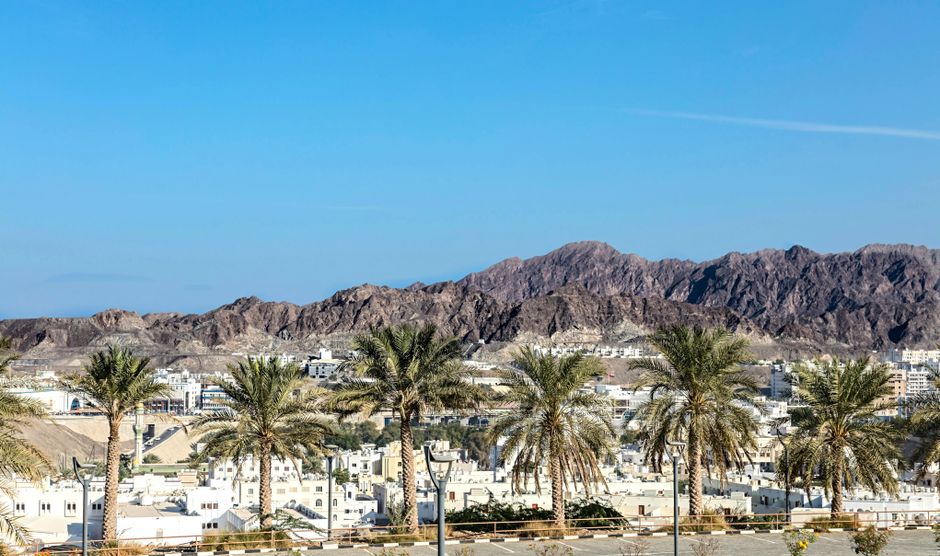
Desert mountains and palm trees under a vibrant blue sky., Suhar, Oman
How do I get from Suhar to the Musandam Peninsula or Dubai? Daily buses operated by Oman National Transport run from Suhar’s central bus station (near Lulu Hypermarket) to Khasab in Musandam (4 hours, 8 OMR) and to Dubai’s Al Ghubaiba station (3 hours, 10 OMR). Timetables change seasonally, so check at the station a day in advance. A taxi to Dubai costs about 50 OMR and takes 2.5 hours, including border formalities.
What should I buy as a souvenir in Suhar? Skip the generic keychains. Your best bet is a small jar of Omani halwa from Al Mahad Sweets (2 OMR), a packet of dried limes for cooking (1 OMR), or a handwoven kumma (traditional embroidered cap) from the souq’s textile sellers (3–5 OMR). For something special, visit the Khanjar Workshop on Al Ghubra Street (near the fort entrance), where craftsman Ahmed Al Balushi hammers silver daggers; custom orders start at 50 OMR and take three days. Bargaining is expected, but keep it friendly—start at half the quoted price and meet in the middle.

