
Sambor Prei Kuk’s Temples, Cambodia for Adventurers: 7 Jungle Trails That Rival Angkor’s Backcountry (2026)
Your heart pounds as you pedal through a root-ribbed trail, the chain grinding against mud-smudged gears. A gust of humid wind carries the tang of wild ginger and damp sandstone. You brake hard – just in time to avoid a broken lintel half-buried in leaf litter. A troupe of macaques screams overhead, and the ancient temple of Prasat Sambor looms through the canopy. This is not the polished show of Angkor; this is raw, self-guided discovery in Cambodia’s oldest surviving temple city.
The Main Event: Off-Road Mountain Biking Through the Inner Sanctum
You’ll start at the village of Sambor, just before the main entrance gate (open 7:00 a.m. – 5:00 p.m., $10 entrance fee). Rent a sturdy mountain bike from one of the local guides in the village for about $15–20 per day – make sure the tires have decent tread and the brakes work. The route takes you on a 4–6 mile loop that snakes past the three main temple groups: Prasat Sambor, Prasat Tao, and Prasat Yeay Poan. The terrain is a mix of packed dirt, loose gravel, and occasional sand pits, so a hardtail bike is fine. Difficulty: moderate – a few short, steep sections near the river will test your legs. Best time is 6:00 a.m. to 8:30 a.m. before the heat and crowds arrive. Insider tip: skip the main path and take the narrow elephant trail that locals use to reach the remote Prasat Srei – it’s not on any map, and you’ll be rewarded with a completely overgrown, partially crumbled temple teeming with butterflies.
As you pedal deeper into the forest, you’ll pass through stands of towering dipterocarps and over streams that have carved new channels around temple bases. The silence is profound, broken only by the crunch of your tires and the occasional thud of a falling fruit. Most tourists never venture beyond the central complex, but seasoned travelers know that the real adventure lies in the outer circuit, where the jungle has swallowed entire structures. Plan for around 3–4 hours, including a stop for photos and a snack of sticky rice with grilled pork sold by a local family near Prasat Tao. Bring two liters of water, a basic repair kit, and a light rain jacket – sudden downpours are common even in the dry season.
Activity #1: Jungle Trekking to Prasat Yeay Poan via the Forgotten Gate
From the main car park, you’ll find a small, almost invisible path marked by a faded red ribbon tied to a tree – that’s the start of the Forgotten Gate trek. This is the kind of adventure that travelers who crave solitude dream about. You’ll walk for about 45 minutes through secondary jungle, crossing a stream three times (wear sandals that can get wet or bring dry socks). The trail ends at the lesser-known Prasat Yeay Poan, an octagonal sanctuary built around 620 AD. The moss-covered walls are carved with scenes of Hindu deities – look for the weathered image of Vishnu reclining on the serpent Shesha. The gate itself is a collapsed sandstone arch half-swallowed by a strangler fig. Most guides skip this route, but locals recommend coming here just after sunset, when the forest glows orange and the temple seems to breathe. Duration: 2 hours round trip. Cost: included in the $10 entry. Difficulty: easy, but you’ll need sturdy walking shoes. Insider tip: download the offline map from OpenStreetMap before you go – cell service is spotty.
Activity #2: Kayaking the Stung Sen River to Remote Islet Ruins
This is the perfect way to cool down after a morning of temple-hopping. You’ll meet your guide at the village of Chnouk, about 4 km east of the main temple site. The guided trip, offered by local cooperative Stung Sen River Adventures (book via a guesthouse or Facebook Messenger), costs $25 per person and includes a sit-on-top kayak, life jacket, and a packed lunch of fish with rice. The route takes you downstream for about 2 hours, gliding past water hyacinths and under the low-hanging branches of kapok trees. Halfway along, you’ll pull ashore on a tiny islet that holds the ruins of a small 8th-century shrine – barely visible through the bamboo. Your guide will point out the remains of a linga pedestal and a broken Nandi bull. The water is brown and shallow, so you won’t need any advanced paddling skills. Return is by tuk-tuk (included). Best time: 8:30 a.m. to 1:00 p.m. to avoid afternoon thunderstorms. What to bring: sun hat, reef-safe sunscreen, and a dry bag for your camera.

Map of the temple area of Sambor Prei Kuk, Sambor Prei Kuk’s Temples, Cambodia
Refuel: Where Adventurers Eat
After a long day of pedaling and paddling, you’ll crave robust, authentic Khmer food. Right at the temple entrance, Sambor Mama’s Kitchen is a ramshackle but beloved spot where locals gather. Try the fish amok – steamed coconut curry wrapped in banana leaf – for just $4.50, served with a mound of jasmine rice. For a heartier meal, drive 20 minutes south to Kampong Thom town and visit The Mekong Riverside Restaurant. It’s perched on the riverbank, and you can hear the cicadas while you order their grilled beef lok lak ($5.00) or the fried river prawns ($7.00). If you want the real local experience, ask your guide to stop at Phum Khmum Street Food – a cluster of carts that appear near the market at dusk. The deep-fried tarantulas (yes, you read that right) are a crunchy, salty snack that adventurous eaters swear by. One spider costs about $0.50 – go on, you’re on an adventure.
Base Camp: Where to Stay
For maximum proximity to the action, Sambor Village Resort (www.samborvillage.com) is the top choice. It’s an eco-lodge just 1 km from the temple entrance, with bungalows set among lotus ponds. They offer bike storage, early breakfast (from 5:30 a.m.), and can arrange guides. A double room runs $35–50 per night. For budget travelers, Sambor Prei Kuk Homestay (book through Booking.com) costs $12 per night and includes a mattress on the floor of a local wooden house, plus a home-cooked dinner. The family will lend you a flashlight and point you toward the best night trails. If you want air conditioning and a pool, head to Kampong Thom Royal Hotel (20 minutes away) – rooms from $25, but you’ll need your own transport to the temples.

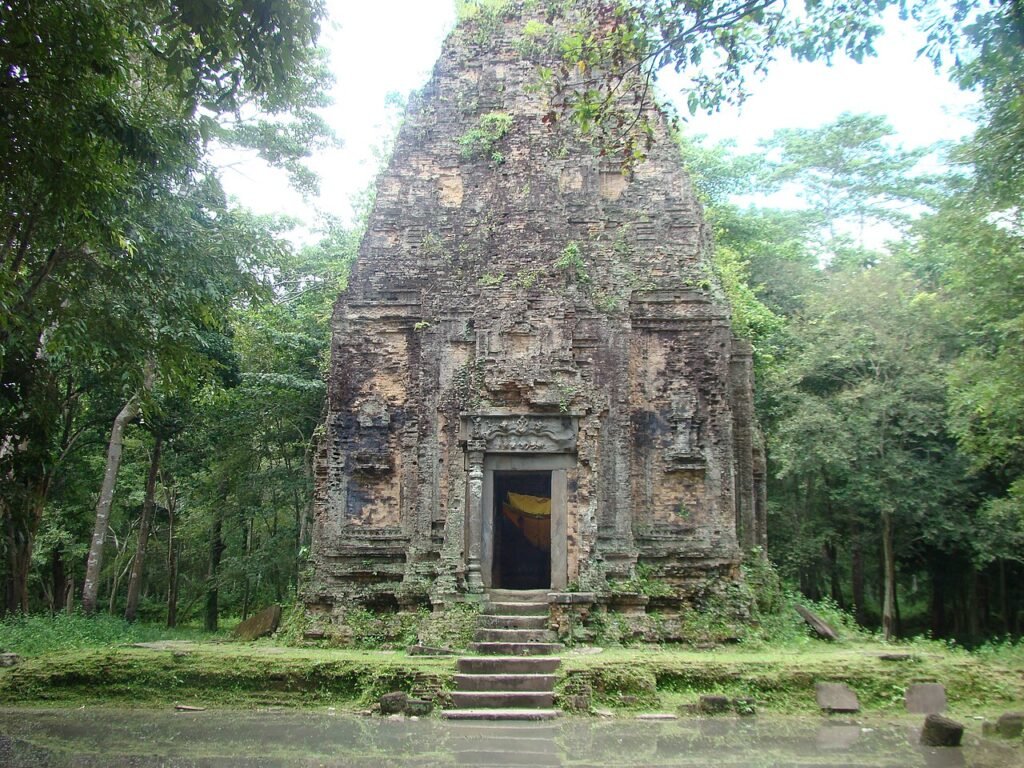
The entrance to an ancient temple in the jungle, Sambor Prei Kuk’s Temples, Cambodia
Gear & Prep Checklist
- Sturdy mountain bike (rental available) or a reliable hybrid if you bring your own – mud tires recommended
- Headlamp with extra batteries (essential for the night safari and dawn departures)
- Insect repellent with DEET (20% minimum) – mosquitoes are relentless near water
- Fitness requirement: comfortable walking or biking for 4–5 hours in humid heat; no extreme fitness needed
- Safety consideration: beware of uneven stone stairs covered in moss; always look twice before stepping – cobras are rare but present
Getting There & Around
- Flights: Fly into Siem Reap International Airport (REP) or Phnom Penh International Airport (PNH). Book at Skyscanner. From either city, it’s a 2–3 hour drive.
- Local Transport: From Kampong Thom town, take a tuk-tuk to the Sambor Prei Kuk entrance (30 minutes, $8–10). For the kayaking start point, your guide will arrange pickup. Most activities are within walking or cycling distance of the village.
- Best Season: November through February – lower humidity, little rain, and temperatures around 25–30°C. March–May is hot and dusty; June–October brings lush jungle but muddy trails and more mosquitoes.

Brown concrete ruins during daytime, Sambor Prei Kuk’s Temples, Cambodia

