
Among the Lingas of the Forest: Why Sambor Prei Kuk Is Cambodia’s Quietest Ancient Wonder (2026)
In the year 616, King Isanavarman I of the Chenla Kingdom ordered a grand procession from his capital, Isanapura, to consecrate a new temple mountain. Thousands of courtiers, priests, and laborers wound through the dense forest, carrying sandstone lingas and offerings of buffalo, honey, and rice. That day, under the canopy of towering dipterocarps, the first bricks of what would become Sambor Prei Kuk were laid—a sprawling pre-Angkorian complex that, thirteen centuries later, still hums with the quiet pulse of a forgotten empire.
The Story Behind Sambor Prei Kuk, Cambodia
You won’t find the crowds of Angkor Wat here, but what you *will* discover is something rarer: the raw, unpolished soul of Khmer civilization. Sambor Prei Kuk—meaning “the temple in the rich forest” in Khmer—served as the religious and political heart of Chenla, the powerful state that preceded the Angkorian empire. Under King Isanavarman I (r. 616–635 CE), this area became a crucible of architectural innovation. The octagonal temple towers that dot the site are among the oldest surviving stone structures in Southeast Asia, their shape borrowed from Indian prototypes but refined into something uniquely Khmer.
Travelers often assume that all of Cambodia’s ancient glory lies in Siem Reap, but the secret that seasoned visitors know is that Sambor Prei Kuk holds the key to understanding what came before. The complex is divided into three main groups—Prasat Sambor, Prasat Yeai Poan, and Prasat Tao—representing the Hindu trinity. Each group contains dozens of brick sanctuaries, many still standing despite centuries of monsoon rain, looting, and jungle encroachment. In the 7th century, this was a city of possibly 10,000 inhabitants, with canals, reservoirs, and workshops for bronze-casting and stone-carving. You’ll feel the weight of that history as you walk the raised causeways between the temples, stepping over roots that have swallowed fallen lintels.
A turning point came in the late 8th century when the kingdoms of Chenla fragmented. By the time Jayavarman II unified the region in 802 and established the Angkorian empire, Sambor Prei Kuk had already begun its slow retreat into the forest. But it never completely vanished. Local farmers continued to worship at the inner shrines, and the site was “rediscovered” by French explorers in the 1860s. Today, it’s a UNESCO World Heritage candidate, and the Cambodian government, with help from Japan, is carefully restoring several structures. Yet visitors still have the rare privilege of exploring the ruins largely alone—a far cry from the selfie-stick queues at Angkor.
Neighborhood by Neighborhood
The Central Sanctuary Group (Prasat Sambor)
You’ll enter the site from the south, and your first jaw-drop moment arrives at Prasat Sambor, the most intact of the three groups. The main sanctuary, a brick tower soaring about 18 meters high, is surrounded by a moat and a laterite wall. What strikes you immediately is the texture: the bricks are laid without mortar, yet they fit so tightly that you can barely slip a knife blade between them. Locals recommend visiting in the late afternoon when the descending sun turns the laterite to a deep ochre. Inside the central shrine—now empty of its original linga—you’ll notice the remains of carved inscriptions in Sanskrit, detailing donations of cows and land by 7th-century nobles. Take time to walk the outer galleries; the lintels over the doorways, though eroded, show scenes of Krishna lifting Mount Govardhana and Vishnu reclining on the serpent Ananta. Most tourists skip these detailed carvings, but you’ll be rewarded if you pause and trace the outlines with your eyes.
The Northern Temple Group (Prasat Yeai Poan)
About 500 meters north, past a grove of sugar palms, you’ll find Prasat Yeai Poan—named after a legendary grandmother who, according to local folklore, turned into a stone statue after her children abandoned her. The story says you can still see her face in one of the brick recesses. This group is smaller but arguably more atmospheric. The forest here is thicker; strangler figs drape over the towers, and you’ll hear the constant chattering of gibbons in the canopy. Savvy visitors bring a flashlight because the inner sanctum is dark, and the fine details of the original stucco—floral motifs, divine figures—are best seen with direct light. From the top of the central platform, you can see the distant blue ridge of the Phnom Kulen mountains, the same range that supplied stone to Angkor. Plan to spend at least 45 minutes here, circling each of the six towers.
The Southern Group (Prasat Tao)
Prasat Tao—the “temple of the lions”—is named for the two sandstone lion statues that guard the eastern entrance. They are worn, mossy, and exude an ancient dignity. Like many visitors, you might be tempted to touch their backs for luck, and locals won’t stop you. This group features the only octagonal towers at the site, a signature of Isanavarman’s reign. Each tower has four false doors on its cardinal axes, carved with intricate medallions. What makes this neighborhood special is its sense of enclosure: the towers crowd around a small courtyard, giving you the feeling of being inside a stone forest. Bring a picnic if you like; there are shaded benches near the lion guardians, and you’ll have the place almost to yourself on weekday afternoons. The ticket checkpoint (entrance fee $10 USD) is at the main gate, and you can hire a guide for $15–20 for two hours—well worth it if you want to understand the iconography.
The Local Table: What Natives Actually Eat
Just outside the temple complex, in the village of Sambo, food culture is deeply tied to the nearby Tonle Sap floodplain. You’ll notice wooden stalls selling *prahok*—the fermented fish paste that underpins Khmer cuisine—piled into clay pots. Locals don’t view it as a “stinky” delicacy; for them, it’s the taste of home, used to season everything from rice porridge to green mango salad. One dish you must seek out is *samlor korko*, a thick, vegetal soup made with green papaya, pumpkin, and—if you’re lucky—chunks of freshwater snakehead fish. The version at the family-run **Srey Pich Restaurant** (just off National Road 6, about 2 km south of the temple entrance) is the best you’ll find in the region. Mrs. Srey Pich herself will bring you a steaming bowl for $2.50, along with a basket of rice and a plate of fresh herbs. She never uses MSG, she’ll tell you, and the fish comes from her cousin’s trap in the river that morning.

Sambor Prei Kuk, Sambor Prei Kuk, Cambodia
The market in Kampong Thom town, 25 km north, is the place to experience real local shopping. You’ll see vendors selling roasted crickets and silkworms, but also mountains of *krolan*—sticky rice cooked in bamboo tubes with coconut milk and black beans. Grab one for breakfast (10,000 riel, about $2.50) and eat it on the road back to the temples. The farmers here rely on the seasonal floods of the Stung Sen River, which deposits nutrient-rich silt. You’ll taste that terroir in every bite of a morning glory stir-fry laced with garlic and chili. Meals are communal; you’ll often be invited to share a table with a family, and the proper way to accept is to gesture toward your heart and say *nyam bai haey* (I have eaten already) if you’re full, or simply smile and eat with your fingers.
Art, Music & Nightlife
At Sambor Prei Kuk, nightlife means the hooting of owls and the rustle of civets moving through the ruins. But culture is alive in the daytime, especially during the annual **Bon Om Touk** water festival (usually in November), when locals gather at the temple moats to launch bamboo rockets and hold traditional *chhayaam* dance performances. The masked dancers, wearing gilded headdresses, reenact the Ramayana epic to the sound of the *skor arak* (war drum) and the *khim* (hammered dulcimer). You can catch these rituals for free in the village’s makeshift pagoda stage. For a more intimate experience, seek out **Mr. Sophal**, a retired monk who carves wooden lingas in his workshop behind the ticket office. He learned the craft from his grandfather and will demonstrate the chiseling technique for a small tip (1,000 riel). He keeps a small collection of pre-Angkorian pottery shards he’s found in the forest—if you show genuine curiosity, he’ll let you hold a piece that’s 1,300 years old.
In Kampong Thom town, the scene is livelier. The **Bambu Hotel** hosts occasional live music nights (Saturday evenings, free entry) with local bands playing *kantrum*—a modern fusion of Cambodian folk and Thai pop. You’ll also find a small gallery, **Kampong Thom Art Space** (near the old market), run by artist Vathana Heng. She paints scenes of rural life and the temple ruins in a vibrant, naive style. Her studio is open by appointment (call +855 92 729 731), and she’ll happily let you sip local iced coffee while she works. Most travelers never bother to seek this out—you’ll be glad you did.
Practical Guide
- Getting There: Fly into Siem Reap International Airport (REP). Domestic carriers like Cambodia Angkor Air and AirAsia connect from Phnom Penh (45 minutes, $60–$100). From Siem Reap, drive 2.5 hours east on National Road 6 to Kampong Thom, then follow signs to Sambor Prei Kuk (15 km southeast). Book flights at Skyscanner.
- Getting Around: A private taxi from Siem Reap round-trip costs $50–$70, including waiting time. Alternatively, take a shared minibus from Siem Reap to Kampong Thom for $8 per person (departs hourly from the old bus station, 6 AM–2 PM). From Kampong Thom, rent a motorbike for $10/day (requires international license) or hire a tuk-tuk for $15 for a half-day tour of the temples.
- Where to Stay: In the village of Sambo itself, the **Sambor Village Homestay** (basic but clean; $12/night with breakfast) lets you sleep a stone’s throw from the ruins. For more comfort, stay in Kampong Thom at the **Bambu Hotel** (double rooms $35–$55) or **Stung Sen Royal Palace Hotel** ($20–$30). Check cheapest rates at Booking.com.
- Best Time: November to February, when the weather is dry and temperatures hover around 28°C (82°F). Avoid April and May—the heat index can hit 45°C (113°F), and the dust on the temple paths becomes oppressive. October and March are also good, with thinner crowds.
- Budget: $30–$50 per day per person: $10 temple entry, $8 for two market meals, $5 for snacks and water, and $12–$20 for basic accommodation. If you hire a guide and taxi, budget $60–$80 daily.
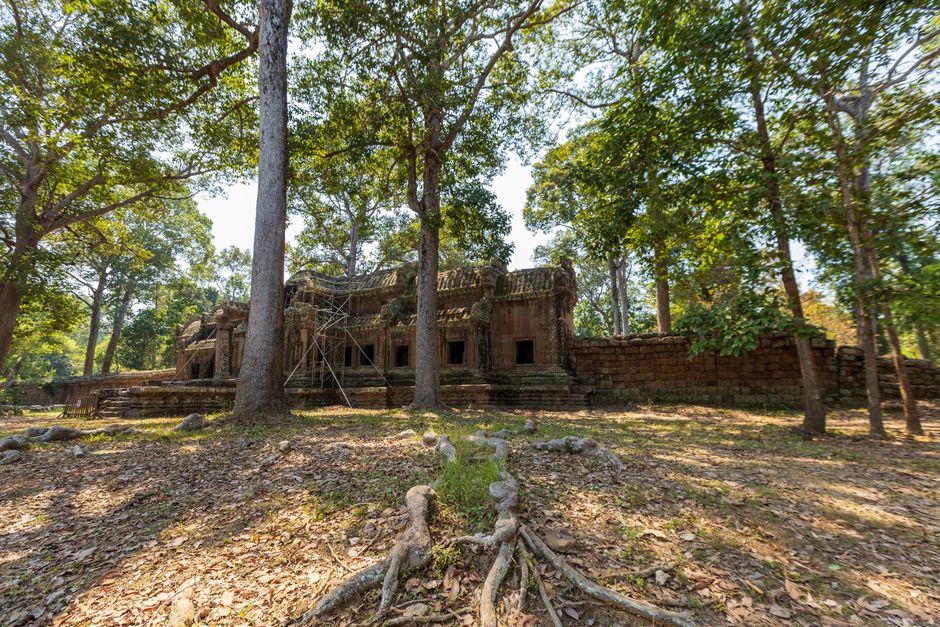
Scenic view of ancient temple ruins amidst lush trees in Cambodia forest., Sambor Prei Kuk, Cambodia
What Surprises First-Time Visitors
First-time visitors are often taken aback by the sheer quiet. At Angkor, you can never escape the hum of tour buses and selfie-stick chatter. Here, you’ll hear your own footsteps on the laterite paths, and the only interruption might be a family of long-tailed macaques rustling through the undergrowth. Many travelers arrive expecting a mini-Angkor, but they find something smaller, more intimate, and curiously more moving. The lack of restoration is part of the appeal—bricks lie where they fell, ivy smothers doorways, and you get a genuine sense of archaeological discovery. The site is huge yet feels abandoned; you can walk for 20 minutes without seeing another person.
Another surprise is the warmth of the local community. Unlike Siem Reap, touts are almost nonexistent. Children will wave and say “hello” shyly, and if you pause near a stall, the women will offer you a plastic stool and a cup of tea. Expect invitations to join a game of volleyball on the dirt court in Sambo village, especially on Sunday afternoons. And be ready for the temple’s resident “guardians”—a troop of semi-tame monkeys that know exactly where tourists stash their bananas. They are bold but not aggressive; your best bet is to keep your bag closed and avoid eye contact.
Your Sambor Prei Kuk, Cambodia Questions
Is Sambor Prei Kuk safe for solo travelers, including women? Absolutely. The site is well patrolled by security guards during opening hours (7 AM–5:30 PM). The dirt roads are safe to drive or ride on, though you’ll want to avoid them after dark because of stray cattle and the absence of streetlights. Women solo travelers I’ve spoken with report feeling completely comfortable; locals are respectful, and the village children may follow you out of curiosity, but they’ll smile and back off if you say you’re tired. Carry your own water and toilet paper—the site has a basic pit toilet at the entrance, but it’s best avoided.
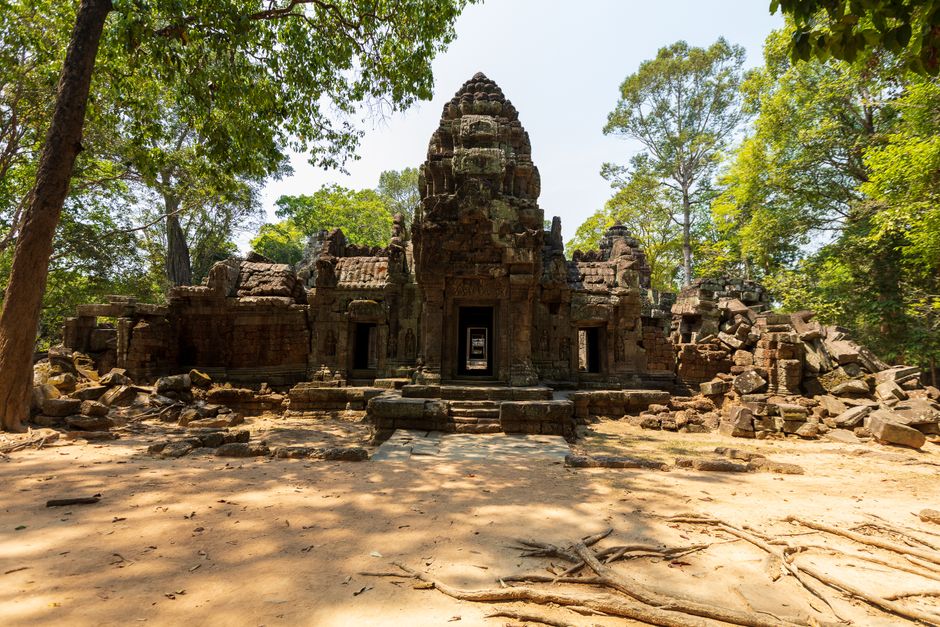
Explore the ancient stone ruins of an Angkor Wat temple amidst lush greenery, Sambor Prei Kuk, Cambodia
How much time should I budget for Sambor Prei Kuk? You can see the main highlights in three to four hours, which is what most day-trippers do. But you’ll enjoy it far more if you spend the night in Sambo village and explore across two days. On day one, walk the central and northern groups at a leisurely pace, then spend the afternoon at the southern group. On day two, hire a guide to hike the forest trails to the less-visited Prasat Chrap temple (1 km east, half-buried in the jungle) and the small reservoir known as the “royal bathing tank.” You’ll find carved crocodiles in the spillway—a remarkable detail most tourists miss. If you have only half a day, commit to just one group, preferably the central sanctuary, and absorb its details rather than rushing through all three.
Can I combine Sambor Prei Kuk with a trip to Angkor in one day? It’s possible but not recommended. The drive from Siem Reap to Sambor Prei Kuk takes at least two hours each way, and the temples themselves demand several hours. If you try to do both in a single day, you’ll be exhausted and end up rushing. Instead, plan a separate day trip from Siem Reap (or better, a two-day detour). A smarter link is to travel overland from Siem Reap to Sambor Prei Kuk, then continue 1.5 hours south to the temple ruins of Koh Ker and Beng Mealea, forming a loop. That route hits three pre-Angkorian gems in two days. Many tour operators in Siem Reap (for

