
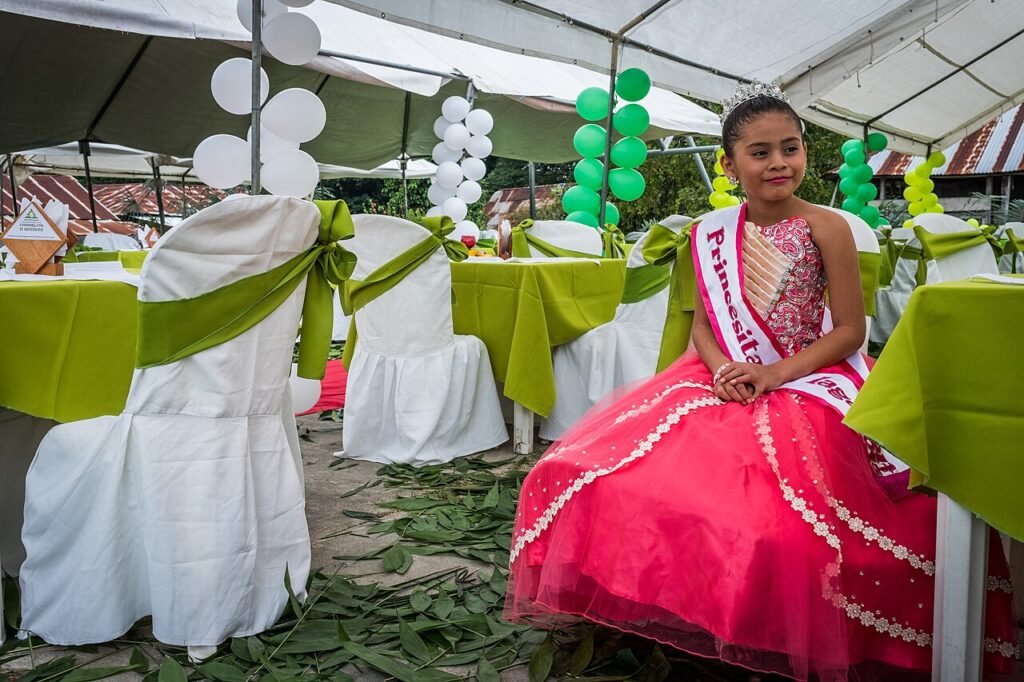
Beyond the Chicle Forests: Why Carmelita, Guatemala Beckons the Adventurous Soul (2026)
In 1931, a lone chicle tapper named Manuel López stumbled upon a collapsed Maya stela deep in the Petén jungle. He was not hunting for antiquities—he was bleeding the sapodilla trees for chewing gum. That accidental discovery, whispered back to Flores, marked the first ripple of change for the remote outpost that would become Carmelita. For decades, the settlement remained a secret among chicleros and loggers; only in the 1990s did the community decide to trade machetes for tourism guides. Today, you will find a village that guards the gateway to one of the largest archaeological marvels in the Americas, but also a place where the quiet pulse of the jungle still dictates the rhythm of life.
The Story Behind Carmelita, Guatemala
Carmelita’s roots lie in the chicle boom that swept the Petén lowlands from the 1910s through the 1950s. The sapodilla tree, Manilkara zapota, produced a latex that, when boiled and kneaded, became the base for chewing gum. Men like Manuel López spent months in the forest, collecting latex and carving rough trails. By the 1960s, synthetic alternatives killed the chicle market, and many chicleros drifted away. But a small core remained, scraping a living from timber and subsistence farming. In 1989, the Guatemalan government declared the surrounding area part of the Maya Biosphere Reserve, threatening to evict these families. Instead of leaving, they organized—forming the Cooperative Carmelita in 1994 and securing a 25-year concession to manage 53,000 hectares of forest sustainably.
This was a turning point. Travelers often discover that Carmelita’s story is one of quiet resilience. The cooperative diversified into ecotourism, partnering with conservation NGOs. In 2003, they opened the first community-run camp inside the Mirador Basin. By 2010, they were leading multi-day treks to El Mirador—the largest Maya city ever found. The people of Carmelita, many of them descendants of those original chicleros, now balance traditional knowledge with modern guiding skills. Locals recommend you listen to Don Efraín, a former chicle tapper now in his 70s, tell stories of jaguar encounters while pointing out medicinal plants along the trail. His grandfather helped map the first route to El Mirador in 1926. That legacy lives in every step you take here.
The community’s success has not been easy. Poaching, illegal logging, and encroaching cattle ranches remain threats. But today, Carmelita stands as a model for community-based conservation. The cooperative reinvests tourism income into schools, healthcare, and patrols. When you visit, you are not just a tourist—you are a partner in protecting a living rainforest.
Neighborhood by Neighborhood
The Village Center (El Centro)
Carmelita’s heart is a clearing of dusty streets lined with wooden houses on stilts, painted in faded blues and yellows. The main square is less a plaza and more a meeting point around the cooperative office, where you will find the check-in area for treks and a small museum displaying Maya artifacts found by locals. The only paved road runs 200 meters from the entrance gate to the cooperativa. At half past six each morning, the aroma of charcoal-grilled tortillas and black beans drifts from Doña Mirna’s Comedor, a palm-roofed cantina where guides gather to eat breakfast before setting out. Savvy visitors know to order the revuelto chiclero—scrambled eggs with chaya leaves and tomato, served with hand-pressed tortillas. The village has no traffic lights, no ATMs, and barely a dozen streetlights. At night, the stars are so dense you feel you could scoop them from the sky. The only sounds are the hum of a generator (which runs from 6 to 10 p.m.) and the distant howl of monkeys.
The Trailhead Corridor (Camino a la Laguna)
Half a kilometer south of the village center, the rutted track known as the Camino a la Laguna splits off toward the wetlands. This is where the serious adventure begins. Along this corridor, you will find the community’s eco-cabins—simple two-room structures with solar lights and mosquito nets. Most tourists overlook this area, preferring to sleep in the village, but seasoned travelers know that staying here places you closer to the dawn bird chorus. A short walk from the last cabin leads to the Laguna de Carmelita, a shallow oxbow lake that reflects the celba trees like dark glass. Locals recommend arriving at 6:00 a.m. with a guide; you’ll see endangered Morelet’s crocodiles sunning on logs and, if you are lucky, the flash of a kingfisher diving. The Camino a la Laguna also hosts the community’s small botanical garden, where you can identify the trees whose sap became Wrigley’s gum: the chicozapote, the ramón (breadnut), and the allspice tree.
The El Mirador Trail Base Camp (Campamento Horizonte)
This is not a neighborhood in the traditional sense, but an overnight camp 2.5 kilometers from the village, at the edge of the reserve. The cooperative built Campamento Horizonte in 2016 as the official launch point for the five-day hike to El Mirador. It consists of a thatched common shelter, hammock-strung dormitories, and a composting toilet. You will share dinner here with fellow trekkers and your guides—typically a mix of young Maya Q’eqchi’ men and experienced chiclero descendants. The meal is always the same: hearty chicken stew with chayote, rice, and corn tortillas. By 8 p.m., the generator shuts off, and only the firelight remains. The base camp sits under a canopy of mahogany and cedar; at dawn, the mist rises like breath from the forest floor. This is where you realize that Carmelita is not a destination in itself, but a threshold—a place that prepares your mind and body for the raw, silent power of the jungle.
The Local Table: What Carmeliteños Actually Eat
You will not find a single restaurant in Carmelita—only comedores that serve one meal per day, typically lunch, to the community and guides. The cuisine here is survival food, refined by generations of forest dwellers. Corn, beans, and squash form the backbone, but the jungle adds wild greens like chaya and hierba mora. Travelers often discover that the most prized ingredient is the pepitoria—a paste of toasted pumpkin seeds used to thicken stews and sauces. Locals recommend you try the caldo de chiclero at Comedor La Selva, run by Doña Olga. This broth simmers for hours with smoked pork ribs, chinchayote (a wild root vegetable), and epazote. It was the standard meal for men who spent weeks in the forest; it is said to ward off fatigue and snakebite.
The only place to buy provisions is the cooperative store, which stocks rice, oil, canned tuna, and, surprisingly, bags of fresh tamarind pulp. There is no bakery, no ice cream, no coffee shop. What the village lacks in variety, it makes up for in ritual. Lunch is served at noon sharp. Everyone washes hands at the pila (concrete sink) outside the comedor, then sits at long plastic tables. Conversation is always in Spanish, sometimes punctuated by Q’eqchi’ phrases. You will be expected to eat every grain of rice—wasting food is considered a deep disrespect to the forest that provided it. For dessert? A slice of fresh papaya from someone’s backyard tree, dusted with lime and salt.

December 2017, Carmelita, Guatemala
Art, Music & Nightlife
Nightlife in Carmelita means sitting in the dark with a flashlight and a bottle of locally made cuxa—a potent sugarcane spirit infused with allspice leaves. There is no bar, no disco, no Wi-Fi. Instead, the community gathers on Friday evenings in the open-sided community hall for a baile de marimba. The marimba is Guatemala’s national instrument, and in Carmelita it is played by a trio of men: Don Pedro on keyboard, his son on the marimba, and his nephew on the turtle-shell drums. The music starts around 8 p.m. and lasts until midnight. Children dance alongside their grandparents, the steps simple and joyful. Travelers are always invited. Do not hesitate—you will learn the basic son step within minutes. The real art of Carmelita, however, is not music but oral storytelling. The guides are master narrators, weaving tales of the Lost City (El Mirador) and the jaguar that once entered the village school. Ask about the legend of La Llorona—here, she is not a ghost but a warning spirit who guards the chicle trees.
For visual art, the cooperative maintains a small gallery in the museum with hand-painted bark paper (amate) depicting forest scenes and Maya hieroglyphs. You can buy these directly from the artists, usually women from the village. The best time to see the full creative spirit of Carmelita is during the Fiesta de la Virgen del Carmen, held July 16. The village erupts in processions, marimba contests, and a bull-riding event (the bull is a wooden frame carried by men). Locals recommend you arrive a day early to help decorate the chapel with palm fronds and bougainvillea.
Practical Guide
- Getting There: Fly into La Aurora International Airport (GUA) in Guatemala City, then take a domestic flight to Flores’ Mundo Maya Airport (FRS) on TAG Airlines or Avianca (approx. $120–$180 one-way, 1 hour). From Flores, drive 2.5 hours north on CA-13 toward Carmelita; the last 30 km are unpaved gravel. Hire a 4×4 pickup from Cooperativa Carmelita in Santa Elena for about $90 total. Book flights at Skyscanner.
- Getting Around: There are no taxis or buses inside Carmelita. Everything is within walking distance (the village is only 400 meters wide). For treks to El Mirador, the cooperative arranges guided hikes (5 days/4 nights, $380 per person, includes mules, food, tents, and guide). You can also hire a horse and local rider for shorter trips to Laguna de Carmelita (approx. $20 an hour).
- Where to Stay: For the full experience, stay in the community’s eco-cabins on the Camino a la Laguna ($15 per person per night). They are basic but clean, with shared cold-water showers. For slightly more comfort, Campamento Horizonte offers hammock dormitories for $50 per person including all meals. In the village center, there is a single guesthouse run by the cooperative—Casa Del Chiclero ($20 per person, shared room). Check options on Booking.com (search “Carmelita” or “Cooperativa Carmelita”).
- Best Time: November through April is the dry season—trails are firm, mosquitos fewer, and the sky is clear at dusk. Avoid May to October when rain can flood trails and make the dirt road impassable. The busiest months are January and February, so book your trek at least three weeks in advance.
- Budget: You should plan on about $50–$70 per day if you stay in village cabins and eat at comedores. The guided El Mirador trek ($380) is the major expense. Bring cash in quetzales—there are no ATMs in Carmelita. The nearest one is in Santa Elena, a 2-hour drive away.
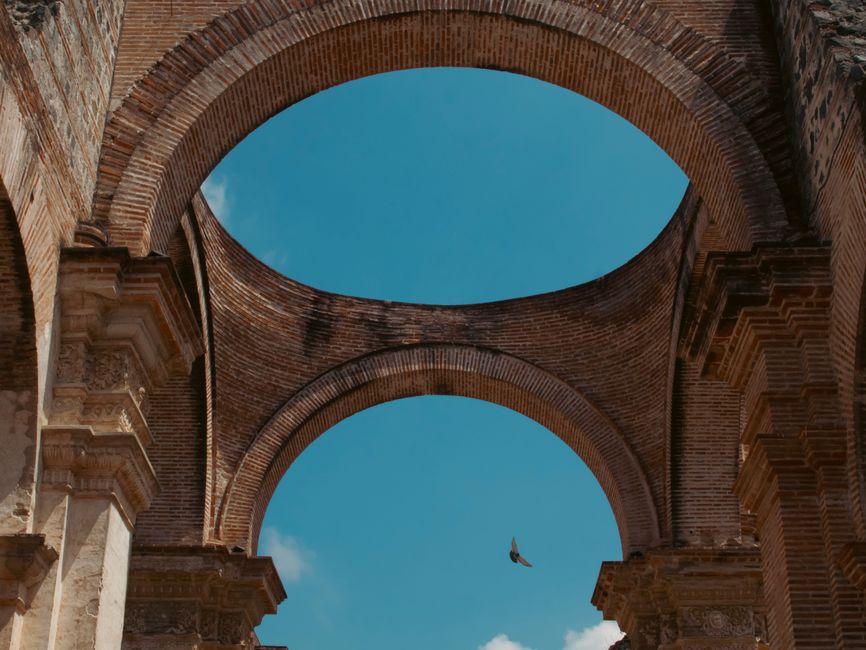
Elegant ancient brick arches of a historic ruin in Antígua, Carmelita, Guatemala
What Surprises First-Time Visitors
Most travelers arrive expecting a wild, untamed frontier—but the first surprise is how orderly the community is. Every transaction goes through the cooperative. You will sign a paper when you buy a bottle of water. The paths are swept each morning by teams of volunteers. The sense of shared responsibility is palpable; you are never just a customer, but a guest in someone’s home. Another surprise: the silence. Even at midday, the village is quiet. No engines roar, no radios blare. You hear birds, wind through the thatch, the occasional laughter of children. That quiet can be disorienting for travelers from cities, but after two days, you will find yourself speaking in lower voices, matching the forest’s calm.
What also catches visitors off guard is the sophistication of the guides. You might expect a simple “nature walk,” but your guide will casually identify the calls of fifteen bird species, explain the medicinal use of the quina tree, recite the Mayan calendar correlation, and then ask about your job in Hong Kong or Berlin. Many guides speak decent English and have traveled internationally to attend ecotourism conferences. The third surprise: the dark. There is no light pollution. At 6:30 p.m., when the generator shuts off, the blackness is absolute. The stars literally cast shadows on the ground. A first-time visitor often spends the first night unable to sleep, simply staring upward.
Your Carmelita, Guatemala Questions
Is Carmelita safe for solo travelers, especially women? Yes, you will find it extremely safe. The community is tightly knit, and the cooperative monitors all visitors. Violent crime is virtually nonexistent. Solo female travelers are common; the guides are respectful and watch out for you. The main risk is getting lost on a trail—always hire a certified guide from the cooperative. They will carry a radio and know the way even in fog. Do not hike alone, but you can walk the village streets at midnight without concern.
Can I visit El Mirador from Carmelita as a day trip? No, and you should not try. El Mirador sits 55 kilometers into the jungle. The round-trip hike takes four to five days. There is no road—only ancient Maya causeways and muddy paths. The cooperative offers a three-night trek, but serious visitors should plan for five full days to truly explore the La Danta pyramid complex. If you are short on time, consider the overnight trip to the nearby archaeological site of Tintal (2 days, $200). Even that is a demanding walk. Bring good boots and a willingness to sweat.
What is the Wi-Fi situation like in Carmelita? Laughably nonexistent. Do not come expecting to check email. The cooperative office has a single satellite internet connection used for reservations, but it is slow and turned off most of the day. Your phone will have no signal, either. This is intentional—the community wants visitors to disconnect and immerse. If you need urgent communication, you can use the satellite phone at the cooperative for a small fee ($2 per minute). Savvy travelers bring a physical book, a deck of cards, and a journal. You will be amazed how quickly your mind unwinds.
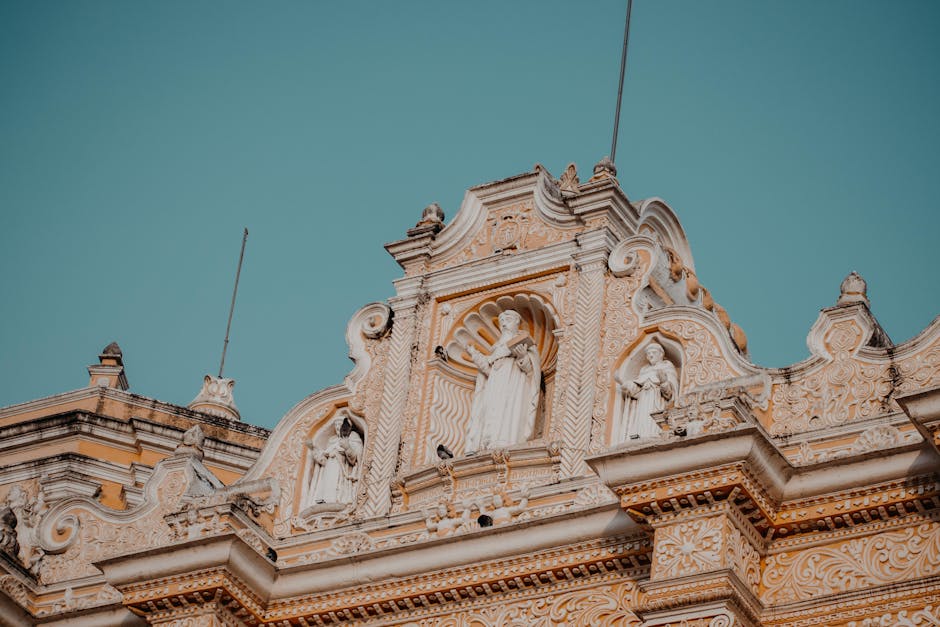
Exquisite baroque facade of La Merced Church, Carmelita, Guatemala

