
Beyond the Coastal Breeze: Why Majene’s Mandar Spirit Captivates Every Traveler Who Ventures to West Sulawesi (2026)
In 1905, as Dutch colonial forces steamed toward the shores of West Sulawesi, a young Mandar prince named Andi Pangerang rallied his people with the cry, “Mandar, resist!” For months, the kingdom of Majene—a coastal stronghold of the seafaring Mandar people—fought off the invaders with coral cannons and swift outriggers. Though ultimately subjugated, that defiant spirit still echoes in the salt-crusted docks and torch-lit ceremonies you’ll witness today.
But the golden age of Mandar power began to fade in the 19th century, as the Dutch expanded their hold over the archipelago. The 1905 Mandar War, which you’ll hear about from locals with a mix of pride and sorrow, was the last major rebellion. The Dutch, armed with modern rifles and artillery, crushed the outnumbered Mandar, but the resistance remained a symbol of cultural tenacity. After independence in 1945, Majene gradually became a quiet administrative capital—yet the Mandar identity persists in every sandeq boat launch and every whispered prayer at the annual Mappadendang festival.
Today, travelers discover that Majene is not a tourist hub; it’s a living museum of a resilient maritime culture. You’ll find no sprawling resorts or international chain hotels—only the occasional losmen (guesthouse) and the warm, slightly bewildered smiles of villagers who still ask, “Why did you come here?” As you walk the narrow streets, you’ll sense that every building and every fishing net carries the weight of centuries.
Neighborhood by Neighborhood
Pattae – The Portside Heart
Start your exploration in Pattae, the bustling harbor district where Majene’s pulse is measured in the rhythm of waves against wooden hulls. The air here is thick with the mingled scents of drying fish, diesel fuel, and clove cigarettes. You’ll see the iconic sandeq—the Mandar outrigger sailboat with its distinctive forked prow—bobbing in rows, their owners repairing nets or painting the hulls in bold reds and blues. The main drag, Jalan Pasir Putih, runs parallel to the shore and is lined with faded Dutch colonial warehouses that now serve as fishmonger stalls and coffee shops. Grab a seat at Warung Kopi Ani (just look for the yellow plastic chairs), where a cup of sweet kopi susu costs only 5,000 IDR, and watch the endless ballet of men hauling tuna and snapper from the morning catch. Locals recommend coming at sunrise, when the light turns the sea a milky gold and you can buy freshly grilled fish skewers from the Makassar grill wagons that set up along the seawall.
Pambusuang – The Sandeq Village
About 15 minutes north of the city center, the village of Pambusuang is where you’ll find the living soul of Mandar craftsmanship. This is not a tourist attraction; it’s a working boatyard where families have built sandeq boats for generations. You’ll see men carving the curved bow pieces from poon wood with hand adzes, while women braid the pattudu (palm-fiber ropes) that hold the outriggers together. The rhythm is hypnotic. The master boatbuilder, Pak Hasanuddin, who learned the trade from his grandfather, will sometimes invite curious travelers to try their hand at planing a plank. His workshop at the end of the beach road is open daily from 7 a.m. to 5 p.m., and he charges nothing for a tour—though a small donation for the village school is welcome. In July, the whole village erupts during the Festival Sandeq, when dozens of these boats race south to Majene in a colorful regatta that commemorates the Mandar’s seafaring heritage. If you can time your visit, you’ll witness a spectacle of silk banners, drumming, and triumphant shouting.
Luyo – The Hilltop Sanctuary
For a completely different perspective, head up into the hills to Luyo, a cluster of traditional banua houses that cling to the slopes of Mount Panyili. These houses, raised on stilts with steep thatched roofs, are built without a single nail—the joints are fitted with wooden pegs and coconut-fiber twine. As you climb the dirt paths, you’ll pass families pounding rice in wooden mortars and children waving from open windows. The air is cooler here, filled with the scent of clove and coffee plants. The main attraction is the Rumah Adat Mandar, a restored 18th-century noble house that now serves as a small museum. Inside, you’ll see traditional Mandar weaving lipa sa’be (silk sarongs with gold thread), old maps, and the ceremonial kris daggers that symbolize the Mandar’s warrior past. The caretaker, Ibu Sitti, will tell you stories of the last prince who lived here—usually in a lilting mix of Indonesian and Mandar that you’ll only half-understand, but the emotion is unmistakable. Plan to spend at least half a day in Luyo; there’s a simple homestay (Homestay Luyo Indah) where you can sleep for 150,000 IDR a night, including breakfast of burasa (steamed rice cakes) and fresh papaya.
The Local Table: What the Mandar Actually Eat
Majene’s cuisine is a reflection of its maritime soul: bold, briny, and rarely sweet. You’ll notice that locals eat with their hands—no spoons or forks required—and they eat early. By 7 a.m., the pasar pagi (morning market) on Jalan Ahmad Yani is already crowded with women in batik sarongs buying fresh cakalang (skipjack tuna) and the fiery rica-rica chili paste that accompanies every meal. The defining dish you must seek out is pallubasa, a thick, rich soup made from beef offal (tripe, intestines, and sometimes tongue) simmered for hours in coconut milk and a blend of turmeric, galangal, and lemongrass, then served with a mountain of fried shallots and a wedge of lime. The best version is at Warung Coto Haji Baco, a simple roadside stall just off the main square (open 7 a.m. to 11 a.m. only—go early). A bowl costs 25,000 IDR, and you’ll eat it with a piece of katupe (steamed cassava cake) to soak up the broth.

Sandeq boats in Majene, West Sulawesi, Indonesia, Majene, Indonesia
For lunch, head to the night market (Pasar Senggol) that sets up around 4 p.m. at Lapangan Majene. Here, you’ll find ikan bakar (grilled fish) slathered in a sweet soy and chili glaze, cooked over coconut husks. Choose your fish from the ice box—usually barramundi or red snapper—and watch the cook flip it with a pair of bamboo tongs. The whole meal with rice, vegetables, and a drink will run you about 40,000 IDR. Locals recommend pairing it with a cold es kelapa muda (young coconut juice) from the cart at the market’s edge. One secret: the best sambal—spicy enough to make your ears ring—comes from the little plastic tubs on the table, marked with a red X. That’s the one the regulars use.
Dessert is simple: barongko, a steamed banana cake wrapped in banana leaves. You’ll find it sold by children near the mosque after evening prayers. Each leaf packet costs 3,000 IDR, and the texture is dense, sweet, and satisfying. Don’t skip it; it’s a taste of Mandar domestic life.
Art, Music & Nightlife
Majene may be small, but its creative scene pulses with the ancient rhythms of the Mandar. The most important cultural event is the Pattuddu Dance, a sacred warrior dance performed during harvest ceremonies and weddings. You can sometimes see a rehearsal at the Gedung Kesenian Majene (Cultural Hall) on Jalan Sultan Hasanuddin if you ask the caretaker. The dance involves men wearing black jackets and red sarongs, brandishing swords and shields while moving to the beat of gandrang drums. The intensity is palpable; travelers often say it feels less like a performance and more like a ritual. For a more modern interpretation, visit at night the little open-air stage known as Café Gelombang, a hangout on the beach road where local bands cover Indonesian pop and play original songs about the sea. A Bintang beer costs 30,000 IDR, and the scene gets lively after 9 p.m. (though never rowdy).
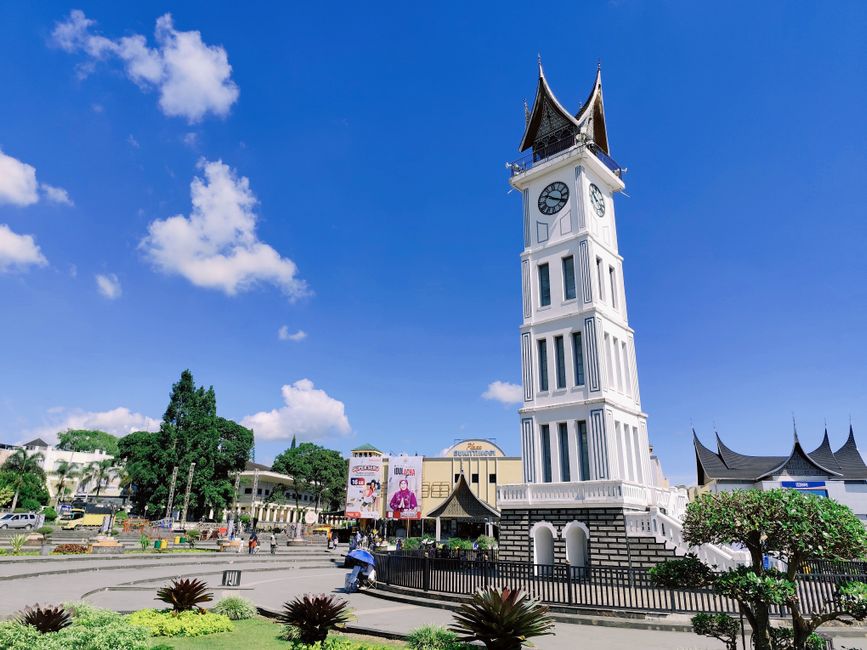
Scenic view of the iconic Jam Gadang clock tower under a blue sky in Bukittinggi, Majene, Indonesia
If you’re visiting in August, you cannot miss the Festival Sandeq, which takes place over the first full week of the month. Majene hosts the opening ceremony, with a parade of boats, traditional music, and a regatta that draws sailors from across the archipelago. The night before the race, there’s a Mappadendang ritual—a feast of sticky rice and roasted pork (for non-Muslim participants) held on the beach, accompanied by kecapi (zither) and suling (bamboo flute) players. It’s a deeply moving experience that connects you to the Mandar’s ancestral ties to the ocean. Bring insect repellent; the mosquitoes are out in force.
Practical Guide
- Getting There: The nearest commercial airport is in Mamuju (Tampa Padang Airport, IATA: MJU), served by Wings Air and Sriwijaya Air from Makassar (UPG). Fares start from 500,000 IDR one-way. From Mamuju, you’ll take a shared minibus (pete-pete) to Majene for 50,000 IDR (2.5 hours). Alternatively, you can fly into Makassar and take a 7-hour bus or private car (800,000 IDR). Book flights at Skyscanner.
- Getting Around: Your best bet is an ojek (motorcycle taxi). Hail one from the main square; short trips within town cost 10,000–15,000 IDR, while trips to Pambusuang or Luyo run around 50,000 IDR. Rent your own scooter from Pak Rudi’s at Jalan Merdeka No. 7 for 100,000 IDR per day—you’ll need a valid international driver’s license.
- Where to Stay: For budget comfort, try Hotel Majene Indah (Jalan Poros Majene, from 200,000 IDR/night). For a more immersive experience, stay at Homestay Luyo Indah in Luyo (150,000 IDR/night). Check Booking.com for options.
- Best Time: The dry season from April to October is ideal. August is best for the Sandeq Festival. Avoid December–February, when monsoon rains make roads muddy and boat trips unsafe.
- Budget: Plan for 400,000–500,000 IDR per day (about $27–$34 USD) including accommodation, meals, transport, and a few small purchases. Majene is remarkably cheap if you eat local.
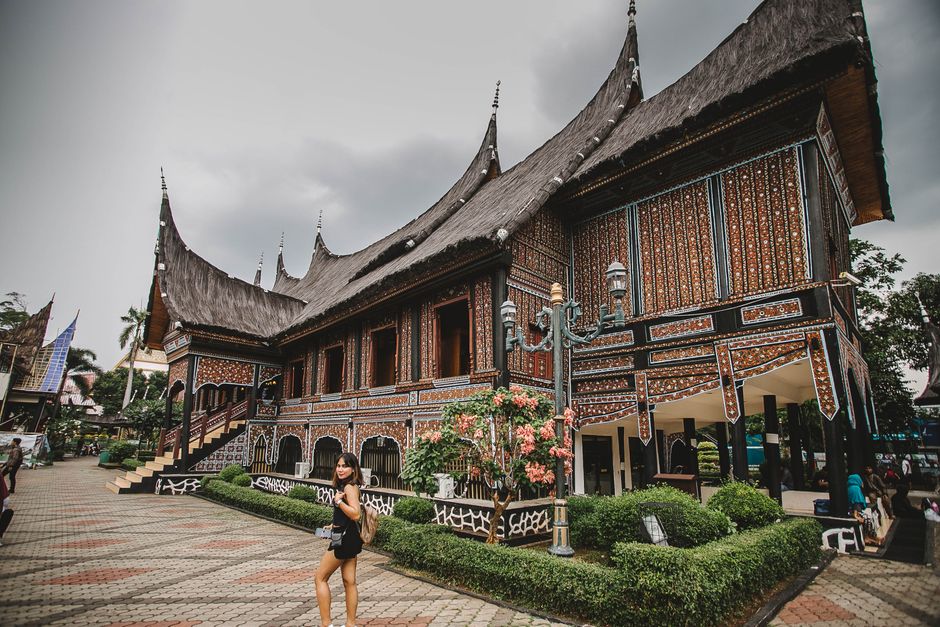
Beautiful traditional Indonesian building with detailed architecture and a …, Majene, Indonesia
What Surprises First-Time Visitors
The first thing that catches you off guard is the silence. Majene is not a bustling city; after 8 p.m., the streets empty, and you’ll hear the waves, the occasional dog bark, and, from the mosque, the soft hum of evening prayers. Travelers accustomed to the chaotic energy of Bali or Jakarta often find this disorienting—but after a day or two, you’ll treasure that stillness. Another surprise: the lack of English. Few locals speak any English beyond “hello” and “thank you.” You will need to rely on a few Indonesian phrases, or better, a translation app. Yet the lack of language barrier creates deeper connections—a pointing finger, a shared smile, a silently offered cup of coffee becomes universal.
Then there’s the hospitality. Locals recommend that you never walk alone at night without being prepared to be invited into someone’s home. On your second evening a grandmother might tug your sleeve and gesture you inside a wooden house where a pot of pallubasa simmers on a charcoal stove. She’ll ladle a bowl

