
# Canyon de Colca, Peru on a Budget: How to Experience the Deepest Canyon in the Americas for $35/Day
While the Grand Canyon charges $35 for a single-day entrance pass before you’ve even laid eyes on the South Rim, Canyon de Colca offers three full days of condor-spotting, thermal springs, and ancient Andean village exploration for just $20 in entrance fees. You’ll discover that this canyon—*more than twice as deep* as its famous northern cousin—delivers jaw-dropping vistas, authentic indigenous culture, and world-class trekking for a fraction of the cost. Travelers often discover that a week here costs less than a single night at a Grand Canyon lodge.
## The Honest Budget Breakdown
## 7 Free Things to Do in Canyon de Colca, Peru
Your entrance fee of approximately S/70 ($18–20) covers three full days and grants access to nearly everything below. Savvy visitors know that once you’ve paid, the canyon is essentially your playground.
– **Condor Spotting at Cruz del Condor (dawn, free with entry fee):** Arrive by 7:00 AM—the condors ride thermal updrafts between 7:30 and 8:30 AM, soaring inches from your face. You’ll see 5–15 condors on a good morning. Locals recommend bringing a thermos of coca tea and standing on the left side of the viewing platform for the closest passes. Most tourists leave by 9:00 AM, but if you linger until 10:30, you’ll often spot a second, smaller wave.
– **Hike the Rim Trail from Cabanaconde to Tapay (free, 4–5 hours):** This is the single best free activity in the canyon. You’ll follow ancient pre-Inca footpaths along the north rim, passing terraces still farmed by the Collagua people. The trail is unmarked in sections—ask for directions at the Cabanaconde police station (Plaza de Armas) and look for cairns. You’ll reach the village of Tapay, where locals sell fresh *choclo* (giant corn) for S/2. The return climb is steep—allow 2.5 hours back up.
– **Explore the Pre-Inca Terraces at Antahuilque (free, 30-minute walk from Chivay):** Most tourists drive past these 1,000-year-old agricultural terraces without stopping. You’ll find them 3 km east of Chivay along the road to Yanque. The terraces are still in use, and you’ll see farmers planting quinoa and potatoes using hand tools identical to those found in archaeological digs. Walk down into the terraces during the golden hour (4:00–5:30 PM) for photos that rival any postcard.

On way from Colca Canyon to Puno in Peru., Canyon de Colca, Peru
– **Visit the Mirador de la Cruz in Cabanaconde (free, 10-minute walk from the square):** This viewpoint gives you a heart-stopping vertical view into the canyon’s deepest section. Locals say the drop is 3,400 meters (11,155 feet) from the rim to the river below—nearly twice the height of the Grand Canyon’s deepest point. Go at sunset when the canyon walls turn burnt orange and the condors glide silently below you.
– **Observe Traditional Weaving Demonstrations in Yanque (free, daily 10:00 AM–12:00 PM):** The Association of Weavers of Yanque meets in a small adobe building just off the Plaza de Armas. You’ll watch women dye alpaca wool using cochineal insects (for red), indigo plants, and local minerals—a technique unchanged since pre-Columbian times. If you’re interested, they’ll teach you basic loom techniques for a small donation (S/5–10). No pressure to buy, but the scarves start at S/25 ($7) and are lifetime-quality.
– **Soak Your Feet in the Natural Hot Springs of Calera (before 7:30 AM, free):** The Calera thermal baths charge S/15 ($4) after 7:30 AM, but locals know that the pools are unstaffed between 5:30 and 7:30 AM. You’ll wade into 38°C (100°F) mineral-rich water with the smell of sulfur and the sound of condors calling overhead. The early morning light turns the steam golden. Bring a small towel and leave valuables in your hostel.
– **Stroll the Sunday Market in Chivay (free, 7:00 AM–2:00 PM Sundays):** On Sunday mornings, Quechua-speaking farmers from surrounding villages descend on Chivay’s Plaza de Armas with live guinea pigs, woven textiles, coca leaves, and freshly made cheese. You’ll see women in embroidered *polleras* (layered skirts) and men in hand-knit *chullos* (ear-flapped hats). Buy a bag of coca leaves (S/5) and a handful of *cancha* (toasted corn, S/1) for a complete local snack.
## Cheap Eats: Where Locals Actually Eat
You’ll eat better in the Colca Valley than in most of Peru—and for shockingly little money. Locals recommend these spots, where the prices are low and the flavors are pure Andean.
– **Mercado Central de Chivay (second floor, stalls 18–24):** Head upstairs at noon for the daily *menú*: a hearty *sopa de quinoa* (quinoa soup with vegetables), a main dish of *trucha a la plancha* (grilled trout from the Colca River) with rice and salad, and a glass of *chicha morada* (purple corn drink) for S/10 ($2.70). Seek out Señora Elena at stall 22—her *lomo saltado* (stir-fried beef) is legendary among local bus drivers. Open Monday–Saturday, 7:00 AM–4:00 PM.
– **La Casa del Truchero (Cabanaconde, Jr. Lima 305):** This no-sign, hole-in-the-wall spot serves the best trout in the canyon. You’ll order *trucha frita* with *papas nativas* (native potatoes) and aji sauce for S/12 ($3.20). The owner, Don Jorge, catches the trout from the river behind his house every morning at 5:00 AM. Open for lunch only, 12:00–3:00 PM. Look for the blue door with a faded fish painted on it.

Tourists enjoy a breathtaking view from a scenic overlook at Colca Canyon i…, Canyon de Colca, Peru
– **Antojitos Doña Rosa (Chivay, corner of Av. Jorge Chávez and Los Incas):** This street cart, which has been in the same spot since 1998, serves *anticuchos* (marinated beef heart skewers grilled over charcoal) for S/4 each ($1.10). Order three skewers with a boiled potato (S/12 total) and you’ve got a filling dinner. Doña Rosa starts grilling at 5:00 PM and sells out by 7:30 PM. Her secret is the *aji panca* marinade—she soaks the hearts for 12 hours.
– **Qhapaq Ñan Restaurant (Yanque, Plaza de Armas s/n):** Don’t be fooled by the simple plastic chairs—this is where local families eat on weekends. Your best bet is the *cuy chactado* (pressed fried guinea pig) for S/25 ($6.70), served with potatoes and *salsa de huacatay* (black mint sauce). It’s not cheap by local standards, but it’s half the price of tourist restaurants in Chivay. The owner, Soledad, has been raising her own guinea pigs on the roof for 30 years. Open Thursday–Sunday, 8:00 AM–8:00 PM.
## Getting There Without Going Broke
– **Cheapest Route:** Take a *colectivo* (shared minivan) from Arequipa’s Terminal Terrestre to Chivay. The 3.5-hour drive winds through the Patapampa plains, reaching 4,910 meters (16,109 feet) at the highest pass. *Colectivos* cost S/25–30 ($7–8) and leave every 20–30 minutes from 5:00 AM to 3:00 PM. The cheapest bus (Chivay Express) costs S/18 ($4.80) but takes 5 hours and stops at every hamlet.
– **Pro Tip:** Buy your return ticket *before* you descend into the canyon. The 5:00 AM bus from Chivay to Arequipa costs S/20 ($5.30) if booked at the terminal the day before, but S/35 ($9.30) if you try to buy it on the spot. Travelers often discover that Sunday afternoon buses are 30% more expensive due to market day demand.
– **From the Airport (Arequipa, AQP):** Take the *colectivo* from Plaza San Francisco for S/2 ($0.55) to Terminal Terrestre. Taxis from the airport cost S/30–40 ($8–11). A cheaper option: walk 500 meters from the terminal to the main road (Av. La Marina) and flag down a passing *combi* (minibus) for S/0.80—they go directly to the terminal.
Compare flights to Arequipa at Skyscanner — round-trip fares from Lima start at $35–60 during low season (March–May).
## Budget Accommodation Guide
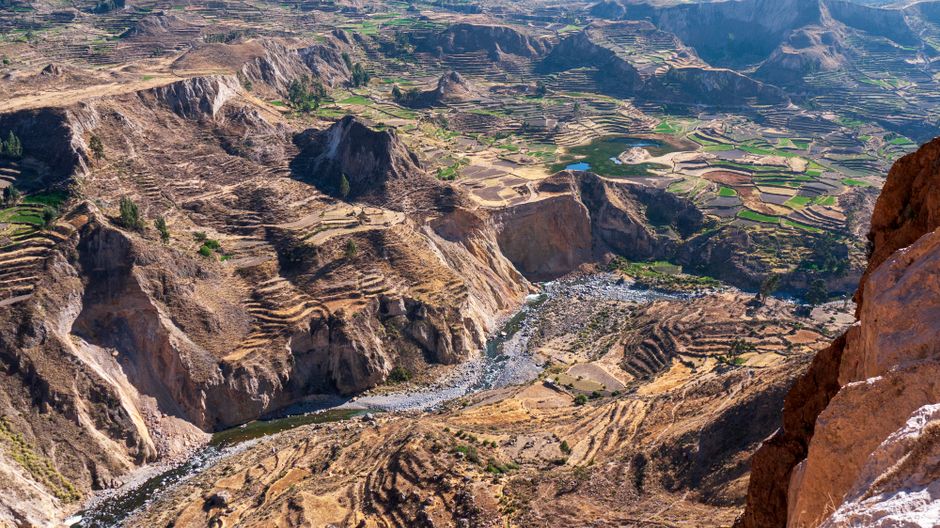
A breathtaking aerial shot of Colca Canyon in Peru, Canyon de Colca, Peru
Your accommodation choice determines your experience. Here’s where to stay based on your budget and goals.
**Chivay (best for foodies and hot springs lovers):**
– **Budget:** Hostal Las Siete Virgenes — a family-run guesthouse with clean dorm beds for S/20 ($5.30) and private rooms for S/40 ($10.60). The owner, Doña Julia, cooks breakfast (included) with eggs from her backyard hens. Book at Booking.com for free cancellation.
– **Mid-range:** Hotel Casa Andina Standard Colca — a reliable chain hotel with heated rooms, hot water 24/7, and a buffet breakfast. Rooms from $45. Book early—it fills up with tour groups.
– **Splurge:** Las Casitas del Colca (Belmond property) — individual cottages with private plunge pools and canyon views. Rates start at $350 per night, but the included meals and guided activities make it good value for luxury seekers.
**Cabanaconde (best for trekkers and adventurers):**
– **Budget:** Pachamama Hostel — dorm beds for S/15 ($4) with canyon-view terrace. The owners organize guided descents for $20 (half the agency price). The hot shower works when the sun is out (11:00 AM–4:00 PM). Book via Airbnb for S/35/night for a private room.
– **Mid-range:** Hotel La Gran casa del Colca — private rooms with en-suite bathrooms and breakfast for S/60 ($16). The rooftop views at sunset are worth the extra soles.
– **Splurge:** Colca Lodge — a 10-minute drive east in Yanque. Rooms from $80 with access to hot springs, a sauna, and a restaurant serving local ingredients.
**Yanque (best for culture and quiet):**
– **Budget:** Hostal Municipal Yanque — a basic but clean option with rooms from S/20 ($5.30). No hot water after 8:00 PM, but the location right on the plaza is unbeatable.
– **Mid-range:** La Casa de la Abuela — a colonial-era guesthouse with flower-filled courtyards. Rooms from $30 include breakfast and a welcome cup of muña tea (Andean mint). Book on Booking.com for best rates.
## Money-Saving Tips Specific to Canyon de Colca, Peru
– **Buy your entrance ticket ONLINE BEFORE YOU ARRIVE:** The official website (autoColca.gob.pe) offers a 15% discount if you purchase 48+ hours in advance. You’ll pay S/60 ($16) instead of S/70 ($20). Download the PDF—most guards accept digital copies. This single tip saves you $4 per person.
– **Bring your own water purification system:** Bottled water costs S/2–3 (50–80 cents) per liter in Chivay, but double that in Cabanaconde and triple at trekking viewpoints. You’ll spend $5–8 per day on water. Instead, bring a SteriPen (UV purifier, $80 one-time cost) or chlorine tablets ($5 for 100 tablets). The canyon’s tap water is safe to purify but not to drink straight. Locals recommend filling your bottle at the public faucets near Chivay’s main square—it’s spring-fed and free.
– **Negotiate trekking tours DIRECTLY with guides, not agencies:** Agency offices in Chivay charge $40–60 for a 2-day canyon descent. But if you walk to the guide meeting point near Cabanaconde’s Plaza de Armas at 6:00 AM, you’ll find independent guides offering the same trek for $20–30. Look for guides wearing red hats with “Guía

