
Where the River Breathes: Life Along the Okavango Panhandle (2026)
In 1849, the Scottish missionary and explorer David Livingstone became the first European to lay eyes on the Okavango River, pushing north through Kalahari sands until he reached a vast, papyrus-choked waterway that seemed to emerge from nowhere. “A magnificent river,” he scribbled in his journal, “one that refuses to surrender its secrets.” He was right. More than 175 years later, the Okavango Panhandle — the narrow, permanent channel where the river first enters Botswana from Angola — remains one of the continent’s most enigmatic andleast-traveled waterways, a thin ribbon of papyrus and palm islands that sustains entire worlds of wildlife and human culture along its languid banks.
The Story Behind the Okavango Panhandle
You may know the Okavango Delta — that vast, seasonal fan of water that spills across northern Botswana and draws safari-goers from every corner of the globe. But the Panhandle is the river before it becomes a delta, a 150-kilometer corridor of permanently flowing water that averages just 15 kilometers wide. Its story begins not in Botswana, but in the highlands of Angola, where summer rains — some 200 billion cubic meters annually — are gathered, filtered through the Kalahari sands, and delivered into a single, unwavering channel. By the time that water reaches the village of Mohembo, at the Panhandle’s northern gateway, it has traveled more than 1,000 kilometers.
The history of human settlement here is measured in millennia. The Hambukushu people, fleeing tribal conflict in Angola and Namibia, began arriving in the late 18th century, settling along the river’s edge in what are now villages like Shakawe and Sepopa. The BaYei followed, and later the Basarwa (San) hunter-gatherers, already present for thousands of years, found refuge in the delta’s margins. The region was colonized indirectly — the British Protectorate of Bechuanaland had little interest in this swampy, malarial frontier, leaving local chiefs to administer their own affairs. In 1966, when Botswana gained independence under Sir Seretse Khama, the Panhandle became part of a new nation, but its isolation persisted. There were no roads to speak of until the 1970s, when the government carved a gravel track from Maun to Shakawe, connecting the Panhandle for the first time to the rest of the country. Even today, you’ll find only a single main road running parallel to the river — a two-lane ribbon of tar that peters into sand long before reaching many villages.
What makes the Panhandle’s history particularly poignant is what it has not experienced. Unlike the Delta’s central areas, where heavy tourism has reshaped local economies and cultural practices, the Panhandle has remained stubbornly, blessedly local. Fishing villages, not safari lodges, define the landscape. The 2021 discovery of significant gas and coal deposits beneath the Kalahari has raised new questions about the region’s future, but for now, the Panhandle endures as Botswana’s quietest secret.
Village by Village: The Panhandle’s Three Faces
Mohembo: The Gateway at the Border
Your journey into the Panhandle starts at Mohembo, a dusty frontier settlement where the tar road ends and the Botswana-Namibia border crossing creates a modest bustle of trucks, traders, and travelers. The air here smells of river silt and diesel; you’ll see women in bright cotton dresses selling smoked bream fish on the roadside, and men repairing fishing nets under the shade of ancient jackalberry trees. Mohembo is not a tourist town — there is no souvenir market, no guided walk — and that is precisely its appeal. The docks buzz each morning at 6:30 a.m. as local fishermen push out in mokoros (dugout canoes) and fiberglass boats, heading for the channels where tilapia and tigerfish lurk. Your best bet for a genuine introduction is to arrive early, buy a cup of sweet tea from a vendor near the border post, and simply watch the river come alive.
Shakawe: The Cultural Heart
Sixty kilometers south of Mohembo, Shakawe is the largest settlement in the Panhandle and its de facto capital. This is where travelers discover the true character of the region. Shakawe spreads along both banks of the river, connected by a single, rickety pontoon ferry that carries cars, goats, and bicycles across the channel — a crossing that can take 20 minutes or two hours, depending on the patience of the ferryman and the number of cattle queued with you. The village is the heartland of the Hambukushu people, and you’ll notice it in the architecture: round, thatched huts with mud walls painted in geometric patterns, set among mango and banana groves that thrive on the river’s moisture. The local kgotla (meeting place) near the main road doubles as a craft market on most Saturdays, where you can buy traditional baskets woven from mokola palm leaves and intricate wooden carvings. For a glimpse into the region’s spiritual life, visit the Livingstone Memorial at the edge of town — not the famous one in Zambia, but a modest stone marker commemorating the explorer’s passage, where locals still leave offerings of maize meal and tobacco.
Seronga: Where Water Meets Land
Further south, at the transition point where the permanent river begins to break into the seasonal floodplains, Seronga marks the Panhandle’s southernmost village. This is where you’ll feel the landscape shift — the reed-lined channels give way to vast, grassy flats that flood during the dry season (May to October) when the rains from Angola finally arrive. Seronga is the base for community-run tourism initiatives that are among Botswana’s most authentic experiences. The Okavango Community Trust operates guided mokoro trips through the back channels here, with polers who grew up navigating these waters and who will point out the tracks of sitatunga antelope and the nests of lesser jacanas. You pay 150 pula per person for a half-day trip, and all proceeds go directly back into the village. Seasoned travelers prefer Seronga to the Delta’s high-end lodges for one simple reason: you are treated not as a guest but as a visitor to a living community. You’ll eat lunch in someone’s home, watch children play football on the riverbank, and hear stories about hippos that wander through the main road during flood season.
The Local Table: What River People Actually Eat

View of Botswana taken during ISS Expedition 59., Botswana, Botswana (Okavango Panhandle)
Food in the Panhandle is defined by a single ingredient: fish. Not the farmed tilapia you know from supermarkets, but wild, river-caught bream, catfish, and tigerfish that are smoked, grilled, or fried within hours of being landed. The staple is pap (maize porridge), served with a relish of fish stewed in tomatoes, onions, and local greens called thebe (wild spinach). Coconut palms, planted decades ago by Portuguese traders, add a surprising Indian Ocean influence to many dishes; you’ll find coconut milk used in fish curries and rice dishes in a way that feels entirely unexpected this far inland.
Your most memorable meal will not be in a restaurant — there are barely a handful of formal eateries in the entire Panhandle — but at the boite khola (roughly, “home kitchen”) run by Mma Bakang in Shakawe. She has no sign, no menu, and no fixed hours, but locals know she cooks from 11 a.m. to 2 p.m. most days. She’ll set you on a plastic chair under a mango tree and bring you a tin bowl of steaming pap, a whole fried bream that you eat with your hands, and a side of morogo — wild spinach cooked with peanut butter and a whisper of chili. The meal costs 30 pula — about $2.50 — and you will remember it for years.
Travelers often discover that the true food culture here is about sharing. If you are invited to eat in a village home — and you will be, if you show genuine interest — you will be offered the head of the fish as a mark of respect. Accept it. Eat it with your right hand, scooping pap with your thumb and forefinger. The hospitality of the Panhandle is not a show; it is a deeply ingrained tradition that predates tourism by centuries.
Art, Music & Nightlife
Nightlife in the Panhandle does not mean nightclubs — the nearest actual club is six hours south in Maun. Instead, nightlife means community gatherings around a fire, where the Hambukushu keep their polyphonic singing tradition alive, accompanied by the mbira (thumb piano) and ngoma drums. The most powerful expression of this culture is the Epera dance, performed during weddings and important community events, where dancers wear skirts of river reeds and ankle rattles made from seed pods. If you visit between July and September, you may witness the Dikgafela festival in Shakawe — a first-fruits ceremony that involves the entire village bringing offerings to the chief in gratitude for the river’s bounty.
For visual art, the Panhandle’s basket weaving tradition is recognized by UNESCO as a Masterpiece of the Oral and Intangible Heritage of Humanity. Women in villages throughout the Panhandle harvest mokola palm fronds, dye them using roots and bark, and weave them into baskets so tightly constructed they can hold water. The patterns are not decorative; they encode stories of migration, marriage, and the landscape. The best place to purchase these baskets without intermediaries is at the Tsodilo Hills Craft Centre, a cooperative run by local women that meets every Saturday morning at the Shakawe kgotla. Prices start at 200 pula for a small basket and can reach 2,000 pula for a large, intricately patterned piece that took three weeks to weave. There are no galleries in the conventional sense — the art here is in the hands of the people who make it.
Practical Guide
- Getting There: Fly into Maun (MUB), Botswana’s northern hub, served by Air Botswana and Airlink from Johannesburg and Gaborone. From Maun, you can rent a 4×4 (essential) or take a shared minibus to Shakawe — the 6-hour drive along the C40 and A35 tar roads is one of the most beautiful in the country, passing through mopane woodland and baobab forests. Book flights at Skyscanner.
- Getting Around: A 4×4 is non-negotiable if you plan to explore beyond the main tar road. Fuel stations exist in Shakawe and Sepopa but are sparse — never let your tank fall below half. Mokoro trips from Seronga cost 150 pula per person for a half-day. The pontoon ferry at Shakawe costs 20 pula for a vehicle; cash only.
- Where to Stay: In Shakawe, the Shakawe River Lodge is the only formal option, with thatched chalets starting at 1,200 pula per night. For authenticity, book a homestay through the Okavango Community Trust in Seronga; they offer round, thatched huts with shared ablutions for 300 pula per night. Check Booking.com for lodge availability.
- Best Time: May to October is the dry season and the prime window. The months of June and July offer cool mornings (10°C) and clear skies, with the highest concentration of wildlife along the river. November and December are extremely hot and humid; the roads may be flooded. Avoid January to March unless you love rain and mud.
- Budget: A realistic daily cost for a mid-range traveler is 1,500-2,000 pula (roughly $115-$155). This covers a simple lodge, three meals, a mokoro trip, and transport costs. Budget travelers can manage on 600 pula per day with homestays and self-catering.
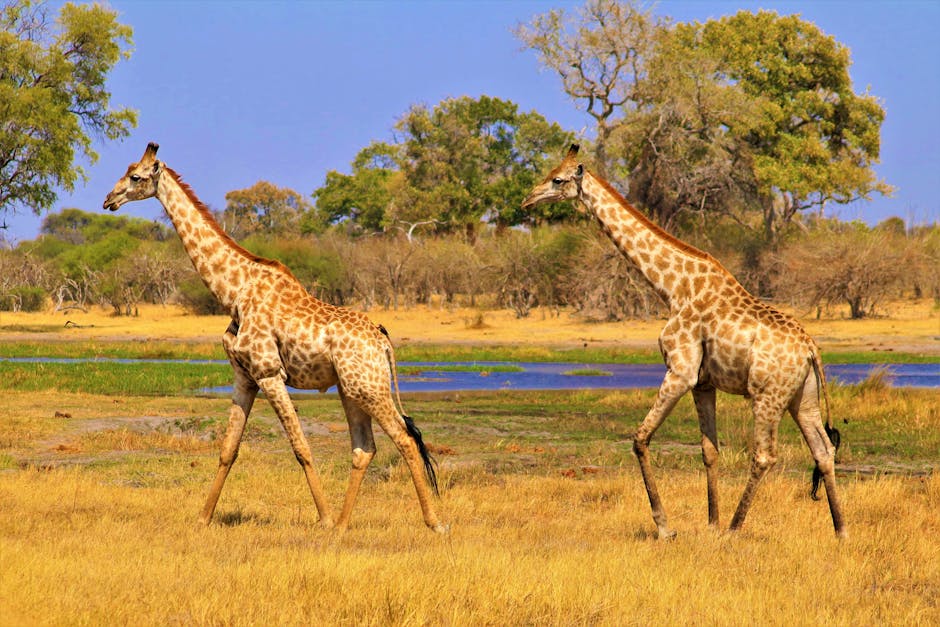
Two giraffes walking in the vibrant African savannah landscape., Botswana, Botswana (Okavango Panhandle)
What Surprises First-Time Visitors
The first surprise is the silence. You expect Botswana to be quiet, but the Panhandle offers a quality of quiet that is almost physical — no engine hum, no airplane contrails, no distant traffic. At night, you hear hippos grunting, the splash of a crocodile sliding off a sandbank, and the rustle of papyrus in the breeze. That absence of artificial sound feels ancient, and it takes your brain a full day or two to stop straining for background noise that never comes.
The second surprise is the hospitality. Travelers often arrive expecting the transactional interactions common in high-end safari destinations. In the Panhandle, people greet you on the path, offer you tea, and invite you into their homes without any expectation of payment. This is not a tourist-performance of friendliness; it is how people live. You must learn to accept it gracefully, and to reciprocate by respecting local customs — always greet elders first, never take a photograph without asking, and never touch another person’s head.
Finally, visitors are surprised by the Panhandle’s ecological intensity. The river here is not a passive backdrop; it is a living force that dictates everything — when to plant, where to fish, which paths are passable. You will see hippo paths worn into the riverbank like footpaths, elephant dung on the main road, and fish eagles so close you can see the glint in their eyes. The misconception that Botswana’s wildlife is only in game reserves evaporates the moment you watch a herd of red lechwe cross the river in front of your car, as if you were the one passing through their home.
Your Okavango Panhandle Questions

A majestic African elephant drinks at a waterhole, Botswana, Botswana (Okavango Panhandle)
Is the Panhandle safe for solo travelers?
Yes — Botswana has one of the lowest violent crime rates in Africa, and the Panhandle is a family-oriented, community-centric region where strangers are treated with respect and protection. Your greatest risk is not crime but logistics: you can rely on the kindness of locals, but there are no hospitals between Shakawe and Maun. Carry a satellite phone if you plan on exploring remote channels, and inform your lodge or host of your route each day. Solo female travelers report feeling entirely safe in villages, though you should exercise the same caution you would anywhere — avoid walking after dark without a local guide, and do not swim in the river (crocodiles and hippos make that a lethal idea).
Can you visit the Panhandle without a tour operator?
Absolutely — in fact, you are encouraged to. The Panhandle is one of the few parts of Botswana where independent travel is straightforward and welcomed. The main road is tarred, there are cheap guesthouses and homestays, and the community trust in Seronga can arrange guided activities on the spot. You do not need a 4×4 for the main road, but you will want one for the village tracks. The biggest piece of advice from seasoned travelers: download offline maps (Google Maps works, but Tracks4Africa is more accurate) because cell coverage is patchy and paper maps are virtually non-existent in the region.
Is there malaria in the Panhandle?
Yes — the Panhandle is a malaria zone, with transmission highest from November to June. You should take prophylactic medication (consult your doctor for recommendations), sleep under a treated mosquito net, and wear DEET repellent in the evenings. That said, the risk is lower than in many other parts of sub-Saharan Africa because the river is permanent and the mosquito population is relatively stable. Locals often recommend carrying a portable mosquito net if you plan on staying in village homestays, where nets are not always provided. The nearest clinic with antimalarial treatment is in Shakawe; do not rely on finding medication locally.

