
Bukchon Hanok Village, South Korea on a Budget: Seoul’s Historic Heart for $35/Day (2026)
While Kyoto’s Gion district charges $25 just to walk its historic streets during peak hours, Bukchon Hanok Village offers you an equally stunning immersion into traditional Korean architecture—completely free. You’ll wander alleyways lined with centuries-old hanok houses, peek into artisan workshops, and capture postcard-perfect views of Seoul’s skyline without spending a single won on admission. For savvy travelers who plan strategically, this living museum of Korean heritage delivers an authentic cultural experience that rivals any paid attraction in Asia, and your wallet will thank you.
7 Free Things to Do in Bukchon Hanok Village, South Korea
- Walk the Bukchon 8 Scenic Viewpoints: Start at the Bukchon Traditional Culture Center (37 Gahoe-dong) and follow the eight marked photo spots along the main alleyways. You’ll ascend gentle slopes between hanok rooftops, and at viewpoint #5 near Gahoe-dong 31-1, travelers often discover the iconic shot of tiled roofs against the N Seoul Tower in the distance. Arrive before 9 AM to avoid crowds and enjoy softer morning light.
- Explore the Bukchon Traditional Culture Center for Free: Housed in a beautifully restored hanok at 37 Gahoe-dong, this center offers free exhibitions on Korean calligraphy, traditional paper-making, and hanok architecture. You can try your hand at writing with a bamboo brush during the free hands-on session held every Wednesday at 2 PM. Locals recommend checking the monthly schedule for rotating cultural displays.
- Hike the Inwangsan Mountain Trail: Just a 15-minute walk from the northern edge of Bukchon, this 2.5-kilometer trail gives you panoramic views over the hanok village and central Seoul. The trailhead begins behind the Seochon district, and the climb takes about 45 minutes. You’ll pass the historic Inwangsan Fortress Wall, built in 1396, and see Buddhist shrines tucked into the granite cliffs. Pack water and wear sturdy shoes—the final stretch is steep but worth every step.
- Visit the Seoul Museum of History for Free: A 10-minute walk southeast of Bukchon at 55 Saemunan-ro, this museum offers free admission to its permanent exhibitions on Seoul’s transformation from Joseon dynasty capital to modern metropolis. Travelers often spend an hour exploring the interactive maps and the impressive scale model of 1930s Seoul. Check-in at the information desk for a free English audio guide—available until 5 PM daily.
- Stroll through the Ikseon-dong Hidden Alleyways: Just a 5-minute walk from Anguk Station Exit 4, this maze of narrow lanes features Korea’s oldest concentrated hanok area, dating from the 1920s. Unlike Bukchon’s more polished streets, Ikseon-dong feels raw and lived-in, with tiny art galleries, communal gardens, and elderly residents hanging laundry. You’ll find no admission fee, and travelers discover that the best photo opportunities come from simply turning a random corner.
- Watch a Free Performance at the Samcheong-dong Cultural Center: On the last Saturday of each month at 3 PM, this center at 17 Samcheong-ro hosts free traditional music and dance performances in its courtyard. Arrive 20 minutes early to secure a seat on the wooden benches. Performances typically include gayageum (zither) melodies and fan dances that transport you back to the Joseon era. Check their Facebook page for schedule changes during holidays.
- Photograph the Jogyesa Temple Lantern Display: A 12-minute walk southwest of Bukchon, this active Buddhist temple at 55 Ujeongguk-ro always features a stunning array of lotus lanterns in its courtyard. The lanterns are hung year-round, but visitors who come during the Lotus Lantern Festival in May see the courtyard transformed into a sea of illuminated paper flowers. Entry is free, and you’re welcome to sit quietly in the main hall during meditation sessions held at 6 AM and 6 PM daily.
Cheap Eats: Where Locals Actually Eat
Your best bet for affordable, authentic Korean food near Bukchon is the Tongin Market at 18 Jahamun-ro 15-gil, a 10-minute walk from Anguk Station Exit 3. For just 10,000 won (approximately $7.50), you can buy a tray of empty brass coins called “yeopjeon” at the market office, then stroll through the maze of stalls exchanging them for small portions of japchae (glass noodles), tteokbokki (spicy rice cakes), mandu (dumplings), and fresh kimbap. Locals recommend visiting between 11:30 AM and 1 PM for the best selection, and you’ll eat like a king for under $8.
For a heartier meal, head to Gwangjang Market (88 Changgyeonggung-ro), a 15-minute walk east of Bukchon. This bustling covered market has been feeding Seoulites since 1905. Your must-try is the mayak kimbap (mini seaweed rice rolls) from the stall run by Mrs. Kim at section 63—just 3,000 won ($2.25) for a plate of 10. Pair it with a bowl of sundae (Korean blood sausage) from the neighboring stall for 4,000 won ($3). Travelers often discover that the best seats are at the shared tables near the entrance, where you can watch ajummas (elderly women) rolling kimbap at lightning speed.
At Bukchon Son Mandu (77 Bukchon-ro 5-gil), you’ll find the most affordable sit-down meal in the village. This tiny, hole-in-the-wall restaurant serves kimchi mandu (dumplings) for 7,000 won ($5.25) and tteokguk (rice cake soup) for 8,000 won ($6). Locals praise the handmade noodles that come in a rich anchovy broth. Arrive before 12:30 PM for lunch, as the queue stretches down the alley by 1 PM. The restaurant is marked only by a small wooden sign with a dumpling icon.
For a cheap breakfast or snack, visit Samcheong-dong Sujebi at 102-2 Samcheong-ro, where a bowl of hand-pulled dough soup costs just 7,000 won ($5.25). You’ll sit on floor cushions at low wooden tables, and the staff refills your banchan (side dishes) without asking. Travelers on tight budgets often order two bowls to share between friends, and the total bill rarely exceeds $10 per person.

Bukchon-ro 11-gil street lined with traditional hanok houses showing Korean…, Bukchon Hanok Village, South Korea
Getting There Without Going Broke
- Cheapest Route: From Incheon International Airport, take the AREX express train to Seoul Station for 9,500 won ($7) in 43 minutes, then transfer to Subway Line 1 to Jonggak Station and walk 8 minutes to Bukchon. This route costs $7 total versus a $45 taxi. If you’re flying from another Asian hub like Tokyo or Hong Kong, use budget carriers like Peach Aviation or Jeju Air for round-trip fares starting at $150.
- Pro Tip: Book your AREX train ticket online at the AREX website at least 24 hours in advance to save 20% on the standard fare. You’ll also skip the ticket line at the airport—just scan the QR code at the gate.
- From the Airport: For $10 instead of $45, take the Airport Limousine Bus (route 6011) from Incheon Terminal 1 to Anguk Station, which stops at the edge of Bukchon. The ride takes 70 minutes and drops you right at Exit 3. Seasoned travelers prefer this option over the subway because you avoid hauling luggage up stairs at Seoul Station. Buses run every 15-20 minutes from 5:30 AM to 10:30 PM.
Compare flights at Skyscanner

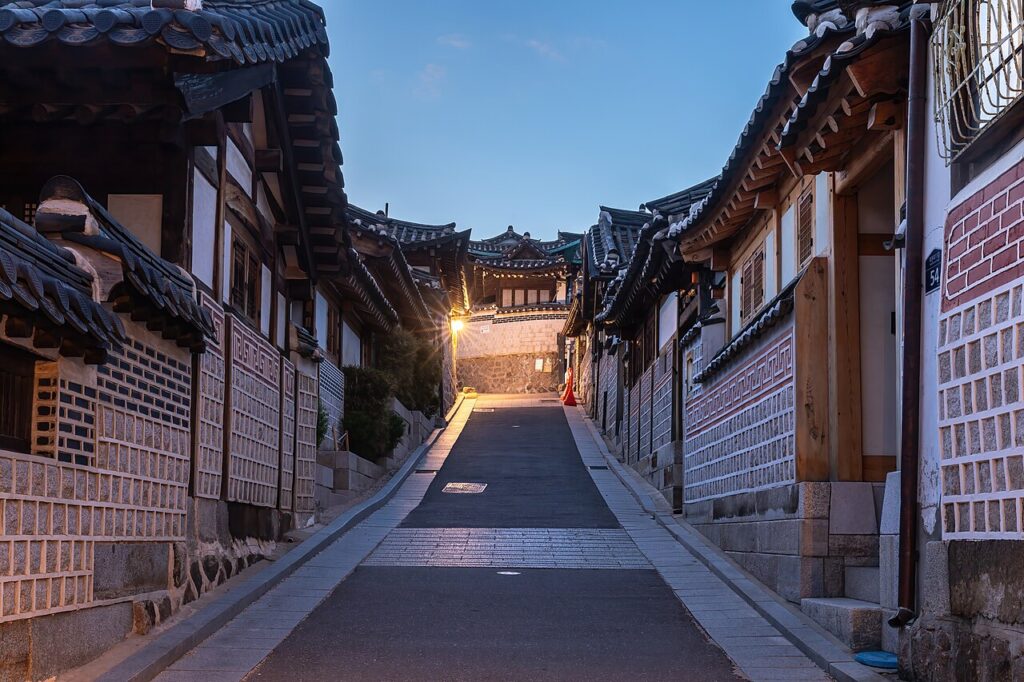
Empty street between houses, Bukchon Hanok Village, South Korea
Budget Accommodation Guide
Your cheapest option in Bukchon itself is a dorm bed at Bukchon Guesthouse (34-11 Gahoe-dong), where you’ll sleep on a traditional yo mattress in a renovated hanok for $12 per night. This guesthouse includes free breakfast (toast, eggs, and instant coffee) and a shared kitchen—perfect for budget travelers who want to cook simple meals. Book on Booking.com at least three weeks in advance, as rooms sell out during cherry blossom season (April) and autumn foliage (October-November).
For a private room near Bukchon, check Kim’s House at 45-1 Samcheong-ro, an Airbnb-style guesthouse where you get your own ondol-heated room with shared bathroom for $30 per night. The owner, Mrs. Kim, provides free wi-fi, laundry access, and a detailed map of local free attractions. You’ll find it listed on Airbnb under “Traditional Hanok Room in Samcheong-dong”—look for the review mentioning “clean and quiet.”
If you’re willing to walk 15 minutes south to the Jongno district, Hostel Korea 11th (53-1 Samil-daero) offers dorm beds for $10 and private rooms for $18. This modern hostel lacks traditional charm but compensates with free breakfast, a rooftop terrace, and 24-hour front desk. Travelers on the tightest budgets often pair this with daily walks to Bukchon, saving $4-$8 per night compared to village accommodations.
For a splurge that still respects your budget, treat yourself to one night at Rak Ko Jae (16-11 Gahoe-dong), a traditional hanok guesthouse where you’ll sleep under paper doors and soak in a wooden tub. Rooms start at $50 per night, but you gain access to a private garden, complimentary tea ceremony, and homemade breakfast. Book directly through their website for the best rate—third-party sites add a 15% markup.

Brown wooden bench on gray concrete stairs, Bukchon Hanok Village, South Korea
Money-Saving Tips Specific to Bukchon Hanok Village, South Korea
- Rent a hanbok on a weekday for 50% off: Most visitors pay $20 for a two-hour hanbok rental, but savvy travelers who rent on weekdays (Monday-Thursday) from Seoul Hanbok at 68 Bukchon-ro 5-gil pay just $10. Arrive at 9 AM when the shop opens, and you’ll avoid the 30-minute wait that builds by 11 AM. The rental includes free hair styling and a small bag—perfect for carrying your camera while you photograph the village in historic attire. Plus, you get free entry to many nearby palaces when wearing a hanbok.
- Bring a reusable water bottle for free refills: Bukchon has five public water fountains along the main walking route, including one at the Bukchon Traditional Culture Center and another near the Samcheong-dong intersection. Locals recommend filling up before climbing to the viewpoints—you’ll save $2-$3 per day on bottled water.
- Use the T-money card for 10% off subway fares: Buy a T-money card at any convenience store for $2.50, then load it with cash. Every subway ride costs 1,250 won ($0.95) with the card versus 1,350 won ($1.02) with a single-trip ticket. You’ll also transfer for free between subway and bus within 30 minutes. Use the card at all convenience stores to avoid carrying heavy coins.
- Eat at convenience stores for breakfast: The GS25 and 7-Eleven stores at the corner of Bukchon-ro and Samcheong-ro sell kimbap rolls for $1.50, instant ramen for $0.80, and fresh banana milk for $1. Travelers who fuel up on a $3 convenience store breakfast save $5-$7 compared to sit-down cafes. The GS25 at 68-5 Samcheong-ro even has a microwave and seating area.
- Book free English walking tours: The Bukchon Walking Tour runs every Tuesday and Thursday at 10 AM from Anguk Station Exit 2. An English-speaking guide leads you through the village for 90 minutes, explaining the history of the hanok roofs and pointing out hidden alleys. Reservations are free but required—email tourism@seoul.go.kr at least two days in advance. Group size is limited to 15, so early booking is essential.
Is Bukchon Hanok Village, South Korea Worth It on a Budget?
Absolutely, and here’s why: Bukchon delivers one of Asia’s most authentic cultural experiences for $0 admission. You miss nothing by visiting on a budget—the free walking tours, temple visits, and mountain trails rival any paid attraction. The only thing you sacrifice is the luxury of a hanok stay, but by spending those saved dollars on street food and market eats, you actually experience the village like a local. Travelers who splurge on a $100 guided tour often regret it, while budget visitors who follow these tips leave feeling they’ve discovered secret alleys and genuine connections that money can’t buy. Visit early in the morning or late in the afternoon, wear comfortable shoes, and keep your camera ready—Bukchon rewards those who explore slowly and sink into its ancient rhythm. Your $35/day budget will buy you memories that last a lifetime.

