
Mosi-oa-Tunya, Zambia on a Budget: How to Witness the Smoke That Thunders for $45/Day (2026)
While the Zimbabwean side of Victoria Falls charges $50 just to glimpse the cascade, and helicopter flights over the gorge start at $150, Mosi-oa-Tunya—Zambia’s sacred “Smoke that Thunders”—offers you the same thundering spectacle, the same rainbows at sunset, and the same adrenaline-pumping gorge for a fraction of the price. Here, travelers discover that $45 a day covers a comfortable guesthouse, three proper meals, local transport, and entry to one of the world’s greatest natural wonders. Your wallet will thank you, and your soul will be drenched in wonder.
7 Free Things to Do in Mosi-oa-Tunya, Zambia
- The Knife-Edge Bridge Walk: From the main entrance to Victoria Falls, follow the path to the Knife-Edge Bridge—a narrow steel span perched over the Batoka Gorge. This is your best free vantage point for the main cascade. Arrive at 6:30 a.m. when the gates open and the mist creates rainbows directly in front of you. The bridge is open year-round, but the spray is heaviest from February to May when the Zambezi is at its peak. You’ll get soaked, and you won’t care.
- Mosi-oa-Tunya National Park Self-Guided Walk: While the park technically charges entry ($12 for international visitors), you can walk the 8-kilometer loop road for free if you enter on foot through the Livingstone side via the park’s back gate near the Zambezi River. Locals recommend starting at 7 a.m. to spot zebras, giraffes, and possibly white rhinos grazing along the riverbank. The park is home to the last wild population of white rhinos in Zambia—you might see them without spending a cent.
- The Livingstone Museum’s Free Entry Days: The Livingstone Museum on Mosi-oa-Tunya Road offers free admission every first Wednesday of the month from 9 a.m. to 4 p.m. You’ll explore exhibits on David Livingstone’s explorations, colonial history, and the traditional cultures of the Lozi and Tonga peoples. The museum also houses a fascinating collection of missionary-era artifacts and original Livingstone letters. Most tourists pay K150 ($6), but savvy visitors plan around these free days.
- Sunset at the Zambezi Riverbank: Walk to the riverside path behind the Royal Livingstone Hotel—it’s public access despite the luxury resort. You’ll find a wooden bench at the bend in the river where the sun drops directly behind the mist column of the falls. Locals gather here from 5:30 p.m. with beers from the nearby Shoprite (K18 each). Bring your own drink, sit on the rocks, and watch the sky turn orange over Botswana. You’ll share the spot with monkeys, not tourists.
- Livingstone Craft Market (without buying): The craft market at the falls entrance is one of the friendliest in Zambia. While vendors will try to sell you carved hippos and wirework bicycles, you can spend an hour browsing without buying. Travelers often discover that the best free experience is watching artisans carve wooden masks and weave baskets—they’ll let you photograph their work if you smile and say “ndiyabonga” (thank you). The market operates daily from 9 a.m. to 5 p.m.
- Boiling Pot Lookout Trail: A 2-kilometer trail from the main falls parking area leads down to the “Boiling Pot”—a churning cauldron of water where the Zambezi River squeezes through a narrow gorge. The descent takes 30 minutes and involves 300 steep steps. From the bottom, you’ll feel the spray on your face and see rafters running the rapids below. The trail is free and open from 6 a.m. to 6 p.m. Wear sturdy shoes—the steps are slippery when wet, which is always.
- Walking Tour of Livingstone Town: Every Saturday at 10 a.m., the Livingstone Tourism Association leads a free walking tour of the historic town center. Starting at the Livingstone Museum, you’ll pass colonial-era buildings, the old train station built in 1905, and the famous Livingstone Clock Tower. Guides explain how the town grew from a railway camp into the tourist hub it is today. The tour lasts 90 minutes and ends at the Mukuni Market, where you can sample free samples of roasted groundnuts and dried mangoes.
Cheap Eats: Where Locals Actually Eat
For authentic Zambian food without the tourist markup, head to the Kitchen Party on Mosi-oa-Tunya Road, directly across from the Shoprite supermarket. This no-signature, tin-roofed canteen serves nshima (maize porridge) with grilled tilapia and rape leaves for K45 ($1.80). Locals pack the benches from 11:30 a.m. to 2 p.m. daily—arrive early because the fish sells out. Order “nshima with kapenta” (small dried fish) for the real local experience at K35 ($1.40).
On the corner of Mokambo Road and Mosi-oa-Tunya Road, you’ll find Mama Joyce’s Grill, a charcoal-brazier stand operating from 4 p.m. to 9 p.m. She grills skewers of chicken hearts and beef liver—sold at K10 ($0.40) per skewer—along with whole tilapia (K25, or $1). You’ll eat standing at a plastic table while locals debate football. Mama Joyce also sells “fritters” (fried dough balls) for K5 ($0.20) each. Travelers often discover that the spiciest sauce is the green one made from crushed chillies and coriander—go easy on it.
For a sit-down meal that still fits a budget, try Dende’s Cafe on Akapelwa Street, a short walk from the Livingstone Museum. This courtyard restaurant serves a “Zambian Plate” with nshima, two relishes (choose from chicken stew, beef in peanut sauce, or chibwabwa—pumpkin leaves), and a side of tomato-onion salad for K65 ($2.60). Their munkoyo (fermented maize drink) costs K12 ($0.50) and is sweeter than the version you’ll find on the street. Dende’s opens for breakfast from 7 a.m. and serves until 8 p.m. Locals recommend their fried chicken with chips—K55 ($2.20) and generously portioned.
Finally, don’t miss the Kitchen at Mukuni Market, near the main bus station. A row of women fry caterpillars (ifishimu), grasshoppers (inswa), and termites in large pans. A paper cone of crispy caterpillars costs K10 ($0.40) and tastes like smoky, crunchy bacon. Most tourists hesitate, but locals know this is the cheapest protein in town. If insects aren’t your thing, buy a bag of roasted groundnuts (K5, or $0.20) from the same stall—they’re roasted on-site in a giant wok over an open fire.

Victoria Falls, Zambia-Zimbabwe, Mosi-oa-Tunya, Zambia
Getting There Without Going Broke
- Cheapest Route: Fly into Lusaka (Kenneth Kaunda International Airport) via budget carriers like Ethiopian Airlines or Kenya Airways, which frequently offer round-trip fares from Europe under $600. From Lusaka, take the Shalom Bus to Livingstone—a 7-hour journey costing K200 ($8) for a comfortable seat. Buses depart Lusaka at 6 a.m. and 2 p.m. daily from the Intercity Bus Terminal. You’ll arrive in Livingstone at the central bus station, a 15-minute walk from most budget accommodations.
- Pro Tip: Book your Lusaka-to-Livingstone bus ticket at least three days in advance through the Shalom Bus website or at the terminal—walk-up prices can be 20% higher. Also, travelers often discover that buying a return ticket simultaneously saves K30 ($1.20) per person. For the best deal, travel on Wednesdays, when Shalom offers a 10% discount on all seats.
- From the Airport: Livingstone’s Harry Mwanga Nkumbula International Airport is 5 kilometers from town. The cheapest transfer is the local minibus (kombi) that meets arrivals—wait at the stop outside the terminal building (look for the blue-and-white minibus with “Town” written in marker). The fare is K10 ($0.40) per person, and it drops you at the Livingstone Shoprite. A private taxi from the airport costs K150 ($6), but you can negotiate down to K100 ($4) if you share with fellow travelers.
Compare flights at Skyscanner

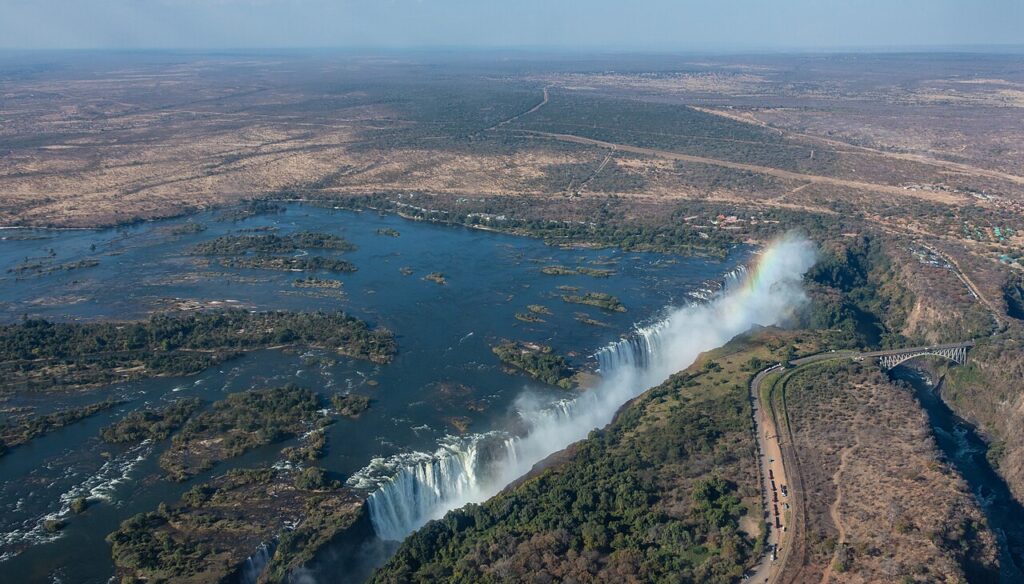
Breathtaking aerial view of Victoria Falls surrounded by lush greenery duri…, Mosi-oa-Tunya, Zambia
Budget Accommodation Guide
Your best bet for dirt-cheap lodging is Jollyboys Backpackers on Kafue Road, a five-minute walk from the Livingstone town center. Dorm beds start at $8 per night, and private double rooms run $25. The property features a swimming pool, self-catering kitchen, and a bar with nightly socials. Travelers love the free Wi-Fi and the free breakfast of toast and jam. Jollyboys also runs free walking tours of Livingstone every Tuesday and Thursday at 9 a.m. Book on Booking.com for the best rates—they often have last-minute deals at $7 per dorm bed.
For slightly more privacy, Fawlty Towers on Mosi-oa-Tunya Road offers private rooms with en-suite bathrooms for $18 per night (double occupancy) and a swimming pool set in a lush garden. The shared kitchen is well-equipped, and the staff will help you arrange budget transport. Fawlty Towers also has a restaurant serving “Fawlty Towers Burgers” for K65 ($2.60)—a hefty portion of local beef with chips. Check availability on Airbnb for apartment rentals in the area, which can be as low as $20 per night for a self-contained studio near the market.
If you’re willing to stay slightly out of town—a 15-minute minibus ride—consider the Livingstone Guesthouse on Namib Road in the Maramba neighborhood. Private rooms with fan (not air conditioning) cost $12 per night, and the guesthouse has a small garden where you can cook your own meals on a braai grill. The Maramba area is safe and quiet, but you’ll need the kombi to reach the falls and restaurants—budget K10 ($0.40) per trip. For the ultimate budget move, look up Camping at Victoria Falls Restcamp on Sichango Road: bring your own tent and pay $5 per person per night for a pitch on manicured lawn with access to hot showers and a communal kitchen.

Breathtaking view of Victoria Falls gorge with cascading waterfalls in vibr…, Mosi-oa-Tunya, Zambia
Money-Saving Tips Specific to Mosi-oa-Tunya, Zambia
- Buy a Park Pass for Multiple Days: The Mosi-oa-Tunya National Park entry fee of $12 is valid for 24 hours. But if you purchase a 72-hour pass at the gate for $25, you save $11 compared to three single-day entries. This is a no-brainer if you plan to visit the falls viewpoint more than once—and you should, because the light changes dramatically at sunset.
- Visit the Falls During “Low Water” Season (June-August): While the falls are most dramatic from February to May (high water), the entry fee is the same year-round. During low water, you can walk the Knife-Edge Bridge without getting soaked, and you’ll see the geological formations of the gorge clearly. More importantly, guides on the Zambian side often offer free, impromptu tours during slow periods—they’re hoping for tips but won’t pressure you.
- Share Transfers to the Falls: The minibus driver at the Livingstone taxi stand charges K10 ($0.40) per person for a ride to the falls entrance. But you’ll pay K100 ($4) if you take a private taxi. Always ask for the “shared rate” and wait for the van to fill up—locals do the same. The ride takes 10 minutes each way, and you’ll avoid the inflated “tourist fare” that taxi drivers love to quote.
- Eat at the Shoprite Food Court: The Shoprite supermarket on Mosi-oa-Tunya Road has a small food court upstairs with a Zambian-style canteen. You can get a full plate of nshima with chicken and vegetables for K30 ($1.20), plus a bottled water for K5 ($0.20). This is the cheapest sit-down meal in Livingstone, and it’s where off-duty police officers and shop staff eat lunch. The food court opens at 8 a.m. for breakfast (samosas and tea for K15, or $0.60) and closes at 6 p.m.
- Barter at Mukuni Market: The craft market near the Livingstone Museum expects haggling. Start at 30% of the asking price—vendors will counter at 50%. For example, a carved wooden hippo listed at K200 should settle at K80 ($3.20). Travelers often discover that buying multiple items from the same stall gets you a better deal. Also, bring small bills: vendors rarely have change for K200 notes.
Is Mosi-oa-Tunya, Zambia Worth It on a Budget?
Honestly? You’ll get the full roar of the falls, the mist in your face, and the wildlife of the park without spending more than pocket change on accommodation and food. You will miss the helicopter flights (from $150), the luxury sunset cruises on the Zambezi (from $80), and the fancy meals at the Royal Livingstone—but those are add-ons that don’t define the experience. What you still get is the same thunder, the same rainbows, the same river that has carved this gorge for two million years. Compared to the Zimbabwean side, where the falls entry alone costs $50 and everything from parking to guided walks is controlled by concessionaires, Zambia offers a raw, less-commercialized encounter with one of the greatest natural wonders on the planet. Mosi-oa-Tunya is not only budget-friendly—it’s the way this place was meant to be felt. Go with your feet on the ground and your eyes on the clouds, and you’ll leave richer than any traveler who flew over in a helicopter.
Explore More Destinations
- Jozani, Tanzania on a Budget: an Ancient Forest for $35/Day (2026)
- Nsumbu, Zambia on a Budget: Wild Africa for $40/Day (2026)
- Semporna, Malaysia on a Budget: Paradise for $35/Day (2026)
- Khuzestan, Iran on a Budget: Ancient Empires for $30/Day (2026)
- Ngerulmud, Palau on a Budget: Island Majesty for $45/Day (2026)
Ready to Visit Mosi-oa-Tunya?
Start planning your trip today. Compare hotels, find the best tours, and get insider tips.
Your adventure in Mosi-oa-Tunya starts here →
Related Guides
Explore more destinations similar to Mosi-oa-Tunya:
- St. George’s, Grenada: Best Caribbean Colors, Spice Markets & Historic Harbors (2025)
- Mochima, Venezuela: Essential Deserted Islands, Bioluminescent Bays & Coastal Wilderness (2025)
- Puerto Cabezas, Nicaragua: Hidden Miskito Culture, Caribbean Coastlines & Untamed Nature (2026)
- Terceira’s Charm, Portugal
{“@context”: “https://schema.org”, “@type”: “FAQPage”, “mainEntity”: [{“@type”: “Question”, “name”: “What is the best time to visit Mosi-oa-Tunya?”, “acceptedAnswer”: {“@type”: “Answer”, “text”: “The best time to visit Mosi-oa-Tunya depends on your preferences. Generally, the dry season offers the most pleasant weather for sightseeing and outdoor activities.”}}, {“@type”: “Question”, “name”: “How many days do I need in Mosi-oa-Tunya?”, “acceptedAnswer”: {“@type”: “Answer”, “text”: “Most travelers spend 3-5 days in Mosi-oa-Tunya to see the main attractions. A week allows for a more relaxed pace and day trips.”}}, {“@type”: “Question”, “name”: “Is Mosi-oa-Tunya expensive to visit?”, “acceptedAnswer”: {“@type”: “Answer”, “text”: “Mosi-oa-Tunya can be visited on various budgets. Accommodation ranges from hostels to luxury hotels, and local restaurants offer affordable dining.”}}]}

