
Where the Sultans’ Horses Still Run: Uncovering the Soul of Bima, Indonesia (2026)
In 1646, the Sultanate of Bima faced a pivotal choice. As the Dutch East India Company tightened its grip on the archipelago, Sultan Abdul Kahir made a fateful decision. He signed the Bungaya Treaty, not with the Dutch, but with the Makassarese Kingdom of Gowa, seeking a powerful ally. This act of strategic defiance, though later complicated by colonial pressures, cemented Bima’s identity as a fiercely independent kingdom, a spirit you can still feel in the weathered stones of its ancient palace and the proud gaze of its people.
The Story Behind Bima, Indonesia
To understand Bima, you must start with the land itself. This is the domain of the *Dou Mbojo* people, whose history is etched into the dramatic landscape of eastern Sumbawa. Long before Islam arrived in the early 17th century, Bima was a collection of chiefdoms known as *Ncuhi*, ruled by council. The transformation into a powerful, centralized Islamic sultanate began in 1620 with the conversion of Sultan Abdul Kahir. For over three centuries, the Sultanate of Bima stood as a major political and cultural force, its influence stretching across the seas, with a written constitution, the *Bo’ Sangaji Kai*, that was remarkably advanced for its time.
The colonial era brought new challenges. After the fall of its ally Gowa, Bima became a vassal under Dutch suzerainty, though it retained significant internal autonomy. This period saw the construction of the iconic Asi Mbojo palace, a unique fusion of local, Makassarese, and European architectural styles that stands as a testament to Bima’s adaptive resilience. The sultanate officially ended in 1951, but the lineage and cultural legacy remain vibrantly alive. Travelers today aren’t just visiting a town; they’re walking through the living layers of a once-great maritime kingdom, where history isn’t confined to museums but is spoken in the local dialect, worn in traditional *tembe* woven cloth, and celebrated in the thunderous beat of the *Gendang Beleq* war drum.
Neighborhood by Neighborhood
Kampung Melayu: The Historic Heart
Your journey into Bima’s soul begins here, in the old Malay quarter that cradles the Asi Mbojo palace. Stepping into these narrow, winding streets feels like entering a different century. The air is thick with the scent of clove cigarettes and frangipani. Your eyes are drawn upward to the distinctive architecture: traditional Bima houses with their soaring, saddle-backed roofs (*dalam* and *sara*), sitting alongside colonial-era shopfronts with faded pastel paint. The centerpiece is, of course, the “Istana Bima,” the Sultan’s palace, with its striking red-and-white facade and ornate wooden carvings. Spend an afternoon simply wandering. Locals recommend pausing at the old mosque, Masjid Sultan Muhammad Salahuddin, and then finding a quiet *warung* for sweet, thick Bima coffee as you watch life unfold around the palace square, where children play football as elders share stories under the banyan trees.
Penaraga: The View from the Hill
For a complete change of pace and perspective, take a short *bemo* (public minivan) ride up to the cooler, breezier hills of Penaraga. This was the site of the original Bima kingdom before it moved downhill, and the atmosphere is palpably older, more serene. Here, you’ll discover the ancient stone graves of early sultans and nobles, simple yet powerful monuments shaded by massive trees. The real reward is the panoramic view. From certain vantage points, you can see the entire city of Bima, the winding coastline, and the vast Bima Bay sprawling below—a view that once allowed rulers to watch for friend and foe alike. The pace here is slow, agricultural. You’ll pass farmers tending vegetable plots and hear the distant call to prayer echoing up from the valley, a moment of profound peace that most tourists overlook.
Dara and Raba: The Modern Pulse
Cross the bridge from central Bima (often called “Bima Kota”) and you enter the bustling, commercial energy of Raba, technically a separate town but functionally Bima’s vibrant twin. This is where you feel the modern heartbeat of the region. The main streets are a thrilling chaos of motorcycles, brightly painted *bemos*, and street vendors selling everything from grilled corn to mobile phone credits. Your evenings might be spent here, sampling legendary *sate raba* (goat satay with a rich, peanut-free sauce) at stalls like Sate Raba Pak Dirman. By day, savvy visitors know to explore the side streets for workshops where artisans hand-weave the magnificent *tembe nggoli* cloth, its geometric patterns telling stories of status and heritage. Dara and Raba offer no historic palaces, but instead, the raw, energetic fabric of contemporary Bima life.
The Local Table: What the Dou Mbojo Actually Eat
Forget the standard Indonesian tourist menu. In Bima, the cuisine is a bold, rustic reflection of its land and sea, dominated by two powerful flavors: fire and coconut. Meals are built around staples like red rice (*pare mawara*) and corn, a testament to the region’s agricultural roots. The true star, however, is the grill. Locals live for *panggang*—anything grilled over coconut husk charcoal. You’ll find small, smoky stalls on every corner after dusk, their glowing coals lighting up the night.
One dish defines the Bima table: ***Uta Kolo***. This is not a fancy restaurant meal; it’s a communal feast. It starts with rice steamed inside a section of bamboo (*kolo*). Once cooked, the bamboo is split open, and the fragrant rice is emptied onto a vast platter lined with banana leaves. It’s then topped with a glorious, spiced coconut stew (*uta*) that can contain chicken, beef, or the local favorite, water buffalo. It’s eaten by hand, shared from the same plate, a practice that turns a meal into a social ceremony. For the most authentic experience, travelers often discover that a visit to **Pasar Raba** (Raba Market) in the early morning is essential. Watch butchers prepare the day’s meat, smell the mountains of fresh spices, and then head to a simple eatery like **Rumah Makan Sari Laut** near the port for their spectacular *uta kolo* and grilled fresh fish, a meal you’ll likely spend under 50,000 IDR ($3.25 USD) for.

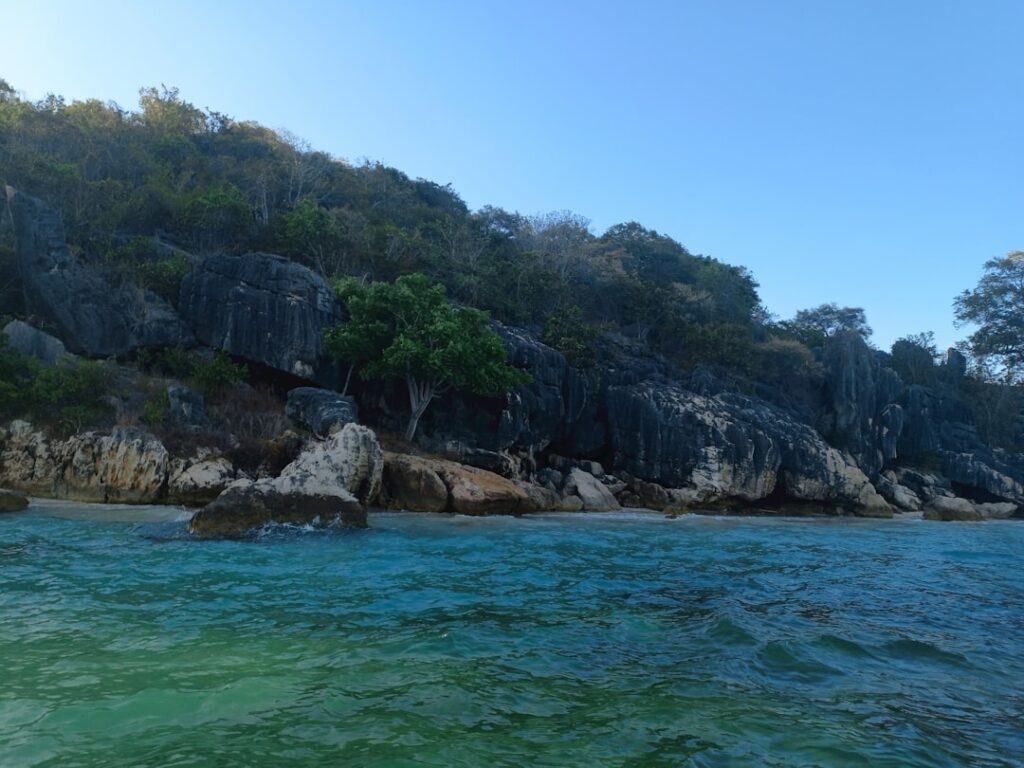
A view from the front of a boat on a body of water, Bima, Indonesia
Art, Music & Nightlife
Bima’s creative spirit is best experienced not in quiet galleries, but in explosive, communal performance. The pinnacle of this is the **Gendang Beleq** (“big drum”), a thrilling war dance and music ensemble. Imagine a dozen men playing massive, two-sided drums slung around their necks, accompanied by gongs and flutes, moving in powerful, synchronized formations. The sound is earth-shaking, meant to stir the spirit of warriors. You can see performances during major festivals like the **Bima Cultural Festival** (usually held in July) or, if you’re lucky, at local weddings. Ask at your hotel or homestay; they often know of village celebrations where you can witness this awe-inspiring tradition.
For a more tangible art form, seek out the weavers. The art of **Tenun Bima** (Bima weaving) is a revered female tradition. The most prized cloth is *Tembe Nggoli*, characterized by bold, geometric patterns in deep reds, blacks, and golds, each motif carrying specific meaning. You can visit cooperative workshops in villages like **Sambinae** or **Palibelo**, where you can watch weavers at their looms and purchase directly from the artisan. As for nightlife, Bima is not a party town. Your evening entertainment will be the simple pleasure of joining locals at a *warung kopi* for strong coffee and conversation, or strolling along the **Pelabuhan Bima** (Bima Port) as fishing boats twinkle on the dark water, a serene end to days filled with discovery.
Practical Guide
- Getting There: Sultan Muhammad Salahuddin Airport (BMU) in Bima. Garuda Indonesia and Wings Air (Lion Air) fly from Bali (Denpasar) and Lombok. Book at Skyscanner
- Getting Around: Use *bemos* (color-coded minivans) for 5,000-10,000 IDR per ride. *Bendi* (horse carts) for short trips in the city center (approx. 20,000 IDR). Rent a motorbike for 70,000-100,000 IDR/day for full freedom.
- Where to Stay: In Bima Kota for history (Lila Guesthouse near the palace). In Raba for modern amenities (Hotel La’ Biza). Check Booking.com
- Best Time: April to October (dry season). Avoid January-February, the peak of the rainy monsoon.
- Budget: A very comfortable daily budget is 300,000-500,000 IDR ($20-33 USD) covering basic lodging, local meals, transport, and entry fees.

A view of a building from across a body of water, Bima, Indonesia
What Surprises First-Time Visitors
Many travelers arrive in Bima merely as a transit point to the legendary Komodo Islands, but the first surprise is how quickly the city itself captivates you. The sheer depth of history, worn so unassumingly into the everyday, is staggering. You’ll be buying fruit from a vendor whose stall leans against a 300-year-old fortified wall. The second, delightful shock is the profound warmth of the people. While English is not widely spoken, the *Dou Mbojo* people are incredibly hospitable. A smile and a polite “*Lamba Ko*” (how are you in Bima language) will often lead to an invitation for coffee, a helpfully drawn map, or a proud explanation of a local tradition.
Finally, visitors are often surprised by the raw, cinematic beauty that lies just beyond the city limits. Within an hour’s drive, you can find yourself on **Sambori Village**’s breathtaking layered rice terraces, hiking to the summit of **Mount Soromandi** for sunrise, or relaxing on the pink-tinged sands of **Lakey Beach**, a world-class surf spot. Bima isn’t just a city; it’s the gateway to a region of astonishing and varied landscapes that most international tourists completely miss, making your discovery of it feel wonderfully personal.
Your Bima, Indonesia Questions
Is Bima safe for solo travelers, including women? Yes, Bima is generally considered very safe. Violent crime against tourists is extremely rare. As a solo traveler, especially women, you should exercise the same common sense as anywhere: avoid poorly lit, deserted areas at night, be mindful of your belongings in crowded markets, and dress modestly out of respect for the local Muslim culture. The biggest challenge is often the language barrier, so having a translation app and a basic phrasebook is a savvy move.
How many days do I need in Bima itself? Most travelers find that two full days is perfect to absorb the core of Bima. Dedicate one day to exploring the historic center of Bima Kota (the palace, Kampung Melayu, the museum) and one day to experiencing Raba’s markets, food, and perhaps a trip up to Penaraga for the views. If you wish to use Bima as a base for exploring the wider region’s beaches, waterfalls, and villages, plan for four to five days minimum.
What’s the best way to get to Komodo National Park from Bima? You have two main options. The most direct is to take a 4-5 hour shared car or bus to the port town of Sape to the east, then catch a public ferry or a faster tourist boat to Labuan Bajo on Flores, the main jump-off point for Komodo tours. Alternatively, you can book a multi-day liveaboard sailing trip directly from Bima’s port, which will sail eastwards, stopping at Komodo and Rinca islands along the way—a more adventurous and scenic route favored by seasoned travelers. Always confirm schedules a day in advance, as they can change.

Stunning view of the modern Grand Mosque in Bandung, West Java, Indonesia., Bima, Indonesia

