
Chiloé Island, Chile Weekend: Wooden Churches, Wool Sweaters & Mythical Forests (2026)
The morning mist hangs low over the Castro waterfront, where brightly painted *palafitos*—houses on stilts—reflect in the still tidal flats. You sip a steaming cup of *mate* on a wooden deck, the air thick with the briny, kelp-rich scent of the Pacific and the distant cry of seabirds. This is not mainland Chile. Over the next 48 hours, you’ll step into a world of myth, masterful carpentry, and a culture fiercely proud of its island identity.
Quick Facts Before You Go
- Best Months: December to March (Chilean summer) for the driest, warmest weather, though October-November and April offer fewer crowds and lush green landscapes.
- Currency: Chilean Peso (CLP). Approx. 1,000 CLP = 1 USD. Always have cash, especially outside Castro.
- Language: Spanish. English is not widely spoken; learning a few basic phrases is highly recommended.
- Budget: A comfortable mid-range budget is 50,000-70,000 CLP ($50-70 USD) per day, excluding accommodation.
- Getting There: Fly into El Tepual Airport (PMC) in Puerto Montt. From Santiago, it’s a 1.5-hour flight. From Puerto Montt, it’s a 30-minute drive to Pargua, then a 25-minute ferry crossing to Chiloé. Book flights at Skyscanner.
Day 1: The Heart of Castro & The Churches of Faith
You start your morning not with an alarm, but with the gentle rocking of the ferry from Pargua, watching the island’s rolling hills emerge from the mist. Stepping onto Chiloé soil, you feel the shift—the pace is slower, the air cooler, the connection to the sea immediate. Your weekend of discovery begins in Castro, the island’s vibrant capital.
- Morning (8-11am): Head straight to the Feria Artesanal y de Productores alongside the Gamboa River. This is where locals shop. Browse stalls of thick, hand-knitted wool sweaters (*chalecos*), marvel at intricate wooden crafts, and sample raw honey and jars of *murtilla* (Chilean guava) jam. A quality sweater costs 25,000-40,000 CLP. Then, walk to the iconic Iglesia San Francisco, a UNESCO World Heritage site. Its vibrant yellow facade and towering arches, built entirely of native wood in 1912, are a stunning introduction to Chiloé’s unique architectural style.
- Lunch: Restaurante Travesía on the main plaza. You must order the classic Curanto al Hoyo (if available) or the equally delicious Cazuela Chilota—a hearty stew with beef, potatoes, and a whole ear of corn. Expect to pay around 12,000 CLP for a generous portion.
- Afternoon (1-5pm): Stroll the *palafitos* neighborhood of Gamboa, snapping photos of the colorful houses perched over the water. Then, take a 15-minute taxi ride (approx. 5,000 CLP) to the Museo de Arte Moderno Chiloé (MAM). Housed in a striking wooden structure in the Parque de Esculturas, its contemporary collections offer a fascinating contrast to the island’s traditional arts. Admission is 2,000 CLP. Return to Castro and visit the Mercado Municipal for a late-afternoon *café cortado* while watching the fishing boats come in.
- Evening: For dinner, locals recommend El Chejo for incredible seafood in a cozy, unpretentious setting. Order the *Reineta a la Plancha* (grilled local fish). Afterward, join the evening *paseo* around the plaza, soaking in the relaxed local life, or enjoy a *pisco sour* at a bar overlooking the tidal flats.

Aerial view of green and white lake, Chiloé Island, Chile
Day 2: Myths, Penguins & A Forest Cathedral
Today, you venture beyond Castro into the island’s soul. The landscape shifts to winding rural roads, past sheep-dotted pastures and weathered shingled houses. The stories here are older than the nation of Chile, whispered in the wind through ancient trees.
- Morning: Start early with a *kuchen* (German-influenced cake) and coffee at a Castro bakery like Dulces Isabel. Then, rent a car for the day (approx. 30,000 CLP) or book a guided tour. Your first stop is the Parque Nacional Chiloé on the western coast. Hike the *Tepual* trail through a magical, moss-draped forest of twisted *tepú* trees—a landscape that feels straight out of a fairy tale and is said to be the dwelling of the mythical *Trauco*.
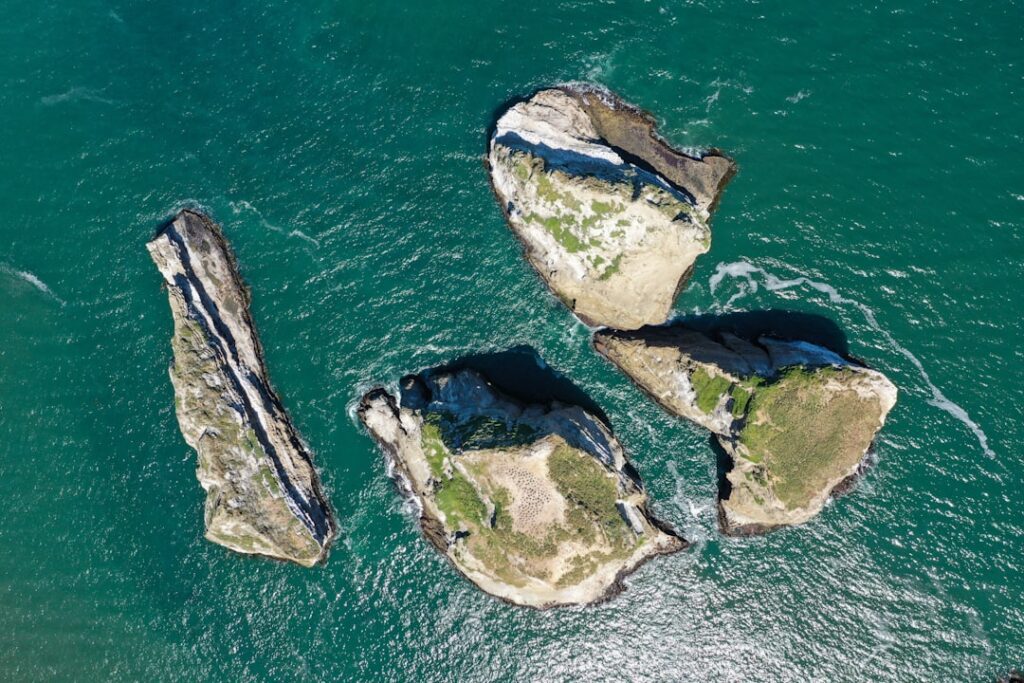
- Midday: Drive to Puñihuil, about 1.5 hours from the park. Here, from December to March, you can take a 90-minute boat tour (approx. 10,000 CLP) to see both Humboldt and Magellanic penguins sharing the same rocky islets—a rare sight. Insider Tip: Book the first tour of the day (around 10:30 am) for calmer seas and more active penguins.
- Afternoon: On your return route, stop in the charming village of Dalcahue. Its Sunday Feria Artesanal is legendary, but the artisan co-op shops around the plaza are open daily. This is your best bet for authentic, high-quality woolens and crafts. Don’t miss the simple yet breathtaking Iglesia de Dalcahue (built 1858-1902), another UNESCO gem, facing the channel.
- Final Evening: For your farewell dinner, drive to the nearby village of Tenaún, famous for its striking blue-and-white triple-towered church. Dine at a simple *cocinería* like El Bote Salvavidas, where you must try the Chapalele con Milcao—traditional potato dumplings often served with *chicharrones* (pork cracklings). As the sun sets behind the church towers, you’ll understand why Chiloé’s magic is both in its landscapes and its enduring traditions.
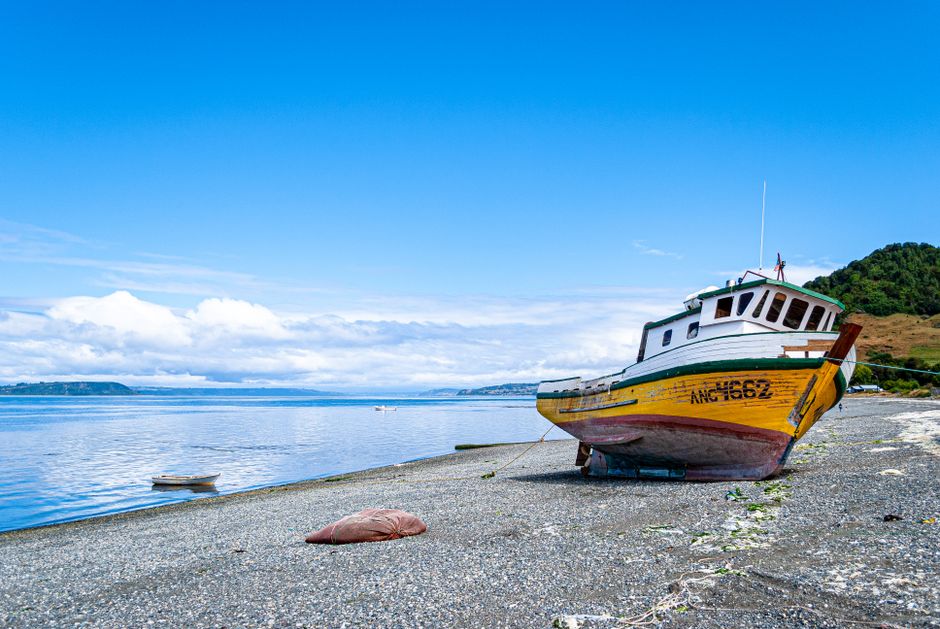
A vibrant fishing boat rests on shore against a serene ocean backdrop on Ch…, Chiloé Island, Chile
The Food You Can’t Miss
Chiloé’s cuisine is a testament to its isolation and bounty from the sea and earth. Your culinary journey is defined by potatoes (over 400 native varieties grow here), shellfish, and slow, hearty cooking. You can’t leave without trying Curanto, the island’s signature feast. Traditionally cooked in a pit in the ground (*al hoyo*), it’s a steaming mix of shellfish, meats, potatoes, and potato breads, all covered with nalca leaves. In restaurants, it’s often prepared in a pot (*en olla*). A serving costs 10,000-15,000 CLP.
For a true street food experience, look for stalls selling Milcaos Fritos—fried potato cakes that are crispy on the outside and soft within, often filled with pork. They’re the perfect, warm snack for a foggy day and cost about 1,000 CLP each. Seafood is, of course, king. Travelers often discover that the simplest preparations are the best: razor clams (*navajuelas*), giant mussels (*choros*), and the local king crab (*centolla*) are sublime. For a sit-down feast, Mar y Canela in Castro is a local institution for its creative takes on Chilote classics, with mains ranging from 8,000 to 14,000 CLP.

A stunning aerial view of a city island surrounded by a calm river under a …, Chiloé Island, Chile
Where to Stay for the Weekend
Castro Centro: The most practical base. You’ll be within walking distance of restaurants, the main church, and markets. Stay in a *palafito* guesthouse for the full iconic experience, waking up to water views. Expect hotel rates from 60,000 CLP/night for a comfortable mid-range option. Browse options on Booking.com.
The Rural *Campo*: For deep immersion, savvy visitors prefer a countryside stay (*hospedaje rural*). These are often family-run lodgings on farms, offering homemade meals and profound peace. You’ll need a car, but the starry nights and morning bird songs are unforgettable. Find unique cabins and farmstays on Airbnb, with prices from 40,000 CLP/night.
Achao (on Quinchao Island): For a quieter, more traditional alternative, take a short ferry to Isla Quinchao. Achao boasts Chile’s oldest wooden church (1740) and a slower pace. It’s ideal for a second visit or for those truly seeking to disconnect.
Before You Go: Practical Tips
- Getting Around: Renting a car is your best bet for a weekend to explore freely (from 30,000 CLP/day). *Colectivos* (shared taxis on fixed routes) and local buses connect main towns but run on limited weekend schedules. Taxis within Castro are affordable for short trips.
- What to Pack: 1) A waterproof jacket and layers—weather changes instantly. 2) Sturdy, waterproof walking shoes for muddy trails. 3) A power adapter (Chile uses Type C/L plugs, 220V). 4) A Spanish phrasebook or translation app.
- Common Tourist Mistakes: 1) Underestimating the weather. The famous phrase “si no te gusta el clima en Chiloé, espera cinco minutos” (if you don’t like the weather, wait five minutes) is absolutely true. 2) Trying to see too much. The island is large; focus on one region to avoid spending your entire weekend in a car.
- Money-Saving Tip: Order the *Menú del Día* (set lunch menu) at local *cocinerías* between 1-3 PM. For 5,000-7,000 CLP, you’ll get a starter, main, drink, and sometimes dessert—it’s the freshest, most authentic, and cheapest meal you’ll find.
Explore More Destinations
- Jozani, Tanzania on a Budget: an Ancient Forest for $35/Day (2026)
- Nsumbu, Zambia on a Budget: Wild Africa for $40/Day (2026)
- Semporna, Malaysia on a Budget: Paradise for $35/Day (2026)
- Khuzestan, Iran on a Budget: Ancient Empires for $30/Day (2026)
- Ngerulmud, Palau on a Budget: Island Majesty for $45/Day (2026)
Ready to Visit Chiloé Island?
Start planning your trip today. Compare hotels, find the best tours, and get insider tips.
Your adventure in Chiloé Island starts here →
Related Guides
Explore more destinations similar to Chiloé Island:

