
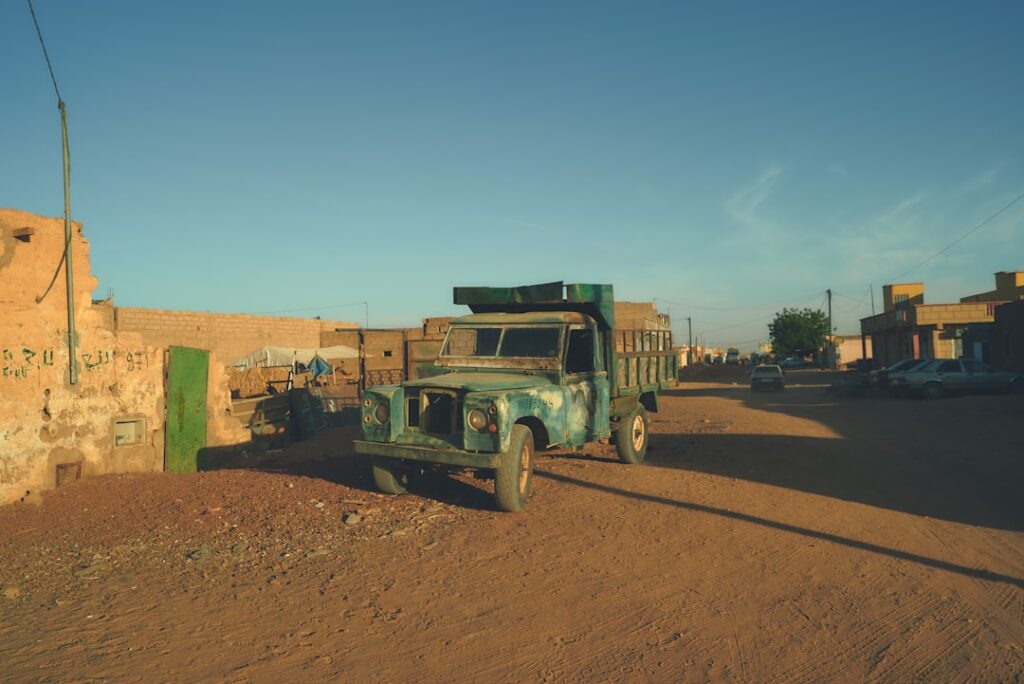
Zouérat, Mauritania’s Hidden Iron, Trains & Saharan Grandeur (2026)
While travelers dream of Marrakech’s souks or Dakar’s beaches, a handful of intrepid explorers—perhaps fewer than 500 a year—venture 700 kilometers into the Mauritanian desert to witness the world’s longest train. At sunset, the 2.5-kilometer iron ore convoy snakes through the dunes like a rust-red serpent, a spectacle of raw industry against an ancient landscape that defines Zouérat not as a tourist town, but as a living, breathing heart of the Sahara.
Why Zouérat, Mauritania Stands Out

An old building with a windmill in the background, Zouérat, Mauritania
- Historic Architecture: The SNIM mining company’s original administrative buildings from the 1960s stand as stark, functional monuments to the town’s founding purpose and economic lifeblood.
- Cultural Scene: The vibrant weekly *souk* (market) near the city center, where Mauritanian traders and local Imraguen fishermen from the coast converge, offers a genuine slice of daily life.
- Local Specialties: You must try *Thieboudienne*, the national dish of fish, rice, and vegetables, often prepared with locally caught mullet.
Pro Tip: The absolute best time for photography and comfortable exploration is during the shoulder months of October to November or March to April. Daytime temperatures are a manageable 25-30°C (77-86°F), and the brutal summer heat or chilly desert nights are avoided. This is also when the light is golden and perfect for capturing the trains at dawn or dusk.
Map of Zouérat, Mauritania
Use these interactive maps to explore Zouérat, Mauritania and plan your route:
📍 View Zouérat, Mauritania on OpenStreetMap
🗺️ Open Zouérat, Mauritania in Google Maps
Planning Your Trip: Practical Essentials
Getting There and Around
- By Air: Zouérat Airport (IATA: OUZ) receives domestic flights from Nouakchott on Mauritania Airlines. Flights are infrequent and subject to change. A taxi from the airport to the town center costs about 500 MRU (approx. $13). Book flights at Skyscanner for best deals.
- By Train: The legendary Iron Ore Train from Nouadhibou is the iconic approach. The passenger car is a basic carriage attached to the freight cars; the 12-15 hour journey is an adventure, not luxury. Bring water, food, and protection from dust. Reserve tickets at Trainline or the national railway website.
- By Car: A 4×4 with an experienced driver is essential for the desert tracks from Atar or Nouakchott. The RN2 road is paved but remote. Parking is informal. Compare car rentals at RentalCars.com for pick-up in Nouakchott.
- Local Transport: Shared taxis (*taxis brousses*) and private taxis are the only options. Negotiate fares before departure. A short trip within town costs 100-200 MRU ($2.50-$5). Check official city transport websites for passes and schedules.
Best Time to Visit
Zouérat’s climate is extreme Saharan. Your experience hinges entirely on timing, with a narrow window offering ideal conditions for exploration.
| Season | Weather | Highlights |
|---|---|---|
| Summer (Jun–Aug) | Scorching: 35-45°C (95-113°F), intense sun, very dry. | Fewest visitors, but outdoor activity is severely limited to early morning/late evening. Not recommended for most. |
| Winter (Dec–Feb) | Cold days: 15-25°C (59-77°F), freezing nights often below 5°C (41°F). | Pleasant daytime exploration, but you’ll need serious bedding for the train or basic hotels. Clear, crisp skies. |
| Shoulder (Apr–May/Sep–Oct) | Ideal: 20-30°C (68-86°F), warm days, cool nights, minimal wind. | The sweet spot. Perfect for all-day excursions, train photography, and comfortable desert nights. Optimal travel conditions. |
Budgeting for Zouérat, Mauritania

National flags of Mauritania and Seychelles waving against a clear blue sky, Zouérat, Mauritania
| Category | Budget | Mid-range | Luxury |
|---|---|---|---|
| Accommodation | 5,000 – 8,000 MRU ($130-$210) for a basic guesthouse | 10,000 – 15,000 MRU ($260-$390) for a comfortable hotel | Limited true luxury; 20,000+ MRU ($520+) for best available |
| Meals | 500 – 1,000 MRU ($13-$26) at local eateries | 1,500 – 2,500 MRU ($39-$65) at hotel restaurants | 3,000+ MRU ($78+) for private guided meals |
| Transport | Shared taxis, 200 MRU/day ($5) | Private taxi hire, 2,000-4,000 MRU/day ($52-$104) | Private 4×4 with driver/guide, 6,000+ MRU/day ($156+) |
| Activities | Free train viewing, market visits | Guided mine perimeter tour (~3,000 MRU / $78) | Multi-day desert excursion from Zouérat (10,000+ MRU / $260+) |
| Daily Total | 6,000 – 10,000 MRU ($156-$260) | 15,000 – 25,000 MRU ($390-$650) | 35,000+ MRU ($910+) |
Top Attractions and Must-See Sights
| Attraction | Description | Hours | Entry Fee |
|---|---|---|---|
| The Iron Ore Train Viewing | Witness the 2.5km train being loaded at the station or snaking through the desert dunes at sunset. | Dawn & Dusk for best light; loading happens intermittently day/night | Free (from public vantage points) |
| Zouérat Central Market | A bustling weekly market where the mining community, nomadic herders, and traders meet for goods and gossip. | Most active Friday mornings; general shops open 8 AM – 1 PM, 4 PM – 8 PM | Free |
| Kédia d’Idjil | The massive iron ore mountain mined since 1963; tours of the periphery reveal the scale of the operation. | Access via guided tour only, typically mornings | ~3,000 MRU ($78) for a guided tour |
| Desert Panoramas from Town Periphery | Hike to the rocky hills surrounding town for breathtaking, uninterrupted views of the Sahara expanse. | Sunrise to Sunset (avoid midday heat) | Free |
3-Day Itinerary: Zouérat, Mauritania’s Highlights & Hidden Gems
Day 1: Industrial Heart & Urban Pulse
- Morning (7-9 AM): Start early at the SNIM train station to see the empty ore cars being prepared. The morning light is sharp and the activity is constant. Your best bet is to ask a taxi driver for the best public viewing spot; a small tip (100 MRU) for guidance is appreciated.
- Afternoon (12-3 PM): Explore the Central Market. For lunch, find a small local restaurant like **Restaurant Salam** for a hearty plate of *Mafé* (peanut stew with meat) for about 800 MRU.
- Evening (6-8 PM): This is non-negotiable. Travelers often discover the most profound experience is watching the fully-loaded train depart towards Nouadhibou at sunset. Position yourself on the dunes south of town. Afterwards, have dinner at your hotel restaurant, as they reliably offer *Thieboudienne*.
Day 2: Desert Giants & Local Insights
- Morning (8 AM): Arrange a guided tour (approx. 3,000 MRU) to the periphery of the **Kédia d’Idjil** mine. You’ll see the colossal machinery and learn about the town’s raison d’être. Wear closed-toe shoes and bring a scarf for dust.
- Afternoon (1 PM): Return to town for a late lunch at **Cafétéria El Wiam**, known for its grilled chicken and chips. Spend the rest of the afternoon visiting smaller local shops away from the main drag.
- Evening: Enjoy a more relaxed evening. Savvy visitors know to simply find a spot at a local tea shop, where the ritual of preparing sweet Mauritanian tea (*ataya*) over three rounds offers a window into local social life.
Day 3: Vast Horizons & Departure
- Morning (7 AM): Hire a taxi (approx. 2,000 MRU) for a short trip to the rocky outcrops on the town’s edge. A 30-minute hike rewards you with a 360-degree panorama of the desert, a silent contrast to the industrial buzz.
- Afternoon (12 PM): Enjoy a final lunch, perhaps trying *Méchoui* (slow-roasted lamb) if available. Double-check your onward travel arrangements—whether it’s a flight time or your spot on the Iron Ore Train.
- Evening: Either depart on the overnight train (an experience in itself) or, if flying out the next day, have a farewell dinner and rest. The desert silence at night here is profound.
Cultural Insights & Etiquette
- Language: Arabic (Hassaniya dialect) is official; French is widely used in business. Key phrases: “As-salamu alaykum” (Hello), “Shukran” (Thank you), “Kayf halak?” (How are you?).
- Customs: Hospitality is sacred. If offered tea or food, it is polite to accept at least a little. Always use your right hand for eating and greeting. Public displays of affection are frowned upon.
- Tipping: Not universally expected but appreciated for good service. Round up taxi fares, leave 5-10% at sit-down restaurants, and tip guides 500-1000 MRU for a half-day tour.
- Dress Code: Conservative dress is key. For both men and women, loose-fitting clothing covering shoulders and knees is respectful. Women may draw less attention with a headscarf.
- Business Hours: Government hours: 7:30 AM – 2:30 PM, Sunday-Thursday. Shops often close for a long lunch (1 PM – 4 PM) and reopen until 8 PM. Friday is the holy day, with reduced hours.
Where to Eat: Zouérat, Mauritania’s Best Bites
Dining in Zouérat is functional and hearty, reflecting its working-town nature. You won’t find fine dining, but you will find generous portions of Mauritanian staples. Most eating is done in hotel restaurants or small, family-run *cafétérias*.
Must-Try Local Specialties
- Thieboudienne: The national dish: seasoned fish, rice, and vegetables cooked in a tomato sauce. The best versions are often found in hotel restaurants like the **Restaurant de l’Amitié**.
- Méchéui: Whole lamb or goat slow-roasted over an open fire, usually for special occasions. Ask at your hotel if any local families or larger restaurants are preparing it.
- Dates & Goat Cheese: A classic Saharan snack. The weekly market is the best place to buy fresh, locally sourced dates of exceptional quality.
Restaurant Recommendations by Budget
| Type | Restaurant | Specialty | Price Range |
|---|---|---|---|
| Budget | Cafétéria El Wiam (City Center) | Grilled meats, omelets, and fries | 500 – 1,200 MRU ($13-$31) |
| Mid-range | Restaurant de l’Amitié (in Hotel de l’Amitié) | Reliable Thieboudienne and French-Mauritanian dishes | 1,500 – 2,500 MRU ($39-$65) |
| Fine dining | Hotel El Waha Restaurant | The most varied menu in town, best for a sit-down dinner | 2,500 – 4,000 MRU ($65-$104) |
Where to Stay
Accommodation is basic but functional. Most hotels are geared towards mining company employees and contractors. Focus on cleanliness and air conditioning/heating over luxury. Compare prices and book at Booking.com or Airbnb for apartments (though Airbnb options are very limited here).
Best Neighborhoods for Accommodation
- City Center: Close to markets, taxi stands, and basic restaurants. It’s convenient but can be noisy. Best for budget travelers who want to be in the thick of things. (e.g., area near the main market).
- Near SNIM Facilities: Quieter, with slightly better-equipped hotels like **Hotel El Waha**. This area suits mid-range travelers and those on business. It’s a short taxi ride from the center.
- There is no distinct third tourist neighborhood. Most hotels are clustered in the two areas above. Seasoned travelers prefer to choose a specific well-reviewed hotel rather than a neighborhood.

Royal guards on horseback in traditional uniforms at the mausoleum in Rabat, Zouérat, Mauritania
FAQs: Your Zouérat, Mauritania Questions Answered
1. Is Zouérat, Mauritania safe at night?
Zouérat is generally safe, but it’s a remote industrial town. Practical advice is key: avoid walking alone at night in poorly lit areas, use taxis after dark, and keep valuables secure. Petty crime is rare but can occur. The main risk is the harsh environment itself—getting lost or stranded.
2. What currency is used and are credit cards accepted?
The Mauritanian Ouguiya (MRU) is the currency. Cash is king in Zouérat. Very few, if any, establishments accept credit cards. You must bring enough cash (Euros or USD to exchange, or MRU) for your entire stay. There are a couple of banks (e.g., BIMA, Attijari) with ATMs, but they cannot be relied upon.
3. How do I get from the airport to the city center?
Zouérat Airport is small. Your only option is a taxi, which will be waiting for arriving flights. Negotiate the fare before getting in; expect to pay 400-600 MRU ($10-$16) for the 10-15 minute ride to the town center. Book airport transfers at

