
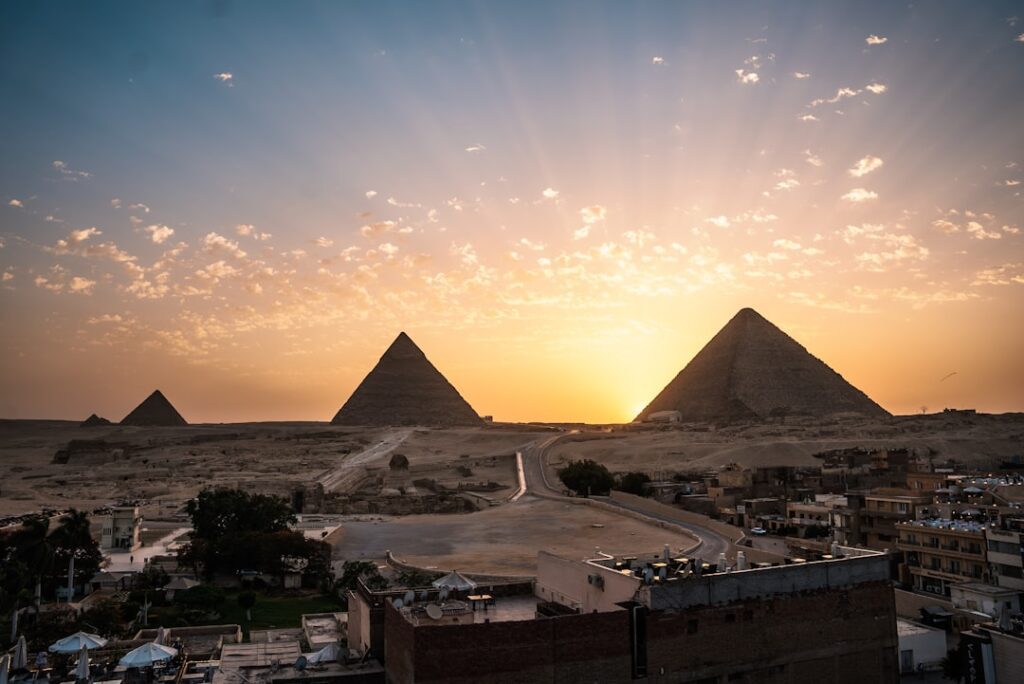
Pyramids of Giza, Egypt: Stunning Timeless Wonder, Desert Sunsets & Living History (2026)
Sunrise at the Giza Plateau reveals a truth no photograph can capture: the Great Pyramid, built around 2560 BCE, casts a shadow so precise it was once a timekeeping instrument. The scent of desert dust mixes with the distant call to prayer from nearby Nazlet el-Samman. This is not a static museum but a 4,500-year-old landscape where history is a tangible, humbling presence under the vast Egyptian sky.
Why Pyramids of Giza, Egypt Stands Out

Person walking near pyramids during daytime, Pyramids of Giza, Egypt
- Historic Architecture: The Great Pyramid of Khufu, circa 2560 BCE, is the sole surviving wonder of the Ancient World and was the tallest man-made structure for over 3,800 years.
- Cultural Scene: The annual Sound and Light Show transforms the pyramids into a cinematic canvas, narrating pharaonic legends in multiple languages against the monumental backdrop.
- Local Specialties: You must try Koshari, a hearty mix of pasta, rice, lentils, and chickpeas topped with spicy tomato sauce and crispy onions, at a local Cairo eatery after your visit.
Pro Tip: The site opens at 8 AM. Savvy visitors know to arrive at 7:30 AM to be first in line. Head directly to the Great Pyramid or the Sphinx to experience them in relative solitude before the tour buses arrive around 9:30 AM. The light for photography is also sublime at this hour.
Map of Pyramids of Giza, Egypt
Use these interactive maps to explore Pyramids of Giza, Egypt and plan your route:
📍 View Pyramids of Giza, Egypt on OpenStreetMap
🗺️ Open Pyramids of Giza, Egypt in Google Maps
Planning Your Trip: Practical Essentials
Getting There and Around
- By Air: Cairo International Airport (CAI) is the main gateway, served by EgyptAir and major international carriers. A pre-booked taxi to Giza costs 250-350 EGP. Book flights at Skyscanner for best deals.
- By Train: Not applicable directly to the pyramids. Travelers take a train to Cairo’s Ramses Station, then a taxi (45-minute drive) to Giza.
- By Car: Driving in Cairo is challenging for visitors. Your best bet is to hire a car with a driver for the day (approx. 600-800 EGP). Compare car rentals at RentalCars.com.
- Local Transport: Use Uber or Careem app for reliable, metered rides from Cairo. Local micro-buses are cheap but confusing for first-timers. A one-way Uber from downtown Cairo to Giza costs about 100-150 EGP.
Best Time to Visit
The ideal visiting window balances bearable heat with manageable crowds. Winter offers pleasant days but peak tourism, while summer brings intense, draining heat.
| Season | Weather | Highlights |
|---|---|---|
| Summer (Jun–Aug) | Extremely hot (95-104°F / 35-40°C), dry, blazing sun. | Fewest crowds, very early mornings are essential, Sound and Light Show in pleasant evenings. |
| Winter (Dec–Feb) | Mild days (65-70°F / 18-21°C), cool nights, occasional rain. | Most comfortable for daytime exploration, but also the busiest with long queues at tomb entrances. |
| Shoulder (Mar–May/Oct–Nov) | Warm days (75-85°F / 24-29°C), pleasant evenings. | The sweet spot: good weather, thinner crowds than winter, ideal for full-day exploration. |
Budgeting for Pyramids of Giza, Egypt

Pyramid of egypt during daytime, Pyramids of Giza, Egypt
| Category | Budget | Mid-range | Luxury |
|---|---|---|---|
| Accommodation | Hostel in Cairo: 200-400 EGP | 3-star Giza hotel: 800-1500 EGP | 5-star pyramid-view hotel: 3000+ EGP |
| Meals | Street food/Koshari: 30-60 EGP | Local restaurant meal: 150-250 EGP | Fine dining with view: 600+ EGP |
| Transport | Public microbus/Uber pool: 20-50 EGP | Private taxi for day: 600 EGP | Private driver & guide: 1500+ EGP |
| Activities | Plateau entry: 240 EGP | Entry + Great Pyramid interior: 440 EGP | Private guided tour + camel ride: 1200+ EGP |
| Daily Total | 500-750 EGP | 2000-3000 EGP | 6000+ EGP |
Top Attractions and Must-See Sights
| Attraction | Description | Hours | Entry Fee |
|---|---|---|---|
| Great Pyramid of Khufu | Enter the ancient passageways (if you’re not claustrophobic) to see the King’s Chamber with its empty sarcophagus. | 8 AM – 4 PM (Interior access often closes by 3 PM) | Plateau: 240 EGP; Interior: +200 EGP |
| The Great Sphinx | The legendary limestone guardian with the body of a lion and head of a pharaoh, gazing eternally eastward. | 8 AM – 5 PM | Included in Plateau ticket |
| Pyramid of Khafre | Appears tallest due to its higher foundation and retained summit casing stones, with a more complex internal structure. | 8 AM – 4 PM | Included in Plateau ticket |
| Solar Boat Museum | Houses the stunning, meticulously reconstructed cedarwood boat meant to carry Khufu into the afterlife. | 9 AM – 4 PM | 100 EGP (separate ticket) |
3-Day Itinerary: Pyramids of Giza, Egypt’s Highlights & Hidden Gems
Day 1: Monuments & The Plateau
- Morning (7:30 AM): Arrive at the Giza Plateau entrance. Your first stop is the Great Pyramid. Consider entering the interior (440 EGP total) right at opening to avoid lines.
- Afternoon (12 PM): Walk to the Panoramic Point for the classic three-pyramid photo. Have lunch at **Restaurant Khufu’s** just outside the site for decent Egyptian fare and cold drinks. Then, explore the Pyramid of Khafre and the Valley Temple beside it.
- Evening (6 PM): Return to the Sphinx area for quieter contemplation. For dinner, head to **Andrea El Mariouteya** in Giza for fantastic grilled chicken and mezze in a garden setting.
Day 2: Deeper History & Local Culture
- Morning (9 AM): Visit the Solar Boat Museum (100 EGP). Then, take a short camel ride (agree on price firmly beforehand, ~200 EGP for 30 mins) from the stable area behind the Panoramic Point.
- Afternoon (1 PM): Taxi to the nearby **Saqqara necropolis** (30 mins, ~150 EGP Uber). Explore the Step Pyramid of Djoser, the world’s oldest stone monument. Lunch at the simple but clean cafeteria on site.
- Evening (7 PM): Attend the **Sound and Light Show** at the pyramids (check languages for showtimes). Book tickets (approx. $15) in advance. Dinner at **Felfela** in downtown Cairo for iconic Egyptian street food in a sit-down setting.
Day 3: Cairo’s Treasures
- Morning (9 AM): Uber to the **Egyptian Museum in Tahrir Square** (180 EGP entry). Spend 3 hours marveling at the Tutankhamun treasures. Don’t miss the Royal Mummy Room (extra 180 EGP).
- Afternoon (1 PM): Lunch at **Kazaz** for excellent Shawarma. Then, explore the labyrinthine **Khan el-Khalili bazaar** in Islamic Cairo. Practice your bargaining skills.
- Evening (6 PM): Enjoy a traditional mint tea at the historic **El Fishawy Café** in the bazaar. For a final dinner, try **Abou El Sid** in Zamalek for upscale, authentic Egyptian cuisine in a decadent setting.
Cultural Insights & Etiquette
- Language: Arabic is official. Key phrases: “Shukran” (Thank you), “Salaam Alaikum” (Hello, peace be upon you), “La, shukran” (No, thank you) to vendors. English is widely understood in tourist areas.
- Customs: Always use your right hand for eating, greeting, and exchanging money. It’s polite to remove your shoes when entering someone’s home. Public displays of affection are frowned upon.
- Tipping: “Baksheesh” (tipping) is ingrained. Tip 5-10 EGP for small services (bathroom attendant), 10-15% in restaurants, 50-100 EGP/day for guides and drivers.
- Dress Code: Modesty is key. Wear clothes covering shoulders and knees. Loose, breathable fabrics are best for the heat and culture. A scarf is useful for women.
- Business Hours: Many sites close for Friday prayers (12 PM – 1 PM). Government sites/museums typically open 9 AM – 4 PM. Bazaars stay open late.
Where to Eat: Pyramids of Giza, Egypt’s Best Bites
Egyptian cuisine is a hearty, flavorful mix of Mediterranean and Middle Eastern influences. Dining is a social, leisurely affair. You’ll find everything from street-side carts serving Ful Medames (fava beans) for breakfast to upscale restaurants reimagining ancient recipes.
Must-Try Local Specialties
- Koshari: The national comfort food. For the best, head to **Koshari Abou Tarek** in downtown Cairo—a multi-story temple dedicated to this one dish.
- Molokhia: A green soup made from jute leaves, often served with rabbit or chicken. Try it at a local family restaurant like **Abou El Sid**.
- Umm Ali: A deliciously rich bread pudding dessert. The version at the **Mena House Hotel** afternoon tea, with a pyramid view, is legendary.
Restaurant Recommendations by Budget
| Type | Restaurant | Specialty | Price Range |
|---|---|---|---|
| Budget | Koshari El Tahrir (Downtown Cairo) | Fast, delicious Koshari in a no-frills setting | 30-50 EGP |
| Mid-range | Andrea El Mariouteya (Giza) | Grilled meats, pigeon, and extensive mezze in a garden | 150-250 EGP per person |
| Fine dining | 9 Pyramids Lounge (Giza Plateau) | Modern Egyptian cuisine with an unobstructed, breathtaking view of all nine pyramids | 600+ EGP per person |
Where to Stay
Your choice is between the convenience of Giza (pyramid views) or the vibrancy of central Cairo (more dining/nightlife). Staying in Giza allows for multiple, easy visits to the plateau at different times of day. Compare prices and book at Booking.com or Airbnb for apartments.
Best Neighborhoods for Accommodation
- Giza (Pyramids Area): Characterized by direct access and iconic views. Pros: You can walk to the site, experience sunrise/sunset easily. Cons: Fewer dining/nightlife options, more tourist-focused. Suits: First-time visitors, photographers, those wanting a dedicated pyramid experience.
- Zamalek (Cairo): An upscale, leafy island neighborhood on the Nile. Pros: Great restaurants, cafes, galleries, quieter than downtown. Cons: A 30-45 minute drive to Giza. Suits: Travelers wanting a comfortable, cosmopolitan base with good amenities.
- Downtown Cairo: The bustling, historic city center. Pros: Central location, close to Egyptian Museum, vibrant street life, budget options. Cons: Noisy, chaotic, heavy traffic to Giza. Suits: Budget travelers and those who thrive on constant urban energy.

A very tall pyramid sitting in the middle of a desert, Pyramids of Giza, Egypt
FAQs: Your Pyramids of Giza, Egypt Questions Answered
1. Is Pyramids of Giza, Egypt safe at night?
The Giza Plateau itself closes at night. The surrounding areas of Giza city are generally safe, but it’s wise to use common sense. Stick to well-lit areas, use registered taxis or Uber, and avoid walking alone in deserted streets. The Sound and Light Show is a supervised, safe evening activity within the complex.
2. What currency is used and are credit cards accepted?
The Egyptian Pound (EGP) is the local currency. As of mid-2024, 1 USD ≈ 48 EGP. While major hotels, upscale restaurants, and tour operators accept credit cards, cash is king at the pyramids site, in taxis, and at local markets and eateries. Always carry small bills for entry fees, tips, and vendors.
3. How do I get from the airport to the Giza pyramids area?
Cairo International Airport (CAI) is about a 45-minute to 1.5-hour drive to Giza, depending on traffic. Your options are: a pre-booked private transfer (approx. 400-500 EGP), an official airport taxi (negotiate firmly, expect 300-400 EGP), or Uber/Careem (most reliable and metered, 250-350 EGP). Book airport transfers at GetYourGuide for convenience.
4. Do I need to speak the local language?
No. English is widely spoken in all tourist areas, including the Giza site, hotels, and major restaurants. Learning a few basic Arabic phrases (hello, thank you, how much) is greatly appreciated by locals and can enhance your interactions, especially in markets.
5. What’s the appropriate dress code?
Dress modestly and for the climate. For both men and women, clothing covering shoulders and knees is required and respectful. Lightweight, loose-fitting trousers or long skirts and breathable tops are ideal. A wide-brimmed hat, sunglasses, and comfortable walking shoes are non-negotiable for exploring the exposed plateau.

