
Where the Mountain Breathes: The Timeless Allure of Zawiya Ahansal (2026)
In the early 1700s, a Sufi mystic named Sidi Said Ahansal climbed into the hidden folds of Morocco’s central High Atlas and planted a small earthen sanctuary beside the raging Assif Ait Bou Oulli river. He came not to conquer, but to arbitrate—and as tribal disputes settled at his feet and caravans began paying tribute for safe passage, his zaouia grew from a hermit’s shelter into a politically sacred hub. Generations of scholars and pilgrims have followed those same riverbanks ever since, and when you stand on the stone terrace outside the old shrine, with the snow-tipped bulk of M’Goun looming above, you will feel exactly why this spot holds such gravitational pull.
The Story Behind Zawiya Ahansal, Morocco
You’re about to encounter a place that defies the tourist trail entirely. Zawiya Ahansal sits in the heart of the M’Goun massif, a stark and breathtaking region where red-earth villages cling to sheer canyon walls and the only sounds are rushing water, wind, and the distant bell of a mule. Travelers often discover that this had been no random sanctuary choice. The Ahansal family—a lineage of holy men known for their piety and steely independence—carved out a socio-political niche in the 17th century that made this otherwise isolated canyon one of the most strategically important inland routes in pre-colonial Morocco.
As the Sultans of Marrakech struggled to project authority beyond the mountains, the Zaouia of Ahansal became an autonomous spiritual state. Its leaders secured a monopoly on local trade, arbitrating disputes between the mighty Ait Atta, Ait Bou Oulli, and Ait Isfoul confederations who fought over grazing rights on the M’Goun plateaus. Historians estimate that thousands of mules laden with dates, salt, livestock, and silver crossed through this valley each season, channelling a significant tax fund to the “Saints of Ahansal” who could both protect caravans and bomb them. It was a delicate dance of charisma, threats, and sage judgment that made the zaouia wealthy.
The modern era pulled this bizarre mountain state into a harsher reality. Under French Protectorate pressure in the 1930s, the French colonial forces constructed a notable road through the Ait Bou Oulli valley to quell the region’s warlords and finally dismantle the sanctuary’s political autonomy. The ritual authority of the Ahansal family declined, but the pilgrimage circuits—especially the annual moussem of Sidi Said—remained woven into the cultural fabric of the High Atlas tribes. Locals recommend visiting during that festival, usually aligned with the Islamic month of seasonal transition, when the graveyard and the white-washed tomb come alive with incense, drums, and proud identity. On a quiet day, though, you’ll feel the old spirits in the cool shadows of the mud-brick lanes, a legacy of centuries in a ghostly calm.
Neighborhood by Neighborhood

El Badi Palace in Marrakech under a clear blue sky with a reflecting pool i…, Zawiya Ahansal, Morocco
Al-Qasba: The Sanctuary’s Heartbeat
Yours will likely be the first steps into Al-Qasba, the fortified heart of Zawiya Ahansal around the saint’s tomb. The approach is a sweeping descent down a gravel track that cuts into ochre slopes. You will all but hold your breath as a dense cluster of pale earthen towers come into view, stacked like dusty gems on terraces above the river. The lanes here are no wider than a single pair of shoulders, and in the afternoons, the bluewash on door frames shimmers under the hard sun. This is the epicenter of religious life, marked by the domed tomb of Sidi Said and a small, austere mosque that usually admits only local worshippers. You’ll notice carved inscriptions on doorways—baraka blessings—and admire how the architecture uses no wood beams at all: ceilings are made of woven tamarix branches sealed with packed clay, a technique you’ll see replicated in every home in the valley.
The daily rhythm here is slow, focused around the morning trip of women and girls to the communal spring head, an important social space. Visitors often discover that the true heart of the quarter is not a square but the *seguias*—narrow irrigation channels that flash silver along every lane—and the almond groves they feed. Neighbors chat as they wash clothes, mint tea trays are handed across low doors, and travelers will find that a simple *”salam alaykum”* from a passing boy carrying a goat opens more doors than any guidebook.
The Souq & Trackside Cluster
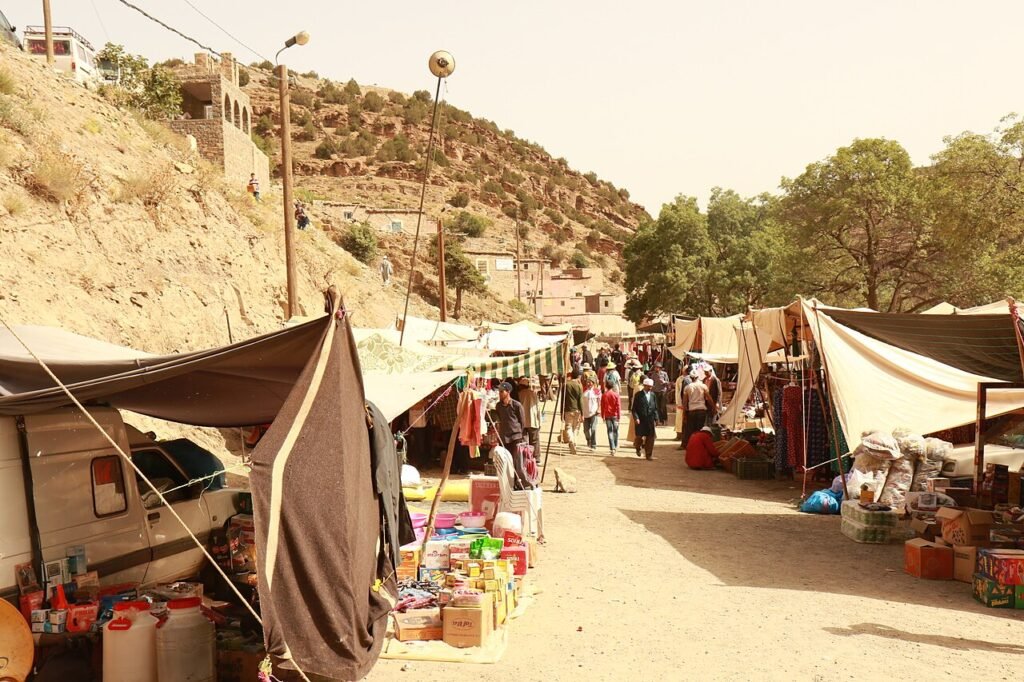
Stretch your legs south along the main dirt track and you’ll find the functional heart of the village—a somewhat newer collection of dwellings built around the track that has replaced the ancient mule road. This is where you will find the cooperative shop, the one satellite phone hub, a dusty village square with graffiti in Arabic, French, and Berber, and the guesthouse where you’ll most likely lodge. The vendors are descendants of the very traders who once paid the zaouia’s tolls, and their small shelves hold stacked Berber carpets, torches, toothpaste, buckets, and tins of gas.
During the weekly *suq*, which locals recommend timing your visit around, you’ll see donkeys loaded with firewood, men in thick hooded djellabas exchanging livestock news, and two or three mobile-meat stalls where fresh mutton is hacked straight onto wooden countertops. A notice board near the track records the comings and goings of the few hired 4x4s that provide the only motorized link to the outside world. This cluster acts as the village’s network center; seasoned travelers know that sharing tea here with the morning dispatch of muleteers is the key to arranging excursions into the mountains or even deeper into the Ait Bou Oulli gorge.
The Upper Hamlets of Ait Isfoul
Across the river, scrambling up a long, cobbled switchback, you’ll spot the scattered hamlets locals loosely call “Ait Isfoul” — although separate names apply to each terrace group. These settlements consist of a few dozen tightly clustered homes built into cliff faces, blurred so beautifully into the landscape that they’re easy to mistake for rock formations. The view from their upper irrigation terraces is staggering: the entire valley of Zawiya Ahansal unfolding below, river twisting the color of sage, and layers of mesas beyond. If you can walk up here at dusk, you will witness a symphony of golden light washing over the red-brown village walls, while shepherds whistle their flocks home.
Walk through these hamlets at your own pace, and you’ll find old women weaving olive-wood *tagines*, men carving curved wooden dippers from walnut roots, and children who will eagerly sell you a pile of walnuts for a handful of dirham. The architecture here is older and slightly more organic than in the main village, with walls sagging under the weight of centuries. Cooking smoke spills from roof-hatches, and the smell of baking barley bread mixes with wild mint and pine. Some travelers make the mistake of rushing down before dark, but locals recommend taking an evening walk among these high terraces—when the day’s heat fades and the M’Goun massif glows pink, the subtle peace of this place will change the way you understand village life.
The Local Table: What the Ahansal Natives Actually Eat
Food in this remote valley is a story of survival and subtle genius. There are no white-tablecloth restaurants here; instead, you’ll be fed as a guest in the plush-carpeted interior of a local family home or at the length of tables in one of the two simple guesthouses. The cuisine is built on mountain barley, lamb, almonds, olive oil, wild thyme, and honey—ingredients that thrive on unforgiving slopes. Your host will almost certainly serve *tansilt*, a thick clay-plate grilled barley and salt bread, paired with *amlou* (a sweet, rich paste of roasted almonds and argan oil—although locals more often use walnut oil up here) and a smear of fresh goat butter.

Capture of historic fortified walls in Rabat, Zawiya Ahansal, Morocco
Lunch will usually be a slow-simmered *tagine* of lamb, prunes and sesame, or a simple stew of beans and onions enriched with a spoonful of smen—that intensely pungent aged butter that turns skeptical first-time visitors into converts. At dinner, you’ll encounter the dish that savvy travelers will dream about for years: *berkoukes*. It’s a hearty mountain couscous, hand-rolled into fat pearls and slow-cooked with chicken, pumpkin, carrots, and a medley of the valley’s wild herbs, infused with a pinch of saffron from Marrakech. You’ll wait for the last moment when the host drizzles warm spiced oil over the whole bowl. For the most authentic experience, ask to eat in the private courtyard of Mama Idir’s mud-brick house opposite the guesthouse—she has been cooking for trekkers for two decades, and her family’s *tagine* is the one that guides will specifically request when they need to recover their strength.
What makes the table here special is not just the raw flavours, but the ritual. Meals are served in deep, shared dishes, and everyone eats from the same side; bread is broken, never cut. You will be pressed to eat seconds and then thirds, not as a courtesy but as a genuine reflection of the Berber reverence for hospitality. Don’t be surprised if, halfway through a warm evening, a neighbour brings over a tray of sweet mint tea and fresh walnuts to celebrate your arrival. This is a place where the meal is not merely about satiating hunger, but about the gradual weaving of trust and community—something you cannot buy in Marrakech.
Art, Music & Nightlife
When the sun sets and the valley plunges into a fantastic, velvety darkness, Zawiya Ahansal’s “nightlife” reveals itself as something far more primal than a bar scene. In local homes, families gather around open fires, and on special occasions, the great Berber tradition of *ahidous* takes over the terrace. This is a group dance of hypnotic, linked-step circles, with men and women side by side, voices rising in call-and-response poetry accompanied by the sharp *taarija* (a small hand drum) and the beating of palms. If you happen to visit during the three-day Moussem of Sidi Said in late spring, your chances of stumbling upon an impromptu *ahidous* are very high; travelers often report that the haunting polyphonic chants echoing against the canyon walls felt like the very soul of the Atlas.
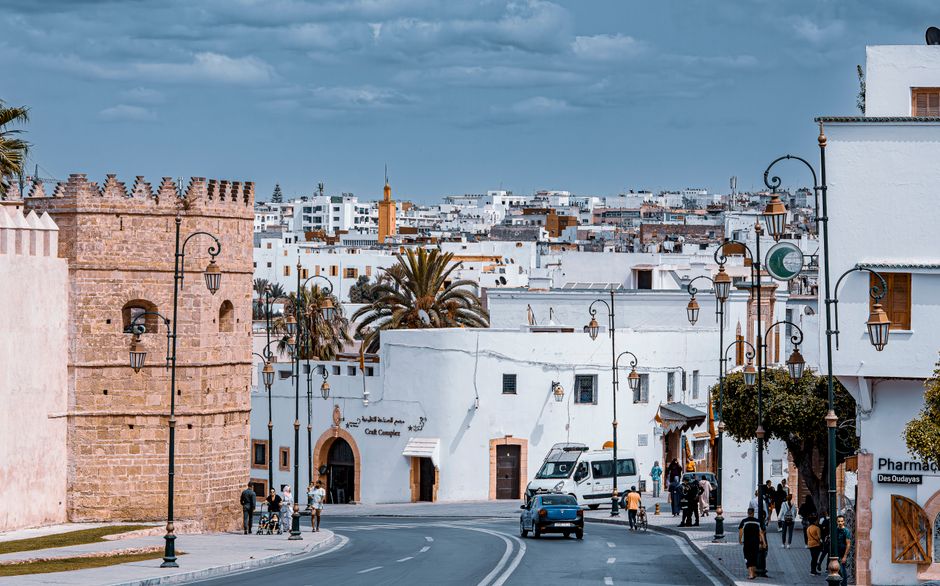
View of historic city street in Rabat, Zawiya Ahansal, Morocco
The creative energy here is not in galleries, but in the handicrafts of daily life. Berber women in the cluster of hamlets around Zawiya Ahansal weave the distinctive Ait Bou Oulli rugs—loose, soft, and speckled with natural dyes of henna, indigo, and oak gall—making them prized collector’s items sold in Marrakech at a considerable mark-up. Buy one here and your evening treasury will be genuine, woven by hands that know the secret of each knot. Musicians from the village also pride themselves on the *rhaita* (a piercing oboe-like instrument

