
Beyond the Great Wall: Why Panshan Beckons the Savvy Traveler to Tianjin’s Rustic Soul (2026)
In 1749, Emperor Qianlong of the Qing Dynasty made his sixth pilgrimage to a mountain that would eventually capture his heart more times than any other destination in his vast empire. Standing at the Temple of Cloudy Rain, overlooking the steep climbs of granite and pine, he reportedly uttered a phrase that locals still whisper with pride today: “If you have seen Panshan, why bother with Jiangnan?”—comparing this humble mountain retreat to the legendary garden landscapes of southern China. Over his lifetime, the emperor would ascend Panshan’s weathered stone steps thirty-two times, leaving behind a legacy of poetry, imperial favor, and a name that remains, for most international travelers, gloriously unknown.
The Story Behind Panshan
Long before Qianlong’s imperial sandals touched its rocks, Panshan was already a sacred canvas. During the Liao Dynasty (907–1125), Buddhist monks carved monasteries into the mountain’s terraces, discovering natural caves and springs they believed were spiritually charged. But it was during the height of the Ming Dynasty, around 1403 when Emperor Yongle moved the capital to Beijing, that Panshan’s strategic position—roughly 110 kilometers east of the new imperial city—turned it into a retreat for court officials, generals, and Taoist sages seeking respite from political intrigue. Walking the mountain today, you’ll notice stone inscriptions by Ming scholars and generals, their calligraphy weathering like ancient tattoos across the cliffs.
The mountain’s true golden age arrived with the Manchu rulers of the Qing Dynasty. Emperor Kangxi, Qianlong’s grandfather, built the first detached imperial palace here in 1705, using Panshan as a summer hunting ground and meditation retreat. When Qianlong inherited the throne, he expanded these palaces, planting ginkgo trees that now shade your path with golden leaves every October. The Qing rulers viewed Panshan not merely as a scenic overlook but as a spiritual balance to the Forbidden City—where yin and yang met, where granite towers pierced clouds, and where the emperor could rediscover what it meant to be mortal. However, the glory wouldn’t last. The Boxer Rebellion in 1900 and subsequent devastations of the Republican era left the palaces reduced to rubble, and the original monasteries suffered heavily. It wasn’t until the 1980s that local authorities began restoring Panshan’s temples and pathways, transforming it from forgotten ruins into Tianjin’s most beloved—and most overlooked—natural sanctuary.
Today, you’ll find a fascinating palimpsest: reconstructed Tang-style pagodas standing beside genuine Liao-era stone carvings, making Panshan feel less like a polished tourist attraction and more like a living archaeological dig. Travelers who visit expecting theme-park perfection are often struck by the authenticity; the historical layers are still exposed, inviting you to piece together centuries of devotion and retreat.
Neighborhood by Neighborhood
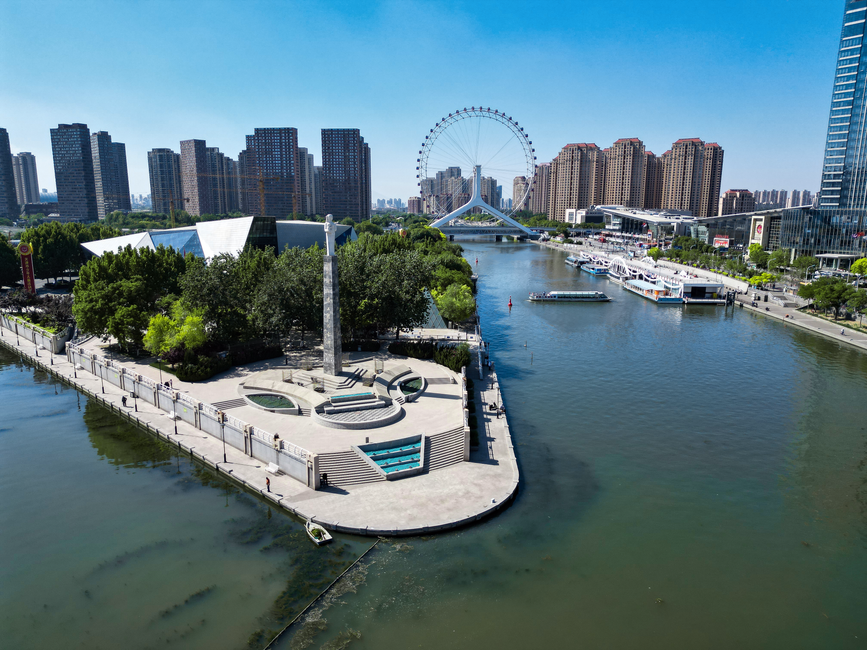
Stunning aerial view of Tianjin’s riverfront with iconic Ferris wheel and m…, Panshan, China (Tianjin’s lesser-known alternative)
The Gateway: Front Hill and the Stele of Beginnings
Your journey begins at Panshan’s Grand Entrance Arch, a towering marble structure erected in 1986 but modeled after Ming Dynasty imperial gateways. Park your car and prepare for the first sensory rush: the scent of pine resin, the chatter of cicadas, and the sight of local women selling woven straw hats and wooden walking sticks. This lower section, often called the “Front Hill” or Panshan Men, is the most accessible, and savvy visitors follow the locals who arrive before 8 AM to catch the cool morning air. The path passes the Daxia Pagoda, a thirteen-story brick structure that dates to 1371, where you’ll notice weathered Buddha niches carved into the base. Most tourists speed past this area, eager for the summit, but you should pause; locals recommend sitting on the stone benches beneath the ancient locust trees and watching the elderly practice tai chi in slow, hypnotic motion. The architecture here mixes rustic brick courtyards with the occasional imperial touch—a carved dragon column, a gilded roof tile—remnants of the once-mighty detached palace.
The Heart: Cloudy Rain Temple and the Sacred Caves
As you ascend the middle section of the mountain, roughly forty minutes from the entrance, you’ll arrive at the Complex of Cloudy Rain Temple (Yun Zhao Si), the spiritual nucleus of Panshan. This is where the mountain shifts from a scenic stroll to a pilgrimage. The current temple was rebuilt in 1986, echoing the original Ming layout, but you’ll discover genuine artifacts if you look closely: a Ming-era bronze bell weighing 1,000 kilograms remains in the belfry, its surface worn by four centuries of hands. Behind the temple, a narrow stone staircase leads to the Cave of the Ancient Buddha, where archaeologists discovered Liao-era murals in the 1990s. Travelers often discover that the air changes temperature here—a sudden coolness sweeps from the cave mouth, making you feel as though you’ve found a natural air conditioner harnessed by medieval monks. The architecture here is a game of contrasts: austere grey stone against vivid red lacquered pillars, Buddhist statues with serene faces gazing past gnarled pine branches toward the plains of Jizhou below.
The Summit: Guayue Peak and the Empty Village
Reaching Guayue Peak, Panshan’s highest point at 864 meters, requires using the cable car for the final stage (35 RMB each way), and trust you’ll want it—the last stretch of 2,000 steps is a thigh-burning exercise that even seasoned hikers will feel. But the payoff is unforgettable. At the top, you’ll find a small, minimalist stone pavilion, catching the wind from all directions. The “neighborhood” here is sparse by necessity: a few snack huts selling grilled corn and sausages, a weatherworn observation deck, and the vast East China Plain stretching endlessly below. On clear days, you can spot the haze of urban Tianjin forty kilometers south, a reminder of how far you’ve traveled in just an hour. The summit feels less like a village and more like an anti-climax in the best possible way—a place where returning pilgrims, not commercial vendors, dictate the energy. Many travelers pack their own picnic, and locals do the same; watching families spread checkered blankets among the wind-worn rocks is a quiet joy in itself.
The Local Table: What Natives of Jixian Actually Eat
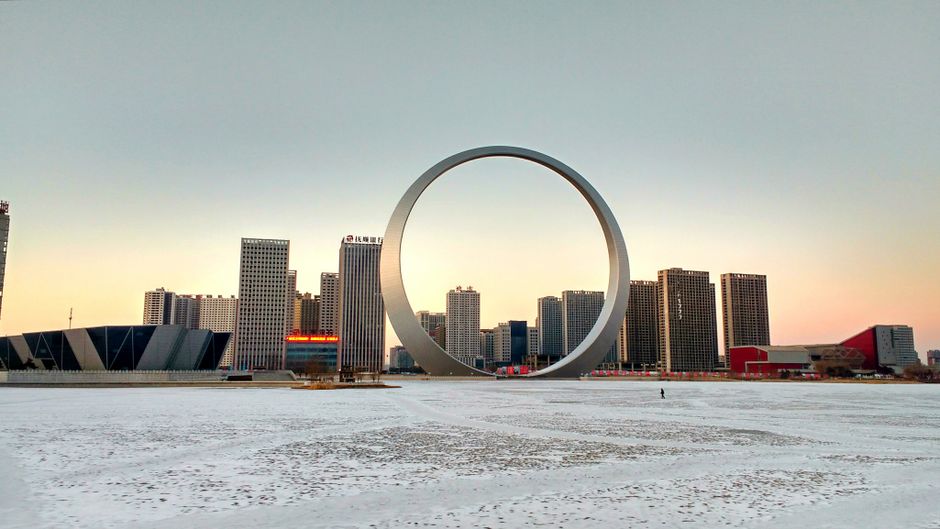
Explore the iconic Ring of Life surrounded by towering buildings in a snowy…, Panshan, China (Tianjin’s lesser-known alternative)
Cuisine around Panshan is not the refined banquet food of Tianjin’s city center; it’s the hearty, farm-driven cooking of the surrounding Jixian County. Locals will likely invite you first to try Shazi, a buckwheat pancake grilled on a stone griddle, stuffed with chopped chives, eggs, and available mountain greens. But the real hero that travelers must seek out is Jixian millet porridge—a creamy, nutty blend made from the locally grown golden millet that emperor Qianlong himself praised in a poem. The secret, you’ll discover, lies in the iron kettle and the spring water; every household claims their version is the true one.
For the definitive experience, head to the family-run Laotie Farmhouse Restaurant (老贴农家院) on the road leading to the east gate, a rambling courtyard restaurant that has served pilgrims since 1996. At noon, you’ll share long wooden tables with local truck drivers and extended families of grandmothers and toddlers. Order the signature Tieguo Yutou—a whole river carp braised in soy sauce with garlic, chilies, and a layer of cornmeal cakes steamed onto the side of the wok. The fish flakes apart lovingly, absorbing a sauce sweetened only with rock sugar. As evening falls, you’ll watch locals toast with Erguotou, a potent sorghum liquor with a 56% proof, explaining that the warmth keeps the mountain chill away. By the end of the meal, you’ll understand why this is not a destination for white-tablecloth pretension.
You’ll also find small food stalls from May through October lining the main path up the mountain, particularly around the middle cable car station. They hawk You Baobi—scallion pancakes fried to a flaky golden crisp on steel drums—and steamers of Jixian jiaozi filled with wild shepherd’s purse, harvested from the mountain slopes each spring. Your best bet is to eat where you see the most local tour groups, as their presence signals both safety and quality. Prices are absurdly reasonable: a full farm meal with tea might set you back 80–120 RMB per person.
Art, Music & Nightlife
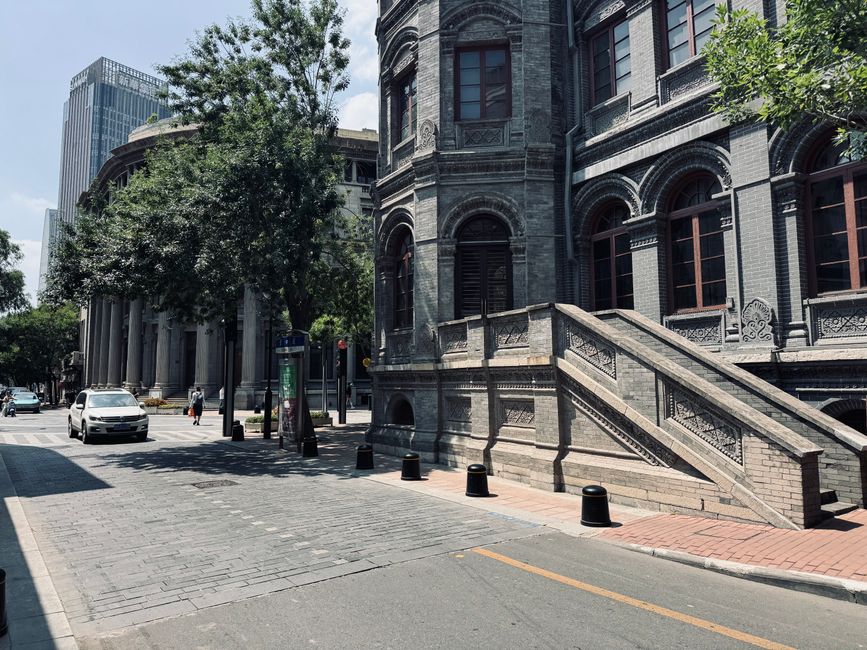
Beautiful city street showcasing historic architecture and modern buildings…, Panshan, China (Tianjin’s lesser-known alternative)
Panshan’s creative scene is not one of neon-lit bars and playlist DJs; it’s an expression of ritual, seasonal rhythm, and folk tradition. The mountain hosts its most vibrant cultural festival every late September, celebrating Guaranteed Harvest, a pre-Qing ritual where local opera troupes in ornate red and gold embroidered costumes perform Gohiang, a form of Hebei opera, on a temporary stage erected in the entrance plaza. The performances are not merely tourist spectacles—they are genuinely attended by local farmers who sing along to every refrain. If you visit during this time, you’ll find an atmosphere closer to a large family reunion than a staged show. Smaller music events pop up at the Temple of Cloudy Rain during the Qingming Festival (early April), when Taoist priests chant and play the guqin, a seven-stringed zither, as a mark of renewal.
For contemporary art and nightlife, you’ll need to decide what you’re after. The nearby village of Guazhou, a ten-minute taxi ride from the east gate, has transformed a few old stone granaries into boutique tea houses and a small gallery space called Mountain & Mist, which features the work of Tianjin-based ink painters and young photographers. It’s not a party destination; most days close by 8 PM. The closest approximation to nightlife happens in the farmstay courtyards where hosts string up fairy lights, roast whole lamb on spits, and pass around acoustic guitars. Travelers often discover that the most memorable evenings here are unplanned—shared under star-smothered skies with new friends, singing covers of Chinese pop songs, the mountain a hulking silhouette against the Milky Way.
Practical Guide
- Getting There: Your flights should connect to Tianjin Binhai International Airport (TSN), served by Air China, China Eastern, and International carriers from Seoul, Tokyo, and Singapore. Alternatively, land at Beijing Capital International Airport (PEK) and take the high-speed train from Beijing South to Tianjin (30 minutes, 55 RMB). Book at Skyscanner
- Getting Around: From Tianjin Station, take the K7781 train to Jixian North (approx. 1 hour, 17 RMB), then local bus 530 to Panshan (20 minutes, 3 RMB). A direct taxi from Tianjin city center costs around 350 RMB and takes 90 minutes. Inside the park, you’ll pay 34 RMB for a through-journey by cable car + bus. The entrance fee itself is 100 RMB from March to November, reduced to 75 RMB in winter.
- Where to Stay: Start with the Farmstay Cottages around Guazhou village, with clean private rooms and full board for 250–400 RMB per night; check Booking.com for choices like the Panshan Zhiwen Resort. For proximity, the Panshan Jixian International Hotel, just 300 meters from the entrance, offers simple comfort; travelers seeking more spacious luxury often base in Tianjin’s Peace Street district and day-trip.
- Best Time: Mid-April through May brings blossoming pear and peach trees, mild temperatures, and soft light. September to late October offers red maple leaves contrasting with golden ginkgo, making it ideal for photography. Avoid national holidays in October 1–7, when domestic tourism peaks; the mountain paths will be shoulder-to-shoulder.
- Budget: Expect daily costs of 300–500 RMB per person, including entrance, meals, accommodation in a farmstay, and local transport. If you choose city hotel stays and order more lavish food, the daily burn rises to 700 RMB. It remains an inexpensive destination compared to Beijing or Shanghai.

