
Gashaka Gumti, Nigeria Weekend: Chimpanzee Calls (2026)
The first sound that hits you isn’t what you expected—it’s not a car horn or a busy market, but the booming, haunting call of a chimpanzee echoing across the forested hills, followed by the hiss of a waterfall crashing in the distance. The air smells like wet earth and wild mint. You’re standing at the edge of Gashaka Gumti, Nigeria’s largest and wildest national park, where dramatic mountains, chimpanzees and remote Fulani settlements create one of Africa’s most extraordinary weekend escapes.
Quick Facts Before You Go
- Best Months: November through March (dry season): the park trails and access roads are open, skies are clear, and wildlife gathers around water sources. Between April and October, winter/summer rains make roads impassable and the experience becomes a mud-soaked adventure.
- Currency: Nigerian Naira (NGN); approximately 1,550 NGN to 1 USD. Cash is essential—there are no ATMs in the park or the gateway town of Serti.
- Language: Fulfulde (the language of the Fulani pastoralists) and Hausa dominate. English is understood by park staff, guides and many townspeople, so you’ll manage perfectly well, though learning “Jarra ma” (hello) earns big smiles.
- Budget: You’ll spend roughly 25,000–60,000 NGN (~$16–$40) per person per day. Park fees, a ranger guide, local guesthouse, food and transport make this one of Nigeria’s most affordable wildlife destinations.
- Getting There: The nearest airport is Yola International Airport (YOL), about 200 km from Serti—roughly 50 minutes by flight from Abuja. From Yola, you’ll take a connecting taxi or bus to Serti (3–4 hours). Alternatively, Jalingo (Taraba’s capital) has a smaller airstrip 160 km west. Book flights at Skyscanner.
Day 1: The Gateway & The Waterfall Trail
You start your adventure in Serti, a dusty but welcoming frontier town of about 25,000 people that serves as the main gateway to Gashaka Gumti. The red-earth streets buzz with motorbikes, market women balancing trays of plantain, and herdsmen in colorful gowns driving cattle through town. Your first task is to check in at the park headquarters to organize your permits and meet your ranger guide—a mandatory and wise step that will define your entire weekend.
- Morning (8–11am): At the Gashaka Gumti National Park headquarters in Serti, you’ll pay park entry fees (10,000 NGN, ~$6.50 for foreign visitors for a weekend pass) and arrange your mandatory ranger guide. Guides cost 5,000 NGN (~$3.20) per day, and they’re worth every kobo—seasoned rangers like Mallam Adamu know every trail, bird call and animal latrine in the park. Ask for the briefing room and watch the short park intro video while you coordinate your itinerary.
- Lunch: At Mama Halima’s Bukka, a modest roadside restaurant near the Serti Market, you’ll find the best tuwo shinkafa (soft rice cakes) served with a rich, peppery baobab leaf soup that locals call miyar kuka—350 NGN (~$0.23) for a generous bowl. Add a helping of grilled tanga (bush meat—actually just beef) skewers and fried plantain for a feast under the corrugated iron shade.
- Afternoon (1–5pm): After lunch, ride a motorbike taxi (2,000 NGN, ~$1.30) to the park’s Chappal Waddi trailhead, about 20 minutes from Serti. From here, you’ll hike the well-marked path to Mayo Selbe Waterfall, a three-tier cascade that plunges into a turquoise pool below. Travelers often discover that the falls are best visited in the late afternoon when the golden light paints the mist in rainbows—locals swear by this time. The 4 km round-trip hike takes about 2 hours, weaving through semi-deciduous forest where Guereza colobus monkeys leap overhead and the throaty clucks of the rare Grey-necked rockfowl (a red-listed species) echo from rocky outcrops. Bring water; you’ll need it.
- Evening: As darkness settles over Serti, you’ll head to Konti Village Restaurant, a simple but atmospheric open-air spot on the edge of town, where grilled suya (spicy skewered beef) with slivers of onion, tomato and powdered kuli-kuli (groundnut spice) is the crown jewel—500 NGN (~$0.32) for a generous stick. The air fills with smoky chardust from the grills, and you’ll hear Fulani herders laughing over cups of kunu, a zobo-like fermented grain drink. Finish your night with hibiscus zobo juice (300 NGN) as you watch the stars blaze overhead in the pitch-black sky.

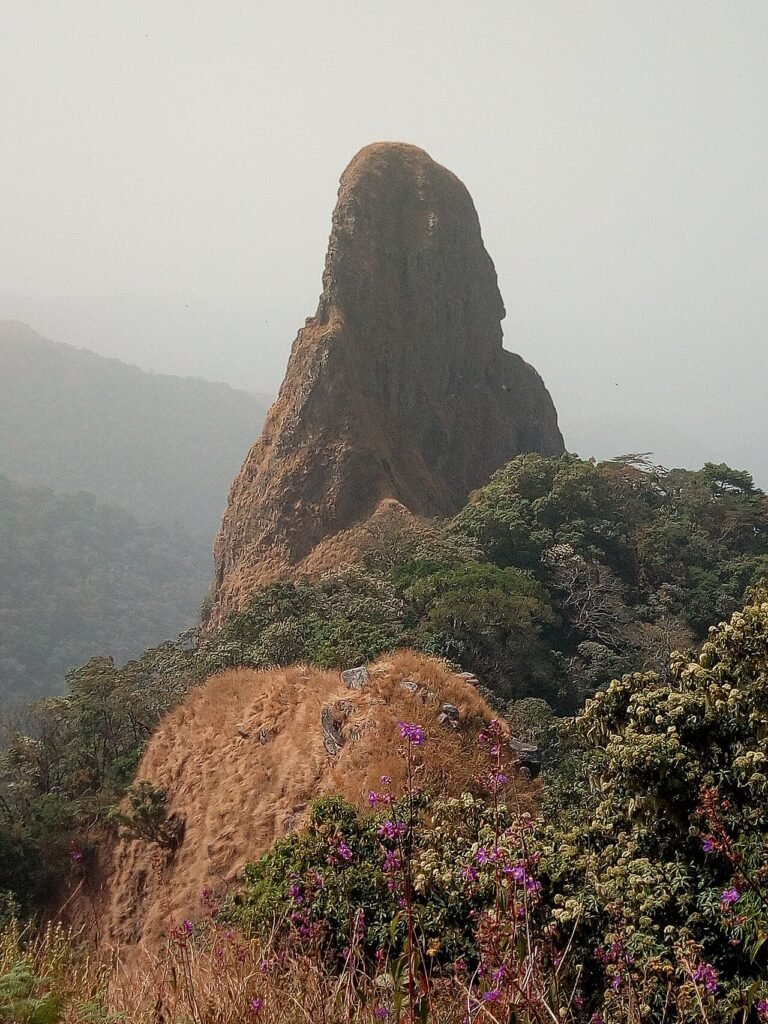
Chappal Waddi’ is a mountain peak December 2017 near the border with Cameroon, Gashaka Gumti, Nigeria
Day 2: The High Plateau & Chimpanzee Country
The roosters of Serti wake you before sunrise, and by 6am you’re bouncing along a washboard dirt road in a park Land Cruiser toward the Gashaka sector. The scenery transitions dramatically here—from open grassy woodland into tangled gallery forest along the riverbanks as the road climbs toward the 2,419-meter Chappal Waddi (the “Mountain of Death”), Nigeria’s highest peak. If Day 1 was about settling in, Day 2 is about chasing wildness you actually have to work for.
- Morning: Start with a proper Nigerian breakfast at Dauda’s Tea Shop in Serti—masa (fermented rice cakes) with honey, fried eggs and a thermos of sweet chai tea, all for 700 NGN (~$0.45). At 7am, meet your rangers at the park HQ gate for the 40-minute drive to the Gashaka sector trailhead. Your drive takes you past sprawling Fulani settlements, and you’ll see colorfully dressed women milking cows and children herding dwarf goats.
- Midday (9am–1pm): Hike the Kwano Forest Trail, the best spot in the park for chimpanzee encounters. The 6 km loop is moderately strenuous, taking about 3 hours with plenty of stops. In the dry season (December–February), savvy visitors know to arrive by 9am before the heat sends the chimps into deep canopy shade. Your ranger will point out fresh dung, nesting platforms and with a bit of luck—your guide estimates about a 60% sighting rate on this trail—you’ll hear the distinctive pant-hoot chorus of a troop of 30+ chimpanzees. Visitors describe the moment as electric: the sudden silence, the snapping of branches, then a dark face with amber eyes peering from the leaves.
- Afternoon: Push on to the Mambilla Plateau viewpoint—arguably the most breathtaking sight in West Africa outside of the ocean. From the rocky ridge, you’ll look out over the endless rolling grasslands of Nigeria’s highest plateau, with cattle herds and tiny villages dotting the green expanse below. Locals recommend carrying a packed lunch, so grab grilled chicken and roast plantain from a roadside stand before the hike (800 NGN, ~$0.52). Spend an hour or two here before descending back toward the Gashaka village, where you’ll explore the small community settlement of about 1,000 people—a Fulani/Ethnic group mix that has coexisted inside the park for generations. The rangers will introduce you to the village head, who often shares stories of the park’s creation in 1991 and the wildlife that once roamed freely through their farmland.
- Final Evening: Back in Serti, your farewell dinner deserves ritual. Head to Salama Lodge Restaurant, the best dining room in town (which is saying little, but the candlelit courtyard and the famous grilled yam with peppered fish make it feel grand). Order the bonanza special: grilled tilapia fish (2,500 NGN, ~$1.60) over smoky yam chips, served with a cold malt drink. As you finish, listen for the far-off drumming from the local cultural group that performs Friday night dances—if you’re lucky, you’ll witness the hypnotic rhythm of the Gashaka traditional performance, a medley of buffalo-horn trumpets and talking drums that celebrates the region’s hunting heritage.
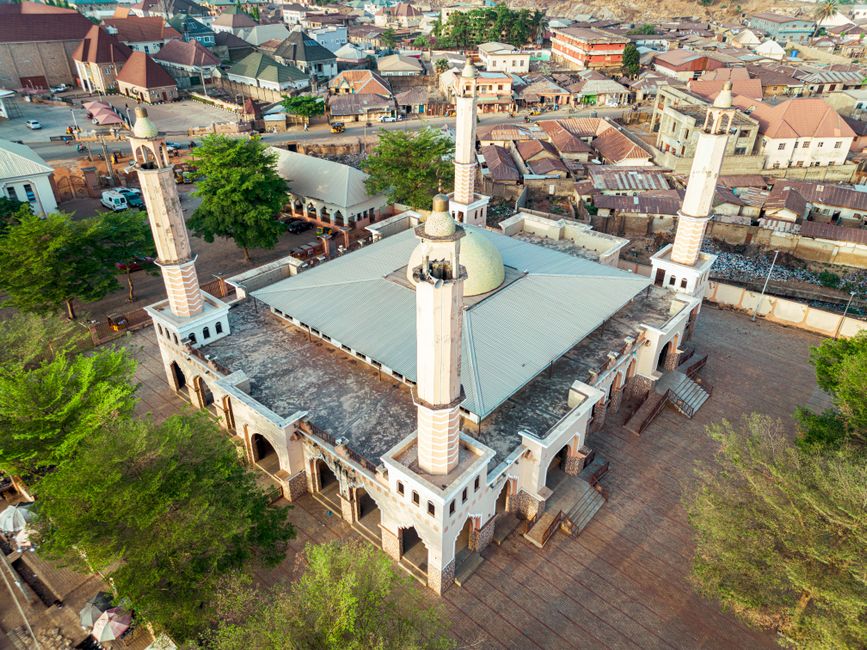
Stunning aerial view of a mosque in Kaduna, Gashaka Gumti, Nigeria
The Food You Can’t Miss
Gashaka Gumti’s food culture is a rugged, rural economy built around what the forest and farmlands provide, and travelers rarely expect to eat this well. For one thing, everything is startlingly fresh. The Fulani herders who graze their cattle across the park supply the surrounding towns with dairy that appears nowhere else in Nigeria—you’ll find impossibly creamy fura da nono, a fermented milk and millet ball drink served in calabash bowls at roadside stalls for just 200 NGN (~$0.13). It’s sweet, sour, cold and absolutely refreshing after a sweaty hike.
For the definitive street food experience, seek out the evening suya stands along Serti’s main junction from 5pm onward. Vendors fan glowing coals as they grill skewered beef coated in yaji—the addictive spice mix of ground peanuts, ginger, chili and paprika—until the edges char and caramelize. Families crowd around plastic tables, and you’ll be passed a brown paper-wrapped bundle of skewers to nibble on while you chat. A good suya session with cold drinks runs about 1,500 NGN (~$1) and is genuinely a highlight of the trip.
For sit-down restaurants, the aforementioned Salama Lodge and Mama Halima’s Bukka cover the two ends of the spectrum. But the culinary secret visitors rarely discover is the Sunday visitor lunch at the park’s ranger station—if you mention your interest when paying your fees, the rangers’ cook will prepare an authentic bush-style meal: wild spinach stew, boiled bush yam and smoked bush meat (usually antelope from their sustainable culling program) served with at least four different dipping sauces. At 2,000 NGN per person, it’s the most culturally immersive meal you’ll find, and the stories told over it are priceless.

Majestic Zuma Rock towering over a peaceful village in Nigeria, Gashaka Gumti, Nigeria
Where to Stay for the Weekend
Your best bet for a weekend base is Serti town—it’s the logistical hub where the park headquarters, guides and all transport converge. The good news is that “weekend getaway” here doesn’t mean luxury; it means immersion. Gashaka Savannah Guesthouse (30,000 NGN/$19 per night) is the most popular traveler base, with clean, private rooms with mosquito nets, solar power in the evenings and a shared terrace overlooking the park edge. The owner, a retired park warden, runs the property with genuine hospitality—he’ll arrange your permits, guides and even pack your lunch boxes if you ask.
A more atmospheric option is the Park’s Self-Contained Chalets (25,000 NGN/$16 per night), three rustic brick bungalows set just inside the park boundary near the Serti HQ. You’ll fall asleep to the rustle of leaves and the call of nightjars, and you’ll wake up right at the trailhead. For the more adventurous, the Mambilla Plateau Eco-Cabins in the higher-altitude Gashaka sector (50,000 NGN/$32 per night) offer jaw-dropping sunrise views over the plateau, though you’ll need the park vehicle to access them. Find your options on Booking.com or Airbnb—though be sure to book months ahead in the dry season, as accommodation is extremely limited.
Before You Go: Practical Tips
- Getting Around: The best options are motorbike taxis (okada) within Serti (300–500 NGN per ride) and a park Land Cruiser for longer distances to the Gashaka sector and trailheads—rentable at the park HQ for 15,000 NGN (~$10) per day including fuel and driver. Public bush taxis to towns like Gembu and Wukari pass through Serti’s main junction throughout the morning.
<li

