
Where the Gauja Whispers Through Time: Valmiera’s Unassuming Soul (2026)
The Story Behind Valmiera, Latvia
Your journey into Valmiera begins long before you arrive. The city’s name itself comes from the castle—Valmiera Castle, founded in 1283 by the Livonian Order as a frontier stronghold against Lithuanian raids and rival bishoprics. By the 14th century, the settlement had grown into a fortified trading post, and in 1375, you would have found it granted city rights under Riga’s law, a privilege that set it on the path to prosperity. Travelers who trace this history soon discover that Valmiera became a proud member of the Hanseatic League, that powerful medieval network of merchant cities spanning from Novgorod to London. The river Gauja was your highway then—rafts and barges carried flax, timber, and amber downstream to the Baltic Sea, and you can still sense that old commercial pulse in the narrow streets near the market square.
The 16th and 17th centuries brought upheaval. You’ll learn that Swedish and Polish armies marched through these streets during the Polish-Swedish wars, and the castle, once impregnable, was partially dismantled by the Swedes in the early 1700s to prevent its use by Russian forces. For locals, the period that followed was perhaps the most transformative: the Russian Empire absorbed the region, and by the 19th century, Valmiera had become an industrial outpost known for its glassworks, brick factories, and a bustling river trade. But what you might not expect is that the city also became a cradle of Latvian national awakening. In the 1860s and 1870s, local intellectuals founded the first Latvian-language newspapers and cultural societies here, and in 1919, at the end of World War I, Valmiera was briefly the capital of the newly proclaimed Republic of Latvia before Riga reclaimed that role. That spirit of quiet resistance and cultural pride still lingers in the air you breathe when you stand in the town square.
The 20th century left its own scars. You’ll see Soviet-era apartment blocks on the city’s periphery, built after World War II destroyed much of the historic center. But unlike many post-Soviet towns, Valmiera has carefully restored its medieval core without erasing its more complex layers. When you visit today, you’re walking a timeline: the 13th-century castle ruins, the 18th-century Lutheran church, the 19th-century Art Nouveau facades on Lāčplēša Street, and the Soviet-era mosaic murals on the high school building—all coexisting in a town that refuses to be defined by any single era.
Neighborhood by Neighborhood

The iron railway bridge in Valmiera was built in 1911, Valmiera, Latvia
Old Town (Vecpilsēta)
You’ll want to start here, in the compact medieval quarter that hugs the river’s curve. The heart of the Old Town is the market square (Tirgus laukums), where you’ll find the whitewashed St. Simon’s Church (Sīmaņa baznīca), its slender spire visible from almost anywhere in the city. Step inside on a Sunday morning—the congregation still sings hymns in Latvian, and the wooden pulpit dates to 1647, carved with biblical scenes you can trace with your eyes. Wander down Bruņinieku Street, where 18th-century timber warehouses have been converted into craft shops and cafés. Locals recommend pausing at the small courtyard at Bruņinieku 11, where a hidden garden blooms with peonies in June and you can escape the occasional bustle of the square. The castle ruins themselves (Valmieras pilsdrupas) sit at the river’s edge—you can climb what remains of the northern tower for a view that stretches across the Gauja valley, especially magical at sunset when the limestone glows amber. Expect to spend at least two hours here, wandering aimlessly, ducking into the small Valmiera Museum (at Brīvības iela 19) to see the 13th-century ceramics and Hanseatic coins uncovered during recent excavations.
Gauja Riverside (Gaujas krasts)
Just a five-minute walk south from the Old Town, the mood shifts completely. The Gauja River bends here into a wide, green corridor lined with century-old oaks and linden trees. You’ll find joggers, dog walkers, and families picnicking on the grassy banks during summer weekends. The river is surprisingly clean—seasoned travelers often rent a kayak from Gaujas Bāze (open daily June through August, €12 for a two-hour rental) and paddle under the arched stone bridge to see the town from the water. On the eastern bank, the Valmiera Drama Theatre (stūra ielā 4) anchors a small cultural plaza. Built in 1931, the theatre’s facade mixes Art Deco with Latvian folk motifs, and its program includes contemporary plays in Latvian (with English surtitles on select evenings) as well as occasional concerts. After a show, you’ll find locals spilling out onto the riverside promenade, where pop-up beer gardens and ice-cream stalls operate until midnight in July and August. This is where you come to breathe—to slow down and let the gauja, the Estonian-Latvian word for “river current,” remind you that time moves differently here.
Pārgauja (The District Beyond the River)
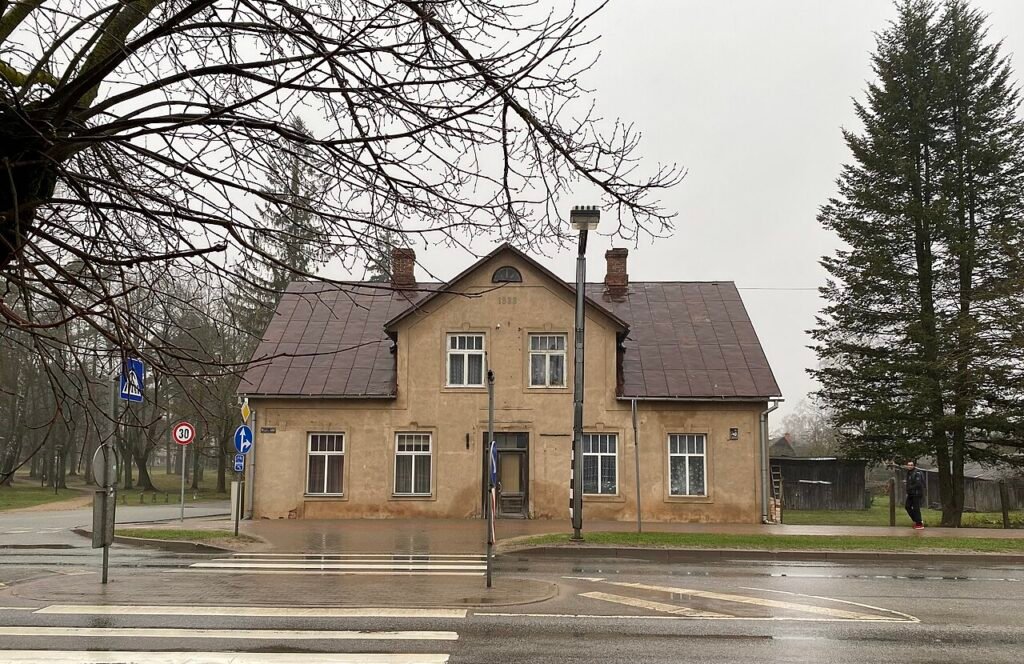
Cross the old stone bridge to the northern bank, and you enter the most authentic part of town. Pārgauja is where many of Valmiera’s working-class families have lived for generations, in wooden houses painted in faded ochre and mint green, with lush vegetable gardens tucked behind weathered gates. You’ll notice the Soviet-era influence more clearly here: a block of five-story panel apartment buildings on Raiņa Street, built in the 1970s, alongside the art nouveau villas of the early 1900s that survived the war. The real draw, though, is the local market (Valmieras tirgus, open daily 7 AM to 5 PM), housed in a 1970s concrete hall that feels like a time capsule. Inside, you’ll find women selling jars of pickled chanterelles and wild bilberry jam, a butcher who smokes his own pork belly on the premises, and a bakery stand where a single speķa pīrāgs (a savory bacon pie) costs just €1.20. Locals recommend visiting on Saturday morning, when farmers from surrounding villages set up tables in the courtyard with fresh cheese, honey, and the first wild garlic shoots in spring. Pārgauja is less polished than the Old Town, but that’s its charm—you’re seeing the city as it lives, not as it poses for photos.
The Local Table: What Valmierians Actually Eat
You might expect a Latvian town to serve up potatoes and pork on every corner, but Valmiera’s food culture is more layered than that—much like its history. The soil along the Gauja is sandy and rich, perfect for growing rye, carrots, and the wild mushrooms that appear in forests every August. For locals, the rhythm of the year is marked by foraged ingredients: first wild garlic in April, then sorrel for summer soups, followed by chanterelles and porcini in late summer, and finally cranberries and lingonberries in autumn. You’ll find these ingredients at the Pārgauja market, but the best way to taste them is at a small family-run restaurant like Krodziņš Pīlādzis (at Lāčplēša iela 27), where the owner, Aija, makes seasonal menus based on what she gathered that morning. Order the grey peas with smoked bacon (pelēkie zirņi ar speķi) in autumn, when the peas are freshly dried—it’s a humble dish, but the earthy, smoky flavors will stay with you.

Silhouette person riding on bike at night, Valmiera, Latvia
Beyond foraged foods, Valmiera has a proud brewing tradition that you must explore. The Valmiermuiža Brewery (about 3 kilometers outside the city center, reachable by local bus €1.50 or a 40-minute walk) has revived the 18th-century brewing methods used on the von der Ropp estate. You can join a two-hour guided tour (€12, Fridays and Saturdays at 11 AM and 2 PM) that ends with a tasting of their unfiltered ales and dark lager, poured from ceramic mugs in the vaulted brick cellars. The brewery also runs a small shop and bar on-site, where you can buy bottles of their spruce-tipped ale—a specialty you won’t find outside Latvia. What surprises many visitors is how seriously locals take their bread: the dark, dense rye loaf called skābmaize is eaten with every meal, and at the market, you can buy a whole wheel from baker Ilze for €3.50. Slice it thick, toast it over a campfire on the Gauja banks, and top it with herring or smoked cheese—you’ll understand why this simple combination has sustained generations.
Art, Music & Nightlife
For a city of just 23,000 people, Valmiera punches well above its cultural weight. The Valmiera Drama Theatre, as mentioned, is the anchor of the creative scene, and you should plan your visit around its program if you can. The summer months (June through August) bring the Valmiera Summer Theatre Festival, where performances take place outdoors in the castle ruins, the riverside park, and even on a floating stage mounted on the Gauja itself. Tickets range from €8 to €20, and the atmosphere on a warm July evening—with the stage lit by lanterns and the river lapping against the platform—is genuinely magical. The festival also features live music and dance performances from Baltic and Nordic guest companies, so you might catch a Lithuanian folk ensemble one night and a Swedish contemporary dance troupe the next.

Man waiting on shed during nightime, Valmiera, Latvia
For a quieter evening, head to the Mākslas galerija “Laipa” (at Lāčplēša iela 16), a small contemporary art space housed in a restored 19th-century granary. Local painters and photographers exhibit here, often drawing on the landscape of the Gauja valley and the cultural memory of the region. The gallery hosts opening receptions on the first Thursday of every month, and you’ll be welcomed to sip wine and chat with the artists (most speak some English). If you’re looking for live music, your best bet is the bars along Lāčplēša iela, especially the underground cellar at Bārs “Grāvītis” (Lāčplēša iela 12), which hosts folk, jazz, and indie rock on Fridays and Saturdays, with a small cover charge of €2–€5. The crowd is a mix of students from the local college and older bohemians, and the atmosphere is convivial rather than rowdy. By midnight, the street is quiet except for the sound of laughter drifting from open pub doors—a gentle end to an evening in a city that values conversation over volume.
Practical Guide
- Getting There: Fly into Riga International Airport (RIX), which has direct connections from most European capitals. From Riga, you’ll take a direct bus (2 hours, €9–€12 with Lux Express or Ecolines) or a train (2 hours 15 minutes, €6–€8) to Valmiera station. Book your flights at Skyscanner
- Getting Around: Valmiera is exceptionally walkable—you can cross the entire Old Town in 15 minutes. For Pārgauja and the brewery, local buses run every 30 minutes (€1.20 per ride, cash only). Taxis cost €3–€6 within the city; download the Bolt app for reliable service.
- Where to Stay: For Old Town convenience, book Hotel Valmija (Bruņinieku iela 1) from €65 per night for a double. For a quieter, more local vibe, choose the guesthouse Pārgaujas Māja (

