
Valparaiso, Chile Weekend: Street Art, Funiculars & The Best Seafood South of Lima (2026)
You step off the funicular at the top of Cerro Alegre, and the first thing that hits you is the scent of fresh empanadas mingling with salt air from the Pacific. Cobblestones glisten under a late-morning sun, and every wall around you is a canvas—murals of impossible colors, political messages scrawled in spray paint, and portraits of poets who died before their time. You’ve got 48 hours to unravel this labyrinth, and the best way to start is by getting gloriously lost.
Quick Facts Before You Go
- Best Months: November through March (Chilean summer). Expect warm days (25–30°C / 77–86°F) and clear skies. Avoid June–August if you dislike damp cold and persistent garúa (mist).
- Currency: Chilean Peso (CLP). As of early 2025, roughly 950 CLP to 1 USD. Check xe.com for live rates.
- Language: Spanish. English is spoken in tourist-oriented spots, but don’t expect it in local markets or hole-in-the-wall restaurants. Learn a few phrases: gracias, por favor, ¿cuánto cuesta?
- Budget: Expect to spend $50–$80 per day per person (midrange), including meals, transport, and a few entry fees. Budget travelers can get by on $35 if they stick to street food and hostels.
- Getting There: Fly into Santiago International Airport (SCL). From Santiago, take a Turbus or Pullman bus to Valparaíso (1.5 hours, about $8). Book flights at Skyscanner.
Day 1: Mural Crawl & Sunset on the Hills
You start the morning at the base of Cerro Alegre, near the Plaza Sotomayor, where a massive monument to the heroes of the Battle of Iquique towers over commuters. The funicular—Ascensor El Peral—clanks upward for 300 pesos (about 30 cents), and within two minutes you’re deposited into a world that feels utterly removed from the grid below. The air is thinner here, the light softer, and the streets are a museum with no roof.
- Morning (8–11am): Grab a café con leche and a pan con palta (avocado on bread, about 2,000 CLP) at Café Turri (Paseo Gervasoni 603). From your table, you’ll watch the sun climb over the harbor. Then begin a self-guided street-art tour: head east along Paseo Atkinson, a pedestrian walkway lined with colorful houses and murals. Look for works by INTI, a Chilean street artist known for his geometric indigenous figures. Most tourists miss the small alleyway Pasaje Stol—turn in here for a secret courtyard covered in mosaics.
- Lunch: Walk three blocks downhill to La Flor de Chile (Calbuco 471), a tiny family-run restaurant that’s been serving locals since 1976. Order a pastel de choclo (corn pie with beef and olives, 7,000 CLP) paired with a terremoto (a sweet wine and pineapple-ice-cream cocktail, 3,500 CLP). The owner, señora Marta, will tell you she learned the recipe from her grandmother.
- Afternoon (1–5pm): After lunch, descend via Ascensor Artillería (another funicular, same 300 CLP) to Paseo 21 de Mayo. From here, you have a postcard-perfect view of the bay and the naval monument. Walk west along the waterfront to the Museo Marítimo Nacional (donation suggested, 1,000 CLP) to learn about Chile’s naval history. Most visitors skip this museum, but travelers who love hidden gems will find a fascinating collection of ship models and weapons from the 19th-century Pacific War. Return to Cerro Alegre via the Ascensor Concepción (300 CLP) and spend the late afternoon exploring the Open-Air Museum of Street Art—entry is free, but a guided tour ($10, 2 hours) reveals stories the murals don’t tell: the 2011 protests, the poet Pablo Neruda’s ghost, the earthquake of 1906 that flattened the city.
- Evening: Dinner at El Desayunador (Alvarado 318). Yes, it’s named for breakfast, but its evening tablas (charcuterie boards, 15,000 CLP for two) are legendary. Grab a bottle of Carmenère, the signature Chilean red, and sit on the rooftop terrace—you’ll watch the city lights flicker on like stars. Afterward, walk to La Piedra Feliz, a bar on Paseo Atkinson that hosts live cueca (Chile’s national dance) from 9pm. Entry is free, and locals are happy to teach you the steps.

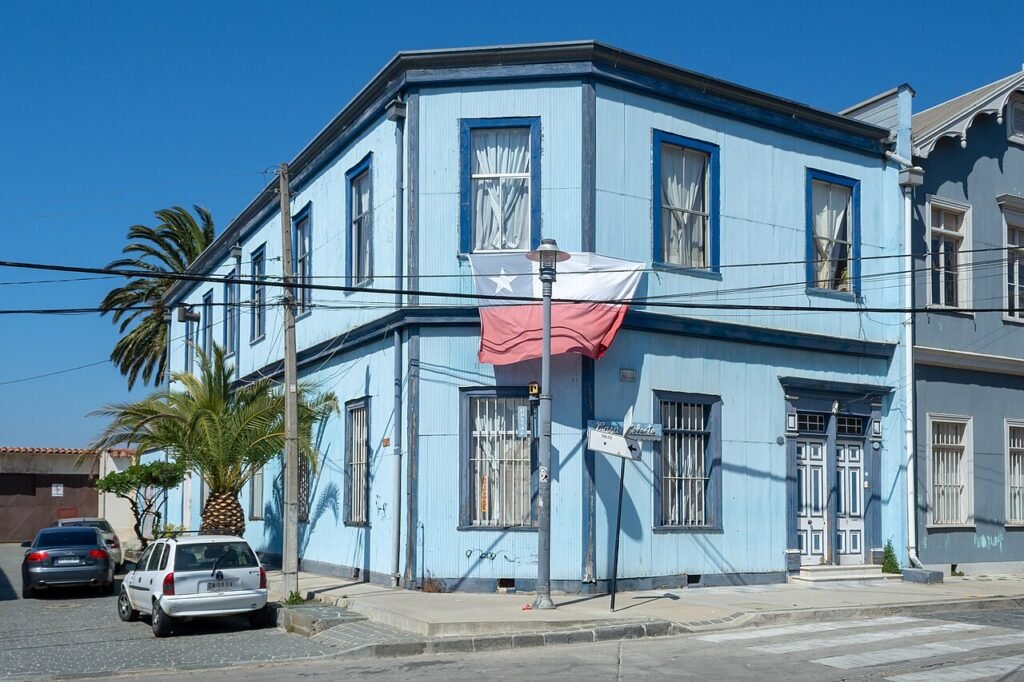
Casa de San Enrique con Templeman, Valparaiso’s Cerro Alegre, Chile
Day 2: Neruda’s Ghost & The Fisherman’s Market
Day two demands an earlier start. Savvy visitors know Cerro Alegre is best seen in the morning, when the fog lifts and the hillsides reveal their full palette. You’ll trade the bohemian chaos of the first day for a quieter, more intimate exploration of Pablo Neruda’s former home and the rough edges of Valparaíso’s working port.
- Morning (7–10am): Rise early and descend to the port area. Walk to Mercado El Cardonal (Calle Uruguay 119), a bustling local market where fishermen unload their catch at dawn. Order a choripán (grilled sausage on bread, 2,500 CLP) from the stand run by Don Carlos—he’s been here since 1995. Locals recommend washing it down with a mote con huesillo (a sweet peach drink with husked wheat, 1,500 CLP). After breakfast, take a 20-minute walk uphill to Casa Museo La Sebastiana (Ricardo de Ferrari 692), Pablo Neruda’s Valparaíso home. Entrance is 6,000 CLP. The house is perched on Cerro Bellavista, and every room has a window that frames a different part of the harbor. Neruda said, “The house is a ship.” You’ll see his collection of figureheads, his eccentric armchairs, and the bar he built like a ship’s bridge. Most tourists don’t arrive until 11am—you’ll have the place nearly to yourself.
- Midday (10am–1pm): Walk downhill through Cerro Bellavista to catch the Ascensor Florida (300 CLP). This funicular is the oldest in operation (built 1906) and feels like a rickety time capsule. At the bottom, spend an hour at Museo a Cielo Abierto—it’s an extension of the street art you saw yesterday, but here the murals are curated by a local collective, with works by Brazil’s Eduardo Kobra and Chile’s Mono González. Entry is free, but a map (1,000 CLP from the tourist office) helps you find the best pieces.
- Afternoon (1–4pm): Lunch at El Puerto del Alma (Calle de la Colina 577), a seafood spot tucked into a graffitied alley. Locals line up for the caldillo de congrio (conger eel stew, 9,000 CLP)—Neruda wrote a whole ode to this dish. After eating, explore the Paseo Yugoslavo, a wide esplanade lined with pastel houses and old-fashioned lampposts. The best photo op: the view down Calle Higuera, where the houses are painted in a gradient from blue to green to yellow. Spend the rest of the afternoon souvenir-hunting at Feria Artesanal de Cerro Alegre (Salvador Donoso 1555), where you find woven ponchos, lapis lazuli jewelry, and copper trinkets—haggle gently, as prices are already fair (most items 5,000–15,000 CLP).
- Final Evening: For your farewell dinner, book a table at El Internado (Paseo Atkinson 152). This restored mansion serves a tasting menu (45,000 CLP per person, including wine) that reimagines Chilean classics: chupe de locos (abalone gratin), duck with merkén (smoked chili), and a chocolate mousse infused with local rosé. The interior is a labyrinth of vintage furniture and tiled floors; ask to sit in the glassed-in interior courtyard. After dinner, take one last walk to the Mirador O’Higgins, a small viewpoint on Cerro Concepción. With the harbor lights below and the stars overhead, you’ll understand why travelers often discover a piece of themselves here.

A street with cars parked on it and buildings on the side, Valparaiso’s Cerro Alegre, Chile
The Food You Can’t Miss
Valparaíso’s food scene is a raw, unfiltered reflection of the sea and the hills. You’ll taste the Pacific in every bite—clams, sea urchins, conger eel, and the ubiquitous mariscos that appear in stews, empanadas, and even soups. The chorrillana, a mountain of fries topped with beef, onions, and eggs, is a good choice if you’re nursing a hangover; you’ll find the best version at El Cinzano (Plaza Aníbal Pinto 1189) for 8,000 CLP—enough for two.
Street food is where the real magic happens. Look for vendors selling chapalele (potato and flour dumplings, often boiled and served with olive oil and chili, about 1,500 CLP) near the Ascensor El Peral at lunchtime. For a full meal that won’t break the bank, head to El Topo (Calle Papudo 1112), a no-frills eatery where a plato del día (soup, main course, and a glass of juice) costs 6,000 CLP—the waitress will tell you what’s fresh that morning.
Don’t leave without trying mote con huesillo from a street cart at the base of Cerro Alegre. The vendor, usually a woman in a white apron, pours the sweet, husked-wheat drink into a plastic cup for 1,500 CLP. It’s sugary, filling, and utterly addictive—the perfect antidote to a long uphill climb.
Where to Stay for the Weekend
For atmosphere and convenience, base yourself on Cerro Alegre itself. Casa Aventura Valparaíso (Pasaje Stol 12) offers private rooms from $45/night and a rooftop terrace with a view of the harbor. The décor is shabby-chic with local art on the walls. Book via Booking.com or Airbnb.
If you prefer quieter surroundings, consider Cerro Concepción, a short walk from Cerro Alegre. Hotel Palacio Astoreca (Paseo Atkinson 154) is a restored 1920s mansion with rooms starting at $120/night. Its courtyard garden is a tranquil oasis; seasoned travelers often book the “Neruda Suite” for its balcony overlooking the bay.
Budget travelers do well at Hostal Mirador Esperanza (Calle Higuera 121), which offers dorm beds from $15/night. The common room has a piano, and the owner, a retired music teacher, sometimes plays tango in the evenings. Check both Booking.com and Airbnb—last-minute deals often appear.
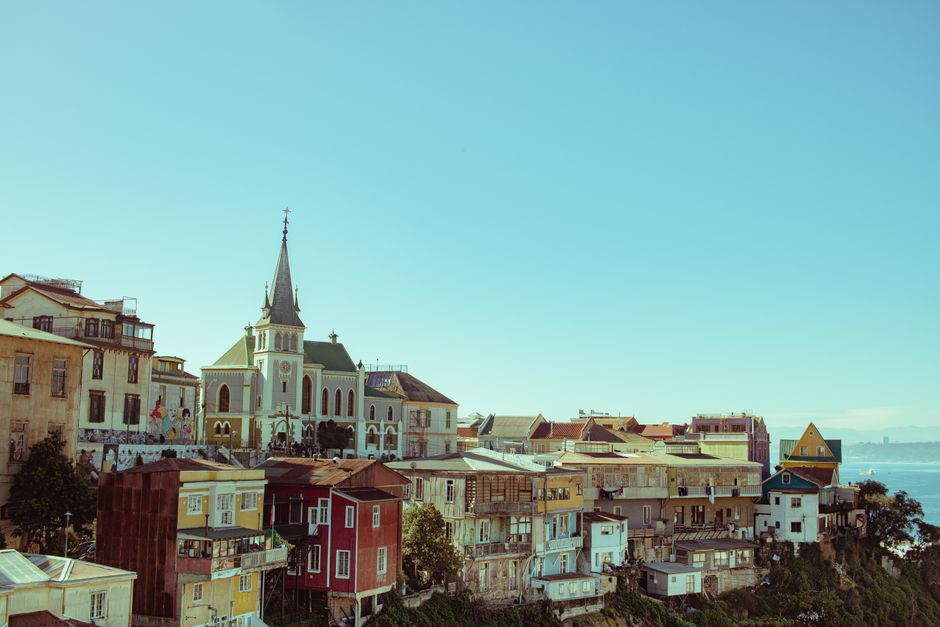
A beautiful view of Valparaíso’s colorful houses and sea under a clear sky, Valparaiso’s Cerro Alegre, Chile
Before You Go: Practical Tips
- Getting Around: You’ll walk a lot—be ready for steep hills. Funiculars (called ascensores) cost 300 CLP per ride; buy a multi-ride card at a booth for 1,500 CLP (5 rides). Local buses (micros) are 700 CLP but route signs are confusing. Taxis within Cerro Alegre run about 3,000–5,000 CLP. Use Uber or Cabify for longer trips to the port area (around 4,000 CLP).
- What to Pack: Comfortable walking shoes with good grip—the cobblestones are treacherous when wet. A light jacket or sweater even in summer, because the evening breeze off the Pacific can be chilly. Sunscreen (the sun at this latitude is intense). Also pack a small notebook and pencil: artists sell custom portraits in the street, and you might want to sketch a door or a face.
- Common Tourist Mistakes: Don’t assume all funiculars run on schedule—some close for maintenance without notice. Check the municipal website or ask your hotel. Also, avoid carrying large backpacks after dark in the lower streets near the port; stick to the upper cerros where it’s safer. Pickpockets are rare but opportunistic in crowded markets.
- Money-Saving Tip: Buy a tarjeta Bip! at any Metro station (it’s actually the Santiago card, but it works on Valparaíso’s buses and funiculars). A single ride costs 300 CLP instead of 500 CLP without the card. You’ll save about $5 over two days—enough for an extra choripán.

