
Where the Nam Tha Runs Quiet: Oudomxay’s Hidden Heartbeat (2026)
In 1961, as the Laotian Civil War tore through the northern highlands, a French-trained Khmu elder named Chao Somsanith gathered villagers along the banks of the Nam Tha River in what is now Muang Xay. Armed with little more than bamboo flutes and oral histories, they performed a ritual to bless the water before the monsoon, a tradition unbroken for centuries. You’ll still hear that same chant echo through the pine forests today—a reminder that Oudomxay’s soul lives in its rivers.
The Story Behind Oudomxay, Laos
Oudomxay’s history is written not in stone but in silk and silver. From the 14th century, it served as a vital nexus on the ancient Lan Xang trade route, where Khmu and Tai Lue caravans exchanged salt from the mountains for tea from China. When the kingdom dissolved in 1707, the region fragmented into smaller muang (principalities), each controlled by local chieftains who paid tribute to Siam. Travelers often miss how deeply the 19th-century “Haw” Chinese rebellion scarred this land: in 1872, rebel armies sacked Muang Xay, burning the original wooden wat (temple) that once stood where the modern town center now sits.
The French arrival in 1893 brought rubber plantations and a new road—Route 13—which sliced through the valley. Yet Oudomxay resisted colonial control longer than most Lao provinces. Locals still recount the 1919 rebellion, when Khmu and Hmong villagers ambushed a French convoy near the Nam Pha River, killing three officials. The colonial response was brutal, but the resistance cemented a fierce local identity. During the Laotian Civil War (1953–1975), Oudomxay became a strategic hub for the Pathet Lao, who used the dense forests as supply lines. The aftermath left unexploded ordnance across 30% of the province, a legacy you’ll see in stark warnings posted near hiking trails today.
What truly shaped Oudomxay, though, was the post-war reopening of the border with China in the 1990s. Muang Xay transformed from a sleepy outpost into a customs crossroads, with Chinese trucks rumbling through daily. Savvy visitors notice the linguistic palimpsest: shop signs in Lao, Chinese, and Khmu, all jostling for space. The province’s name itself means “rich and prosperous”—a hopeful epithet from the 1970s that still feels aspirational.
Neighborhood by Neighborhood
Muang Xay Town Center
Your first impression of Muang Xay is a single, paved main street—Route 13—lined with corrugated-roof shophouses painted in faded pastels. The heart beats at the morning market, Talat Sao, where from 5:30 a.m. locals sell bunches of water spinach, dried buffalo jerky, and sticky rice wrapped in bamboo tubes. You’ll find the old Wat Luang temple at the north end, its sim (ordination hall) featuring 1960s murals that depict scenes of local life—a rare departure from traditional Buddhist iconography. The architecture here is a jumble: Chinese-built guesthouses with red lanterns stand next to French-era wooden villas, their balconies sagging with laundry and jasmine vines. By midday, the heat drives travelers into the shaded arcades of Boua Coffee Lounge on Road 4, where you can sip a Lao latte while watching motorbikes weave around stray dogs.
Ban Sikeud
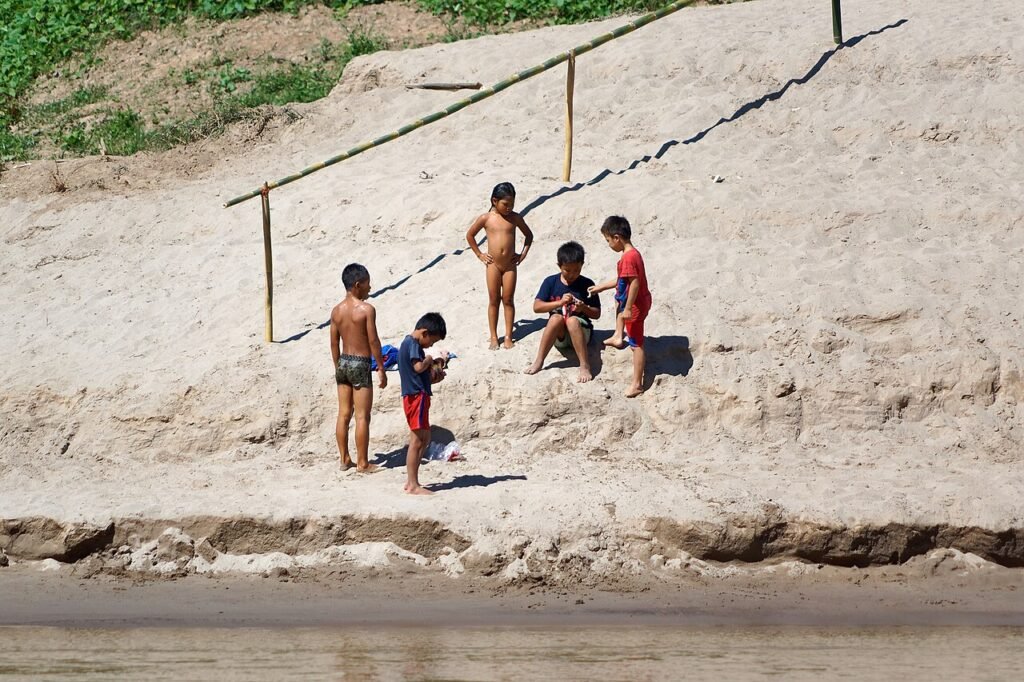
Cross the Nam Tha River via the narrow steel bridge, and you enter Ban Sikeud, a Khmu village that feels a world away from the town’s bustle. Here, houses rise on wooden stilts, with woven bamboo walls and thatched roofs. In the dry season (November–February), the riverbank becomes a social hub: women pound chili paste with mortar and pestle, children chase frogs in the shallows, and elders weave baskets from rattan. The dirt paths lead to Wat Ban Sikeud, a tiny temple whose stupa (reliquary) is covered in faded green tiles. You must try the local nam khao (crispy rice salad) at Nang’s Riverside Kitchen, a family-run stall open from 11 a.m. to 3 p.m. on weekends—the owner, Mrs. Nang, learned the recipe from her grandmother, who served it to Pathet Lao soldiers in the 1970s.
Nam Pha Valley
For a completely different rhythm, drive 20 minutes south to the Nam Pha Valley, a cluster of villages hugging the river of the same name. This is the heart of Hmong and Tai Lue settlement, and the landscape is a quilt of rice terraces and cardamom gardens. In Ban Nam Pha, you’ll stumble upon the old Chinese-built dam, now covered in moss and children’s laughter. The Phou Thao Phou Nang viewpoint, a 90-minute hike through bamboo groves, offers a panorama of limestone karsts rising from the mist. Locals here speak a mix of Hmong with Lao borrowings, and you’ll notice the Hmong textile tradition everywhere: indigo-dyed hemp jackets with embroidered collars, sold by women at the weekly Lao-Tai Lue Market on Saturdays from 7 a.m. to noon.
The Local Table: What Natives Actually Eat

Fisherman on the Mekong River in Oudomxay Province, Laos, Oudomxay, Laos
Food in Oudomxay is a story of scarcity and resourcefulness. Because the province is landlocked and mountainous, meals center on what grows wild: bamboo shoots, bitter herbs, and river fish. The defining ingredient is jeow bong, a fiery paste made from dried chili, garlic, and the skin of mak kheng (a local sour fruit). You’ll find it spooned over sticky rice at every meal. But the dish that defines Oudomxay is laap khua—a dry-fried minced meat (usually buffalo or chicken) tossed with toasted rice powder, lime leaves, and makhwaen (a wild pepper that tastes like Sichuan pepper crossed with lemon). Unlike Laotian laap from the south, which is raw, Oudomxay’s version is always cooked, a nod to the Khmu tradition of preserved, smoked meats.
Your best bet for an authentic meal is the Muang Xay Night Market, which sets up on Road 1 every evening from 5 p.m. to 10 p.m. Seek out Mrs. Som’s Stall (look for the blue umbrella), where she serves khao jee pâté—a baguette sandwich stuffed with homemade pork liver pâté, pickled vegetables, and fresh cilantro. This Lao-French fusion is a legacy of the colonial era, and Mrs. Som’s recipe, passed down from her grandfather who worked in a French depot, includes a secret sprinkle of crushed peanuts. For dessert, try khao nom kok, tiny coconut pancakes cooked in a dimpled iron pan, drizzled with palm sugar. You can get them for 5,000 LAK (about $0.30) from a vendor near the town’s clock tower.
Seasoned travelers know to visit Ban Song, a Tai Lue village 12 km north of Muang Xay, during the harvest season (October). Here, you can join a pii khao ceremony—a ritual where villagers offer the first rice to the phi (spirits) in boisterous, beer-fueled feasts. The food includes tam mak hoong (green papaya salad) with fermented crab, and ping kai (grilled lemongrass chicken). The key is to eat with your hands, scooping sticky rice from a communal basket—a tradition that builds trust and intimacy.
Art, Music & Nightlife
Nightlife in Oudomxay is low-key but rich. The main drag on Route 13 has two karaoke bars (KTV Oudom and Muanglao) where locals gather to belt out Lao pop tunes and drink Beerlao from 6 p.m. until midnight. But the real scene happens during Boun Heua Fai (the Boat Racing Festival) on the Nam Pha River every October. You’ll see elaborately carved wooden boats—some over 30 meters long—rowed by teams of 50 men, while women dance on the banks wearing traditional sinhs (silk skirts). The drumming is hypnotic, a mix of khong (gongs) and khene (bamboo mouth organs) that echoes for hours.
Artisanship here is embedded in everyday life. In Ban Phon Sawan, a Hmong village 30 minutes from town, you can watch women weave pua ntaub, a intricate reverse-appliqué embroidery used for ceremonial headdresses. The patterns—geometric, with symbols of snails and arrows—encode tribal stories. The Oudomxay Cultural Center (open Tuesday–Sunday, 8 a.m.–4 p.m.) in town exhibits these textiles alongside ancient bronze drums from the 2nd century. If you visit in December, don’t miss the Khmu New Year celebration at Ban Keng Tu (15 km south), when villagers perform the ngaeb sun dance, wearing masks carved from kapok wood to honor the harvest spirits.
Practical Guide
- Getting There: Fly into Oudomxay Airport (ODX) from Vientiane (daily Lao Airlines flights, 90 minutes, $70–$100) or Luang Prabang (three times weekly, $50–$70). Book at Skyscanner
- Getting Around: Rent a motorbike from Muang Xay Motorbike on Road 5 ($10/day). Local songthaews (shared pickup trucks) run between villages for 20,000–40,000 LAK ($2–$4) per trip. Tuk-tuks inside Muang Xay cost 15,000 LAK ($1.50).
- Where to Stay: In town, Oudomxay Blessed Youth Hotel (Road 4, from $15/night) offers clean rooms and river views. For a more local experience, Muanglao Eco Lodge (Ban Sikeud, from $25/night) has bamboo bungalows and traditional Khmu cooking classes. Check Booking.com
- Best Time: November to February. Dry season with 20–25°C days; perfect for trekking and river activities. Avoid April–June (rice harvest and extreme heat).
- Budget: $30–$50/day per person (includes dorm bed, street food, and motorbike rental). A mid-range budget of $60–$80 covers a private room and two meals in restaurants.

Elegant colonial-style building at a street corner in Luang Prabang, Oudomxay, Laos
What Surprises First-Time Visitors
The biggest shock to travelers is the silence. Unlike the motorbike din of Luang Prabang or the karaoke buzz of Vang Vieng, Oudomxay’s evenings are dominated by the sound of the Nam Tha River and the rustle of bamboo. By 9 p.m., most restaurants have closed, and you’ll find yourself sitting under a canopy of stars with a Beerlao in hand, listening to the faint music from a distant Khmu ceremony. It’s a kind of quiet that allows introspection—and reveals how connected you are to the land.
Another surprise is the warmth of the people. In other parts of Laos, travelers may encounter polite reserve, but here locals approach you with an open curiosity. You’ll be invited to join a family’s lunch at a river stall, offered a bowl of feu ga loi (noodle soup) without any expectation of payment. The lack of English speakers (most speak Lao, Khmu, or Chinese) forces you to communicate through gestures and smiles—a profound experience that deepens your travel. Locals often say: “Baw mee bun” (no problem), a phrase that captures Oudomxay’s relaxed philosophy.
Finally, the natural beauty is humbling. You expect mountains in Laos, but Oudomxay’s landscape is vertical, with rice terraces clinging to 60-degree slopes. The Chom Ong Cave, a 2-hour hike from the village of Ban Oom, is the longest dry cave in Laos (over 20 km), with caverns the size of cathedrals. Few tourists make the journey—your reward is a subterranean world lit by your headlamp, with stalactites shaped like frozen waterfalls and the sound of dripping water that syncs with your heartbeat. Most tourists overlook this place, and that’s precisely what makes it magical.
Your Oudomxay, Laos Questions

Low angle of old stone Buddhist church facade with ornament behind trees in city, Oudomxay, Laos
Is Oudomxay safe for solo travelers? Yes, Oudomxay is one of the safest provinces in Laos for solo adventurers, especially if you’re respectful of local customs. Violent crime is almost nonexistent; the main risks are traffic (watch for high-speed Chinese trucks on Route 13) and unexploded ordnance if you stray off marked trails. Solo women travelers will find it particularly welcoming—locals are protective and will often check on your well-being. That said, always carry a flashlight for night walks (streetlights are sparse) and download offline maps before you arrive, as mobile coverage is patchy.

