
Where the Turtles Return: Ras Al Hadd, Oman’s Secret Shoreline (2026)
In June 1973, a young Omani fisherman named Salim al-Masroori anchored his wooden dhow at the mouth of the Wadi al-Jizzi, near the village of Ras Al Hadd. As he waded ashore under a moonless sky, he stumbled upon something that would later transform this remote stretch of coastline into an international natural wonder: dozens of green turtles, each nearly a meter long, hauling themselves up the beach to dig nests. Salim had no idea he was witnessing a ritual that had repeated here for millennia—a ritual that today draws travelers from Tokyo to Toronto. But in 1973, Ras Al Hadd was just a sleepy fishing outpost, its mud-brick houses huddled behind a crumbling watchtower, its people living as their ancestors had for centuries. The turtles’ quiet return marked the beginning of a different kind of arrival—yours.
The Story Behind Ras Al Hadd, Oman
Ras Al Hadd, which translates to “Cape of the Green” in Arabic (referring to the lush mangroves that once lined its shores), sits at Oman’s easternmost point, where the Gulf of Oman meets the Arabian Sea. For most of recorded history, this cape was a landmark for Indian Ocean traders—sailors from Zanzibar, Persia, and India used its distinctive white cliffs as a navigational beacon. The Portuguese, who fortified Oman’s coast in the 16th century, built a small watchtower here in 1568, the ruins of which you can still see today. But the village itself remained an afterthought, overshadowed by the bustling ports of Sur and Muscat. Omani tradition holds that the local tribe, the Al-Masroori, descended from the Banu Yas clan, and their livelihood depended on sardines, sharks, and the seasonal monsoon winds that brought dhows to their shores.
The turning point came in 1996, when the Omani government, under Sultan Qaboos bin Said, designated the adjacent Ras al Jinz as a protected turtle reserve. The move was controversial among local fishermen, who had harvested turtle eggs for generations. But by the early 2000s, eco-tourism had arrived, and with it, a new chapter. The village began to welcome visitors not for its fish but for its turtles—the endangered green turtle (Chelonia mydas) that nests on these beaches year-round, peaking between June and October. Today, Ras Al Hadd remains a curious blend of old and new: you’ll still see women weaving palm-frond baskets in the shade of mud-brick homes, while young men drive Land Cruisers ferrying tourists to nighttime turtle watches. The watchtower still stands, but now it’s a backdrop for selfies.
Neighborhood by Neighborhood
Al Hadd Village
This is the heart of old Ras Al Hadd, a compact cluster of low, sand-colored buildings sandwiched between the sea and the scrubby inland plateau. You’ll enter through the main road, a narrow tarmac lane that runs past the Friday mosque—a simple white cube with a single minaret, built in the early 1980s. Wander into the back alleys, and you’ll discover the village’s character: houses with carved wooden doors, shaded courtyards where goats nap under date palms, and the occasional falaj irrigation channel trickling alongside the walls. The air smells of salt, sun-dried fish, and cardamom coffee from the small café near the village square. Stop at the Al Hareef Traditional Café (open 7 a.m. to 9 p.m.) and order a kahwa—strong Omani coffee with saffron and rosewater—for 0.500 OMR (about $1.30). The real treat is watching elderly men in white dishdashas play carrom on chipped boards at the corner table. They’ll invite you to join if you show interest. Do not decline.
Turtle Beach Strip
A 10-minute walk east from the village brings you to the modern tourist corridor: a straight stretch along the coast where Ras Al Hadd’s handful of guesthouses, souvenir shops, and the Ras al Jinz Turtle Reserve visitor center are located. The architecture here is generic concrete villas, but the views are spectacular. You’ll face a crescent of pale sand that stretches for miles, broken only by the jagged silhouette of the turtle reserve’s observation deck. At sunset, travelers gather on the beach to watch the sun dissolve into the Arabian Sea—it’s a ritual as reliable as the turtle nesting. The reserve’s visitor center (open 8 a.m. to midnight during nesting season) offers guided night tours for 5 OMR per person. You’ll need to book at least 24 hours in advance; call +968 2449 3003. Locals recommend bringing a red flashlight (white lights disturb the turtles) and wearing closed-toe shoes for the walk along the dunes.
Fishing Port & Mangrove Lagoon
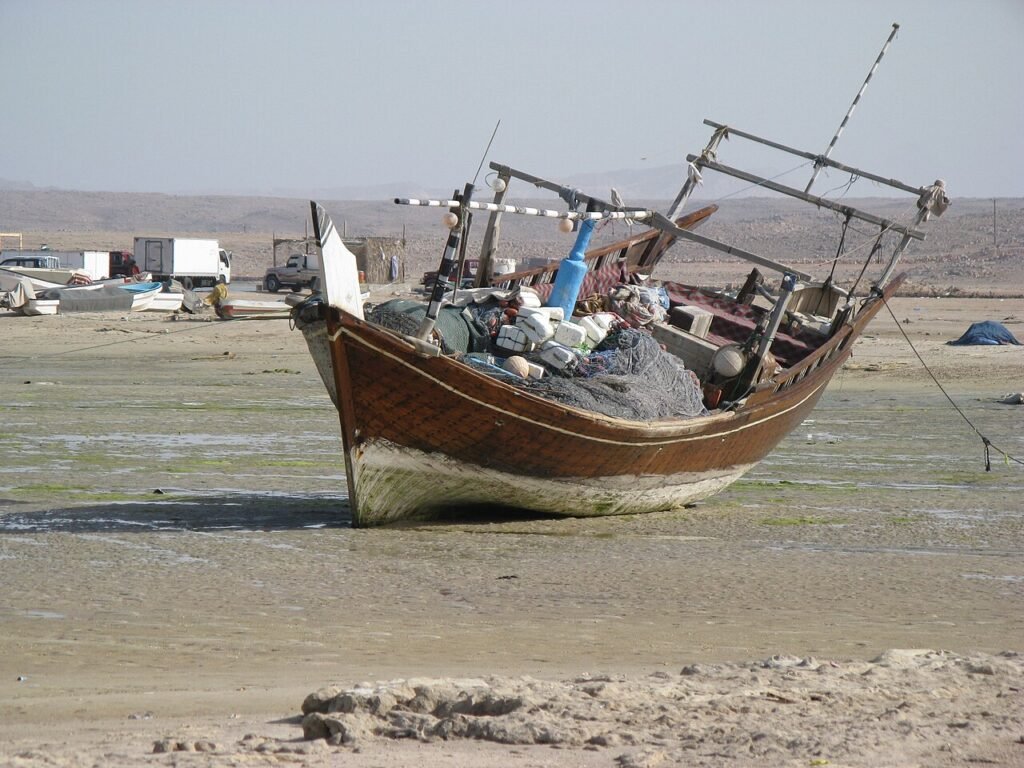
Head south from the village along the dirt track for about 1.5 kilometers, and you’ll reach the working fishing port, where traditional wooden dhows bob in the shallow lagoon beside a grove of mangroves. This is the least-visited part of Ras Al Hadd, and it reveals the village’s pulse. In the early morning (around 6 a.m.), fishermen haul in their catch—grouper, snapper, and the prized kingfish. You can buy fish directly off the boat: a whole grouper might cost you 3 OMR ($8). The mangroves beyond the port are a birdwatcher’s haven; between November and March, you’ll spot flamingos, herons, and the occasional osprey. The path is rough, so your best bet is to rent a bicycle from Al Hadd Village Rentals (2 OMR per day, ask at the grocery store). There are no guides here—you’re on your own—but the solitude is the point.
The Local Table: What Natives Actually Eat
Ras Al Hadd’s cuisine is a reflection of its maritime soul. The foundation of every meal is fresh fish, typically grilled over mangrove charcoal until the skin crackles. Locals eat it with Omani flatbread (khubz rakhal), a drizzle of date syrup (dibs), and a handful of aromatic rice (majboos) spiced with cinnamon, black lime, and dried rose petals. You will find no elaborate restaurants here—the culinary experience is homespun and unpretentious. The only dedicated eatery in the village is the Ras Al Hadd Family Restaurant (open daily 11 a.m. to 10 p.m., near the main square). It’s a simple, family-run joint with plastic tables and a faded menu. Order the grilled kingfish with green chili salsa (3.500 OMR) and a side of salat barri (a wild leafy green that grows in the wadis, similar to purslane). The owner, Umm Salim, will likely bring you a complimentary cup of shai (sweet, milky tea) and ask where you’re from—it’s her way of welcoming strangers.

Fort in Ras al Hadd, Oman.
For a true insider experience, visit the Fish Souq near the port (open 5 a.m. to 8 a.m., no set closing time). This is not a tourist attraction—it’s a concrete slab where fishermen sort their catch. Travelers often discover that you can buy two small snappers for 1 OMR and ask one of the port workers to clean them for you. If you have a stove in your hotel room, you’re set. The secret is to season the fish with nothing but salt, a squeeze of local lime, and a pinch of black lime powder—sold at the souq for 1 OMR for a bag. That’s the taste of Ras Al Hadd: clean, salty, and surprising in its simplicity.
Art, Music & Nightlife
Ras Al Hadd does not have a nightlife scene in the usual sense—you won’t find clubs, bars, or live music venues. Instead, the creative pulse here is tied to tradition. The village’s most celebrated art form is Al-Razfa, a men’s dance performed at weddings and festivals: you’ll see lines of men in white robes, holding wooden staffs, moving in slow, synchronized steps to the beat of a drum and a mizmar (a double-reed horn). If you happen to visit during the Sur Festival (typically held in late October in the nearby town of Sur, 35 kilometers away), you can experience this dance alongside camel races and traditional dhow sailing at the Sur Corniche. It’s a 30-minute drive from Ras Al Hadd, and locals will eagerly point you in the right direction. For a quieter artistic encounter, stop by the small Al Hadd Museum (free entry, open Fridays 9 a.m.–12 p.m.), housed in a restored watchtower. Inside, you’ll find black-and-white photographs of fishermen from the 1960s, old brass diving bells used for pearl diving, and a collection of turtle-shell relics—a poignant reminder of how quickly this place has changed.
Practical Guide
- Getting There: Fly into Muscat International Airport (MCT) with airlines like Oman Air, Emirates, or Qatar Airways. From Muscat, drive 3 hours southeast on Route 23 and then Route 1; the road is excellent. Alternatively, fly to Sur Airport (small planes from Muscat, operated by Oman Air but with limited schedules—check availability). Book flights at Skyscanner
- Getting Around: A rental car is essential. Rent from Muscat Airport for about 20 OMR per day (includes insurance). There is no local bus service and taxis are scarce; you’ll negotiate with private drivers in the village (expect 15 OMR for a round trip to Sur).
- Where to Stay: For atmosphere, book a room at the Turtle Beach Lodge (from 50 OMR/night, includes breakfast and turtle tour discount). For budget, Al Hadd Guest House (25 OMR/night, basic but clean). Both are in the beach strip. Check Booking.com for availability.
- Best Time: Peak turtle nesting is June to September, but conditions are hot (38°C / 100°F). The sweet spot is late October to March, when temperatures drop to 28°C (82°F) and turtle activity is still high. Avoid July–August unless you love humidity.
- Budget: A reasonable daily budget for Ras Al Hadd is 60–80 OMR ($156–208) per person for a double occupancy, covering accommodation, meals, turtle tour, and rental car. Thrifty travelers can get by on 40 OMR.

Aerial view of winding roads through the rocky landscape of Jebel Jais in R…, Ras Al Hadd, Oman
What Surprises First-Time Visitors
The first shock is the silence. After the chaos of Muscat, Ras Al Hadd feels like a ghost town—traffic is almost nonexistent, shopkeepers don’t haggle, and the only constant sound is the low hum of the sea. Travelers often arrive expecting a beach resort vibe, but they find a place where life moves at the speed of a tide. You won’t be offered cocktails or tanning chairs; instead, you’ll be invited to sit on a plastic chair outside a fisherman’s house and offered a cup of tea that seems to last an hour. This isn’t rudeness—it’s hospitality on Omani terms.
The second surprise is the intensity of the turtle experience. Most people think they’ll walk onto the beach and see turtles. Instead, you’ll walk a kilometer in the dark, guided by a ranger who whispers instructions, and then wait—sometimes for twenty minutes, sometimes for two hours—until a massive female drags herself up from the surf. When she starts digging, the ranger will allow you to approach within two meters. You will see the wonder in her eyes (turtles have dark, glossy eyes that seem to reflect the moon) and feel the weight of her ancient, slow breathing. It’s an experience that rearranges something inside you.
Finally, visitors are surprised by the modesty of the infrastructure. Ras Al Hadd is not developed for mass tourism. The ATM in the village only dispenses Omani rials inconsistently, the one grocery store sells stale chips and warm water, and the Wi-Fi (if you get any) will die at dusk. But locals treat this as a feature, not a bug. “Here, you have the beach, the turtle, and the calm,” an old fisherman named Khamis told me. “That is enough.” He was right.
Your Ras Al Hadd, Oman Questions
When is the best time to see turtles nesting?
You can see green turtles nesting at Ras Al Hadd year-round, but the peak season is from June to September, when up to 80 females return each night to lay their eggs. The hatching season follows roughly 6–8 weeks later, so between August and November you might catch hatchlings scrambling toward the sea. The reserve runs night tours every evening, rain or shine, starting at 8 p.m. and lasting until midnight. Arrive by 7:45 p.m. to secure your spot. Remember: no flash photography, no lights, and stay behind the ranger at all times. If you’re a solo traveler or a couple, your best bet is to join the public tour (5 OMR) rather than a private guide (usually 25 OMR, but not necessary).
Beautiful canal amid residential area with palm trees in Ras Al-Khaimah, Ras Al Hadd, Oman
Is Ras Al Hadd safe for solo female travelers?
Absolutely. Oman is one of the safest countries in the Middle East, and Ras Al Hadd is especially low-risk. The village is small enough that everyone knows everyone. Women may receive curious stares—especially if traveling alone—but it’s friendly curiosity, not harassment. You should still dress conservatively: cover shoulders and knees, and wear a scarf for entering the mosque (the Friday mosque near the village square is open to visitors outside prayer times). Walk home alone at night? Yes, it’s fine. The only risk is stepping on a ghost crab on the beach—those are harmless but startle you.
Can you visit Ras Al Hadd as a day trip from Muscat?
Technically yes, but you’ll regret it. The drive is 3 hours each way, which leaves you only 4–5 hours in the village. You can see the turtles on a night tour, but you’d have to drive back to Muscat at midnight or very early the next morning—neither is ideal. Seasoned travelers prefer to stay at least two nights: one to acclimate to the quiet, one for the turtle tour, and a half-day to explore the fishing port and mangroves. If you absolutely must do a day trip, leave Muscat at 6 a.m., stop at the Sur Corniche for a 30-minute coffee break, and reach Ras Al Hadd by 10 a.m. Book the turtle tour for that

