
Bianouan, Côte d’Ivoire Weekend: Markets, Mosques & Morning Call to Prayer (2026)
You step off the shared taxi into the heavy, sweet air of Bianouan – a mix of river damp, charring fish, and the faint, dusty scent of cocoa sacks. The muezzin’s call from the minaret layers over the clatter of a nearby market. This is your 48-hour immersion into a town where Ghana meets Côte d’Ivoire, where every corner offers a story, and where the best grilled brochettes sizzle just as the sun dips behind the mango trees.
Quick Facts Before You Go
- Best Months: November to February – the dry season brings clear skies and manageable heat, perfect for walking the market lanes and exploring the riverbanks.
- Currency: West African CFA franc (XOF). As of early 2025, roughly 600 CFA = 1 USD. ATMs exist only in the central market area; bring cash.
- Language: French is the official language; local Agni and Baoulé dialects are common. English is rarely spoken – pack a phrasebook or learn a few French greetings.
- Budget: You’ll comfortably manage on $30–50 per day, including meals, transport, and a modest guesthouse.
- Getting There: Fly into Abidjan’s Félix-Houphouët-Boigny International Airport (ABJ). From Paris, it’s about 6 hours. Then take a shared taxi or bus to Bianouan (4–5 hours, 5,000–7,000 CFA). Book flights at Skyscanner.
Day 1: Crossing the Comoé – Markets & Minarets
You start the morning at the edge of town, where the Comoé River glimmers beneath a sky already turning white-gold. Travelers often discover that the real Bianouan reveals itself not on maps but through sound: the rhythmic thump of yam being pounded, the chatter of women balancing enamel bowls on their heads, and the distant, melodic call from the Grand Mosquée. This is the heartbeat of the region.
- Morning (8–11am): Dive into the Marché de Bianouan, the sprawling open-air market that spills from the main square into side alleys. You’ll find everything from printed pagne fabric to piles of dried fish and mounds of red palm oil. Don’t miss the cocoa bean section – locals roast and sell them by the scoop (200 CFA per bag). Admission is free, but bring small bills.
- Lunch: Head to Chez Awa, a no-signboard shack tucked behind the market stalls. Order the kpokpo – a spicy palm nut soup with chunks of smoked catfish, served with attiéké (cassava couscous) – for 1,500 CFA. Wash it down with a frozen bag of bissap (hibiscus juice) for 100 CFA.
- Afternoon (1–5pm): Visit the Grand Mosquée de Bianouan (built 1892, restored 2010). Travelers must wear modest clothing and remove shoes at the entrance. You’ll be guided by a young imam eager to share stories of the town’s founding by Agni clans in the late 18th century. Then, walk to the nearby potters’ quarter (Quartier des Potières) where women shape clay into water jars and cooking pots. Watch them fire the pottery in open pits – a technique unchanged for generations. A small pot can be yours for 500–1,000 CFA.
- Evening: At dusk, follow the scent of grilled meat to Le Brochetteur du Comoé, a row of street-side charcoal grills near the taxi park. Locals recommend the spicy beef brochettes (300 CFA each, order four) with a side of grilled plantain and hot pepper paste. As darkness falls, the generators hum, and you’ll share a plastic table with truck drivers and traders – the perfect, gritty end to your first day.

View of Basilica of Our Lady of Peace in Yamoussoukro, Bianouan, Côte d’Ivoire
Day 2: Into the Cocoa Groves – River Views & Village Life
Your second morning feels different – quieter, more intimate. Savvy visitors know to wake early and rent a bicycle from the shop near the mosque (1,500 CFA for half a day). You’ll pedal along red dirt paths that weave through cocoa farms, past children waving and old men mending nets, until the road opens to the Comoé’s wider banks.
- Morning (7–10am): Start at the tiny café Au Petit Grain – a wooden kiosk serving strong, sweet coffee (150 CFA) and beignets (fried dough balls, 100 CFA for four). Grab a seat on the stoop and watch the town wake up. Then cycle 2 km east to the river landing where fishermen haul in morning catch. You can buy a fresh tilapia for 500 CFA and have it grilled on the spot by Madame Joséphine (she’ll season it with ginger and chili – 200 CFA extra).
- Midday (11am–1pm): Visit the Cocoa Cooperative de Bianouan, a humble but vital warehouse where farmers deliver wet beans during harvest. The manager, Monsieur Koné, gives impromptu tours if you arrive before noon. He’ll explain how fermentation and drying work, and let you taste a raw cocoa bean – bitter, earthy, unforgettable. Insider tip: come on a weekday to avoid groups; weekends are empty. Free entry, but a small donation (500 CFA) is appreciated.
- Afternoon (2–4pm): Explore the Quartier Ghana, a stretch of town inhabited by families with historical ties to the Ghanaian side. The streets here feel different – bright flags, loud music from portable speakers, and stalls selling kenkey (fermented corn dumplings) and fried fish. Step into Mama Bee’s Attiéké Shack for a late lunch of foutou banane – mashed plantains with a fiery okra sauce (1,200 CFA). Locals will likely invite you to sit with them; accept.
- Final Evening: Your farewell dinner deserves a view. Cycle back to the river and find Le Jardin du Comoé, a terrace restaurant hidden behind bougainvillea. Order the poisson braisé – whole grilled barracuda with sautéed vegetables and rice – for 3,000 CFA. As you eat, the sun bleeds orange over the water, and the calls to prayer echo softly from both sides of the border. Travelers often call this the moment they fell hard for Bianouan.

Drone shot of the Basilica of Our Lady of Peace with expansive gardens in Y…, Bianouan, Côte d’Ivoire
The Food You Can’t Miss
Bianouan’s kitchen belongs to the street and the market. You’ll discover that attiéké – fermented cassava granules, steamed to a fluffy grain – is the region’s soul food. It appears under everything: grilled fish, peanut sauce, or simply drizzled with palm oil. The best iteration is at the hole-in-the-wall stall known only as “Chez Rachel” (just northeast of the mosque), where Rachel herself piles your plate with chicken kedjenou – a slow-cooked stew (2,000 CFA). Arrive before noon; she sells out by 1pm.
Street food is non-negotiable. Follow the clusters of men gathered at dusk around small charcoal braziers – that’s where you’ll find brochettes de bœuf (beef skewers) rubbed in a secret spice mix of ginger, garlic, and ground peanuts. The vendor near the taxi park, Souleymane, has been grilling for 20 years. His brochettes cost 300 CFA each, and savvy visitors buy six at once. For a sweet finish, look for women carrying large enamel basins – they sell dègoué, a tangy yoghurt-like millet porridge with a splash of tamarind (200 CFA per bowl).
For a sit-down meal, Le Jardin du Comoé is your best bet. The poisson braisé (grilled fish) is consistently excellent, and the owner, Madame Adjoua, speaks a little English. She’ll recommend the sauce gombo (okra stew) with rice if you want something vegetarian – 1,800 CFA. Service is slow, but you’re in Bianouan; nowhere is in a hurry.
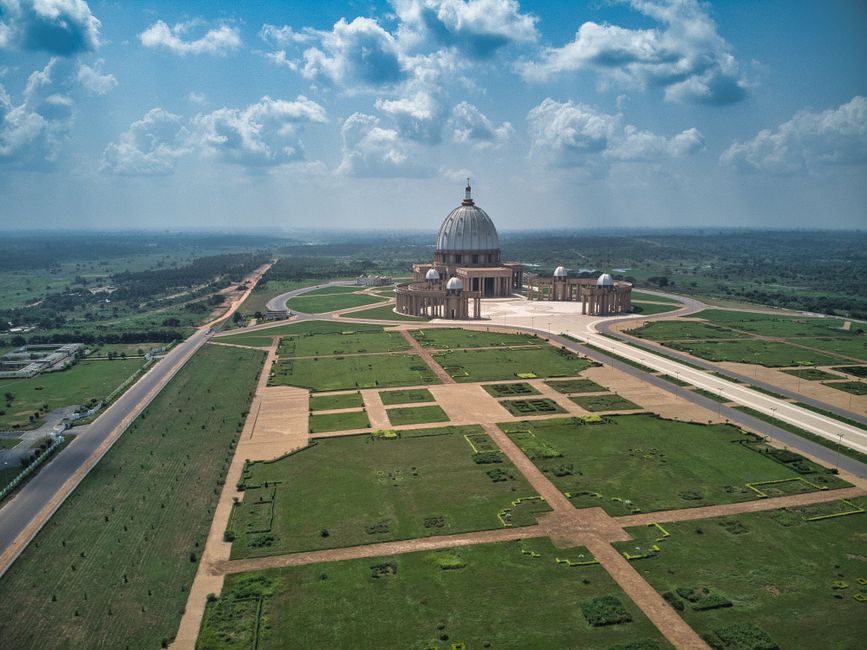
A breathtaking aerial shot of the Basilica of Our Lady of Peace in Yamoussoukro, Bianouan, Côte d’Ivoire
Where to Stay for the Weekend
Your best base is the central area around the market and mosque – everything is walkable, and the taxi brousse stops nearby. For character and local interaction, try Auberge de la Comoé (12 rooms, fan-only, shared bathroom – from 8,000 CFA per night). The owner, Papa Bamba, greets every guest with a glass of vache qui rit (processed cheese) and bread in the morning. It’s rough around the edges, but the rooftop terrace overlooks the river at sunset. Book via Booking.com (listings are rare but exist under Bianouan guesthouses).
For a step up in comfort, Chez Paul (Quartier Résidentiel, 4 km north of centre) offers private rooms with air conditioning and en-suite bathrooms – 25,000 CFA per night. Paul runs a small restaurant downstairs with acceptable European-style dishes if you need a break from attiéké. You can reserve through Airbnb (search “Bianouan” – options are limited but occasionally include Paul’s place).
Insider tip: For a truly local stay, ask at the market for Madame Fatim’s chambres d’hôtes – no online presence, just word of mouth. Three rooms in her courtyard house for 5,000 CFA per night. It’s basic but you’ll eat dinner with her family and probably learn a few words of Agni.
Before You Go: Practical Tips
- Getting Around: Shared taxis (taxi-brousse) are the main option for longer trips – 500–1,000 CFA per ride within town. For the cocoa co-op and river landing, rent a bicycle (1,500 CFA/day) from the shop beside the Grand Mosquée.
- What to Pack: Lightweight cotton clothing (long sleeves for evenings), a headscarf for visiting mosques, mosquito repellent with DEET, a reusable water bottle (water sachets are 25 CFA each but create waste), and a small flashlight – many streets go unlit after 8pm.
- Common Tourist Mistakes: Taking photos without asking – always ask permission, especially of elders. Another: assuming prices are fixed at the market. Travelers often pay triple if they don’t bargain. Start at half the quoted price and meet in the middle.
- Money-Saving Tip: Eat where the locals queue. Breakfast at the street level (coffee and beignets) costs 250 CFA vs 1,500 CFA at a hotel. Bring enough cash from Abidjan – ATM failures are common and credit cards are useless outside the airport.

