
Copiapó, Chile Weekend: Desert Ghosts (2026)
You step off the plane into air so dry it crackles, and the first thing you notice is the silence—broken only by the distant clank of a freight train hauling copper toward the coast. The sun feels older here, whiter, as if it’s been baking this valley for millennia. Dust rises from your boots as you walk, and somewhere in the hills, the ghost of the 2010 mining accident still whispers. This is Copiapó: a city carved from stone and stubbornness, where the desert meets the sky and history is buried underground.
Quick Facts Before You Go
- Best Months: March to November—mild days (20–28°C / 68–82°F) and cool nights, with almost zero rain. Summer (December–February) can hit 35°C/95°F, but the desert heat is dry and bearable.
- Currency: Chilean Peso (CLP). At time of writing, $1 USD ≈ 950 CLP. Bring cash; many smaller spots still don’t take cards.
- Language: Spanish. English is spoken in hotels and some tour offices, but you’ll rely on gestures and phone translators in markets and at smaller eateries. Learn “gracias” and “la cuenta, por favor.”
- Budget: A comfortable weekend costs around $80–120 USD per person per day, including accommodation, meals, tours, and transport. Budget travelers can do $50–70.
- Getting There: Fly into Desierto de Atacama Airport (CPO) from Santiago—a 1-hour 40-minute flight. Book at Skyscanner for the best rates. From the airport, it’s a 45-minute taxi or transfer into town (around $25–30 USD).
Day 1: Dust, Miners & The 33
You start the morning at the Plaza de Armas as the sun climbs over the cathedral’s bell tower, and the city slowly wakes—elderly couples sweeping doorsteps, a fruit vendor setting out chirimoyas and lucumas, the faint smell of freshly baked marraquetas drifting from a panadería. Copiapó feels sleepy until you remember what happened just 14 years ago, when 33 men were trapped 700 meters below the earth, and the world held its breath for 69 days. That story pulses through this city—you’ll feel it in the dust, in the memorials, in the quiet pride of the people.
- Morning (8-11am): Head to the Plaza de Armas for a free self-guided walk. Admire the neoclassical Catedral de Copiapó (built 1870), then visit the Museo Regional de Atacama (Calle Atacama 551, open Tues–Sun, 9am–5pm, $3 USD). The museum holds pre-Columbian artifacts, mining relics, and a moving exhibit on the 2010 rescue. You’ll see the famous “Fénix” capsule that pulled the miners to the surface—your skin will prickle.
- Lunch: Walk two blocks to La Pica del Minero (Calle Copiapó 452). Order the pastel de choclo (a corn-and-beef casserole, $7 USD) or the cabrito al horno (roast goat, $10 USD). Locals recommend the house-made pebre sauce—spoon it generously. The walls are covered in miner helmets and newspaper clippings from the rescue.
- Afternoon (1-5pm): Book a tour to San José Mine and the Campamento Esperanza memorial (half-day tours from $35 USD, depart 2pm from your hotel). Most tourists overlook this, but savvy visitors know: the site is a pilgrimage. You’ll stand over the collapsed shaft, see the “Campamento Esperanza” where families camped for 69 days, and the chapel built for St. Lorenzo—the miners’ patron. Your guide, likely a local with family ties to the rescue, will tell you stories the news never captured. After, visit the Museo del Sitio (included in tour) for a sobering look at the rescue operation.
- Evening: Dinner at Restaurante Casa del Minero (Rancagua 572, 7:30–11pm). Try the chupe de camarones (shrimp chowder, $9 USD) and a bottle of Carmenere from Chile’s Central Valley ($12 USD). The atmosphere is warm and intimate—exposed brick, candlelight, and a corner dedicated to the 33 miners with signed jerseys and photos. After, stroll the Paseo del Valle along the river, where locals walk their dogs and couples hold hands under the desert stars.

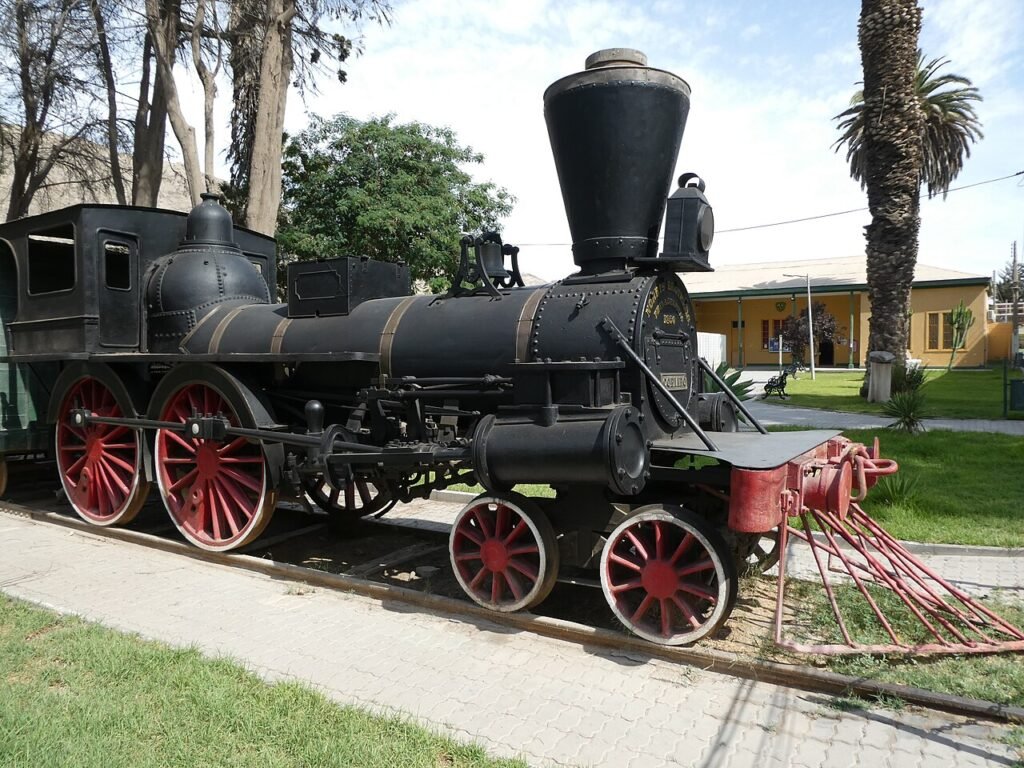
La locomotora Copiapó fue construida por Norris Brothers en Filadelfia en 1850, Copiapó, Chile
Day 2: Canyons, Geoglyphs & The Silence of the Desert
Day two flips the focus from mining history to the ancient desert itself—a landscape so vast and empty it feels like another planet. You’ll trade the city’s dust for canyon walls that have watched over this valley for 10,000 years. This is where Copiapó reveals its quieter soul: petroglyphs carved by pre-Columbian hands, salt flats that shimmer like snow, and a silence so complete you can hear your own heartbeat.
- Morning (7am–12pm): Rise early and drive east toward the Valle del Encanto (25 minutes from town, $5 USD entry). This canyon is a natural museum of geoglyphs—ancient drawings of llamas, shamans, and celestial symbols etched into the rock faces. Most tourists skip this for the better-known Pan de Azúcar, but seasoned travelers prefer it for the solitude. You’ll walk the 2-km loop trail in about an hour. Look for the “Sol de Copiapó” geoglyph—a sun figure that aligns with the winter solstice. Bring water, a hat, and sunscreen; there’s zero shade.
- Midday: Stop for breakfast at Panadería y Pastelería La Francesa (Calle Chacabuco 350, open 7am–2pm). Try a terremoto de fruta (a fruit pastry, $2 USD) and a café con leche ($1.50 USD). The secret is the mil hojas—a thousand-layer cake that locals insist is the best in the Atacama Region. If you’re lucky, you’ll snag the last one before noon.
- Afternoon (1-5pm): Drive to Tierra Amarilla (30 minutes south, free entry) to see the Cerro del Inca geoglyph—a colossal figure of a llama carved into the mountainside, visible from the road. This is one of the largest geoglyphs in Chile, stretching 80 meters across. Bring binoculars. For the truly adventurous, continue to Nevado Tres Cruces National Park (2 hours east, $8 USD entry), where you’ll find high-altitude lagoons and, on clear days, views of Ojos del Salado—the highest volcano on Earth at 6,893 meters. The turquoise waters of Laguna del Negro Francisco are a photographer’s dream.
- Final Evening: Farewell dinner at La Vitrina del Mar (Calle O’Higgins 410, 7–11pm). This seafood spot, beloved by locals, serves the caldillo de congrio (conger eel stew, $11 USD)—the same dish Pablo Neruda wrote a poem about. Pair it with a crisp Sauvignon Blanc from the Elqui Valley ($8 USD). If you have room, the leche asada (baked custard, $4 USD) is the perfect sweet note. Sit on the terrace—the evening air still holds the day’s warmth, and the stars over the desert are so bright you’ll swear you can touch them.

Gray shopping cart, Copiapó, Chile
The Food You Can’t Miss
Copiapó’s cuisine is a reflection of its geography: hearty, earthy, and built for desert appetites. The city sits at the crossroads of the Atacama’s salt flats and the Pacific coast, so you’ll find seafood that traveled 80 kilometers inland alongside goat and corn dishes that speak to the agricultural valleys. Travelers often underestimate the food scene here, but you’ll quickly learn that the best meals come with stories.

A couple of animals that are in the water, Copiapó, Chile
Start your culinary tour on the street: Los Empanadas de la Abuela at the corner of Calle Portales and Atacama (weekdays 11am–7pm, $2 USD each) are legendary. Locals queue from 10:30am for the pino version (beef, onion, egg, olive, and raisin) served with aji amarillo sauce. The secret is the dough—lard-based and impossibly flaky, baked in a brick oven that’s been there since 1982. You’ll see miners, office workers, and grandmothers all standing side by side, eating from napkins, and you’ll understand why this is Copiapó’s most democratic pleasure.
For a sit-down experience, El Fogón de Copiapó (Calle Rodríguez 620, dinner from $12 USD) is where locals take visiting relatives. The cazuela de cabrito (goat stew with potatoes, corn, and squash, $10 USD) is the house specialty—slow-cooked for six hours in a clay pot. The owner, Doña Marta, learned the recipe from her grandmother in the 1970s, and she’ll likely come out to ask how you like it. The atmosphere is unpretentious—plastic tablecloths, a TV playing Chilean football, and the steady hum of conversation. It’s not fancy, but it’s authentic, and that’s worth more than any white tablecloth.
Barrio Plaza de Armas ($$$): The historic heart, with the cathedral, museums, and the best restaurants. The Hotel Atacama Suites (Calle Atacama 450, rooms from $80 USD/night) offers spacious rooms with desert views and a rooftop terrace where you can watch the sunset over the valley. It’s a 2-minute walk to everything. For a boutique option, Hostal Mirador de Copiapó (Calle O’Higgins 320, $55 USD/night) has a lovely courtyard garden and staff who can arrange tours. Book through Booking.com for the best rates.
Barrio Industrial/Avenida Copayapu ($$): More local and slightly cheaper, with good access to the bus station and markets. The Hotel Diego de Almagro (Av. Copayapu 850, $65 USD/night) is a solid mid-range choice with a pool and buffet breakfast. For self-catering, Departamentos La Serena (via Airbnb, from $40 USD/night) offer kitchenettes and laundry—perfect if you’re staying longer and want to visit the nearby valleys.
Before You Go: Practical Tips
- Getting Around: The city center is walkable, but for the mine and Valle del Encanto, you’ll need a car or a tour. Rental cars from the airport cost $35–50 USD/day (book with full insurance). Local colectivos (shared taxis) run fixed routes for $1 USD—flag them down on Avenida Copayapu. For the mine tour, most hotels arrange pickups for $5–10 USD round trip.
- What to Pack: A wide-brimmed hat and sunblock (SPF 50+—the desert sun is brutal); a lightweight windbreaker for evenings (temperatures drop 20°C/36°F after sunset); sturdy walking shoes (the canyon trails are rocky); and a refillable water bottle—the tap water is safe here, but you’ll go through at least 2 liters a day.
- Common Tourist Mistakes: Underestimating the altitude—Copiapó sits at 400 meters, but trips to Nevado Tres Cruces go above 4,000 meters. Acclimate in town for a day before heading up; chew coca leaves or sip coca tea (available at any pharmacy) to avoid headaches. Another mistake: skipping sunscreen on cloudy days—the UV index in the Atacama is among the highest on Earth. You’ll burn in 15 minutes without it.
- Money-Saving Tip: Eat lunch at the Mercado Central de Copiapó (Calle Portales 200, 8am–6pm) instead of restaurants. The market stalls serve enormous completos (Chilean hot dogs with avocado, tomato, and mayo, $3 USD) and fresh juice made from locally grown chirimoya and papaya ($1.50 USD). You’ll save $10–15 USD per meal, and you’ll eat with the city’s pulse.

