
Where the Mountains Meet the Sea: Corsica’s Untamed Heart (2026)
In the summer of 1755, when most of Europe was still bowing to kings and popes, a Corsican intellectual named Pasquale Paoli gathered the island’s fractious clans in the village of Corte and proclaimed a democratic republic—complete with separation of powers, a written constitution, and universal male suffrage. It was a radical experiment that lasted barely a generation before the French annexed the island in 1769, the same year a boy named Napoleone Buonaparte took his first breath in Ajaccio. That tension between fierce independence and outside influence still hums in the air today.
The Story Behind Corsica, France
Corsica’s history reads like a Mediterranean epic, written in Phoenician ships, Roman roads, and Genoese fortresses. The Greeks called it Kyrnos; by the 13th century, the city-state of Genoa had locked its grip on the island, building towering watchtowers along 600 miles of coastline. You can still spot these circular stone guardians—the Genoese towers—silhouetted against headlands in places like Porto and Santa Giulia, each one a silent sentinel from an age of pirate raids. Genoa’s rule lasted nearly 500 years, but it was never comfortable. When you walk the narrow, vaulted alleyways of the Old Town in Bastia, you’re stepping through the political tension of a people who refused to be ruled.
Paoli’s republic (1755–1769) was the first major break. He established a university in Corte, minted coins, and created a national army. The French, however, were not about to tolerate a democratic micro-state near their border. After his defeat at Ponte Novu in 1769, Paoli fled to exile in London, and Corsica became French—except it never really became French. Travelers often discover that locals still speak Corsican (a language closer to Italian than French) and that every village has a maquis—the thick, aromatic scrub that symbolizes resistance and defiance. The 20th century brought two world wars and a persistent separatist movement; even today, you’ll see spray-painted slogans on cliffsides demanding “Indipendenza.” Yet for the visitor, this turbulent past adds a layer of soul to an already stunning landscape.
Neighborhood by Neighborhood
Bastia: The Genoese Gate
Start in Bastia, the island’s de facto capital for visitors arriving by ferry. The Terra Vecchia (Old Town) wraps around the Port of Santa Maria in a labyrinth of stairways and courtyards that smell of salt and tomatoes. Don’t miss the Place du Marché, where farmers set up stalls every morning except Monday. The cobbled Rue du Dragon leads you uphill to the Palais des Gouverneurs, a pale-yellow Genoese palace that now houses the Bastia Museum. Here, you’ll hear voices echoing in Corsican—a guttural, honeyed tongue—and see women balancing baguettes on bicycles. Travellers often pause at the Bar de la Marine for a coffee and a view of the fishing boats bobbing against a backdrop of ochre buildings. The real magic, though, happens in the Piève, the upper citadel quarter, where laundry hangs across narrow alleys and a 16th-century cathedral stands silent under the sun.
Corte: The Mountain Heart
Drive inland on the D47 winding road, and after an hour of hairpins and pine forests, you’ll reach Corte, perched at 350 meters in the Tavignano valley. This is the historic capital of Paoli’s republic, and you can feel its defiant spirit in the Musée de la Corse, housed in the old citadel. Visit in late September for the U scontru di e nazioni, a traditional music festival that fills the streets with polyphonic chanting. Spend an afternoon sipping a Pietra—the local chestnut beer—at a table on Place Gaffori, watching students from the university spill out of cafés. Corte is not a beach town; it’s a mountain town, where the air is crisp and the houses cling to the hillside like geological layers. The best walk is to follow the path along the Tavignano River, past swimmers and sunbathers on flat rocks, to the abandoned village of Grotelle—a ghost of the pastoral life that once defined these slopes.
Bonifacio: The Cliff Citadel
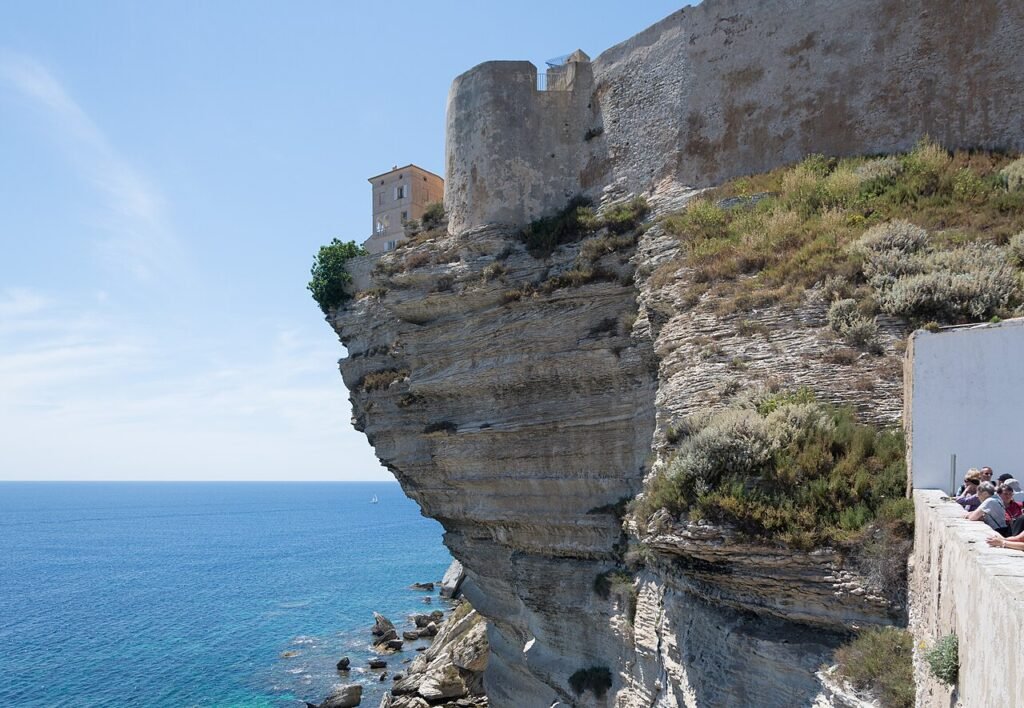
At the southern tip, Bonifacio is a geological marvel and photographic obsession. Its old town sits atop a sheer white limestone cliff that plunges 70 meters into a turquoise sea. You enter through a 16th-century gateway, the Porte des Gones, and then descend into a maze of narrow lanes that smell of grilled sardines and lavender. The La Marina neighborhood, at sea level, is where you’ll find the harbour cafés and the ferry to Sardinia—only 12 km away. Make time to walk the Bastion de l’Étendard, a 13th-century Genoese fort that offers vertiginous views of the Gulf of Saint-Tropez on clear days. The true locals’ secret is the Escalier du Roy d’Aragon: a 187-step staircase carved into the cliff face, used by a French king during a siege in 1421. Climb it at dawn, and you’ll have the sea, the sun, and the silence to yourself.
The Local Table: What Islanders Actually Eat
Corsican food is robust, earthy, and unashamedly rural. The island’s maquis scrub—myrtle, rosemary, wild thyme—permeates everything, from the cheese to the cured meats. Locals start the day not with a croissant but with a canistrelli (a hard anise biscuit) dipped in coffee. Lunch is often a slice of fiadone, a cheesecake-like torte made with brocciu (fresh whey cheese), lemon rind, and a hint of chestnut flour. Dinner, if you’re invited to a mountain home, might be a slow-cooked wild boar stew (sanglier) served with chestnut polenta. The most iconic dish you must seek out is civet de sanglier à la corse—wild boar marinated in red wine and maquis herbs—and the best place to try it is at Restaurant U Fragnu in Bastia’s old town. This family-run spot, hidden on Rue des Terrasses, has been simmering the same recipe since 1973. Reserve a table at 8 p.m. sharp; expect to spend around €35 for three courses and a carafe of local Niellucciu red wine.

Skylark of 1937 during the ‘Corsica Classic 2013’ yacht race, Corsica, France
To see how locals shop, arrive at Ajaccio’s Marché Central (Place du Diamant, open daily except Monday 6 a.m.–1 p.m.) and follow your nose. You’ll find coppa and lonzu—pork shoulders air-dried in mountain air—as well as glistening wheels of tomme de brebis (sheep’s milk cheese) and jars of honey from chestnut blossoms. The secret is to ask for a tasting; farmers are happy to let you try before you buy. And always finish with a shot of liqueur de myrte, a dark, syrupy digestif made from the berries of the Myrtus communis bush. Travelers often find that sharing a bottle with the cheesemonger turns into a half-hour conversation about lineage and land rights.
Art, Music & Nightlife
Corsica’s creative pulse beats strongest during summer festivals. The Festival du Vent in Calvi (every July) brings windsurfing, kite festivals, and live rock concerts to the bay. But the island’s truest art form is paglialla—polyphonic singing—where three or four men intertwine voices in a haunting, hypnotic call-and-response. You can hear this in churches during Semana Santa (Easter week) in Sartène, where a chanted procession known as the Catenacciu has been performed since the 14th century. For contemporary art, visit the Palais Fesch in Ajaccio, home to Napoleon’s uncle’s collection of Italian Renaissance paintings. The gallery’s blue-domed rotunda hosts rotating exhibitions of modern Corsican photography and sculpture. Nightlife outside of July–August is low-key; your best bet is a evening at Le Bambou in the Upper Town of Bastia, a jazz bar where local musicians play from 9 p.m. on Thursdays. Sip a Pastis and listen to the clink of boules from the square outside. If you’re on a party mission, head to the L’Ile Rousse port, where clusters of twentysomethings dance on dock-side clubs until 4 a.m.
Practical Guide
- Getting There: Fly into Ajaccio Napoleon Bonaparte Airport (AJA) or Bastia Poretta Airport (BIA) from Paris, Marseille, London, or Brussels. Airlines include Air Corsica, EasyJet, and Volotea. Book at Skyscanner. Ferry from Marseille (10–12 hours) or Nice (5–6 hours) with Corsica Ferries or SNCM; book via their direct sites.
- Getting Around: Rent a car—Corsica’s bus network is sparse and unreliable. Expect about €50–70 per day in peak season for a compact manual. Mountain roads are narrow and winding; allow double the time Google Maps suggests. The train (Chemin de Fer de la Corse) runs from Bastia to Ajaccio via Corte—€25 one-way, 4 hours, scenic but slow. Book tickets at the station 20 minutes before departure; credit cards often not accepted.
- Where to Stay: In Bastia, stay in the old town at Hotel Pietracap (€120–180/night) for Genoese charm. In Corte, choose Château de la Punta (€90–140) for gardens and mountain views. For Bonifacio, the Hôtel des Étrangers (€150–250) offers cliffside rooms with sea terraces. Check availability at Booking.com.
- Best Time: May–June and September–October. July and August bring crowds, high prices (hotels double), and maddening traffic. In October, the chestnut harvest livens up hilltop villages; you can tour the Maison du Châtaignier in Evisa for free. Winter (Nov–Feb) is quiet, many restaurants close, but hiking is still possible—just bring rain gear.
- Budget: Plan for €100–130 per day per person in shoulder season (car, hotel, meals). In high season, budget €170. Street-side creperies serve a galette for €10; sit-down restaurants run €25–45 for a three-course meal.

Buildings beside body of water during daytime, Corsica, France
What Surprises First-Time Visitors
The biggest shock is the sheer size of the maquis. You expect a scrubby hillside, but stepping off a path in the Corsican interior, you’re swallowed by a dense, knee-high thicket that snags your clothes and bursts with the smell of rosemary and juniper. This is not a manicured landscape; it’s a wild, carpet-like ecosystem that locals use to flavor cheese and ward off snakes. Many travelers arrive expecting a French Riviera vibe—white sand and cocktails—only to discover that Corsica’s best beaches, like Saleccia or Palombaggia, require a 20-minute walk through sand dunes that feel like a desert. There are no beach clubs or deck chairs; you bring your own umbrella and listen to the waves without a waiter in sight.
Another surprise: the island’s bilingual reality. Signs are in French and Corsican, but many locals—especially older residents—will greet you with “Bonghjornu” and answer in Corsican first. Don’t be flustered; they’ll switch to French if you look lost. English is not widely spoken outside tourist zones, so having a few French phrases (and the Corsican “grazie” for thank you) goes a long way. Savvy visitors also learn that time moves differently here. A two-hour lunch break (12–2 p.m.) is sacred; shops close, and no amount of pleading will open a cash register before 2:15. Plan your day around that rhythm, and you’ll find yourself unwinding into a pace that feels like the island itself—ancient, unhurried, and fiercely proud.
Finally, the heat. Summer temperatures soar to 35°C (95°F) inland, and the absence of air conditioning in many historical apartments can be draining. Your best defense is to swim by 10 a.m. and sleep with windows open—just be sure the mosquito net is intact. Locals themselves take a siesta from 1–4 p.m.; follow their lead, and you’ll avoid the burnout that tourists face when they try to hike the GR20 trail in July. That trail—the famously rugged 180-km mountain path across the island—is the ultimate surprise: 15 days of granite peaks, wild boar sightings, and a kind of solitude that most people never know.
Your Corsica, France Questions
Is Corsica safe for solo travelers? Yes, very. Violent crime is rare; the biggest threat is pickpocketing in crowded markets in Ajaccio and Bastia. The island’s mountain trails are well marked, but solo female hikers should register their itinerary with the local gendarmerie before setting out on a full-day trek. That said, locals are warm and protective—if you break down on a winding road, expect help within 20 minutes. Trust your instincts, carry a headlamp, and you’ll be fine.

White speedboat beside shore on body of water, Corsica, France
Can you see Corsica without a car? It’s possible but limiting. The train connects the major towns, but beaches, mountain villages, and the famous Calanques de Piana are unreachable by public transport. Your best alternative is to base yourself in Calvi for a week and join day tours (€60–80 per person) to Scandola Reserve and the Piana red rocks. For maximum flexibility, rent a car—just prepare for narrow roads and steep drop-offs that can unnerve even experienced drivers. Consider a small car (a Fiat 500) and purchase the super-inclusive insurance; a scratch on a rented Peugeot can cost you €500.
What is the one place you should not skip? The Calanques de Piana, a Unesco World Heritage site on the west coast. These crimson granite cliffs rise vertically from the Gulf of Porto, sculpted by wind and sea into fantastical shapes—a dog’s head, a prayerful monk, a giant’s tooth. Visit at sunset (around 7:30 p.m. in July) and walk the short path from the Col de la Croix to the viewpoint. The light turns the rocks from orange to blood-red, and you’ll understand why Corsicans call it “the red city of the sea.” Pack water and a picnic; the only vendor near the car park closes at 5 p.m.

