
Mývatn, Iceland Weekend: Geothermal Baths, Pseudocraters & Midnight Sun Through the Highlands (2026)
You step off the gravel path at Skútustaðir and hear the low, rhythmic hiss of steam escaping from a fissure—mixed with the soft clatter of a dozen ducks skimming the water’s surface. The air smells of sulfur and wet moss, but also of something clean and cold, a wind that has blown across lava fields only hours before. It’s 10 PM, the sun is still high, and Mývatn is just getting started.
Quick Facts Before You Go
- Best Months: June through August for endless daylight and birdlife; September and October for Northern Lights and fewer crowds. Winter brings ice caves and snow-covered craters—but roads can be challenging.
- Currency: Icelandic króna (ISK). At time of writing, 1 USD ≈ 140 ISK. Most places accept credit cards; cash is rarely needed.
- Language: Icelandic, but virtually everyone speaks flawless English. Signs, menus, and tour guides are bilingual.
- Budget: Plan on about 30,000–50,000 ISK ($215–$360) per person per day, including accommodation, rental car, meals, and one paid attraction.
- Getting There: Fly into Akureyri Airport (A EY)—a 50-minute flight from Reykjavík—then drive 90 minutes east on Route 1. Book flights at Skyscanner.
Day 1: Pseudocraters, Steam Baths & a Lake of Midnight Birds
You start the morning in Akureyri with a strong cup of coffee and a view of the fjord, then climb into your rented 4×4 and head east. The road unspools past sheep-dotted green hills and the deep blue of Lake Mývatn. By the time you pull into the village of Reykjahlíð, you’ve already spotted the charcoal‑black hummocks of Hverfjall crater on the horizon. The air sharpens with geothermal minerals, and for a moment you forget that a full day of walking and soaking lies ahead.
- Morning (8-11am): Start at Skútustaðagígar—the pseudocraters on the southern shore. These grassy, bowl-shaped formations were created when lava flowed over a marsh 2,300 years ago, causing steam explosions. A 3‑km loop trail takes you right through them, with interpretive signs in English. You can spot whooper swans and teal in the pools. Cost: FREE. Tip: arrive by 8:30 to have the craters to yourself before the tour buses roll in from Akureyri.
- Lunch: Head to Vogafjós Farm Resort (Route 848, 5 minutes from Skútustaðir). This working dairy farm sits right on the lake’s edge. You sit in a cozy dining room with a glass wall overlooking the barn—cows, calves, and all. Must-order: the smoked lamb sandwich (2,950 ISK) made from their own sheep, served with house-baked rye and a side of skyr cream. Nearly every visitor orders the “cow view” table; locals recommend the geysir bread (baked in a geothermal oven) as a starter.
- Afternoon (1-5pm): Three stops in a loop. First, Grjótagjá—a lava-tube cave with a geothermal spring where Jon Snow and Ygritte hid in Game of Thrones. The water temperature fluctuates between 45°C and 50°C, too hot for swimming, but you can descend the stone steps and feel the steam on your face. Second, Hverfjall (Hverfell) crater—a 1‑km‑wide tephra ring formed in an explosive eruption 2,500 years ago. You hike to the rim (steep, 20 minutes) and walk the circumference. The view down into the black bowl is otherworldly. Cost: FREE. Third, Dimmuborgir (“Dark Castles”)—a surreal lava field of twisted pillars, arches, and caves. You follow the marked trails (the 1‑km red trail takes you past the “Church” rock formation). Legend says this is where the Yule Lads live. Cost: FREE for self-walking; parking is 700 ISK.
- Evening: Dinner at Kaffi Borgir (Reykjahlíð, on the main street). The atmosphere is cozy, with peat-fired stoves and views over the lake. Locals recommend the fish stew (4,250 ISK)—a creamy cod and potato soup served with flatbread. After dinner, drive 10 minutes to Mývatn Nature Baths (open until midnight in summer). Entry: 5,500 ISK (about $40). You soak in turquoise, silica-rich water between 36°C and 40°C, with a bar serving beer and smoothies from the pool. The steam rises against the endless twilight—by 11 PM the light is still bright enough to read a book. Good luck tearing yourself away.

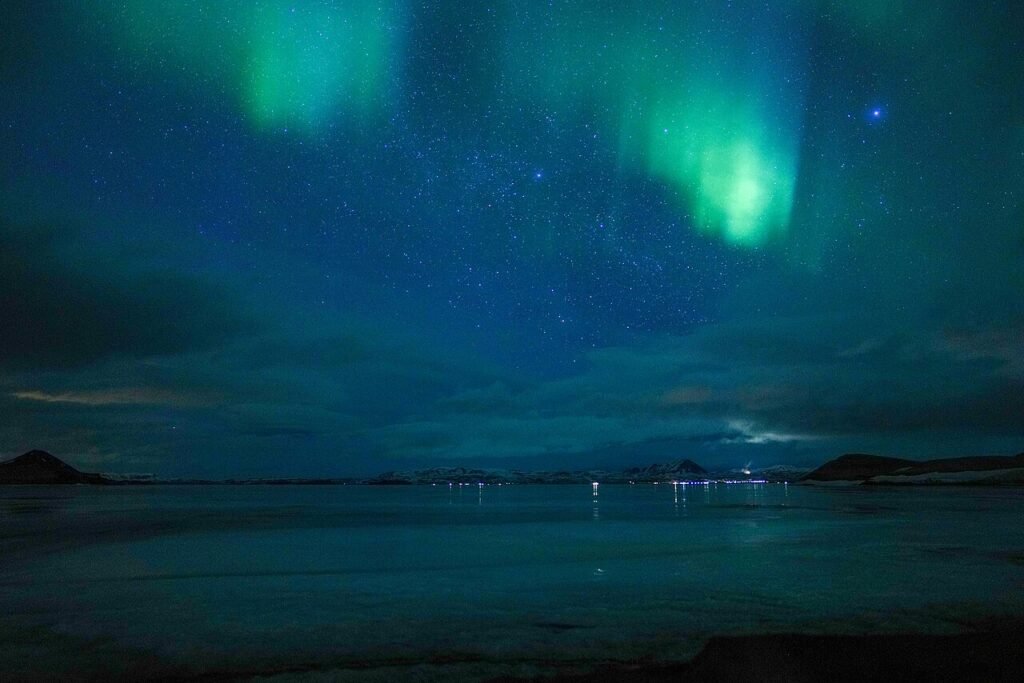
Northern lights in the night sky over Mývatn (Iceland), Mývatn, Iceland
Day 2: Lava Fortresses, Hot Springs & a Farewell to the Fjord
Your second day feels different—slower, more contemplative. The jet lag has worn off, and you wake to the strange hum of a fly-rod being cast from a rowboat on the lake. Today you’ll dive deeper into the volcanic landscape, then reward yourself with one last geothermal soak before the drive back. Savvy visitors know that Sunday afternoon is the quietest time for the main attractions; you’ll have Hverir almost entirely to yourself.
- Morning (8:30–11:30am): Drive east to Hverir geothermal area (northern shore). The ground is a palette of ochre, yellow, and red, with fumaroles hissing steam and mud pots bubbling at 100°C. A boardwalk loops through the site; the smell of sulfur is strong, but the intensity fades after a few minutes. Walk to the far end for a view across the lake to Krafla volcano. Cost: FREE. Then hike up to Krafla – Leirhnjúkur—a volcanic crater last erupting in 1984. A 4‑km trail circles the steaming vent and passes a neon-blue lake formed in the explosion. The texture of the lava—ropy, glassy, still bare—feels like you’re walking on planetary crust. Afterward, grab breakfast at Kaffi Norður (in Reykjahlíð) for a skyr‑based smoothie bowl (1,950 ISK) with local berries and granola.
- Midday (12–2pm): Head to Dettifoss—Europe’s most powerful waterfall, 30 minutes east of Mývatn (Route 862 gravel road, accessible with a regular car in summer). The roar is deafening; you feel the spray from the car park 200 meters away. The trail to the edge is a flat 20‑minute walk. Most tourists stop at the viewpoint, but you should continue another 15 minutes to Selfoss, a smaller but more elegant cascade upstream. Insider tip: come before 11 AM to avoid the tour buses from Akureyri—on Sunday, you’ll have the falls to yourself for at least an hour.
- Afternoon (2:30–5pm): Return to the lake and explore the Laxá River delta—a shallow wetland where you can spot harlequin ducks and golden plovers. Then stop at Borgarvirki, a basalt column fortress about 20 minutes west of the lake. This 250‑year‑old Viking‑era marker was used as a landmark by medieval settlers. Climb the spiral staircase cut into the rock for a panorama of the entire Skagafjörður region. Cost: FREE. Finish at Húsavík Whale Museum (entry 2,200 ISK) if you have time—it’s a 30‑minute drive, but the exhibits on whale biology and Icelandic whaling history are world‑class.
- Final Evening: Your farewell dinner deserves a special setting. Book a table at Daddi’s Pizza (Reykjahlíð)—a family‑run spot serving wood‑fired pizzas in a greenhouse‑like garden. The “Mývatn” pizza (3,200 ISK) comes with smoked Arctic char, pickled onions, and aioli. The atmosphere is effortlessly convivial—locals chat with travelers over craft beers (try the Mývidör from Borg Brugghús). If you can, linger until 11 PM; the sunset colors (yes, it sets for a couple of hours in June) cast a pink glow over the lake, and you’ll hear the call of red‑throated loons. That’s the moment you understand why Icelanders call this place “the lake of midges”—the tiny swarms dance in the last light, and somehow it’s beautiful.

Gray rocky mountain under white cloudy sky during daytime, Mývatn, Iceland
The Food You Can’t Miss
Mývatn’s food culture is rooted in what the land and lake provide: trout, Arctic char, lamb, and rye bread baked in geothermal ovens. The most iconic dish is geysir bread (hverabrauð)—a dense, sweet rye loaf that’s buried in the hot ground near Hverir for 24 hours. You’ll find it at Vogafjós and at the Mývatn Nature Baths café, slathered with butter (350 ISK per slice). Locals also swear by smoked lamb from the farm at Vogafjós—they smoke it over birch wood for 12 hours, then serve it with rhubarb jam and a shot of brennivín (Icelandic schnapps).

Brown and gray mountains beside river during daytime, Mývatn, Iceland
For a casual lunch, you can’t miss the fish stew at Kaffi Borgir (4,250 ISK) or the Arctic char with dill potatoes at Vogafjós Farm Resort (5,900 ISK). Another street‑food hidden gem: Kjötsúpa (lamb soup) at Skútustaðakirkja—the church’s community centre hosts a soup lunch on summer Sundays (1,500 ISK, usually fresh‑made by local women). For dessert, try skyr with wild blueberry preserve, available at almost every café. Pair it with a coffee from Kaffi Norður—they roast their own beans from a small roastery in Reykjavík.
Where to Stay for the Weekend
The logical base is the village of Reykjahlíð, on the eastern shore of the lake. It has the highest concentration of hotels, restaurants, and grocery stores. You’ll find Hotel Laxá (4-star, rooms from 22,000 ISK/night in summer) with a view of the lake and an in‑house geothermal hot tub. For a more intimate stay, consider Fosshótel Mývatn—a modern property with floor‑to‑ceiling windows facing the dormant volcano (rates from 28,000 ISK). Budget travelers prefer the Mývatn Hostel (dorm bed 6,500 ISK, private room 15,000 ISK) in the same village, run by a friendly Icelandic couple who also serve a hearty breakfast buffet (2,500 ISK). If you want total quiet, book Airbnb at a farm near Skútustaðir—you’ll wake up to sheep and a view of the pseudocraters. Compare options at Booking.com and Airbnb.
Before You Go: Practical Tips
- Getting Around: A car is essential. Rent a 4×4 if you plan to visit Dettifoss or take dirt roads. Car rental in Akureyri starts around 12,000 ISK/day for a compact car. Buses exist (the 56 route runs from Akureyri to Mývatn daily) but limit your flexibility.
- What to Pack: A waterproof jacket with hood (rain is frequent, even in summer), a micro‑fleece or wool sweater (layers are key), sturdy hiking boots, a swimsuit and towel for the baths, and insect repellent for the midges (the “Mý” in Mývatn means “midge”—they’re harmless but annoying). Winter visitors need thermal base layers and insulated boots.
- Common Tourist Mistakes: The biggest mistake is visiting Hverfjall or Dimmuborgir during lunchtime (12–2 PM) when tour buses arrive—crowds and limited parking. Another: skipping the pseudocraters at Skútustaðir because they look small from the road. Walk the trail—you’ll appreciate their scale. Also, don’t touch the water in Grjótagjá; it’s too hot, and signs warn of bacterial contamination.
- Money-Saving Tip: The Mývatn Nature Baths cost 5,500 ISK, but if you visit after 8 PM (closing at midnight), the ticket drops to 4,500 ISK. Also, bring your own snacks—a sandwich and drink at the bath’s café can run 3,000 ISK. Buy groceries at the Krónan supermarket in Reykjahlíð for picnic supplies.

