
Osa’s Corcovado Park, Costa Rica Weekend: Scarlet Macaws (2026)
The six-note call of a howler monkey breaks the dawn silence, followed by the screech of a flock of scarlet macaws taking flight over the canopy. You stand at the edge of a muddy trail, the air thick with the scent of wet earth and decomposing leaves. A tapir emerges from the undergrowth, snuffling the path ahead. This is Corcovado National Park—the most biologically intense place on Earth, according to National Geographic—and you have exactly 48 hours to dive into its raw, humming heart. Welcome to the Osa Peninsula, where the jungle meets the Pacific in one glorious, untamed weekend.
Quick Facts Before You Go
- Best Months: December–April (dry season, easier hiking and less mud) or June–November (green season, lower prices, fewer tourists, rain departs by noon)
- Currency: Costa Rican colón (₡). Roughly 560 colones to 1 USD. US dollars widely accepted, but bring small bills for sodas and park fees.
- Language: Spanish. English is spoken at most lodges and tour agencies, but a little “gracias” and “buenas” go a long way in local villages.
- Budget: $80–$150 per person per day (mid-range: guided tours, soda lunches, shared lodging). Up to $400/day for luxury eco-lodges with full board.
- Getting There: Fly into Puerto Jiménez Airport (PJM) from San José – a 1-hour domestic flight on Sansa or Nature Air. Book at Skyscanner.
Day 1: Mud, Monkeys & the Forest Awakening
You land in Puerto Jiménez just after 8 a.m., the twin-propeller plane skimming over emerald hills and chocolate-brown rivers. The air already feels heavier—thick with humidity and the promise of adventure. After a quick breakfast of gallo pinto and strong Costa Rican coffee at Soda Doña Zora, you meet your guide, Carlos, who has been leading treks into Corcovado for 15 years. “The park isn’t a theme park,” he says, tightening his boots. “You respect it, and it opens up.” By 9 a.m., you’re bouncing down a gravel road toward the La Leona Ranger Station, ready for that opening.
- Morning (8–11am): Arrival in Puerto Jiménez and orientation. Grab a breakfast of casado (rice, beans, plantain, and choice of meat) at Soda Doña Zora (₡2,500 / $4.50). Then take a shared taxi or bus to the La Leona entrance ($5 per person, 30 min drive). Park entrance fee $15 per person, payable in cash.
- Lunch: At the ranger station, you’ll buy a packed lunch (₡3,000 / $5.50) – usually a burrito, fruit, and a bottle of water. Eat on the beach before your hike. Most travelers don’t realize you need to organize this in advance; your guide can arrange it.
- Afternoon (1–5pm): Guided hike along the La Leona–Sirena trail, the park’s classic 12-mile (19 km) route. You’ll spot white-faced capuchin monkeys, coatis, and—if you’re lucky—a Baird’s tapir. Your best bet is to hire a certified guide ($50–$70 per person for a half-day). The secret is to walk quietly and stop often; the forest rewards patience. At around 3 p.m., you’ll reach a river crossing where Jesus Christ lizards skitter across the water. Plan to spend at least an hour here watching wildlife.
- Evening: Dinner at Soda El Bosque in Puerto Jiménez (main street, open ‘til 9 p.m.). Must-order dish: the grilled fish with patacones (fried green plantains), ₡4,500 ($8). Afterward, join a night walk (₡20,000 / $35 per person) with a guide from Osa Wild tours. You’ll see red-eyed tree frogs, sleeping toucans, and perhaps the glint of a fer-de-lance viper coiled beside the trail. The forest at night is a different world—sound becomes your map.

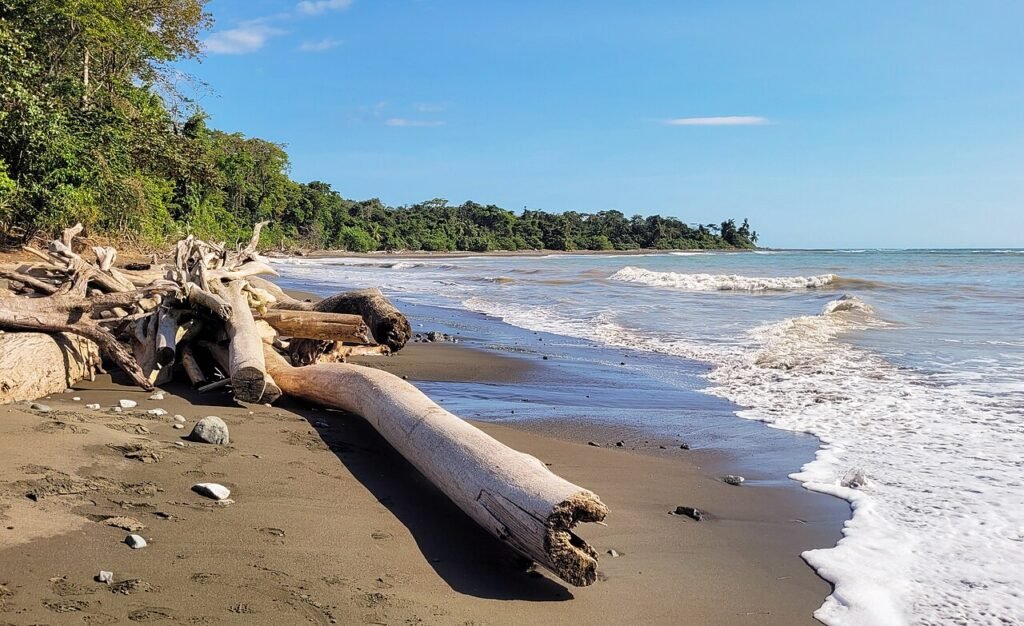
Corcovado National Park is located on the Osa Peninsula, Costa Rica, Osa’s Corcovado Park, Costa Rica
Day 2: Beaches, Bites & the Macaw Flyover
Your second day begins before dawn, because the best wildlife shows happen between 5:30 and 8 a.m. You’ve booked a guided kayak paddle through the Sierpe Mangroves, just north of Drake Bay. The mist hangs low over the water as your guide points out a three-toed sloth draped over a branch. A pair of macaws flies overhead, their red and blue feathers electric against the grey sky. “Locals call this the ‘painted forest’ hour,” your guide whispers. By midday you’ll swap the kayak for a beach towel, but first, you have a date with the jungle.
- Morning (5:30–8am): Sunrise kayak tour in the Sierpe Mangroves (₡30,000 / $55 per person, includes guide and gear). You paddle through narrow channels lined with red mangroves, spotting crocodiles, herons, and river otters. After the tour, head to the Drake Bay Bakery (₡1,500 / $2.70) for an empanada de queso and fresh mango juice—a local favorite.
- Midday (9am–12pm): Hike to Playa Cocalito, a half-mile of white sand accessible only by foot from the San Pedro Ranger Station. The trail is 20 minutes through secondary forest; you’ll likely have the beach to yourself. Insider tip: Arrive before 10 a.m. to avoid the midday heat and the occasional tour group. Bring snorkel gear (rentable in town for $10/day) to see parrotfish and rays in the crystal-clear shallows.
- Afternoon (1–4pm): Explore the village of Puerto Jiménez itself. Stroll the main street, Avenida Principal, where you’ll find small souvenir shops selling hand-carved wooden animals and locally made jewelry. Stop at the Osa Artisans Market (open weekends 10 a.m.–3 p.m.) for a handwoven hammock (₡15,000 / $27) – a fair price and a better quality than airport souvenirs. Most tourists overlook this market; it’s the place to chat with local craftspeople.
- Final Evening: Farewell dinner at La Parada Restaurant, right on the main square. Order the ceviche mixto (shrimp and fish cured in lime, ₡6,000 / $11) followed by arroz con camarones (rice with shrimp, ₡5,500 / $10). Sit on the open terrace as the sun sets over the Gulf of Dulce – the sky turns orange, and the sounds of the forest crescendo with the fading light. A last howler monkey roar echoes across the bay. You didn’t just visit Corcovado; you felt it.

Green trees beside blue sea, Osa’s Corcovado Park, Costa Rica
The Food You Can’t Miss
The Osa Peninsula’s food is as wild and honest as its landscape. Base your meals around the local sodas – tiny family-run diners that serve sprawling plates of casado for ₡3,000 ($5.50). At Soda La Tica in Puerto Jiménez, you’ll find the best gallo pinto (rice and beans with Lizano salsa) on the peninsula; it’s the breakfast that powers park guides before dawn. For street food, track down the churros rellenos (filled with dulce de leche) sold by a cart near the market on weekend afternoons – ₡1,000 ($1.80) for three. Savvy visitors know to ask for the homemade horchata (rice-and-cinnamon drink) at the same cart. For a sit-down restaurant that doesn’t break the budget, try Restaurante Marisquería Corcovado (calle principal, Puerto Jiménez). Their pargo entero frito (whole fried snapper, ₡8,000 / $14) is served with coconut rice and a tangy chimichurri that tastes like the coast. Reservations aren’t necessary for dinner before 7 p.m., but after that, tables fill with locals. The secret ingredient throughout the region? The abundance of fresh coconut oil and the zing of local limón mesino, a sour citrus that cuts through the richness of the fried fish like a splash of sunshine.

Brown wooden bridge over green mountains during daytime, Osa’s Corcovado Park, Costa Rica
Where to Stay for the Weekend
For a weekend in Corcovado, your choice of base matters. The best option for budget-conscious travelers is Puerto Jiménez town – it’s where the buses and flights arrive, and you’ll find rooms from $30 to $50 per night at places like Cabinas Jiménez (basic but clean, with a shared kitchen). Walk everywhere, eat cheaply, and join day tours from the central square. If you crave immersion, stay inside the park at the Sirena Ranger Station bunkhouse (₡8,000 / $14 per person, reservations required through the park system). You’ll sleep to the sound of monkeys and wake to tapirs grazing the lawn, but you need to pack in all your food and water—there’s no restaurant. For a mid-range splurge with comfort, Bosque del Cabo (a 20-minute drive from Puerto Jiménez) offers cabanas with ocean views starting at $180 per night, including breakfast and dinner. All three areas have something to offer: town convenience, wilderness immersion, or luxury with a conscience. Book lodges weeks ahead in the dry season – rooms fill fast. Check Booking.com for Puerto Jiménez hotels or Airbnb for eco-cabins and family-run stays.
Before You Go: Practical Tips
- Getting Around: The cheapest way is by public bus from Puerto Jiménez to the park entrances (₡800 / $1.50 one way, runs roughly every hour from 6 a.m.). Taxis cost $15–$25 to La Leona or Carate. For the Sierpe Mangroves, take the 6 a.m. bus from Puerto Jiménez to Sierpe (₡1,200 / $2.20). Most travelers do a combination: taxi in the morning, bus back in the afternoon.
- What to Pack: Rubber boots (rent them in town for $5/day – essential for muddy trails); a lightweight rain jacket that fits in your daypack (rain can start without warning even in dry season); insect repellent with 25–30% DEET (the sandflies near beaches are relentless); and a waterproof phone pouch (humidity kills electronics quickly). Don’t forget binoculars – they turn a moving leaf into a toucan.
- Common Tourist Mistakes: Skipping a guide in the park. The trails are unmarked and wide even for wildlife-watching; a guide doubles your sightings and keeps you safe from snakes and currents. Another mistake: underestimating the rain. Even in “dry” season, you can get a sudden downpour at 2 p.m. If you pack for mud, you’ll have a great time.
- Money-Saving Tip: Eat at sodas for all meals – a full casado costs ₡3,000 ($5.50) versus ₡12,000 ($21) at tourist restaurants. Also, book your Corcovado tour through a local agency like Osa Wild (Puerto Jiménez main street) rather than online – you’ll save $15–$20 per person because the middleman is cut out. A half-day guided hike with lunch runs about $55 per person if booked in town.

