
Beyond the Beach Club: Why Cap Skirring Still Whispers the Soul of Casamance (2026)
In 1974, a handful of French engineers landed on a strip of pristine white sand at the mouth of the Casamance River, sent by Club Méditerranée to build what would become the first international resort in West Africa. They found a tiny Diola fishing village called Kabrousse, where women wove palm-frond roofs and men paddled pirogues under baobabs older than any charter flight. The villagers, as locals still tell, politely watched the bulldozers with quiet bemusement, then returned to their evening bowl of thiou over an open fire, unaware that fifty years later their coastline would draw thousands from Dakar, Paris, and beyond—yet somehow keep its whispering soul intact.
The Story Behind Cap Skirring, Senegal
Long before any sun lounger graced its shore, Cap Skirring belonged to the Diola people, a proud ethnic group whose animist traditions and fierce independence shaped the entire Casamance region. Unlike the hierarchical kingdoms of northern Senegal, Diola society was decentralized, organized around rice paddies, sacred forests, and boucotte ceremonies—initiation rites where young men still prove their courage by wrestling the village bull. Portuguese explorers charted this cap (cape) in the 15th century, naming it Cabo do Escudo after the shield-shaped rock formation near its tip, but they never colonized deeply. The Diola resisted French rule well into the early 20th century, and you can still see traces of that resistance in the stone circles and sacred huts that dot the interior.
The turning point came in the 1960s, shortly after Senegal’s independence. President Léopold Sédar Senghor, a poet from nearby Joal, envisioned tourism as a bridge between his country and the world. He invited Club Med to build the first “all-inclusive” resort in sub-Saharan Africa, and in 1974, the Cap Skirring Club Med opened its famous red-and-white doors. Suddenly, this sleepy fishing outpost had an airstrip, a swimming pool, and a nightly disco under the palm trees. Travelers often discover that the resort’s arrival brought electricity, paved roads, and a steady stream of visitors, but it also sparked a quiet cultural preservation movement. Local Diola elders insisted that the new hotels respect the sacred bois sacré—the forest groves where spirits reside—and today you’ll find no large chain hotel violating those boundaries. The result is a rare balance: a beach destination with serious soul.
In the 1990s, a separatist conflict in Casamance dampened tourism for nearly a decade, but peace returned by the early 2000s, and Cap Skirring has since evolved into a haven for those who want more than just sand. You’ll find boutique lodges run by former Peace Corps volunteers, fishing villages where tourism dollars have funded new schools, and a generation of young Diola who speak French, English, and their native language with ease. The history here isn’t written on monuments—it’s carried in the rhythm of the pirogue paddles and the salt in the air.
Neighborhood by Neighborhood
Kabrousse – The Village Behind the Beach
Just a ten-minute walk from the main resort strip, Kabrousse is where Cap Skirring’s heart actually beats. You’ll recognize it by the smell of smoked fish mingling with frangipani, and by the sandy lanes lined with case—traditional mud-and-thatch huts painted in ochre and indigo. The village square, Place des Pêcheurs, fills every morning around 7 AM as men in faded shirts negotiate the day’s catch. Women sit on woven mats, shelling peanuts or braiding one another’s hair, while children kick a flattened soccer ball under a massive kapok tree. The real secret here, seasoned travelers know, is to seek out Mama Bintou’s stall near the well—she fries fresh pastels (savory bean fritters) for 100 CFA (about 15 cents) apiece until they run out, usually by 9:30 AM. Don’t expect street signs; locals navigate by landmarks: “turn left at the blue mosque, then past the baobab with the bicycle tire swing.” Wander deeper, and you’ll find the small Catholic mission, built in 1960, where Sunday mass is sung in Diola and French to the beat of a djembe drum.
Cap Skirring Plage – The Tourist Strip
This is the “bamboo-and-thatch Riviera” that first-time visitors imagine. A single paved road—Avenue de la Plage—runs parallel to the ocean for about three kilometers, lined with low-rise hotels, souvenir stalls, and open-air restaurants serving grilled dorade and cold Gazelle beer. You’ll spot the old Club Med complex at the northern end, now refurbished but still recognizable by its red roofs, and farther south, the more intimate lodges like Les Hibiscus and Le Calao. The real charm of the Plage, however, is the beach itself: a broad arc of powder-white sand that slopes gently into warm turquoise water. Most tourists set up under rented umbrellas near their hotel, but savvy visitors walk south toward the estuary mouth, where you’ll find deserted stretches perfect for a solitary swim. At sunset, the action shifts to the beach bars—Le K’s Club plays reggae and mbalax, while Chez Fatima offers $3 mojitos and a front-row seat to the sky turning tangerine. Prices here are double what you’d pay in Kabrousse, but the convenience and ocean views justify it.
Oussouye – The Sacred Forest Interior
If you crave more than beach, a 30-minute taxi ride (about 5,000 CFA, or $8) takes you inland to Oussouye, the spiritual and cultural heart of Diola country. The town clusters around a central market that explodes on Saturday mornings with fresh produce, hand-dyed fabrics, and carved wooden masks. Don’t leave without visiting the bois sacré—a protected grove of ancient trees where the Diola hold initiation ceremonies and rituals to honor the Emitai (the supreme spirit). You must hire a local guide (count on 3,000 CFA per person) to enter respectfully; your guide will explain the significance of the stone altars and the sacred “wishing tree” where tied cloth strips represent prayers. Oussouye also has a small ethnographic museum, the Musée de la Culture Diola, housed in a restored colonial villa. It’s open from 9 AM to 12 noon and again from 3 PM to 6 PM, closed Mondays. The entry fee is symbolic—1,000 CFA—but the stories you’ll hear about the Diola resistance against French rule, including the 1942 uprising led by Alinesitoué Diatta, are priceless. Plan half a day here, and for lunch, stop at Le Djembé Restaurant on the main square—their yassa poulet (marinated chicken in onion sauce) with rice is the best in the region, at 4,500 CFA ($7.50).
The Local Table: What Denizens Actually Eat
To understand Cap Skirring’s food, you have to understand rice. The Diola are master rice farmers—they cultivate dozens of varieties in flooded paddies that trace the Casamance River—and every meal begins with a mound of fluffy white or red rice, steamed with palm oil or coconut milk. The star dish is thiou (pronounced “chew”), a rich fish stew made with cassava, eggplant, okra, and a generous dollop of nététou—a fermented locust-bean paste that gives it an umami depth. Locals recommend heading to the fish market in Kabrousse by 6 AM, when the pirogues bring in the catch: red snapper, barracuda, and the prized thiof (grouper). Buy a whole fish for about 1,500 CFA ($2.50), then walk it over to Maman Adama’s cooking station behind the market. For 500 CFA she’ll clean it, season it, and grill it right there over charcoal, serving it with a mound of rice and a spicy onion sauce called dibi. You’ll eat with your hands at a shared wooden bench, and the only utensils you need are your right hand and a napkin.
Street food rules the evening hours. From 6 PM, vendors outside the main moped parking area near the Club Med roundabout fire up portable grills for dibi poulet—chicken marinated in mustard, garlic, and lime, then grilled over coals until charred and smoky. A quarter chicken with fried plantains costs 2,000 CFA ($3). And don’t miss the boulettes de manioc, cassava dumplings steamed in banana leaves, sold by women balancing brass trays on their heads. For a sit-down meal, the bar-restaurant Le Perroquet, just off Avenue de la Plage, serves a refined version of mafé (peanut stew) with goat meat, priced at 6,000 CFA ($10) and best washed down with a chilled Bissap (hibiscus juice) or the local Bouye (baobab fruit drink). The freshest ingredient, however, is the ocean itself. Every dinner should start with a dozen grilled prawns, still sizzling in garlic butter—you’ll find them at Chez Sandrine for 3,500 CFA.

Cap Skirring is a small village in Casamance region very popular among tourists, Cap Skirring, Senegal
Art, Music & Nightlife
Cap Skirring’s creative pulse beats strongest during the Festival de la Mer, held every second weekend of November on the beach in front of the old Club Med grounds. It’s a two-day explosion of Diola mask dances, sabar drumming, and reggae bands from across West Africa, with dancers in raffia skirts leaping over bonfires as tourists and locals mingle under strings of colored bulbs. The rest of the year, you’ll find live music most nights at La Pointe, a bar built on stilts over the lagoon at the southern tip of the peninsula. Thursday is reggae night, Saturday is mbalax —the fast-paced Senegalese dance music pioneered by Youssou N’Dour—and the cover charge is never more than 3,000 CFA ($5). For gallery browsing, the Atelier Diola in Kabrousse sells hand-painted batiks starting at 5,000 CFA, and the owner, Jean-Baptiste, will explain how each pattern tells a story of marriage, harvest, or initiation. Don’t leave without buying at least one small wooden mask from the artisans at Kafountine, a village just across the Casamance River (15 minutes by pirogue taxi, 1,000 CFA round-trip). The nightlife starts late—around 11 PM—and ends when the last fish grill embers die, usually around 3 AM. If you prefer quiet, simply walk the beach under a canopy of stars that seem lower here than anywhere else on earth.
Practical Guide
- Getting There: Cap Skirring has its own international airport (CSK) served by Air Senegal and Transair from Dakar (1 hour, 15 minutes, round-trip from $150). From Europe, charter flights arrive seasonally (November–April). Book flights at Skyscanner.
- Getting Around: The village and beach are walkable, but for longer trips rent a bicycle (2,000 CFA/day) or a moto-taxi (500–1,000 CFA per ride within town). For Oussouye or Kafountine, hire a regular taxi (5,000–10,000 CFA depending on distance). Prices are non-negotiable on tourist routes; it’s better to confirm before you get in.
- Where to Stay: For boutique charm, book Les Palétuviers in Kabrousse (doubles from $80/night, with a pool and restaurant overlooking the estuary). For beachfront convenience, Le Calao on the Plage (doubles from $120/night) is a favorite of returning visitors. Budget travelers love Campement Wakola in Oussouye (dorm beds from $15). Check Booking.com for all options.
- Best Time: November to April—dry and sunny, average 28°C. Avoid August and September (rainy season with mud and mosquitoes). February is particularly good for whale-watching—humpbacks pass just offshore.
- Budget: A frugal traveler can get by on $50/day (eating street food, staying in basic rooms). For comfort (decent hotel, one sit-down restaurant meal, taxis), budget $100–$150/day. Add $30–$50 for guided excursions.

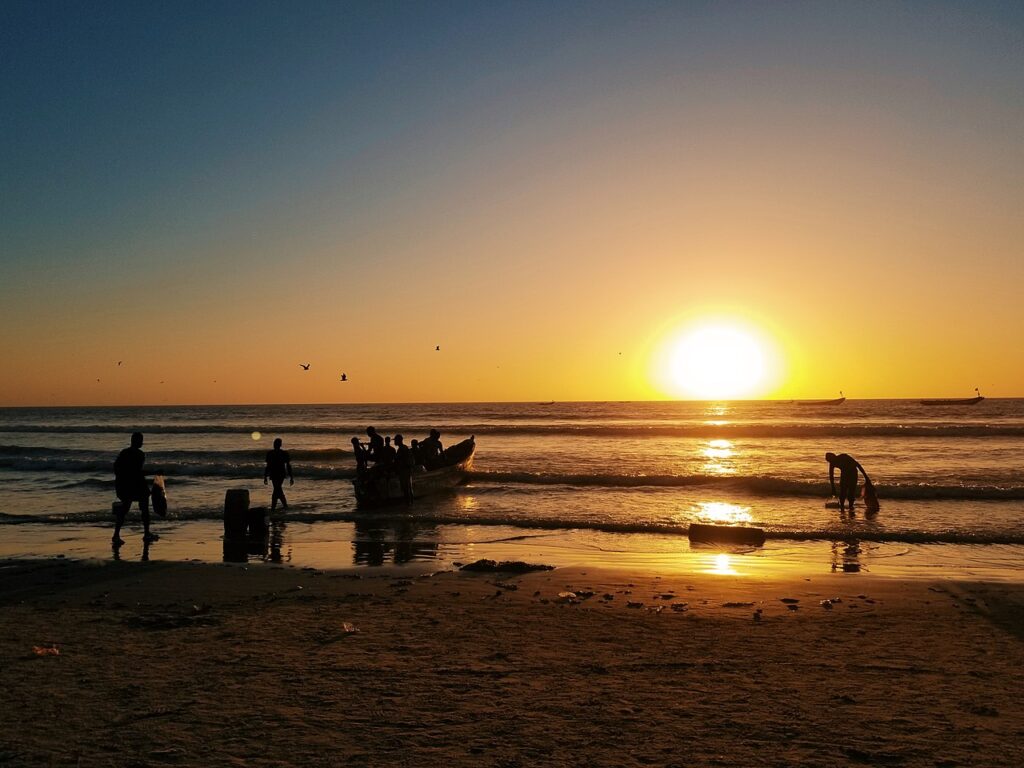
Silhouette of person fishing on sea during sunset, Cap Skirring, Senegal
What Surprises First-Time Visitors
The first surprise is the quiet. After the honking chaos of Dakar, Cap Skirring feels like someone muted the world. The only sounds are the rhythmic shush of waves, the click-click of mopeds, and the occasional call to prayer from the Kabrousse mosque, which lasts barely two minutes. Travelers often arrive expecting a junky spring-break party scene and find instead a place where families share bowls of rice and strangers greet you with a handshake and “Na ng def?” (How are you?), expecting a real answer. The second surprise is the politics of time. Dinner reservations? Made when you arrive. A boat trip to the Îles des Oiseaux? You’ll wait an hour or two while the captain finishes his tea with friends—and that’s normal. Savvy visitors learn to bring a book, order a drink, and watch the sunset twice: once in the sky, and once in the patient, unhurried faces around them.
Perhaps the most unexpected joy is the total lack of commercial hard sell. Unlike beach towns in many parts of the world, souvenir vendors here are gentle, rarely aggressive. A simple “Jërëjëf” (thank you in Wolof) and a smile sends them on their way. And the Diola themselves are astonishingly open—if you show genuine interest, you may be invited into a home for a cup of ataaya (mint tea). The third surprise is the wildlife: monkeys clatter across the hotel rooftops at dawn, and if you walk the southern beach at dusk, you’ll see ghost crabs skitter sideways and, if you’re lucky, a sea turtle lumbering back to the ocean. This is not a sanitized resort zone. The wild is woven right into the sand between your toes.
Your Cap Skirring, Senegal Questions
Is it safe to travel to Cap Skirring given the Casamance conflict?
Yes—peace has held since a 2004 ceasefire, and the separatist movement is now confined to occasional incidents far north near the Gambian border. The Cap Skirring area, including Kabrousse and Oussouye, sees almost no violence. Local police are visible and welcoming.

Explore traditional nipa huts in a rural Senegal village, Cap Skirring, Senegal

