
Beyond the Desert Sands: Why La Guajira’s Wayuu Spirit Captivates Every Traveler Who Ventures North (2026)
In 1525, when Spanish conquistador Rodrigo de Bastidas first set foot on the scorched peninsula of La Guajira, he encountered a people who would never be conquered. The Wayuu, whose matrilineal society had thrived for centuries before Columbus sailed, defied every colonial attempt to subdue them. They watched the Spanish build a fort at Nuestra Señora Santa María de los Remedios del Cabo de la Vela, then quietly continued their trade routes, their spiritual ceremonies, and their fierce independence—a resilience you will still feel in every wind-whipped dune and handwoven mochila bag you encounter today.
The Story Behind La Guajira’s Wayuu, Colombia
To understand La Guajira, you must first understand that the Wayuu never signed a peace treaty with the Spanish crown. While the rest of Colombia fell under colonial rule, the Wayuu maintained their sovereignty through strategic alliances, guerrilla resistance, and an intimate knowledge of this unforgiving desert landscape. By the 18th century, they had become masterful smugglers, trading pearls, salt, and contraband with English, Dutch, and French merchants who anchored off their coasts—a legacy of commerce and self-determination that travelers still witness in the bustling market towns today.
The tipping point came in 1769, when Spanish authorities attempted to impose a royal monopoly on the pearl fisheries near Riohacha. The Wayuu launched what historians now call the “Great Rebellion,” burning Spanish settlements and driving colonists back to the coast. It took the Spanish decades to regain control, and even then, their hold was tenuous. By Colombia’s independence in 1810, the Wayuu had secured a unique legal status that persists to this day: they govern their own territories under Indigenous customary law, maintain their own language (Wayuunaiki), and practice a matrilineal clan system where lineage, inheritance, and political power flow through the mother’s line.
What you will discover here is not a museum piece of indigenous culture, but a living, breathing society that has adapted modernity on its own terms. The Wayuu population today numbers over 400,000, making them the largest indigenous group in Colombia and one of the largest in South America. They straddle the Colombia-Venezuela border with a disregard for national boundaries that predates both countries—a reality that has shaped their recent history profoundly, especially as the Venezuelan crisis sent waves of migrants through their territory.
Neighborhood by Neighborhood

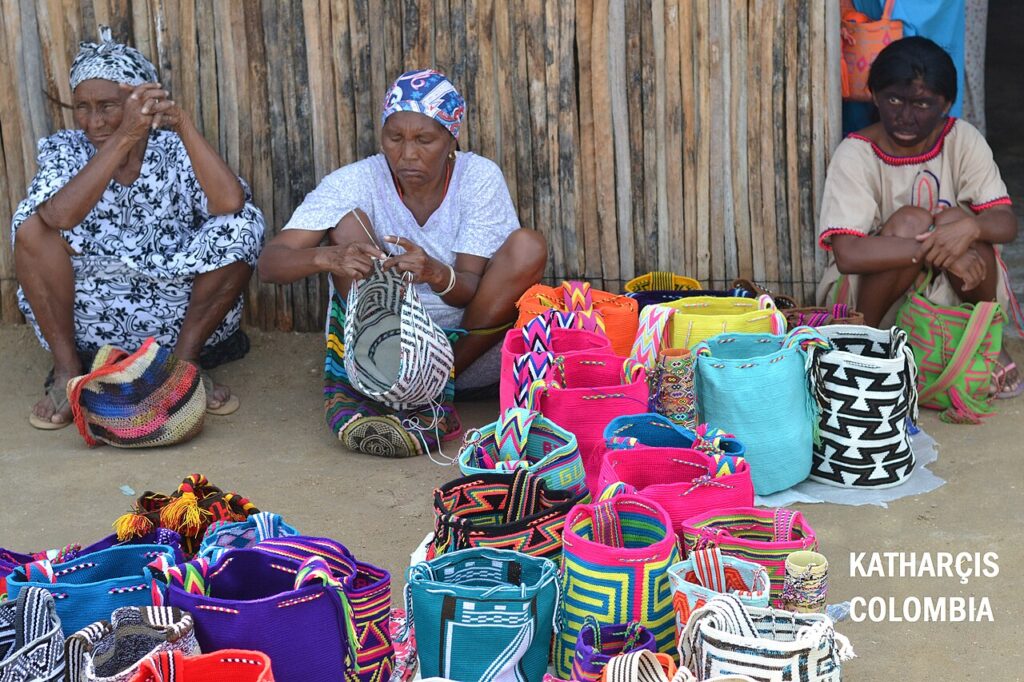
Los tejidos y vestidos coloridos son representativos en toda la Guajira, La Guajira’s Wayuu, Colombia
Ranchería Wayuu: The Heart of Clan Life
You cannot visit La Guajira without stepping into a ranchería—the traditional Wayuu settlement that serves as both home and social universe. Scattered across the arid plains, these clusters of bohíos (circular mud-and-cane huts with conical palm roofs) house extended matrilineal families. The architecture is perfectly adapted to the desert: the thick walls keep interiors cool despite daytime temperatures that regularly hit 40°C, while the high roofs allow heat to escape. When you visit a ranchería—and you should arrange this through a local guide, not by wandering unannounced—you will notice the single hammock per person strung inside each hut. Hammocks are far more than sleeping arrangements; they are status symbols, gifts at weddings, and the place where Wayuu women teach their daughters the thousand-year-old craft of mochila weaving. Locals recommend the rancherías around Nazaret, where the community has developed respectful tourism programs. Expect to be offered chicha (fermented corn drink) and to sit in a circle as elders tell stories in Wayuunaiki while a translator helps you follow along.
Riohacha: The Coastal Gateway
Riohacha, the departmental capital founded in 1545, serves as your launch point into Wayuu territory, and savvy visitors spend at least a day here before heading into the desert. The Malecón, a recently revitalized boardwalk along the Caribbean, offers your first taste of Guajiro hospitality—stroll it at sunset when the wind picks up and local vendors sell fresh coconut water and fried arepas de huevo. The heart of the city is the Catedral de Nuestra Señora de los Remedios, a striking white church whose image of the Virgin Mary has dark Wayuu features, a subtle but powerful sign of cultural blending. You will find the best introduction to Wayuu culture at the Museo Wayuu on Calle 2, a small but excellent museum housed in a colonial building. The museum’s textile collection alone is worth the visit: intricate mochila bags, hammocks, and kanas (traditional belts) that tell clan histories through their geometric patterns. Plan to spend 10,000 COP (about $2.50) for entry and another hour in the museum’s gift shop, where proceeds go directly to Wayuu artisans.
Cabo de la Vela: Where the Desert Meets the Sea
Two hours north of Riohacha by dusty road lies Cabo de la Vela (Cape of the Candle), the spiritual heart of Wayuu territory. This is not a town in any conventional sense—it is a scattering of palapa-roofed hostels, seafood shacks, and Wayuu artisan stalls set against a backdrop of red-and-ocher cliffs plunging into turquoise Caribbean waters. The site was sacred to the Wayuu long before the Spanish arrived; they believed this was where the souls of the dead embarked on their journey to Jepira, the afterlife. You will understand why the moment you climb the Pilon de Azúcar, a rocky pyramid that rises 150 meters above the coast. Do this at dawn—the 20-minute scramble is worth the effort for the 360-degree view of the desert meeting the sea, the wind whipping your hair as pelicans glide below you. The beach at Playa Dorada is your best bet for swimming, though locals warn you to respect the currents, which can be strong. Stay overnight at one of the eco-hostels like Utta Eco Hostal (about 50,000 COP per night for a hammock, 120,000 COP for a room) and watch the stars without a trace of light pollution.
Punta Gallinas: The Northernmost Point
For the truly adventurous, Punta Gallinas marks the northernmost tip of South America, and reaching it is an odyssey you will not forget. From Cabo de la Vela, you negotiate with Wayuu drivers in their battered 4x4s for a bone-rattling three-hour journey across dunes, salt flats, and rocky tracks. The landscape shifts constantly: one moment you are crossing the Salinas de Manaure, where Wayuu families have harvested salt for centuries, the next you are bouncing across the Taroa Dunes, massive sand mountains that plunge straight into the Caribbean. At Punta Gallinas itself, you find a lighthouse, a few Wayuu families living in isolated rancherías, and a silence so profound you can hear your own heartbeat. Stay at the Hostal Punta Gallinas, run by the Epieyú family, where you sleep in hammocks or basic rooms and eat freshly caught lobster and fish. The cost is around 70,000 COP per person per night including meals—a bargain for one of the most remote experiences in the Americas. Do not miss the boat trip to the Faro lighthouse at sunset; your Wayuu captain will navigate through mangroves and open sea as flamingos lift off around you.
The Local Table: What the Wayuu Actually Eat
Wayuu cuisine is a revelation for travelers expecting standard Colombian fare. There are no bandeja paisa or arepas rellenas here—instead, you encounter a desert-adapted diet built around goat, fish, corn, and the ingenious use of every edible plant the arid landscape offers. The staple is friche, a dish so central to Wayuu identity that it is practically a symbol of the culture. Goat meat is chopped into small pieces, including the organs and sometimes the blood, then slow-cooked with salt and local herbs until it becomes dark, crispy, and intensely flavorful. You will find friche served with yuca or arepas at roadside stands along the route to Cabo de la Vela, but the best version is made by Wayuu families in their own rancherías. Do not be shy—when invited to share a meal, accept. Refusing is considered deeply disrespectful.

Scenic view of a rural village surrounded by desert landscape in Guajira, La Guajira’s Wayuu, Colombia
Along the coast, fish takes center stage. At the fishermen’s cooperative in Cabo de la Vela, you can buy fresh-caught pargo rojo (red snapper) or jurel (jack fish) that was swimming hours before it hits your plate. The Wayuu preparation is simple: grilled over open coals with salt and lime, accompanied by patacones (fried green plantains) and a tomato-onion salsa. You must try the caracol de la Guajira—a local conch prepared in a coconut milk sauce that locals swear is an aphrodisiac. For the adventurous palate, there is chivo al carbón (charcoal-grilled goat) sold at the Sunday market in Riohacha, where Wayuu women preside over smoking grills from dawn until the meat runs out, usually by early afternoon. Wash it all down with fresh coconut water straight from the husk, or if you are feeling bold, a shot of chirrinche, a potent moonshine distilled from sugarcane that the Wayuu have made for generations. Be warned: chirrinche hits hard and fast, and locals will laugh warmly at your expression after your first sip.
The key market is the Mercado de Riohacha on Calle 8, where Wayuu women arrive before sunrise to sell produce, dried fish, and handmade crafts. Your best bet is to arrive by 7:00 a.m. before the heat becomes oppressive. Here you can buy totumas (gourd cups), panela (unrefined cane sugar), and the ingredients to make your own mojito de coco—a Wayuu take on the classic cocktail using coconut water, lime, and rum that you will find at roadside stands for about 5,000 COP.
Art, Music & Nightlife
The creative soul of La Guajira lies in its textile traditions, and no souvenir is more meaningful than a handwoven Wayuu mochila bag. These bags, coiled using a technique the Wayuu call “crochet of the ancestors,” require weeks or months to complete depending on the complexity of the design. Each geometric pattern tells a story—the zigzag represents the path of the snake, the diamond signals a clan alliance, and the spiral marks the journey of the soul. You will find authentic mochilas in the artisan market in Riohacha or directly from weavers in rancherías, where prices range from 30,000 COP for a small bag to 200,000 COP for an intricate large one. A word of caution: cheap imitations flood tourist shops, but a genuine Wayuu mochila is dense, evenly stitched, and carries a story the weaver will happily share.
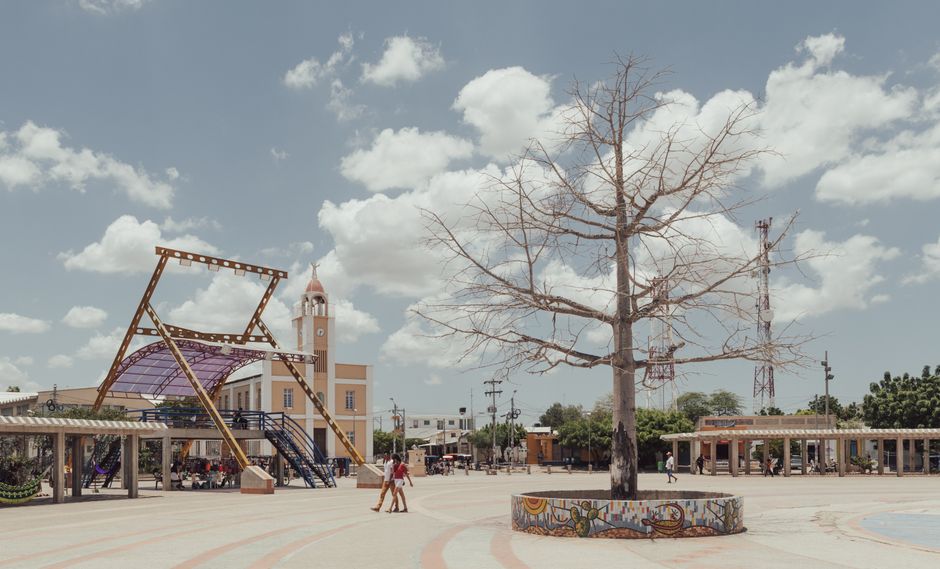
View of a unique architectural structure and bare tree in the plaza of Uribia, La Guajira’s Wayuu, Colombia
Music in La Guajira is inseparable from daily life. The traditional sound is the gaita, a long, flute-like instrument made from cactus wood, accompanied by drums and maracas. You will hear it at the annual Festival de la Cultura Wayuu, held every May in the town of Uribia. The festival is a riot of color, music, and dance, with competitions for the best mochila weaving, the fastest friche cooking, and the most elegant yonna dance—a traditional Wayuu courtship dance where women circle men with flirtatious steps. In Riohacha, the nightlife scene centers around bars on the Malecón, where live vallenato music—a Colombian genre with deep Wayuu roots—plays until the early hours. For a more authentic experience, seek out a velada, a spontaneous evening gathering in a ranchería where elders tell stories, young people dance, and everyone shares chirrinche under the stars. These are not tourist events; you will need a local guide to arrange an invitation, and you must follow protocol: bring a gift (sugar, coffee, or cooking oil), and never refuse food or drink.
Practical Guide
- Getting There: Fly into Riohacha’s Aeropuerto Almirante Padilla (RCH) from Bogotá or Medellín via Avianca or LATAM. The flight from Bogotá takes about 90 minutes and costs around $80–150 USD one way. Book at Skyscanner for the best deals.
- Getting Around: From Riohacha, shared jeeps and colectivos run to Cabo de la Vela for about 30,000 COP per person (2 hours). For Punta Gallinas, negotiate a 4×4 from Cabo de la Vela for around 300,000 COP total (3 hours). Within Riohacha, mototaxis cost 3,000–5,000 COP per ride. Always agree on the price before you get in.
- Where to Stay: In Riohacha, stay at Hotel Waya Guajira (from 150,000 COP/night) near the Malecón. In Cabo de la Vela, Utta Eco Hostal offers hammocks from 50,000 COP and rooms from 120,000 COP. For Punta Gallinas, book through Hostal Punta Gallinas (70,000 COP/person including meals). Check Booking.com for Riohacha options.
- Best Time: December to April is the dry season, offering reliable sunshine and cooler temperatures. January and February are ideal—the wind is strong enough to cool you but not fierce enough to make desert travel unpleasant. Avoid October and November, when rains can make dirt roads impassable.
- Budget: Plan for about 150,000–200,000 COP ($38–$50 USD) per day for mid-range travel including accommodation, food, transport, and a tour or two. Budget travelers can get by on 80,000 COP per day sleeping in hammocks and eating at market stalls.
What Surprises First-Time Visitors
Nearly every traveler arrives in La Guajira expecting a purely tropical Caribbean experience, and nearly everyone is shocked by the desert. The Guajira Peninsula is one of the driest regions in South America, receiving less than 300mm of rain annually. You will see cacti taller than houses, sand dunes that look like a miniature Sahara, and a landscape palette of ochre, rust, and bone-white that feels more like Namibia than Colombia. The wind is a constant presence—a dry, insistent breeze locals call “the breath of Jepira”—that will have you reaching for lip balm and sunglasses regardless of the season. Most tourists overlook the fact that this wind is not just weather; it is a central metaphor in Wayuu cosmology, representing the movement of spirits between the world of the living and the afterlife.
What also surprises visitors is the warmth and dignity of Wayuu hospitality. Travelers often arrive with nervous misconceptions about indigenous communities being closed or wary of outsiders. In reality, you will be welcomed into rancherías with genuine curiosity and generosity—provided you follow basic protocols. Ask permission before taking photographs of people or their homes, dress modestly (cover shoulders and knees when visiting communities), and never touch anyone’s head, as the Wayuu believe the spirit resides in the crown of the head. Learn one phrase in Wayuunaiki: “Atünüiki” (pronounced ah-too-NEE-kee), meaning “thank you.” The smile you receive in return will be one of your most treasured memories.
The final surprise is the sheer logistical challenge of getting around. Roads are unpaved, signposts are virtually non-existent, and GPS signals are unreliable beyond Riohacha. Seasoned travelers prefer to hire a local Wayuu driver-guide for the journey north—not just for navigation, but because having a Wayuu speaker opens doors that remain closed to independent travelers. Your guide will know which rancherías welcome visitors, which beaches are safe for swimming, and where to find the best friche. Plan for your “two-hour” drive to Cabo de la Vela to take three or four hours, and embrace the delays as part of the experience. The Wayuu concept of time is fluid; you will learn to watch the shadows lengthen and the wind shift rather than checking your

