
Marojejy National Park, Madagascar for Adventurers: The Summit Ascent That Rewrites Your Limits (2026)
Your quadriceps burn as you pull yourself up a root-ladder on the final push to Marojejy’s summit, the air thinning at 2,133 meters. Mist curls through the moss-draped canopy below, and a silky sifaka leaps across a branch ten feet from your face—its white fur glowing against the emerald green. This is Madagascar as few travelers ever see it: raw, steep, and utterly wild. Welcome to the adventure of a lifetime.
The Main Event: The Summit Trail to Marojejy Peak
This is the crown jewel of Marojejy National Park, and it will test every muscle you have. The Summit Trail (Circuit 3) is a three-day, two-night round trip that climbs from 600 meters at the park entrance to the highest point in northeastern Madagascar. You’ll start at the Mandena Gate, where you must register and pick up your mandatory guide—book ahead through Madagascar National Parks (www.parcs-madagascar.com) or arrange on arrival. The cost is 55,000 Ariary (about $12 USD) per person for the park entry fee, plus 40,000 Ariary daily for your guide. Plan to depart by 7:00 AM sharp to make Camp Marojejy by lunch and Camp Summit by dusk on day two.
The trail is relentless: think wet clay, fallen logs, and sections where you’ll haul yourself up using vines and nylon ropes bolted into rock. Locals recommend bringing trekking poles with carbide tips and a headlamp—you’ll want the latter for the predawn summit push on day three. The payoff? Standing on Madagascar’s third-highest peak as the sun rises over the Indian Ocean 50 kilometers east. Insider tip: Book your trip for October or November, when the silky sifaka are most active at lower elevations, and you’ll spot them from the trail without veering off. Your guide will carry your camping gear, but you’ll need to pack light: a 40-liter day pack is ideal.
Activity #1: Night Walk for Lemurs and Chameleons
After a day of hard trekking, you might think your legs deserve a rest. But savvy visitors know that Marojejy comes alive after dark—and a night walk is your ticket to the park’s most elusive residents. You’ll meet your guide at the Mandena Gate at 6:30 PM sharp, just as the last light drains from the valley. Armed with a headlamp (red mode is best—it doesn’t disturb nocturnal animals), you’ll follow a short loop through the lowland rainforest, about 1.5 kilometers on gentle terrain. The cost is 25,000 Ariary for the guide, which you can arrange the same day at the park office. Travelers often discover the mouse lemur—the world’s smallest primate—staring back at them from eye-level branches. You’ll also spot leaf-tailed geckos camouflaged against tree trunks and, if you’re lucky, a panther chameleon hunting crickets. Locals recommend keeping your voice low and your steps slow; the noise from the nearby village fades quickly once you’re 50 meters into the forest. Bring insect repellent with DEET and wear long pants—the mosquitoes are active until 8:30 PM. The walk takes about two hours, and you’ll be back at your lodge by 9:00 PM, just in time for a beer and dinner.
Activity #2: Silky Sifaka Tracking in the Canopy
This is the activity that separates the casual visitor from the committed adventurer. The silky sifaka, known locally as the “angel of the forest” for its pure white coat, is one of the rarest lemurs on Earth—fewer than 2,000 remain, and Marojejy is its last stronghold. To track them, you’ll head out with a specialist guide from the park’s research team (book through the Mandena office for 30,000 Ariary extra). Your best bet is starting at 7:30 AM, when the sifaka are most active feeding in the canopy. The terrain is steep and muddy, and you’ll need to look up constantly as the animals leap 10 meters between branches at speeds that’ll make your jaw drop. The tracking session lasts three to four hours, covering about 4 kilometers of mapped trails near Camp Marojejy. The guides use radio telemetry on collared individuals, so you have a 90% chance of a sighting. Bring a camera with a 100mm lens at minimum—the sifaka rarely descend below 15 meters. The experience is humbling: you’re witnessing a species that has existed for 50 million years, and you’re one of only a few thousand people who will ever see it in the wild. Most tourists overlook this activity in favor of summit hikes, but travelers who prioritize it leave with the deepest memories.

Marojejy National Park, Madagascar
Refuel: Where Adventurers Eat
Your hiker’s appetite will demand serious calories. Start with Le Petit Restaurant de Mandena (just outside the park gate), where you’ll refuel on zebu stew with rice and local greens for 8,000 Ariary—the owners know guides’ schedules and will keep the kitchen open late for returning trekkers. In Andapa, the nearest town 60 kilometers away, Chez Maman Bako serves the best *romazava* (Madagascar’s national beef and leaf stew) in the region; a hearty bowl with a side of coconut rice runs about 12,000 Ariary. Locals recommend the grilled tilapia here—it’s caught fresh from the Andapa River that morning. For a quicker fix between hikes, the Snack-Bar Ambodimanga at the park headquarters offers fried bananas and samosas for 3,000 Ariary, plus bottled water and instant coffee strong enough to wake a sleeping fossa. If you’re camping on the trail, your guide will cook simple meals of rice, beans, and canned vegetables over a campfire—tip them an extra 10,000 Ariary per day to add fresh fish from the village market. You’ll find that eating local is not just economical but essential: you’re supporting the communities that protect the park.
Base Camp: Where to Stay
Active travelers need lodging that understands an early departure. Camp Marojejy (the park’s primary campsite at 600 meters) offers basic wooden bunkhouses with sleeping pads and solar lights for 15,000 Ariary per person per night. There’s no running water, but you’ll have a pit toilet and a cold stream for washing—perfect for a quick rinse after the summit. Book through the park office. For a step up in comfort, Nature Lodge Marojejy sits 15 minutes from the gate with private rooms (45,000 Ariary/night) and hot showers. They pack you a breakfast box when you request it the night before—essential if you’re aiming for a 6:00 AM start on the Summit Trail. The lodge also stores excess gear for a small fee. In Andapa, Hôtel de la Gare (from 30,000 Ariary/night) is a favorite among guides for its early breakfast service starting at 5:30 AM and its secure parking if you’re renting a 4×4. Book all your stays in advance during peak season (June–November) through Booking.com—the park has only limited bed space.
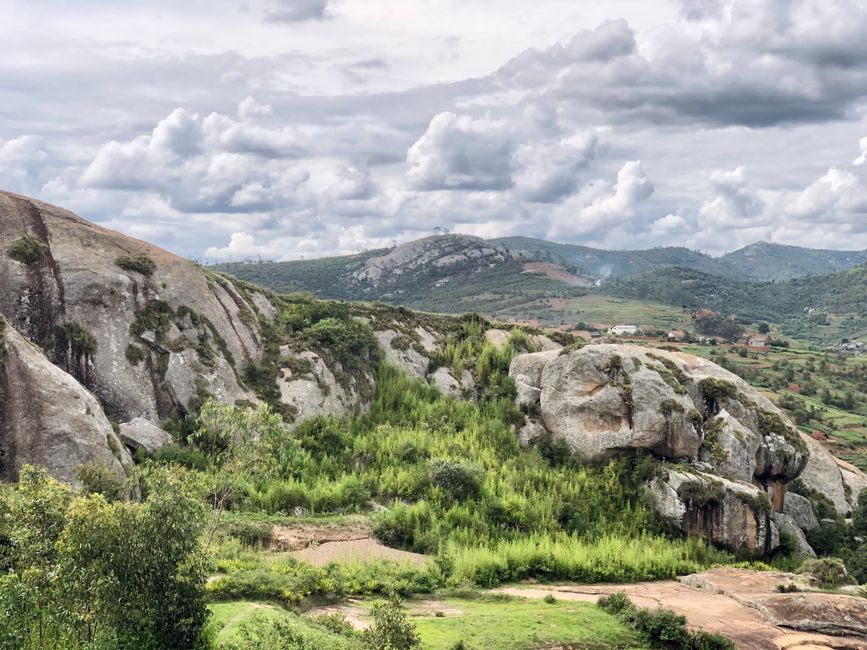
Breathtaking view of rocky terrain and lush greenery under a cloudy sky in …, Marojejy National Park, Madagascar
Gear & Prep Checklist
- Trekking poles with mud baskets—the trails are slick clay that’ll send you sliding without them
- Headlamp with red mode (for night walks) plus spare batteries—no electricity on the trails
- Waterproof jacket and gaiters—rain can hit within minutes at altitude, and leeches love wet ankles
- Fitness requirement: you need to be comfortable climbing 1,500 meters of elevation gain over 8 hours with a 10-kg pack. Train with stair climbs for 4 weeks beforehand
- Safety consideration: check with your doctor about malaria prophylaxis—Marojejy is a high-risk zone. Chloroquine-resistant strains are common in this region
Getting There & Around
- Flights: Fly from Antananarivo to Sambava or Andapa with Skyscanner—Tsaradia has daily flights to Sambava (1 hour, from 200,000 Ariary one-way). From Sambava, it’s a 3-hour drive by 4×4 to the park gate
- Local Transport: From Andapa, hire a 4×4 taxi-brousse (shared, 15,000 Ariary per person) or a private taxi (80,000 Ariary) for the 1-hour drive to Mandena Gate. Roads are unpaved and require high clearance—your guide can help arrange this
- Best Season: April to November is the dry season, with October and November being ideal for wildlife visibility (silky sifaka are lower) and trail conditions. Avoid January to March when cyclones close the park

A stunning view of Pedra do Baú rock formation under a clear blue sky in Sã…, Marojejy National Park, Madagascar
Is Marojejy National Park, Madagascar Worth It?
Honestly, no—if you want a gentle rainforest stroll with Wi-Fi and a bar. But if you’re here for the raw adventure, the physical challenge, and the chance to see a critically endangered primate in its only habitat on Earth, then Marojejy delivers in spades. Travelers who love the Alps will find the trails steeper and muddier than anything in Chamonix—but the solitude and biodiversity are unmatched. You won’t find crowds here; in 2023, fewer than 3,000 people visited the entire park. Compare that to Andasibe-Mantadia, which gets 50,000 annually, and you’ll understand why Marojejy feels like the last true frontier. The difficulties are real: the roads are bad, the rain is constant, and the leeches are persistent. But for those who make it, the summit sunrise is a moment that rewires your sense of what adventure means. My recommendation? Commit to the full Summit Trail circuit, book a night walk, and spend one morning tracking the sifaka. You’ll leave with muddy boots, tired legs, and memories that will outlast any five-star resort.

