
Beyond the Baobabs: Why Serowe, Botswana Captures the Heart of Southern Africa (2026)
In 1923, as the iron wheels of colonial change rolled across southern Africa, a pair of immense baobab trees in a quiet Kalahari settlement became the silent witness to a revolution. Under their sprawling limbs, the Bamangwato people gathered to bury their great chief, Khama III—the man who had navigated a treacherous path between British protection and Batswana sovereignty. Today, those same baobabs shade the Serowe kgotla, the traditional court, and if you listen closely, you’ll hear the rustling leaves still whispering his name.
The Story Behind Serowe, Botswana
Serowe is not just a town; it is the beating heart of the Bamangwato people, the largest traditional kingdom in Botswana. Your journey here begins not with a road, but with a dynasty. In 1902, Chief Khama III relocated his people from Phalatswe (Old Palapye) to this spot—a strategic move to escape tsetse fly and encroaching European settlers. He named it Serowe, meaning “a place of meeting.” For decades, the royal kgotla beneath those baobabs served as the stage for history: it was here that Seretse Khama, the future first president of Botswana, argued for his controversial marriage to British woman Ruth Williams, a union that would shake the Commonwealth in 1948.
You’ll find the Khama III Memorial Museum perched on a hill, housed in the old colonial fort that once guarded the town. Inside, you can hold a replica of Chief Khama’s walking stick, or browse faded photographs of the 1895 delegation to Britain—the same journey that secured Botswana’s future as a protectorate rather than a colony. Locals recommend you start your visit here, because the story of Serowe is inseparable from the story of Botswana’s peaceful rise to independence in 1966. The museum’s guides are often descendants of the royal household, and they’ll share family anecdotes that no textbook captures.
Travelers often discover that Serowe’s history is written not in stone but in sand and acacia. The town’s layout owes nothing to a colonial grid; it spirals outward from the kgotla, with cattle tracks becoming streets, and homesteads mingling with shops. You’ll sense a deep continuity—the same families have lived here for generations, and the same red-earth walls that Khama III would have seen still glow at sunset.
Neighborhood by Neighborhood
Botalaute: The Royal Heart
Botalaute is Serowe’s historic core, where the kgotla and the royal cemetery sit shoulder to shoulder along the dusty main road. You’ll recognize it immediately by the twin baobabs, their bulbous trunks wrapped in a protective fence built in the 1930s. The houses here are old, many constructed from handmade mud bricks painted a deep ochre. The air smells of woodsmoke and cattle; you’ll hear the rhythmic thud of a pestle grinding sorghum from a nearby courtyard. The Khama III Memorial Museum stands on the eastern edge, and across the road, you can buy fresh mageu—a fermented porridge drink—from a woman who has been selling it since 1978. Spend an hour watching the kgotla in session (open Monday to Saturday, 8:00 am to 12:00 pm), where locals bring land disputes and family arguments to the chief’s advisors. It’s a living democracy far older than any parliament.
Mabeleapodi: The Market Quarter
Half a kilometer south of Botalaute, Mabeleapodi is where the town breathes commerce. The name means “where the cows drink,” a reminder that this was once a watering hole for cattle drives. Today, it’s a jumble of metal-roofed stalls and open-air barbershops. Every Saturday morning, the main street transforms into a lively flea market. You’ll find everything from second-hand shoes to hand-carved wooden spoons. The best time to visit is just after 7:00 am, when vendors set up under the jacaranda trees and the smell of grilled seswaa (shredded beef) invites you to breakfast. Cross the unpaved road to the Tsholofelo Bakery, where a loaf of fresh white bread costs 3 pula (about $0.25). Savvy visitors know to grab a bag of madombi (sweet fried dough) from Mama Keletso’s stall on the corner—she’s been frying them since 1995 and her secret is a pinch of cardamom. Mabeleapodi is also your best bet for finding local crafts: woven baskets, leather sandals, and replicas of the “three buffalo” motif from the royal crest.
Botlhatlogo: The Hilltop View
For a different perspective, climb the rocky path to Botlhatlogo, the neighborhood that clings to the hill east of the town center. The name means “the place of the small hill,” and from the top you get a sweeping panorama of the entire Serowe valley—the red roofs, the acacia-dotted plains, and the distant blue smudge of the Tswapong Hills. This area grew in the 1960s when the first government housing was built; the homes here are larger, many with corrugated iron roofs painted green or blue. The residents are mostly teachers, nurses, and retired civil servants. You’ll find no shops or cafes, only quiet streets shaded by wild fig trees. Locals recommend walking here at dawn, when the light paints the houses gold and you might spot meerkats darting between gardens. The real draw is the view, but the hidden gem is the tiny St. Joseph’s Catholic Church, built in 1962, whose altar was carved from a single fallen baobab trunk. Mass is held every Sunday at 9:00 am, and visitors are warmly welcomed.
The Local Table: What Denizens Actually Eat
Food in Serowe is honest, filling, and deeply tied to the land. People eat what they can grow or raise, and the diet revolves around sorghum, maize, beans, and beef. You won’t find fine dining or fusion cuisine here—instead, you’ll get platters of seswaa, a slow-cooked shredded beef that’s salted only after cooking, served with pap (a stiff maize porridge) and morogo (wild spinach). The secret to good seswaa is patience: it must simmer for at least three hours over a low fire until the meat falls apart. Travelers often discover that the best place to taste it is not in a restaurant but at the Serowe Main Market, where women set up large black pots under canvas awnings. Look for the stall run by Keabetswe Setshedi, known simply as “Mama K.” For 10 pula ($0.80), you get a generous portion of seswaa, a scoop of pap, and a ladle of morogo. She’s been cooking there since 2002 and serves about 80 portions a day.
Another dish you must seek out is sorghum porridge called ting. Unlike the bland pap, ting has a slight sourness from natural fermentation. It’s usually eaten for breakfast with a dollop of runny honey or a spoonful of peanut butter. The best ting in town is at Botle’s Cave, a no-signboard house in Mabeleapodi that opens from 6:00 am to 10:00 am. You’ll know it by the long queue of workers grabbing breakfast before heading to the fields. Botle herself is there every morning, stirring a giant pot over a fire of mopane wood. She charges 5 pula per bowl. For a drink, try the local non-alcoholic beverage, mokgope juice—a tart infusion made from the fruit of the mokgope tree, which grows in the Tswapong Hills. It’s sold in plastic bottles at the market for 2 pula. Seasoned travelers always carry a reusable cup.

Map of the Serowe North constituency for the Botswana National Assembly ele…, Serowe, Botswana
Art, Music & Nightlife
Serowe’s creative scene pulses with a quiet pride. Music here is rooted in borankana, a traditional dance and drum style that dates back to the 19th century, often performed at weddings and community celebrations. The best place to experience it is the Serowe Cultural Festival, held every September in the grounds of the Radise Stadium. You’ll see dancers in ostrich-feather headdresses, men playing the segaba (a one-string fiddle), and women singing call-and-response lyrics that tell stories of cattle and courtship. The festival runs from the second Saturday of September, from 10:00 am to sunset, and entry is free. If you miss that, head to the Batalaote Social Club on a Friday night. It’s a zinc-roofed hall where locals gather to dance to kwaito and the occasional borankana remix. No cover charge, but buy a quart of Castle Lager (15 pula) at the bar—it’s the unwritten rule.
For visual art, the Tiny Thari Arts Centre, just off the main road in Botalaute, is a hidden gem. Run by a collective of women, it showcases batik fabrics, beaded jewelry, and large canvas paintings of daily life in the Kalahari. They also offer workshops (50 pula per person, one hour) where you can try your hand at traditional basket weaving using palm leaves and natural dyes. Open Monday to Friday, 9:00 am to 5:00 pm. You’ll leave with both a souvenir and a story. Nightlife outside the social clubs is quiet—Serowe is a family town, and by 10:00 pm, most lights are out. But the true magic happens after dark under the baobabs, where the sky is so clear you can see the Milky Way like a river of stars.
Practical Guide
- Getting There: Fly into Sir Seretse Khama International Airport (GBE) in Gaborone on Air Botswana or Airlink. From there, it’s a 4.5-hour drive north on the A1 road. Alternatively, take a daily bus from Gaborone’s Rank “B” terminal (7:00 am and 2:00 pm, 120 pula). Book flights at Skyscanner.
- Getting Around: Serowe is walkable within the core neighborhoods, but for Botlhatlogo or the outskirts, use a combi (minibus) from the central rank. Fares are 3-5 pula per ride. Taxis (called “special hire”) cost 30-50 pula for a town trip. Your best bet is to negotiate the price before getting in.
- Where to Stay: For history lovers, stay at the Serowe Hotel (Botalaute, from 400 pula per night) which overlooks the kgotla. For a more local experience, try the Tau Guesthouse in Mabeleapodi (from 250 pula, breakfast included). Check Booking.com for availability.
- Best Time: Visit between May and September, the dry winter months. Days are warm (25-30°C) and nights cool (10°C). Avoid November to March, when heavy rains can turn roads to mud and make the open market less active.
- Budget: You can live well on 300-500 pula per day ($25-40 USD), including three meals, local transport, and a souvenir. A sit-down meal at a restaurant costs 60-100 pula.

Silhouette of an elephant by a riverbank during a vibrant orange sunset in …, Serowe, Botswana
What Surprises First-Time Visitors
The first surprise is the silence. Serowe has no traffic lights, no sirens, no blaring music—just the wind through acacia leaves and the low rumble of a distant combi. Travelers often expect a dusty, chaotic outpost, but instead find a town that moves at the pace of a slow breath. You’ll notice that people greet everyone they pass—even strangers—with a warm “Dumela, rra/mma.” It’s not formal; it’s genuine. Locals have time for conversation. Plan to spend an extra hour at the market just talking.
Another pleasant shock is the cleanliness. Botswana is famously litter-free, and Serowe is no exception. You’ll see no plastic bags flapping in the breeze; since 2003, the country has banned them. Instead, people carry reusable baskets and fabric bags. The result is a landscape that feels pristine, even in the bustling market. Finally, the hospitality around food will move you. If you sit down at Mama K’s stall, don’t be surprised if she offers you a second helping free of charge, or if a stranger at the next table insists on buying you a mageu. This is not a tourist gimmick; it’s just how things are done in Serowe.
Your Serowe, Botswana Questions
Is Serowe safe for solo travelers, especially women?
Yes, in a word. Botswana has one of the lowest violent crime rates in Africa, and Serowe is considered very safe. Locals are protective of visitors. You can walk alone during daylight hours in any neighborhood. At night, stick to well-lit main roads in Botalaute and Mabeleapodi. The only common nuisance is the occasional stray dog, but they’re more curious than aggressive. Carry a small whistle if you’re anxious; it’s also a good conversation starter.
Can I visit the royal kgotla as a tourist?
Absolutely, but with respect. The kgotla is a working court, not a museum. You can sit on the benches at the back during public hearings Monday to Saturday 8:00 am to 12:00 pm. Do not take photos without asking the chief’s secretary. Dress modestly (long pants or skirt, covered shoulders). If a case is sensitive, you may be asked to leave—just nod and smile. The best time to attend is Tuesday mornings, when land allocation disputes are heard; it’s a fascinating window into traditional justice.
What’s the best way to see the baobab trees without being intrusive?
The twin baobabs at the kgotla are on public land. You can walk right up to them. Touch the bark—it’s surprisingly soft and spongy. The best time for photos is early morning (6:30-7:30 am) when the light is golden and few people are around. There’s also a lesser-known single baobab on the road to Botlhatlogo, estimated to be over 1,200 years old, but it’s on private property. You can see it from the road; just wave to the owner if they’re outside. They might invite you in for tea.
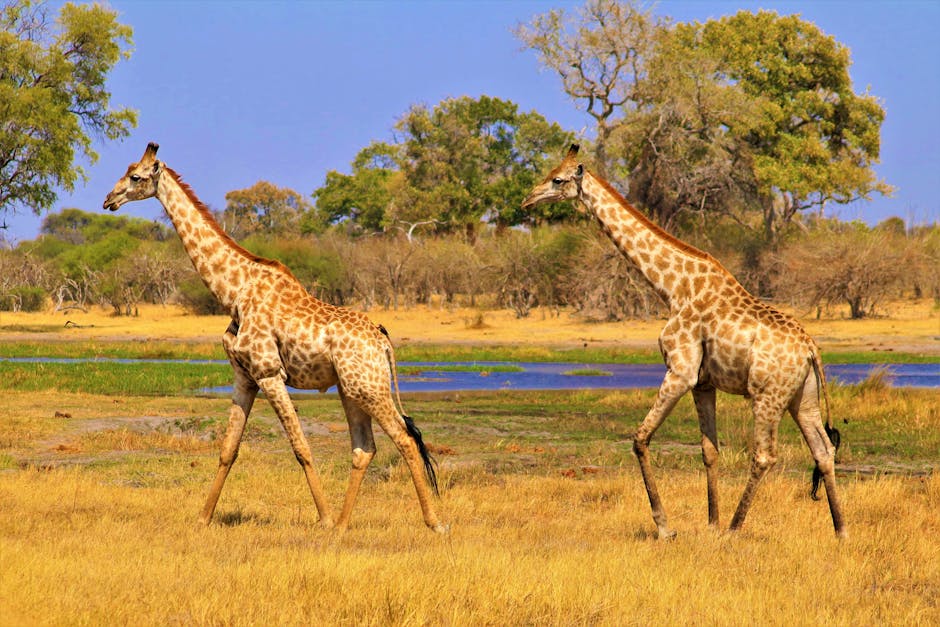
Two giraffes walking in the vibrant African savannah landscape., Serowe, Botswana

