
Neiva, Colombia Weekend: River Walks, Desert Sunsets & Colombia’s Heartland Cuisine (2026)
You step off the plane and the thick, fragrant air hits you first—a blend of sun-warmed asphalt, ripe mangoes from a roadside stall, and the distant, earthy scent of the Magdalena River. The buzz of mototaxis and the call of a churro vendor pierce the heat. You’re in Neiva, the gateway to Colombia’s arid Tatacoa Desert and the heart of the country’s agricultural soul. Over 48 hours, you’ll walk the riverfront, taste the best tamales in Huila, and stargaze under some of the darkest skies in South America. This is a weekend that feels more like a discovery than a vacation.
Quick Facts Before You Go
- Best Months: December to March (dry season) – you’ll avoid the stifling humidity and get clear skies for desert excursions. June is also great for the Bambuco Festival.
- Currency: Colombian Peso (COP). Roughly 4,000 COP to 1 USD. Most vendors accept cash; cards work at hotels and upscale restaurants.
- Language: Spanish. English is rarely spoken outside major hotels – a few phrases go a long way, and locals love your effort.
- Budget: $30–$50 USD per day (120,000–200,000 COP) – you’ll eat well, travel by taxi, and enjoy a mid-range hotel. Desert tours push it higher.
- Getting There: Benito Salas Airport (NVA). Direct 50-minute flights from Bogotá on Avianca or LATAM. Book at Skyscanner (round-trip often under $120 USD).
Day 1: Riverfront Rhythm & Tamale Temptations
Your first morning in Neiva begins with the rising sun painting the Magdalena River gold. You join the early risers jogging along the Malecón, the riverside promenade that spills from the heart of the city. The heat hasn’t yet clamped down, and the scent of coffee from a kiosk reminds you of Huila’s legendary bean. Travelers often discover that this ribbon of green and water is the city’s living room – it’s where you’ll feel the pulse of Neiva.
- Morning (8–11am): Start at the Malecón de la Magdalena (free). Walk the 2-kilometer path past sculptures and lookout points, then detour into Parque Santander, the main square shaded by giant ceiba trees. You’ll see locals playing chess and vendors selling jugo de corozo (a tart local fruit juice) for 2,000 COP per cup. Climb the Mirador de la Virgen (free, but wear good shoes) – a short uphill path rewards you with a panoramic river view.
- Lunch: Head to Restaurante La Cañada (Calle 6 #7-32). Don’t overthink it: order the tamal huilense (18,000 COP) – a giant maize loaf stuffed with pork, chicken, potato, and vegetables, steamed in a banana leaf. The flavor is smoky, earthy, and unforgettable. Pair it with chicha de maíz (fermented corn drink) for a true local experience.
- Afternoon (1–5pm): Take a short taxi (15,000 COP) to Bosque Popular El Prado – a beloved city park with a small zoo, a butterfly house (entry 5,000 COP), and trails under towering fig trees. The Museo de Arte Contemporáneo del Huila (free, closed Mondays) inside the park offers a cool, quiet contrast. Later, explore Calle 8, the pedestrian shopping street – you’ll find cobblers, hammock vendors, and the aroma of grilled arepas.
- Evening: dinner at El Cielo Asadero (Carrera 5 #10-45) – a lively open-air spot where the smoke from charcoal grills mingles with cumbia music. Order sobrebarriga (flank steak) with patacones (fried plantains) and aji (spicy salsa) – around 35,000 COP. Afterwards, stroll back to the Malecón for a nightcap at La Terraza del Río, a rooftop bar where you can hear the river’s low rumble under the stars.

Fotografías de paisajes del Jardín Botánico de la ciudad de Neiva Colombia, Neiva, Colombia
Day 2: Desert Dreams & Starry Silence
Your second day takes you out of the city – a 45-minute drive into a landscape so surreal you’ll wonder if you’re still in Colombia. The Tatacoa Desert (officially a dry tropical forest) is a patchwork of rust-red and grey canyons, dotted with cacti and fossils. Seasoned travelers plan their desert day around sunset and stargazing, because the real magic begins when the sky darkens.
- Morning: Leave Neiva by 7am – hire a taxi for the day (around 200,000 COP, or join a tour from $35 USD – book at GetYourGuide). Eat breakfast at your hotel or grab a simple arepa con queso from a street cart (2,000 COP). The drive is quick; you’ll pass through small villages and fields of rice.
- Midday: Arrive at Tatacoa Desert (entry free, but guides recommended – about 80,000 COP per group). Head to the Cuzco area (grey canyons) first – the less visited of Tatacoa’s two zones. Walk the Laberinto de Cuzco (400m path, free) – a maze of eroded spires. Insider tip: arrive before 10am to avoid heat and crowds. Then drive to the Rojo zone (red canyons) – the iconic landscape for photographs. The short hike down to the El Pesebre viewpoint is worth every drop of sweat.
- Afternoon: Lunch at El Refugio de Tatacoa, a simple restaurant with thatched roofs. You’ll feast on grilled chicken, sancocho de pescado (fish soup), and homemade lemonade – about 30,000 COP. Afterwards, visit the Observatorio Astronómico de Tatacoa (entry 10,000 COP) – the desert’s low light pollution makes it one of South America’s best stargazing sites. You can book a guided night session in advance (usually starts at 7pm).
- Final Evening: After watching the sunset paint the canyons orange, return to Neiva for a farewell dinner. Restaurante Doña Lele (Calle 5 #6-20) is a cozy family spot known for its lechona (roast pork stuffed with rice and peas) – 25,000 COP. The owner might even sing you a traditional bambuco tune. End with a postre de natas (milk pudding) – sweet, creamy, and pure nostalgia.

Drone view of Charalá, Neiva, Colombia
The Food You Can’t Miss
You’ll quickly learn that Neiva’s cuisine is a love letter to corn, plantain, and river fish. The star is tamal huilense – not the small wrapped bundles you see elsewhere, but a massive, dense triangle of masa filled with chicken, pork, potatoes, and hard-boiled eggs, all wrapped in bijao leaves. The best version? Savvy visitors line up on Sunday mornings at Tamales La 14 (Carrera 14 #7-30) – they sell out by 11am, and one tamal (15,000 COP) will fuel you for hours.
Street food is a joy here. Seek out chuzos – skewers of marinated pork or beef grilled over charcoal, served with a coca-cola and a squirt of lime – you’ll find them on every corner for 6,000 COP. At the Mercado Sur (Calle 8 between Carreras 4 & 5), you can grab a jugo de lulo (2,000 COP) and watch vendors shave ice for raspados. Don’t skip arepa de choclo – a sweet corn pancake with fresh cheese, often sold from carts near Parque Santander (3,000 COP).
For one proper sit-down meal, book a table at La Casona de la 12 (Calle 12 #5-40) – a colonial house turned restaurant. Their sancocho de gallina (hen soup with yucca and plantain) is legendary, served with rice and avocado (28,000 COP). The patio is shaded by bougainvillea, and you’ll hear the clatter of dominoes from the next table. It’s the kind of meal that makes you want to stay another night.
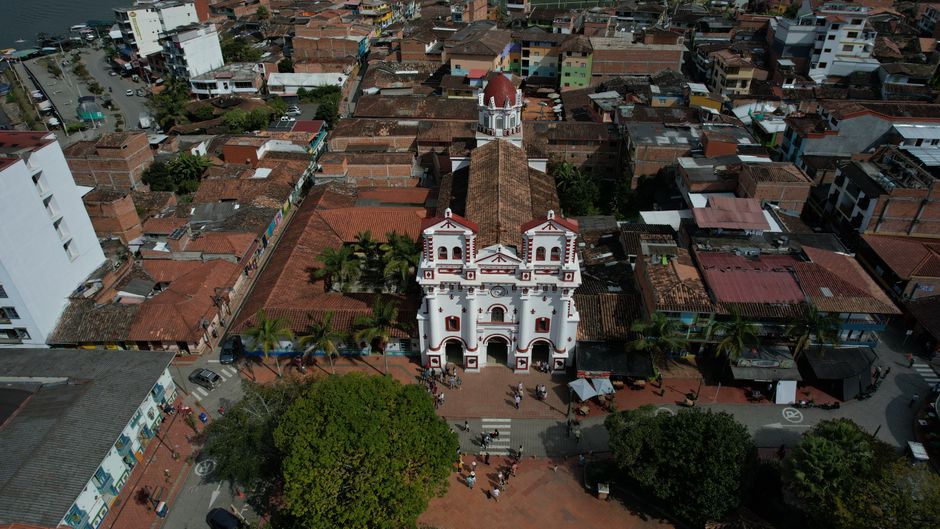
Drone capture of Guatapé’s iconic church and surrounding townscape in Colombia., Neiva, Colombia
Where to Stay for the Weekend
Hotel Cóndor (Carrera 6 #8-60, around $50 USD/night) – a restored mid-century building with a rooftop pool and a top-floor restaurant. Travelers love the staff’s warmth and the short walk to the Malecón. Rooms are clean, simple, and air-conditioned – a must.
For a quieter, more local vibe, stay in the San Pedro neighborhood – slightly removed from downtown but full of residential charm. Hostal San Pedro (Calle 4 #7-30, $25 USD/night for a private room) offers a garden courtyard and homemade breakfast. The owners are a retired couple who happily recommend hidden eating spots.
If you prefer a boutique experience, Hotel Villaloma (Carrera 3 #10-20, $70 USD/night) has sleek modern rooms, a gym, and a small cafe serving Huila-grown coffee. It’s near the university area, so nightlife is a short taxi ride away. Book via Booking.com or find an apartment on Airbnb (budget $30–$60/night for a central studio).
Before You Go: Practical Tips
- Getting Around: Taxis are cheap – flag one on the street (base fare 5,000 COP, most rides under 15,000 COP). Uber doesn’t operate in Neiva, but the official taxi app Taxi Neiva works well. For the desert, book a tour or negotiate a day rate (200,000–250,000 COP).
- What to Pack: A wide-brimmed hat and sunscreen (the sun is fierce by 9am). Light linen or cotton clothes – you’ll sweat even in the dry season. A good pair of walking shoes for the desert. And a jacket – the Tatacoa desert gets surprisingly cool after sunset.
- Common Tourist Mistakes: Relying on English – download Google Translate and learn “¿Cuánto cuesta?” (How much does it cost?). Also, don’t skip the desert because it’s “hot” – the early morning and late afternoon are stunning, and the shade is plentiful. Lastly, avoid drinking tap water – stick to bottled.
- Money-Saving Tip: Eat lunch at the Mercado Sur food court – you’ll get a filling bandeja huilense (rice, beans, plantain, chorizo, and steak) for just 15,000 COP, compared to 35,000 COP at a tourist restaurant. Also, buy snacks for the desert trip here – a whole mango costs 1,000 COP.

