
Gabu, Guinea-Bissau Weekend: Markets, Mosques & The Best Grilled Fish East of Bissau (2026)
You step off the dusty road into Gabu’s main square just as the muezzin’s call ripples across the red-earth rooftops at dusk. The smell of charcoal-grilled capitaine fish mingles with the sweet, nutty aroma of roasting cashews from a street-side brazier. Within minutes, a Fula elder in a flowing boubou greets you with a warm handshake and a soft “Salam aleikum”—and you realize you’ve arrived somewhere that still moves at its own unhurried, ancient rhythm.
Quick Facts Before You Go
- Best Months: November to February. The dry season brings brilliant blue skies, lower humidity, and roads that are actually passable. By March the heat becomes intense, and from June to October the rains turn rural tracks to mud.
- Currency: West African CFA franc (XOF). 1 USD ≈ 600 XOF; 1 EUR ≈ 655 XOF. Bring crisp banknotes—tattered bills are often refused.
- Language: Portuguese is the official language, but Crioulo (Kriol) is the everyday tongue. Fula is widely spoken in Gabu. English is very limited; learning a handful of Crioulo greetings will transform your experience.
- Budget: 30,000–50,000 XOF per day ($50–$85) covers a comfortable guesthouse, three meals, local transport, and a few souvenirs. Budget travelers can manage on 20,000 XOF daily.
- Getting There: Fly into Osvaldo Vieira International Airport in Bissau (OXB). From there, shared minibuses (toças) run to Gabu in 4–5 hours for about 3,500 XOF. Private taxis cost around 35,000 XOF. Book flights at Skyscanner.
Day 1: The Pulse of the Fula Capital
You start the morning before the sun has fully cleared the mango trees. Gabu wakes early—shopkeepers splash water on dusty doorsteps, women in indigo wraps arrange pyramids of tomatoes and onions, and the smell of fresh fry bread drifts from a dozen street stalls. By 7 a.m. you are already swept into the rhythm of a city that has been a crossroads for Fula traders since the 19th century. Your first day is about immersion: the market, the mosque, and the long, lazy afternoon that West African heat demands.
- Morning (8–11am): Head straight to Gabu’s Grande Mercado, the sprawling heart of the city. By 8 a.m. the market is a riot of color and sound—piles of glossy red palm oil, mounds of dried shrimp, ropes of garlic, and, most famously, sacks of Gabu’s own cashews (1,000 XOF for a generous bag). Weave through the fabric stalls where Fula women sell hand-dyed cotton; bargaining is expected, and a polite “diminui um pouco” (“lower it a little”) will get you a fair price. Arrive hungry—the breakfast section serves bowls of cafriela, a spicy chicken and rice porridge, for 500 XOF.
- Lunch (12pm): Follow your nose to Restaurante Kambas di Garandi, a open-air spot on Avenida Principal beloved by locals. The house specialty is grilled capitaine fish with mufete—a tangy sauce of palm oil, garlic, and chili that you’ll dream about for weeks. A whole fish with rice and fried plantains costs 3,000 XOF. Your best bet is to arrive by 11:45 a.m. to snag a table under the shade of the corrugated awning.
- Afternoon (1–5pm): The midday heat demands a siesta, but at 3 p.m. walk to the Grande Mesquita de Gabu, the city’s iconic white-washed mosque built in the 1950s. Non-Muslims cannot enter, but you can stand in the courtyard and admire the geometric tile work while children play football in the adjacent square. From there, a 15-minute walk east leads you to the Fula Cultural Centre (free entry, donations appreciated), where a local guide named Mamadu (ask for him by name) might show you the exhibition of antique Fulani jewelry, leatherwork, and a beautifully preserved 19th-century Quran. Most tourists overlook this gem—seasoned travelers know it’s the best place to understand Gabu’s identity.
- Evening (6–9pm): As the sun softens, make your way to Bar do Rio, a dusty terrace perched on the banks of the Colufi River. The breeze off the water makes this the coolest spot in town. Order a chilled Gasosa (local soda) or a bottle of Flag beer (1,000 XOF each) and watch the sky turn ochre and violet. Dinner is at Churrasqueira Gabu, where a charcoal grill roars outside—order frango no churrasco (grilled chicken with a smoky, spicy rub) and funje (cassava porridge) for 4,000 XOF. The crowd is lively, the music is loud, and you’ll likely be invited to share someone’s table.
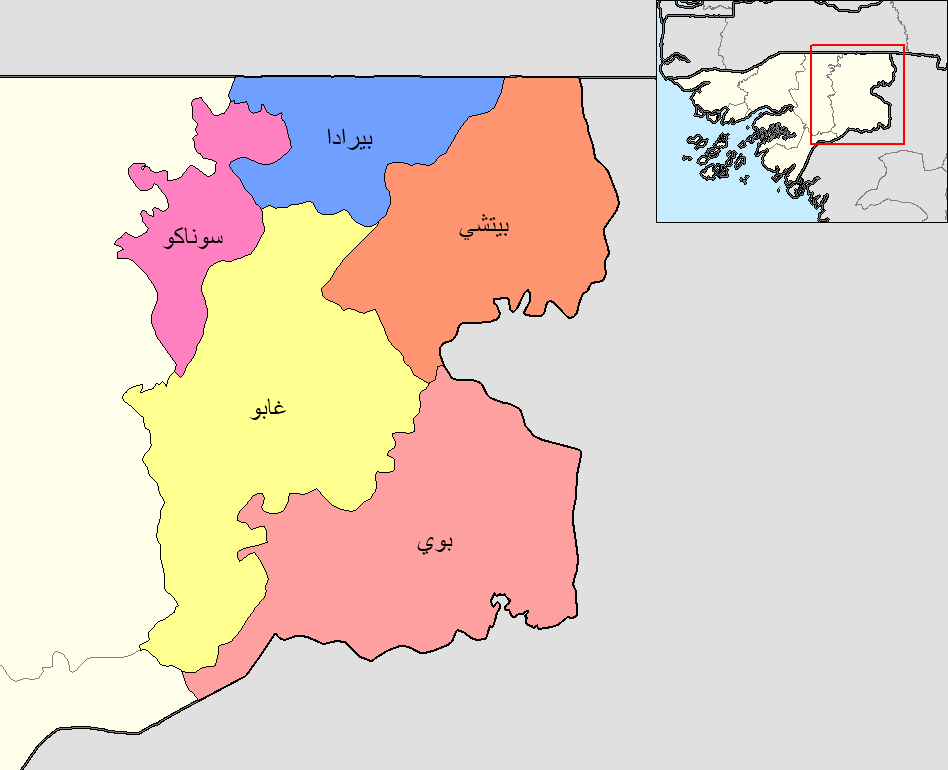
Map of the sectors of Gabu region in Guinea-Bissau., Gabu, Guinea-Bissau
Day 2: Villages, Cashews & The Road to Bafatá
Travelers often discover that Gabu’s real magic lies just beyond the city limits. Your second day takes you into the surrounding savanna, where Fula villages cling to the edges of dirt roads and cashew orchards stretch to the horizon. This is a day for slow travel—for stopping when you see a baobab grove, for accepting a cup of sweet mint tea from a stranger, for understanding why the Fula people call this region Diiwal Fulbe—”Land of the Fula.”
- Morning (7–10am): Rent a bicycle from Locadora de Bicicletas do Mamadu (just off the main square; 1,500 XOF for a day) and cycle 8 km northwest to the village of Sare Uale. The road is flat, red dust that turns your shoes the color of clay. In Sare Uale, you’ll find the Monday-Friday morning women’s cashew-processing cooperative, where Fula women crack, roast, and package cashews using traditional methods. You can buy a kilo of roasted cashews for 2,000 XOF—half the price in Bissau. Breakfast at the village: a bowl of mais (millet porridge with baobab powder) for 300 XOF and a thermos of sweet mint tea poured from height by a young boy named Demba.
- Midday (10am–12pm): Cycle back to Gabu and visit the Mercado de Gado (livestock market), held just north of town on Saturdays and Sundays. From 10 a.m. onward, hundreds of goats, sheep, and a few long-horned cattle are traded under a haze of dust and bleating. The bargaining is fierce, the energy electric, and the spectacle is pure West Africa. Your best bet is to arrive before 11 a.m., when the crowds peak—after noon the heat clears the field and the action subsides.
- Afternoon (1–4pm): Lunch is at Pastelaria Central, a cool, tiled café on Rua da Independência. Try the pastel de carne (beef pastry) and a strong café de cabra (locally grown goat coffee, surprisingly smooth and chocolaty), total 1,500 XOF. Then take a taxi (3,000 XOF, 30 minutes) to the Bafatá River Gallery, a small art collective run by a Senegalese painter named Ousmane. The gallery is a museum-worthy space of Fula abstract art and cashew-wood carvings—locally made and priced fairly (carvings from 5,000 XOF). Most tourists never leave Gabu proper; savvy visitors know that Bafatá district holds the region’s best artisan work.
- Final Evening (5–8pm): For your farewell dinner, return to Restaurante Kambas di Garandi, but this time order ahead—locals recommend the plato completo, a banquet of grilled prawns, capitaine fish, chicken yassa (onion and mustard stew), and a mountain of rice with black-eyed peas. Cost: 7,000 XOF per person, but you’ll need a group of two to finish it. End the night at Bar do Mercado, a lively rooftop spot overlooking the darkened market square. Order a djarro (palm wine, mildly sour and sweet, served in a calabash gourd) for 500 XOF. As the star-speckled sky settles over Gabu, you’ll hear the distant thrum of a kora being played somewhere in the shadows—a sound that will follow you home.

Peaceful road lined with palm trees in Malabo, Equatorial Guinea., Gabu, Guinea-Bissau
The Food You Can’t Miss
Gabu’s cuisine is a testament to its Fula heritage and its position at the crossroads of West African trade routes. You’ll find dishes here that blend the peanut-based gravies of Senegal with the fiery chili peppers of Guinea, unified by the ubiquitous presence of fresh fish from the nearby rivers and the Atlantic coast beyond. The star ingredient, however, is the cashew—not just the nut itself but the apple-like fruit that surrounds it, which locals press into a tangy, mildly alcoholic juice called cajuína.
Your best bet for street food is the nightly Rua da Feira food stalls, which spring to life around 6 p.m. Here you can try pastéis de feijão—deep-fried dough pockets stuffed with spiced black-eyed peas (200 XOF each)—or brochettes de cabrito, goat skewers grilled with chili and onion (500 XOF each). For a true Gabu specialty, seek out canja de peixe, a fragrant fish soup thickened with ground cashews and served with lime—available at Dona Mariama’s Food Stall near the mosque entrance for just 1,000 XOF a bowl.
For a sit-down meal, Restaurante Kambas di Garandi remains the undisputed king, but adventurous eaters should also try Pequeno Dakar, a family-run spot on the eastern edge of town where the Senegalese owner makes thiéboudienne (spiced fish and rice) that rivals anything in Dakar itself—a generous plate costs 3,500 XOF. Don’t leave without trying sorrel juice, a deep crimson drink made from hibiscus leaves, sold everywhere for 200 XOF a glass; it’s tart, refreshing, and utterly addictive.

Aerial shot of a rural village in Africa with dirt roads and modest homes., Gabu, Guinea-Bissau
Where to Stay for the Weekend
Gabu offers a handful of authentic accommodation options that place you right in the city’s rhythm. For location and character, Bairro de Diferencia is the best area to base yourself—it’s a quiet residential quarter a five-minute walk from the main market, safe at night, and dotted with tiny family-run guesthouses. Here you’ll find Pensão Central Gabu, a crumbling, charming colonial-era building with high ceilings, mosquito nets, and a rooftop terrace where you can drink coffee while watching the city stir to life. A double room with fan and private bathroom costs 12,000 XOF per night. Book via Booking.com (listed as “Pensão Central Gabu”) or search for nearby options on Airbnb.
A step up in comfort is Hotel Gabu Palace, a newer, concrete-and-tile building on Avenida Principal. It has air conditioning, a reliable generator, and a small pool that feels like a luxury in the afternoon heat. Rooms start at 25,000 XOF per night, and the on-site restaurant serves passable international food if you need a break from local flavors. Budget travelers swear by Guesthouse Bissau Azul, a four-room family home in Bairro de Missira where the owner, Señora Isabel, cooks a communal dinner every evening (included in the 8,000 XOF per night dorm rate). It’s the kind of place where you’ll end the night playing cards with a Dutch backpacker and a Guinean goat trader—and it’s unforgettable.
Before You Go: Practical Tips
- Getting Around: The best way to explore Gabu is on foot—the city is compact and walkable. For trips to surrounding villages, hire a bicycle (1,500 XOF/day) from Mamadu’s rental near the market. For longer distances, shared toça minibuses run from the central station to Bafatá (1,500 XOF, 45 minutes) and Bissau (3,500 XOF, 4 hours). Private taxis within town cost 500–1,000 XOF per ride; agree on the fare before you get in.
- What to Pack: (1) A lightweight sarong or scarf—women must cover their shoulders and knees when visiting the mosque, and everyone benefits from a dust shield on the bumpy roads. (2) A headlamp or small flashlight—power cuts happen daily and the market lanes become pitch black after sunset. (3) A reusable water bottle with a filter—tap water is not safe to drink, and plastic bottles are hard to recycle here. (4) A portable fan—your budget guesthouse likely won’t have air conditioning, and March–May heat is relentless.
- Common Tourist Mistakes: The biggest error is assuming you can rely on English. Learn at least “Obrigado” (thank you), “Bon dia” (good morning), and the Crioulo greeting “N’ka bai?” (how are you?). The second mistake is trying to rush—service is slow, roads are unpredictable, and the 10 a.m. market visit you planned might start at 11:15 a.m. Embrace it.
- Money-Saving Tip: Exchange money at the Banco da Guiné-Bissau in the city center, where rates are fair and commission is low (3% on CFA cash). ATMs exist but are unreliable; carry enough cash for your entire stay. If you eat at market stalls and street vendors for breakfast and lunch, and save restaurant meals for dinner, you can eat well for 8,000 XOF/day—less than $14.

