
Beyond the Diamond Dust: Why Dundo’s Red Earth Holds Angola’s Most Unexpected Stories (2026)
In 1912, a Portuguese geologist named Alfredo de Oliveira stumbled upon a glittering pebble in the gravel of the Chiumbe River, just a few miles from what would become Dundo. That single diamond sparked a rush that transformed a remote Lunda outpost into a colonial boomtown. By 1925, the Companhia de Diamantes de Angola (Diamang) had established its headquarters here, and the red earth of the region began yielding fortunes that would shape not just Angola, but the global diamond trade for decades.
The Story Behind Dundo, Angola
To understand Dundo, you need to start with the diamonds. The arrival of Diamang in the early 1920s didn’t just bring mining—it brought a whole colonial apparatus. The company built a railway spur from the Congo border, erected a hydroelectric plant on the Luachimo River, and constructed a European-style settlement complete with a hospital, a cinema, and tree-lined avenues. By the 1940s, Dundo had become a company town in the truest sense: everything from the water supply to the local police was run by Diamang. Travelers often discover that the city’s very layout—wide, rectilinear streets radiating from a central praça—still echoes that corporate paternalism.
Yet the story is far from exclusively Portuguese. The indigenous Chokwe people, whose ancestors had inhabited the Lundas for centuries, were both the labor force and the cultural soul of Dundo. Their intricate mask carvings, known as makishi, began to catch the eye of European ethnographers in the 1930s. In 1945, Diamang’s chief medical officer, Dr. José Redinha, established the Dundo Museum to preserve Chokwe artifacts—a collection that now stands as one of the most important in Central Africa. The irony is sharp: a diamond company that exploited Chokwe labor also preserved their art for posterity.
Independence from Portugal came in 1975, but for Dundo, the next three decades were a cruel sequel. Angola’s civil war (1975–2002) devastated the region. Diamang’s infrastructure was looted, the railway ceased to run, and the once-prosperous town shrank to a shadow of its former self. The diamonds, however, remained. In the 1990s, Dundo became a center for artisanal garimpo—illegal mining—that funded both sides of the conflict. It was only after peace returned in 2002 that the city began to breathe again. Today, you will find a place of stark contrasts: rusting colonial villas beside freshly painted Chinese-built shops, and UN trucks sharing the dusty roads with battered Toyota Hiluxes heading to the mines.
Neighborhood by Neighborhood
Aldeia Operária
The old “Workers’ Village” is where you feel the colonial footprint most vividly. Built by Diamang in the 1930s for its African employees, this neighborhood stretches along the Rua da Mina in tidy rows of single-story houses with corrugated-iron roofs and concrete verandas. The streets are unpaved here, and after a rain, the laterite clay turns a deep russet that stains your shoes. Local children kick a half-deflated football between the mango trees, while women sell dried fish and cassava from wooden stalls near the junction with Avenida 4 de Fevereiro. Your best bet for a glimpse of everyday life is to wander here early in the morning, around 7 a.m., when the air is still cool and the smell of charcoal fires mingles with the sweet scent of ripe papaya. Look for the small chapel of São Francisco, a whitewashed building from 1952 where Diamang held Catholic mass for the workers—the faded frescoes inside still show a diamond-encrusted cross.
Bairro Central
Dundo’s commercial heart, Bairro Central, clusters around the Praça da Independência. This is where the Portuguese built their administration buildings: the old Diamang headquarters, a two-story yellow Art Deco block with green shutters, now partly houses government offices. Across the square stands the majestic Mercado Municipal, a concrete hall from the 1950s with a high sawtooth roof. You’ll find it buzzing from sunrise to noon, especially on Saturdays, when vendors from as far as Saurimo bring baskets of groundnuts, dried caterpillars, and palm oil. The noise is a cacophony—haggling in Portuguese, Chokwe, and Lingala—but the energy is infectious. Savvy visitors know to buy a bag of roasted cashews from Dona Júlia’s stall (look for the red umbrella) for 200 kwanza. A few steps away, along Rua do Comércio, are the Chinese-run electronics shops where you can buy a cheap phone charger or a SIM card from Unitel.
Bairro da Catedral
Climbing the gentle hill to the east, you reach Dundo’s most contrasting quarter. Bairro da Catedral takes its name from the imposing neo-Romanesque Cathedral of Nossa Senhora da Conceição, completed in 1956. Its twin bell towers rise above a sea of corrugated-iron roofs, a striking landmark you can see from almost anywhere in town. The neighborhood itself is a mixture of well-kept villas—once the homes of Diamang managers—and newer apartment blocks built after the war. Here you’ll find the Dundo Museum, housed in a colonial bungalow surrounded by flame trees. Plan to spend at least an hour inside, studying the remarkable collection of Chokwe masks, ivory carvings, and ethnographic photographs from the 1930s. The entrance fee is just 500 kwanza (around $1), and the curator, Sr. João, has been working there since 1982; if you’re lucky, he’ll show you the storage room where they keep a rare 19th-century throne. From the museum, a short stroll down Avenida da Amizade leads to the Luachimo River, where locals gather at dusk to wash clothes and children splash in the shallow rapids.
The Local Table: What Denizens Actually Eat
Dundo’s cuisine is rooted in cassava and palm oil, the twin pillars of Lunda cooking. You’ll rarely find a meal without funge, a stiff porridge made from cassava flour that serves as both plate and utensil. Locals hold it in their right hand, roll it into balls, and dip it into a sauce of okra or peanut. The dish that truly defines Dundo, however, is moamba de galinha—chicken simmered in red palm oil with garlic, okra, and sometimes ground pumpkin seeds. Travelers often discover that the best version is served at the family-run Restaurante Kimbangu, tucked behind the municipal market on Rua do Cemitério. For 1,500 kwanza (about $3), you get a generous portion of chicken in a rich, rust-colored sauce, accompanied by funge and a pile of fried plantains. Eat there at lunch, when the place fills with diamond traders and government clerks, and the owner, Dona Luzia, will tell you how her grandmother learned the recipe from a Chokwe chief.

Beautiful Dundo, Angola scenery
Another essential experience is the morning market at the Largo da Estação, near the disused train station. From 5:30 to 8:00 a.m., women sell kissangua, a mildly alcoholic drink made from fermented cassava, in recycled plastic water bottles. The taste is sour and fizzy—an acquired pleasure—but it’s the social ritual that matters. You’ll also find bolinhos de feijão, deep-fried bean balls sold by the dozen for 100 kwanza. For a quick breakfast, try the cachaça bread sold by street vendors near the cathedral: a soft doughy roll with a caramelized top, perfect with strong coffee from the café next to the Banco BIC.
Travelers who want to learn more about local ingredients should visit the horta comunitária on Rua da Vidrul, a community garden run by a women’s cooperative. They grow okra, sweet potatoes, and a leaf called jimboa (a spinach relative) that appears in many stews. The cooperative offers a cooking workshop every Saturday at 10 a.m. for 3,000 kwanza (about $6). You’ll spend two hours chopping, grinding, and simmering, then share the meal with the women under a thatched shelter—an unforgettable taste of Dundo’s real kitchen.
Art, Music & Nightlife
Contemporary Dundo’s creative pulse beats strongest in the neighborhood of Bairro da Catedral, where a small collective of painters and sculptors works out of a former Diamang warehouse turned into an arts center known as Espaço Kwanza. Every Friday afternoon, they open their doors for an informal market and exhibition. You’ll find Chokwe-inspired acrylic paintings on canvas—bold, abstract depictions of masks and spirits—alongside more experimental works using diamond dust mixed with resin. The founders, brothers Artur and Mário Lopes, learned their craft from an older generation of tombos (traditional carvers). Pieces start at around 10,000 kwanza (about $20). For music, your best bet is the Tudo Nosso dance club on Avenida 4 de Fevereiro. Thursday through Saturday nights, from 10 p.m. until dawn, the sound system blasts semba (Angola’s precursor to samba) and kizomba—a slow, sensual dance that locals have perfected. Entrance is 1,000 kwanza, and the plastic tables outside are where you can sip a chilled Cuca beer and watch the city’s stylish youth sway under the stars.
Dundo also hosts an annual cultural festival, the Festa do Tchokwe, which takes place over the first weekend of August. The streets around the museum fill with processions of dancers wearing makishi masks—some carved with exaggerated expressions that send children screaming in delight. Drum groups from surrounding villages compete for prizes, and the whole town spills into the Praça da Independência for a communal feast of grilled fish and funge. If your travels bring you to Dundo in early August, do not miss it; the masks alone are worth the journey. For after-hours relaxation, head to the Esplanada do Rio, a riverside bar on the Luachimo where you can sit on plastic chairs in the sand, sip a fresh coconut, and listen to the quiet murmur of the current.
Practical Guide
- Getting There: Dundo Airport (DUE) receives a few weekly flights from Luanda’s Quatro de Fevereiro Airport (LAD) operated by TAAG Angola Airlines. Flights are often subject to change; book in advance through Skyscanner. The fare is roughly 35,000–50,000 kwanza one-way (about $70–100). Alternatively, you can drive from Luanda (a 12-hour trip on the EN180 and EN230), but consider a 4×4 and experienced driver.
- Getting Around: Within Dundo, the main options are mototáxis (motorcycle taxis) and collective minibuses known as candongueiros. A mototáxi ride across town costs 150–300 kwanza (less than $1). Negotiate the fare before getting on. Minibuses follow fixed routes like “Bairro Central–Mercado” and cost 100 kwanza. For more comfort, hire a private taxi through your hotel—approximately 2,000 kwanza per hour.
- Where to Stay: The best option is Hotel Dundo on Rua do Comércio (modern rooms with AC and WiFi; doubles from 15,000 kwanza/night). For budget travelers, the Pensão Luachimo near the market offers basic rooms with shared bathrooms for 5,000 kwanza. Check availability on Booking.com.
- Best Time: April through October, the dry season, brings less humidity and fewer mosquitoes. July and August are especially pleasant, with daytime temperatures around 28°C (82°F). Avoid November to March, when heavy rains can make roads impassable and increase the risk of malaria.
- Budget: A budget traveler can manage on about 10,000 kwanza per day (around $20), including street food, dorm accommodation (if available), and local transport. For mid-range comfort with hotel meals and private taxis, budget 25,000–35,000 kwanza ($50–70).

Aerial view of Lubango city with a prominent church in Huíla, Dundo, Angola
What Surprises First-Time Visitors
The biggest surprise for most travelers is Dundo’s sheer quietness. Arriving from chaotic Luanda, you will find a city where the loudest sound is often the rustle of palm fronds in the wind. The streets are wide and mostly empty of cars, and you can walk from one end of town to the other in under an hour. That peacefulness, however, belies a deep history of exploitation and conflict. Savvy visitors notice the many boarded-up colonial houses—once elegant, now crumbling—that stand as reminders of the diamond boom that suddenly went bust. Yet the people you meet are unfailingly warm and curious. A foreign face draws stares, but always followed by a grin and a wave. Locals are eager to practice their Portuguese or even a few words of English, and you’ll be invited to share a cup of coffee at a roadside stall more than once.
Another thing that catches first-timers off guard is how visible diamonds still are. Not the polished gems of jewelry stores, but the gritty reality of the trade. You’ll see men squatting over piles of gravel near the river, sifting with round metal pans. If you strike up a conversation, they may show you a small rough diamond—a dull pebble that, under a loupe, reveals icy internal fractures. It’s legal to watch, but do not attempt to buy or handle without explicit permission; the trade is tightly regulated, and foreigners have been detained for misunderstandings. The museum, however, has a display of uncut diamonds that you can safely admire.
Finally, many visitors are amazed by the persistence of Portuguese colonial architecture, from the cathedral to the railway station. That station, built in 1926, no longer has trains, but the platform is used as a basketball court by neighborhood kids. The old water tower next to it still stands, painted with a faded advertisement for Diamang. It’s a place where history feels unfinished—where the past hasn’t been erased, but merely covered by a layer of red dust waiting to be brushed away.
Your Dundo, Angola Questions
Is it safe to travel to Dundo? Since the end of the civil war in 2002, Dundo has been peaceful, though the surrounding Lunda Norte province still deals with occasional banditry in remote mining areas. In the city itself, you’ll find normal levels of petty crime—keep your wallet out of sight and avoid walking alone at night on unlit streets. The main risk is health related: malaria is endemic, so you must take prophylactics, use mosquito repellent, and sleep under a net. Overall, Dundo is safer than most Western visitors imagine, but it demands the same vigilance you would exercise in any unfamiliar city.
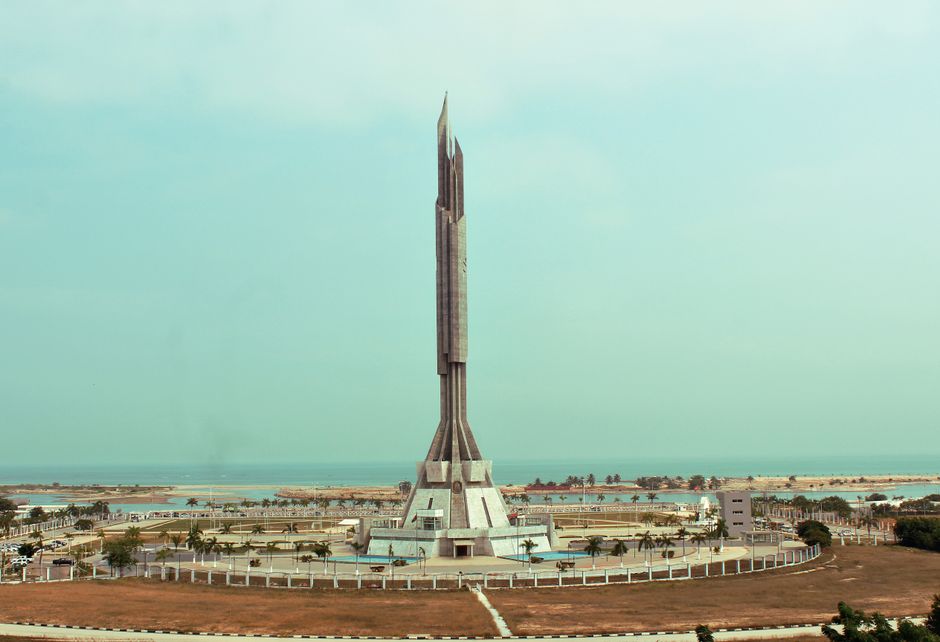
A striking view of the Mausoleum of Neto in Luanda, Dundo, Angola
What documents do I need to visit Dundo? All foreign nationals require a visa to enter Angola. You can obtain a tourist visa (up to 30 days) from an Angolan embassy or consulate before travel; the process takes about a week and costs $100–200 depending on your country. You’ll also need a yellow fever vaccination certificate—border officials often check upon arrival. If you plan to visit any diamond-mining concessions (not recommended for casual tourists), you will need special authorization from the Ministry of Mineral Resources. For standard tourism in Dundo itself, your regular visa and passport are sufficient.

