
Beyond the Coral Coast: Why Jizan’s Mudbrick Labyrinths and Mountain Terraces Captivate Every Traveler Who Ventures South (2026)
In 1934, as the ink dried on the Treaty of Taif ending the Saudi-Yemeni war, Jizan was formally absorbed into the Kingdom of Saudi Arabia. Yet for centuries before, this port had been a crossroads—where frankincense traders from Somalia met Ottoman soldiers and Yemeni merchants. You can still feel that layered history in the labyrinthine alleys of the Old City, where wooden balconies lean like old confidants.
The Story Behind Jizan, Saudi Arabia
Jizan’s recorded history stretches back to the 6th century BCE, when it served as a key stop on the incense route that carried frankincense and myrrh from the Horn of Africa to the Mediterranean. The town grew wealthy, but it was the arrival of the Ottomans in the 16th century that truly shaped its skyline. They fortified the port, built mosques with distinctive minarets, and introduced the irrigation techniques that still water the lush wadis today. In 1801, the Qarar tribe rebelled against Ottoman rule, but by the 1840s Jizan was once again under Ottoman control, this time as part of the Vilayet of Yemen.
The most transformative moment arrived in 1934, when the Treaty of Taif finally drew a border between Saudi Arabia and Yemen. Jizan became a Saudi frontier town, and the government poured resources into infrastructure: the King Fahd Causeway (though actually a series of dams) tamed the seasonal floods, and the Jizan Economic City project began in the early 2000s. Yet for all the modern concrete, the soul of Jizan remains in its old core, where families still grind coffee beans by hand and the call to prayer echoes off sun-scorched mudbrick walls. Savvy visitors discover that the best way to understand Jizan is to walk its past—from the Ottoman-era Al-Hakim Mosque to the bustling water reservoirs known as sabils.
Neighborhood by Neighborhood
Al-Madina Al-Qadima (The Old City)
You’ll enter Al-Madina Al-Qadima through a narrow archway on King Fahd Road, and within steps the clamor of traffic fades. The alleyways are barely two meters wide, shaded by overhanging wooden rawashin—intricately carved balconies that let families capture the breeze without being seen. The walls are a warm, dusty ochre, built from the red mud of the surrounding hills. Head to Souk Al-Haraz, open daily from sunrise until noon and again after evening prayers. Here, you’ll find spice mountains of turmeric, cumin, and the fiery shatta that locals stir into breakfast. The real treasure is the honey section: Jizan produces some of the world’s finest wild Sidr honey, dark as molasses and priced around SAR 200 (US$53) per kilogram. Don’t miss the Al-Hakim Mosque, built in 1720 with a single minaret that you can see from half the neighborhood. Plan to spend at least two hours wandering; every corner reveals a tiny mishwar (restaurant) serving ful medames or a craftsman hammering copper.
Jizan Corniche and Waterfront
In sharp contrast to the Old City, the Corniche is a four-kilometer sweep of palm-lined promenades, fountains that dance to soft music, and an artificial lagoon where families rent paddleboats shaped like swans. Travelers often come at sunset when the temperature drops and the light turns the Red Sea molten gold. The Jizan Waterfront, completed in 2017, features a floating restaurant, Al-Malik, where you can sit on a deck over the water and eat grilled parrotfish or harad (a local fish) with rice and a fiery tomato salsa. The walk is dotted with coffee kiosks selling qahwah sweetened with date syrup. For a different perspective, rent a bicycle for SAR 10 per hour and cycle the full length—on weekends the path is crowded with families, and you’ll hear the clicks of bacas (traditional dance sticks) as young men perform spontaneous dances. If you’re here on a Friday evening, look for the samboosa stalls that pop up near the central fountain; the chickpea filling with mint is a local favorite.
Al-Rashid District
Al-Rashid is Jizan’s modern commercial heart, a grid of wide boulevards lined with glass-fronted shops, chain restaurants, and the gleaming Al-Rashid Mall. Locals recommend visiting in the late afternoon when the sun is less punishing and the streets fill with young people browsing mobile phone stores or sipping mango juice at Twist Café. The district is home to the Jizan Regional Museum, a small but well-curated building that holds artifacts from the ancient kingdom of Qataban, including incense burners and a replica of a 7th-century BCE trading ship. Entry is SAR 15 (US$4). For a taste of Jizan’s agricultural abundance, head to the Al-Rashid Fruit and Vegetable Market, open from 5 a.m. until noon. You’ll see mountains of mangoes (the Namlah variety is sublime), papayas, and the legendary Jizani bananas—short, sweet, and creamy. Most tourists overlook this market, but it’s the best place to chat with farmers and try a fresh-pressed sugarcane juice for SAR 3.
The Local Table: What Denizens Actually Eat
Jizan’s cuisine is a beautiful hybrid of Yemeni and Tihama traditions—lighter than Najdi cooking, more reliant on fish and grains, and deeply flavored with fenugreek (hilba). The cornerstone of a true Jizani meal is aseda, a thick porridge made from wheat flour, served with a broth of chicken or lamb and drizzled with honey. You’ll eat it with your right hand, scooping the spongy dough and dipping it into the spicy shourba. For a lighter bite, seek out mutabbaq—a thin, pan-fried pastry stuffed with minced meat, eggs, and onions, served at street stalls for around SAR 7.

Fuso Rosa in Jizan, Saudi Arabia. Captured on November 28 2019, Jizan, Saudi Arabia
The quintessential Jizani ingredient, however, is honey. The region’s acacia and Sidr trees produce a honey that locals believe heals wounds and cures colds. Head to Souk Al-Haraz and find Abu Nasser’s honey stall—he has been selling his family’s harvest for forty years. He’ll let you taste the difference between the floral samer honey and the darker, more intense sidr. Pair it with a scoop of fool (fava beans) for breakfast, or drizzle it over meseenen (fried dough) at Al-Bayt Al-Ta’am restaurant on King Fahd Road, where a full breakfast costs about SAR 25. And don’t leave Jizan without trying jareesh—cracked wheat cooked with tomato and lamb, often served during Ramadan but available year-round at the family-run Al-Dhafra kitchen in the Old City.
Art, Music & Nightlife
The creative energy in Jizan pulses most strongly during the annual Jizan Summer Festival, held from June to August on the Corniche. The event transforms the waterfront into an open-air gallery of live painting, traditional dance competitions, and poetry readings in the humeini dialect. The music is dominated by al-dahha, a percussion-and-voice performance where men line up in rows, waving sticks and singing call-and-response verses about love and honor. You’ll find smaller, impromptu performances on Thursday nights in Al-Madina Al-Qadima—just follow the sound of the tombak drum. For contemporary art, visit the small but ambitious Jizan Art Gallery on Al-Rashid Street (open Saturday–Wednesday, 9 a.m.–1 p.m. and 5–9 p.m.). The gallery showcases local painters who blend Islamic calligraphy with abstract landscapes of the Farasan Islands.
Nightlife in Jizan is subdued, as you’d expect in a conservative region, but there are charming alternatives. The roof terrace of the Ramada by Wyndham Jizan offers a panoramic view of the city lights, a shisha menu with apple and grape flavors, and mint tea served until midnight. Some travelers prefer the beachside cafés at Al-Shu’bah—try Qahwah Al-Bahr, where you can sit on cushions in the sand and listen to the waves. For a truly local evening, join a group of men playing baloot (a card game) at a street-side maqha (café) in Al-Rashid; you won’t speak Arabic, but the friendly nods and shared tea are their own language.
Practical Guide
- Getting There: Fly into Jizan Regional Airport (GIZ), served by Saudia, Flynas, and flyadeal with daily connections from Riyadh, Jeddah, and Dammam. Book at Skyscanner — fares start around SAR 350 round-trip from Jeddah.
- Getting Around: Taxis within the city cost SAR 10–20 per ride; negotiate before boarding. For the Corniche, you can rent a bicycle for SAR 10/hour. To reach the Farasan Islands, take a ferry from the Jizan Port (SAR 50 round-trip, departures at 8 a.m. and 2 p.m. daily).
- Where to Stay: For comfort and views, the Corniche area offers the Ramada by Wyndham Jizan (rooms from SAR 450/night) and the newer Jizan Hotel (from SAR 350). For budget travelers, Al-Rashid has clean guesthouses like Al-Mutzner Inn (SAR 150/night). Check Booking.com for the best rates.
- Best Time: October through March, when daytime temperatures hover around 28–32°C (82–90°F) and humidity is lower. Avoid July and August, when the heat and humidity can be overwhelming.
- Budget: A mid-range traveler can get by on SAR 250–400 per day (US$67–107) including meals, transport, and entry fees. Street food keeps costs under SAR 50/day.

Beautiful view of Riyadh Water Tower silhouetted against a stunning sunset sky., Jizan, Saudi Arabia
What Surprises First-Time Visitors
Most travelers arrive expecting a dusty, monotonous city—and Jizan quickly proves them wrong. The first surprise is the sheer greenness: banana plantations line the roads, mango trees shade the sidewalks, and the air smells of damp earth and flowering jasmine. You’ll see farmers tending terraced fields on the mountain slopes just beyond the city, a landscape that feels more like Southeast Asia than Arabia. Another shock is the warmth of the people. Locals will approach you with a smile, offer you qahwah from a brass pot, and insist you try their grandmother’s honey. It’s so genuine that you’ll find yourself lingering longer than planned.
The third surprise is the pace of life. In Jizan, the afternoon siesta is sacred—shops close from 1 to 4 p.m., and the streets empty. Rather than see it as an inconvenience, embrace it: join the locals in a shaded café, play a game of dominoes, and let the city slow you down. By evening, the energy returns, and you’ll discover that Jizan’s magic lies not in monuments but in moments—a shared joke with a fisherman, the smell of turmeric in a spice stall, the way the call to prayer reverberates across the water at sunset.
Your Jizan, Saudi Arabia Questions
Is Jizan safe for solo female travelers? Yes, with the usual precautions for any conservative region. You should dress modestly (long skirts or trousers, sleeves to the wrist, a headscarf optional but appreciated) and avoid walking alone after dark in quiet areas. The Corniche and major malls are well-patrolled and feel safe even in the evening. Solo women often report that locals are protective rather than aggressive—you may be invited for tea more often than you expect, but always in public spaces. A smile and a polite “la, shukran” (no, thank you) will suffice if you’re not interested.
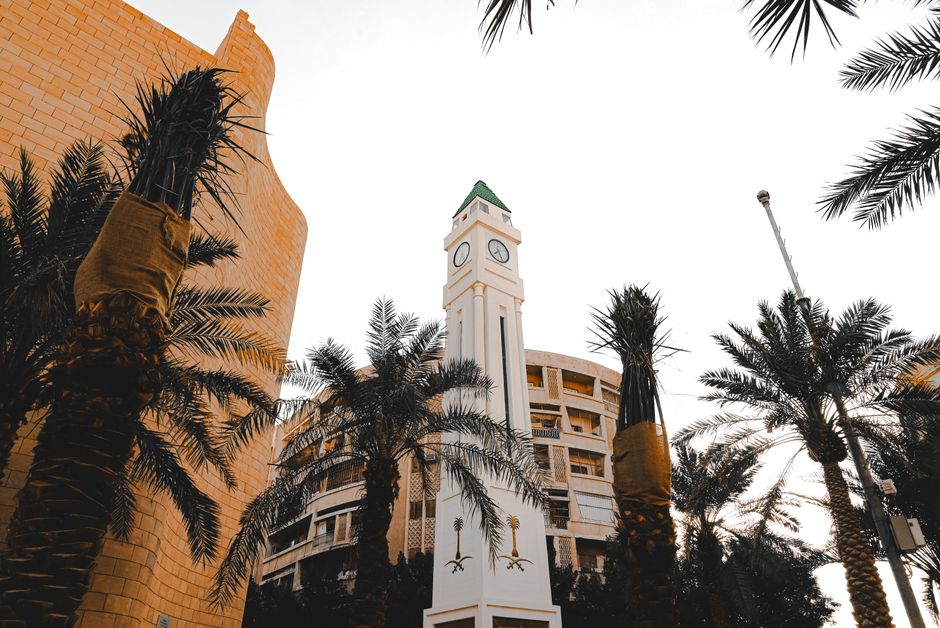
A striking clock tower surrounded by palm trees against a bright sky in an …, Jizan, Saudi Arabia
Can you visit the Farasan Islands as a day trip? Absolutely, and you should. The ferry from Jizan Port runs twice daily (8 a.m. and 2 p.m.) and takes about 90 minutes, costing SAR 50 round-trip. The islands boast pristine white beaches, a ruined Ottoman fort, and the hauntingly beautiful mangrove forests of Ghubbah. Pack your own lunch or eat at the simple fish shack near the dock—grilled grouper with rice for SAR 20. The last ferry back to Jizan departs at 5

