
Beyond the Divided Line: How Galkayo Forges Resilience from Ash and Acacia (2026)
In April 1993, as the dust from Somalia’s collapsing state still hung heavy over the Horn of Africa, a group of elders from the Darod and Hawiye clans gathered under a single acacia tree on the outskirts of what is now Galkayo’s central market. The tree, known locally as Geedka Nabadda (the Tree of Peace), had witnessed centuries of shade trade and disputes. That afternoon, with neither ink nor paper, they carved a verbal truce that would later become the foundation of the city’s fragile dual-governance system. Walking those same market lanes today, you can still feel the weight of that agreement—negotiated from scratch, not with politicians, but with men who weighed their words like gold.
The Story Behind Galkayo, Somalia
No other city in Somalia embodies the nation’s contradictions quite like Galkayo. Straddling the invisible administrative line between the semi-autonomous Puntland (north) and Galmudug (south), the city has been both a symbol of division and a laboratory for coexistence since the early 1990s. To understand its soul, you must start long before the civil war. During the 14th and 15th centuries, this area was a vital watering stop for Somali camel caravans plying the incense and spice routes from the Indian Ocean coast to the Ethiopian highlands. The town’s name itself is thought to derive from Gaal Kaayo—“the place where the infidels (pre-Islamic pastoralists) left their cattle”—a reference to the deep pastoral roots that still anchor daily life.
Somalia’s colonial period brushed Galkayo only lightly, leaving it a dusty border outpost of Italian Somaliland until independence in 1960. The real transformation began under President Siad Barre, who in the 1970s built the Galkayo Airport and a paved road connecting it to Mogadishu. But it was the civil war, starting in 1991, that forged the city’s current character. As Mogadishu imploded, Galkayo swelled with refugees and traders. By 1998, the town had effectively split into two administrations: the Puntland regime to the north and, after years of instability, the Galmudug state to the south, formally recognised in 2006. Today, a dusty demarcation line—sometimes just a patch of asphalt—runs through the centre, policed by separate forces but crossed hourly by families, camels, and pickup trucks carrying everything from Italian pasta to Chinese solar panels.
Travelers often discover that Galkayo’s history is not written in grand monuments but in the lived texture of daily negotiation. The annual Galkayo Cultural Festival, held every August since 2015, deliberately brings together poets, musicians, and elders from both sides to perform on a shared stage—an event that locals describe as “the city’s truce made visible.” Every shopkeeper, every tea seller you meet has a story of a relative who crossed the line to marry, trade, or flee. That intimacy with survival is the city’s true historical document.
Neighborhood by Neighborhood
Garoonka Bari (North Galkayo)
East of the airport, across the faint administrative boundary, Garoonka Bari unfolds as the more orderly, Puntland-governed half. You’ll notice it first by the street names: here, the roads are numbered, the electricity poles stand straighter, and the police checkpoints, while present, have a more bureaucratic air. This is the face of Galkayo that the local government promotes—home to the Galkayo Regional Hospital and the sprawling University of Galkayo campus, where students in crisp hijabs and rugby shirts gather under corrugated roof shelters. The main artery, Waberi Road, is lined with shops selling khat (the stimulant leaf chewed by many Somali men), Bollywood DVDs, and counterfeit sneakers. By late afternoon, the pavement fills with men pulling plastic chairs onto the street to chew jaad and argue about football. Your best bet for a quiet moment is the small park behind the Governor’s compound—a patch of bougainvillea and broken benches where old men play checkers with bottle caps in the shade.
Farah Dheere (South Galkayo)
Cross the line into the Galmudug side, and the city’s rhythm shifts. Land here is cheaper, the buildings lower, and the streets narrower—dusty lanes that snake between compound walls made of corrugated iron and plaster. Farah Dheere is the commercial heart, where the main market (Souk Huda) sprawls over three blocks of tarpaulin-covered stalls. You’ll hear the guttural calls of camel herders haggling over a young calf, the hiss of pressure cookers from women frying sambusa, and the tinny pop of Indian music from a phone repair kiosk. Locals recommend arriving at dawn, when the light falls soft over the meat section and the air smells of cardamom and freshly roasted coffee. The real action is at the livestock holding pens near the riverbed—a seasonal wadi that only flows after rains but serves as a natural amphitheatre for debates, marriages, and the occasional poetry battle. Savvy visitors know to carry a kufiya scarf here; the afternoon dust storms can whip up without warning.
Garas-Gore (Eastern Periphery)
A 15-minute drive east of the centre takes you to Garas-Gore, a sprawling, informal settlement that has mushroomed since 2015 as climate displacement forced pastoral families closer to urban services. This is not a tourist district, but it is essential for understanding what resilience looks like in the twenty-first century. The houses are mostly self-built from mud-brick and tarpaulins stencilled with UN agency logos. Life runs on a schedule set by the sun and the water truck: a yellow tanker arrives every Tuesday and Friday, and you can join the queue of women balancing 20-litre jerrycans on their heads. Despite the hardship, Garas-Gore hums with enterprise—tailors sewing canvas bags on foot-pedal Singers, solar panel installers scaling roofs, and a single primary school where 200 children sit on woven mats under a mango tree. Travelers who visit (often with a local guide from one of the NGOs) say the community’s spirit of improvisation is both heartbreaking and inspiring. The small clinic, run by a retired midwife named Habibti, treats up to 40 patients a day on a budget of essentially nothing. Most tourists overlook Garas-Gore, but it reveals the Galkayo that the official brochures leave out.
The Local Table: What Galkayo’s Denizens Actually Eat
Forget the tourist restaurants that serve “Somali cuisine” as a nine-dollar set menu. In Galkayo, food is a matter of resourcefulness, ritual, and climate. The foundation of every meal is canjeero (spongy, pancake-like flatbread) and muufo (cornmeal flatbread baked on hot stones). Breakfast is simple: shaah (spiced tea stewed with cardamom, clove, and cinnamon) poured over watery goat milk, with a piece of muufo dipped in sesame oil. Lunch is the heavy meal—usually isku karis, a one-pot stew of rice, camel meat, onions, and tomatoes that simmers for two hours until the rice explodes with flavour. But the dish that defines Galkayo for anyone who’s spent time here is malawah, a sweet, crepe-like bread griddled with sugar and ghee, then rolled and sliced like a cigar. It’s sold on street corners from 5 p.m. until the last prayer.

Omar Samatar High School, Galkayo, Galkayo, Somalia
The place to experience this is Suuq Weyne (Big Market) in South Galkayo. Between the fabric stalls and the phone charger vendors, you’ll find Asha’s Tea Corner—a wooden bench under a faded blue umbrella, run by Asha herself for 22 years. For about $0.50 she pours you a clay cup of shaah and hands you a plate of malawah, still sizzling from the tava pan. Local women gather here after their afternoon Quran lessons, laughing as they dip the sweet bread in spiced tea. Asha’s secret is a pinch of freshly ground black pepper in the batter—something she learned from her grandmother, who walked camels from Galkayo to Mogadishu in the 1940s. Seasoned travelers make a point to shake her hand before leaving.
Visitors often discover that Galkayo’s food reflects its geography: everything arrives on four legs or on a truck from the coast. Fresh fish is rare (the nearest coast is 400 km), so camel meat, goat, and occasionally chicken dominate every plate. Huurda—a sour, fermented porridge made from leftover bread—is a humble but skilful way to avoid waste, often eaten by labourers at dawn before a day of heavy lifting. Ask for it at the Jilacow compound, a family-run restaurant in North Galkayo that serves only breakfast, from 6 a.m. to 9 a.m. They charge 5,000 Somali shillings (roughly $0.10) per bowl. You will not find a better introduction to the city’s ethos of making something from nothing.
Art, Music & Nightlife
Galkayo has no nightclubs, no jazz bars, no neon lights. But its creative life thrives in the spaces between prayers. The most important cultural expression is dhaanto, a traditional dance and music form that combines call-and-response poetry with fast, syncopated drumming. During the Galkayo Cultural Festival (first week of August), the main square in North Galkayo transforms into a dancing ground: men in white smocks and women in colourful guntiino wraps stamp their feet in rolling waves, while a single drummers’ union (led by a veteran named Ismail Adan) keeps the beat for hours. Poetry is the city’s true second language. Competitive gabay (epic poems) sessions can draw crowds of hundreds, with poets extemporising for 20 minutes at a time on topics ranging from drought to corruption to a lost goat. If you hear a sudden roar from a tea shop, it’s likely a couplet that skewered a politician.
For visual art, head to the Galkayo Peace Museum on Waberi Road, a modest one-room gallery founded by local artists in 2019. The walls display paintings on recycled cardboard: camels crossing desert dunes in charcoal, women weaving baskets in pink and green acrylics. Every piece is for sale, with prices set by the artist (usually $10–$50). The museum also runs a weekly drawing workshop for children from Garas-Gore—you can visit on a Saturday morning and watch kids sketch the city they want to build. There is no formal nightlife, but after Maghrib prayer, the men’s tea shops (especially the one opposite the mosque on Liberation Road) fill with a different kind of energy. They don’t serve alcohol, but they do host impromptu a cappella performances of qaraami—a poetic, melancholic singing style about love and loss. If you’re invited to stay, accept. You will leave with your heart cracked open.
Practical Guide
- Getting There: Fly into Galkayo’s Abdullahi Yusuf Airport (IATA: GGR) on Somali Airlines or Daallo Airlines from Mogadishu (1 hour, $70–$100 each way) or Garowe (45 minutes, $50–$70). Connections to Addis Ababa and Nairobi usually go via Mogadishu. Book at Skyscanner
- Getting Around: Shared minibus taxis (called sahaah) run the main routes for about $0.50 within the city. Private hires (white Toyota Corollas) are negotiable from $5 per hour—agree on the price before you get in. For the Garas-Gore area, hire a tuk-tuk from the central taxi rank near the livestock pens ($2 one-way).
- Where to Stay: North Galkayo offers the safest options. The Galkayo International Hotel (Waberi Road, from $60/night) has reliable electricity and a restaurant. For a budget option, the Al-Najma Guesthouse (close to the airport, $25/night) is clean and family-run. Check Booking.com (limited listings) or arrange directly via local contacts. Avoid staying in South Galkayo overnight unless you have trusted local hosts.
- Best Time: June to September (the dry season) brings clear skies and daytime temperatures around 30°C (86°F). The cultural festival falls in early August. Avoid April–May and October–November (the two rainy seasons), when the wadi floods and dirt streets turn to axle-deep mud.
- Budget: Travelers on a local economy can manage on $40–$50 per day (cheap guesthouse, street food, shared taxis). Mid-range (hotel meals, private car, bottled water) runs $80–$120. Cash only—US dollars are preferred (new, crisp bills); Somali shillings are used for small purchases.

Explore the ancient coastal ruins of Mogadishu with colorful fishing boats …, Galkayo, Somalia
What Surprises First-Time Visitors
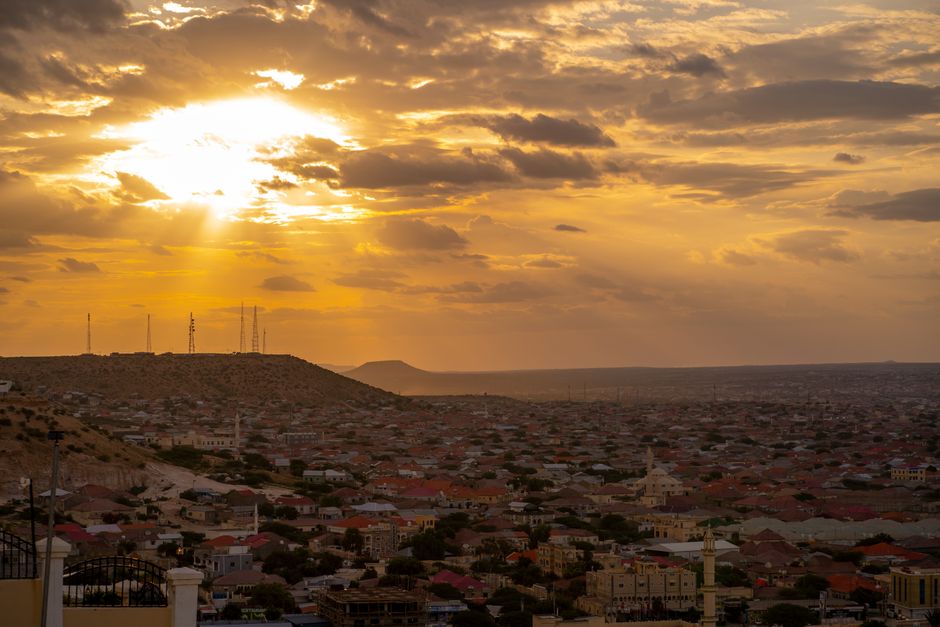
Most tourists arrive expecting a lawless dustbowl, but the first surprise is the city’s order. The two administrations, for all their rivalry, have created a functional dual system: you can cross the line without papers, and shopkeepers accept both Puntland and Galmudug phone networks. The calm is punctuated by the muezzin’s call five times a day, which echoes from minarets across the skyline—a sonic map of devotion. What you will not hear is car horns or sirens. Galkayo moves on foot and at a walking pace. The second surprise is the generosity. If you stop to look at a map, a stranger will approach, ask where you’re headed, and walk you three blocks out of their way. Accepting tea from a shopkeeper is not optional; it’s part of the social contract. Travelers often write home about the man who refused payment for a repurposed tire sandal because “you are a guest, and guests do not pay.”
The third surprise is the quiet intellectual life. Galkayo has a literacy rate that hovers around 40%, but oral literacy is nearly universal. A camel herder can recite genealogies going back 20 generations. A tea seller can quote a poem written in 1943 about a drought. You will be struck by how much people remember—the names of streets that no longer exist, the year a specific shop burned down, the exact wording of a 2005 peace deal. This is a city whose history is stored in human voices, not archives. And the biggest misconception you should discard is that Galkayo is “dangerous.” While it has suffered periodic inter-clan clashes (most recently in 2020), the city is now heavily policed by both sides, and violent crime against foreigners is virtually unheard-of. The real risk is the heat and the dust. Bring a refillable water bottle, electrolytes, and a sense of patience. Things move slowly here, and that is precisely the point.
Your Galkayo, Somalia Questions
Is it safe for a solo traveler to visit Galkayo?
Yes, provided you take sensible precautions. Solo travelers—especially men—can visit Galkayo without a security escort if they stick to North Galkayo during daylight hours, stay in a reputable guesthouse, and avoid the southern periphery after dark. The city is stable because both governments have a vested interest in protecting international visitors who come for trade or development work. Women travelling alone should hire a female guide (available through the Hargeisa-based Somali Women’s Network; ask your hotel for a referral). The biggest safety issue is not conflict but dehydration: always carry a litre of bottled water, and drink
Capture of a breathtaking sunset over the cityscape of Hargeisa, Somalia., Galkayo, Somalia

