
Beyond the Fortress Walls: Why Bengkulu Whispers Stories to the Patient Traveler (2026)
In June 1938, a man with a smoldering intellect stepped off a Dutch ship onto Bengkulu’s sweltering shore. He was not a tourist. Sukarno, the future founding father of Indonesia, had just been exiled to this remote Sumatran port by colonial authorities. Over the next four years, as he walked the ramparts of Fort Marlborough and taught village children beneath the canopy of banyan trees, he planted the seeds of a nation. Today, you can still feel his spectral presence in the colonial-era streets and hear his echo in the quiet dignity of the Bengkulu people.
The Story Behind Bengkulu, Indonesia
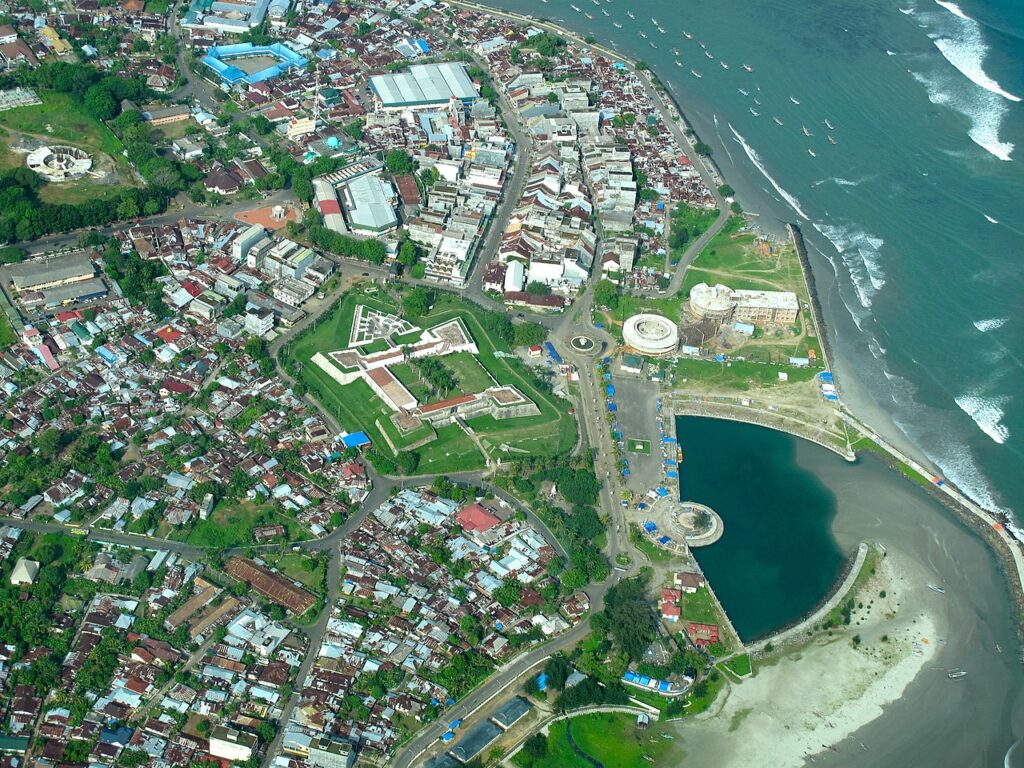
Bengkulu’s history reads like a maritime drama scripted by rival empires. Long before Sukarno’s exile, the pepper trade drew first the Portuguese, then the British, who in 1685 established a trading post here, beating the Dutch to a foothold in Sumatra. But the British presence was precarious—besieged by malaria, rival sultanates, and Dutch machinations. In 1714 they began constructing Fort Marlborough, a massive star-shaped bastion of coral stone that still squats over the city today. You’ll notice its walls are unusually thick: the British, fearful of land attacks from inland kingdoms, designed a fortress that could withstand siege and cannonade. For a century, it was the nerve center of British trade on Sumatra’s west coast.
The year 1818 marks a turning point. Sir Thomas Stamford Raffles, then Lieutenant-Governor of British Sumatra, visited Bengkulu and was appalled by the decay of the fort and the brutality of the slave trade still thriving here. He abolished slavery on the spot and began reforming governance—but his tenure was short. By 1825, the British ceded Bengkulu to the Dutch in the Anglo-Dutch Treaty. Travelers often discover a poignant irony: the same colonial forces that exiled Sukarno had themselves been exiled from influence here a century earlier. Under Dutch rule, Bengkulu faded into a sleepy backwater, a role it has never fully shed. That quietness, however, became its charm. During Japan’s occupation in World War II, the city suffered bombing and hardship, but the post-independence era saw it emerge as a modest provincial capital, rich with memories and unburdened by mass tourism.
Neighborhood by Neighborhood
Kota Tua: The Colonial Heartbeat
Your first stop should be Kota Tua, the old town clustered around Fort Marlborough. Here, streets like Jalan Ahmad Yani and Jalan Soeprapto are lined with peeling Dutch-era shop-houses, their facades painted in faded pastels—mint green, ochre, powder blue—as if the tropics themselves have bleached the color. You’ll hear the clatter of angkots (minivans) and the chatter of traders selling fried bananas from carts. The fort itself is a living museum: climb its ramparts at sunset and you’ll see the Indian Ocean stretching to the horizon, exactly as sentries did three centuries ago. Just east of the fort, the historic cemetery of Christian martyrs from the British era offers a somber contrast—headstones from the 1700s bear names of sailors and soldiers who never sailed home.
Kampung Muara: Where the River Meets the Sea
A ten-minute walk south along the Muara River brings you to Kampung Muara, a fishing village that feels a world away from colonial formality. Stilted wooden houses lean over the brown water, their foundations studded with barnacles. Travelers often discover that this is where Bengkulu’s soul truly resides: men mending nets under the midday sun, women gutting tuna on the dock, children diving off wooden jetties. The scent of drying fish and wood smoke hangs heavy in the air. Locals recommend visiting in the early morning, around 6 am, when the fishing boats return and you can buy fresh-caught anchovies straight from the baskets. The narrow alleyways are too tight for cars, so you’ll walk—past tiny warungs selling coffee and sweet sticky rice wrapped in banana leaves. This is not a tourist tableau; it’s a working waterfront where the rhythms of life haven’t changed much in a hundred years.
Sukaraja: Hills of Exile and Reflection
Head northeast up the gentle slopes away from the coast, and you’ll reach Sukaraja, a residential area that offers respite from the heat and a different kind of history. This is where Sukarno lived during his exile. His simple white house, now the Museum Rumah Pengasingan Bung Karno (Jalan Soekarno, open 8 am–4 pm, entry IDR 5,000), is a time capsule of 1930s domesticity. The rooms are sparse: old photographs, a rattan chair, his daughter’s crib. The garden is lush with frangipani and bougainvillea. Locals recommend coming in the late afternoon, when the light softens and you can sit in the courtyard imagining the conversations that shaped a nation. From the hilltop, you get a panoramic view of the city and the sea—a view that, for Sukarno, was both a window to the world and the bars of his cage. Today, Sukaraja is a quiet neighborhood of modest homes and small shops, perfect for a leisurely stroll away from the city’s main drag.
The Local Table: What Denizens Actually Eat

Cannon at Fort Marlborough, Bengkulu 2015-04-19, Bengkulu, Indonesia
Bengkulu’s cuisine is a delicious fusion of Minangkabau heat from the highlands and coastal freshness. Spices rule here: turmeric, galangal, bird’s eye chili, candlenut. You’ll notice that locals eat with a hardiness that reflects their life between sea and plantation. Rice is the anchor, but the soul is in the sambal—a fiery condiment of ground chili, shallots, and shrimp paste that each cook guards as a secret recipe. The quintessential dish you must seek out is pendap, a fish (usually mackerel) steamed in a rich paste of turmeric, coconut milk, and lemongrass, wrapped in a banana leaf. The flesh becomes impossibly tender, infused with a citrusy earthiness that pairs perfectly with warm rice. You’ll find the best pendap at Rumah Makan Sari Rasa (Jalan Pembangunan no 27, open 10 am–8 pm), a no-nonsense family operation where three generations crowd the kitchen. A plate with rice, pendap, a fried egg, and sambal costs about IDR 25,000—roughly $1.70.
To really understand the city’s food culture, spend a morning at Pasar Panorama (Jalan S. Parman, busiest 6–10 am). This sprawling market is a sensory kaleidoscope: piles of purple mangosteen, still-life rows of fresh tuna, and the dizzying scent of clove and cardamom from spice stalls. Locals recommend you eat breakfast at one of the warung nasi padang in the market’s northern corner—the aromatic beef rendang, slow-cooked in coconut milk for hours, is a revelation. Don’t miss the kue cucur, a crispy-edged fried cake made from rice flour and palm sugar, sold by women carrying bamboo trays on their heads. Two pieces and a small bag of fried peanuts will set you back IDR 10,000. Savvy visitors know to bring their own container and eating utensils, as plastic waste is still a concern here.
Art, Music & Nightlife
Bengkulu’s creative pulse is less about nightclubs and more about traditional rhythm. The most famous cultural expression is the Tabot Festival, held annually from the 1st to the 10th of Muharram (the Islamic lunar month). This is a Shi’a-inspired commemoration of the martyrdom of Imam Husayn, brought to Bengkulu centuries ago by Tamil traders. For ten days, neighborhoods compete to build towering wooden tabot shrines, which are paraded through the streets with drumming and shouting. On the final night, the tabot are thrown into the sea—a dramatic, cathartic eruption of color and sound. Travelers often discover that Bengkulu’s version of Tabot is unusually syncretic, mixing Islamic piety with local animist touches. If you can’t time your visit for Muharram, you can still catch smaller performances at the Gedung Kesenian Bengkulu (Jalan Merdeka) every few weeks, where traditional danding music—poetry sung to a frame-drum—is performed.
Nightlife in Bengkulu is mellow. The city has few proper bars; most socializing happens in coffee shops that stay open until 11 pm or midnight. Kafe Lawang (Jalan Sudirman) is a favorite with local students—it’s a low-key spot with free Wi-Fi, okay iced coffee, and the occasional acoustic guitar session in the back. For something more atmospheric, head to Kopi Kulo (Jalan Ahmad Yani), a hipster-ish joint housed in a restored Dutch building, where you can sip a creamy gula Melaka latte and chat with artists. Don’t expect a late-night scene; Bengkulu is in bed by 10 pm. Instead, take a walk along Pantai Panjang (Long Beach) after dark—the breeze is cool, vendors sell roasted corn, and the moon reflects off the water. It’s perfectly safe, just bring a flashlight.
Practical Guide
- Getting There: Fly into Fatmawati Soekarno Airport (BKS) from Jakarta (Garuda, Lion Air, Batik Air; 1 hour 15 minutes) or Padang. Book at Skyscanner
- Getting Around: Bentor (motorized rickshaw) are the classic way—flag one down, negotiate a price (IDR 10,000–20,000 for a short hop downtown). Angkot minivans (IDR 5,000 per ride) follow set routes but can be confusing. Taxis are rare; use ride-hailing app Gojek if you have local SIM.
- Where to Stay: For convenience, stay in Kota Tua—the Santika Hotel (Jalan Sudirman, from IDR 400,000) offers clean mid-range comfort. For local character, the homestay Pondok Sepakat (Sukaraja, from IDR 150,000) is basic but puts you near Sukarno’s house. Check Booking.com
- Best Time: May–September is the dry season, with cleaner skies and less oppressive humidity. October–December sees heavy rain and potential flooding in low-lying areas. Travelers often discover that the July full moon coincides with calm seas and special beachside events.
- Budget: You can live well on IDR 350,000–500,000 per day (about $23–$33) including a mid-range hotel, three meals, and a bentor ride. Budget backpackers can shave that to IDR 200,000 by eating at warungs and staying in homestays.

White and black bus on road during daytime, Bengkulu, Indonesia
What Surprises First-Time Visitors
Most travelers arrive expecting the hustle of Jakarta or the beaches of Bali. Instead, Bengkulu greets you with a gentle provincial quietness that can feel almost unsettling. The streets are not choked with traffic; the beat of the city is slow, almost lazy. Locals smile easily and approach you not to sell something but often simply to practice English or ask where you’re from. Travelers often discover that this openness is genuine—Bengkulu sees so few foreign visitors that your presence is a novelty, not a nuisance. The surprise is that in a country of 270 million, you can still find a place where you are the only bule (foreigner) for blocks.
The architectural starkness is another jolt. Unlike Yogyakarta’s Javanese ornamentation or Medan’s Malay grandeur, Bengkulu’s colonial buildings are austere—whitewashed, blocky, functional. You might find it underwhelming until you understand that this austerity is a reflection of the city’s history: a frontier outpost where empire was less about splendor and more about survival. Then the fort’s thick walls and the humble wooden houses begin to speak. And then there’s the ocean: Pantai Panjang stretches for nearly seven kilometers of black volcanic sand, waves that are too rough for swimming but hypnotizing in their relentless crash. Locals recommend walking it at dawn, when the only footprints are yours, and the horizon is empty of cruise ships and jet skis. That emptiness, that lack of a tourist gaze, is Bengkulu’s most precious surprise.
Your Bengkulu, Indonesia Questions
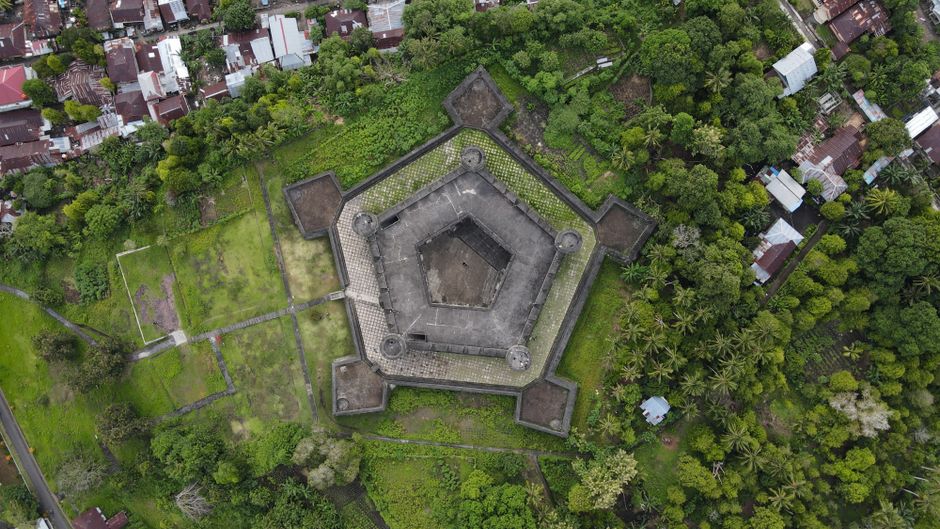
A top-down view of a historic fortified structure surrounded by greenery an…, Bengkulu, Indonesia
Is Bengkulu safe for solo travelers, especially women? Yes, Bengkulu is one of the safer cities in Sumatra. Violent crime is rare, and most locals are respectful. However, you should exercise standard caution: avoid walking alone late at night on deserted streets, keep valuables out of sight, and always negotiate bentor fares before getting in. Solo female travelers report feeling comfortable, though you may receive more stares and the occasional request for a photo—it’s

