
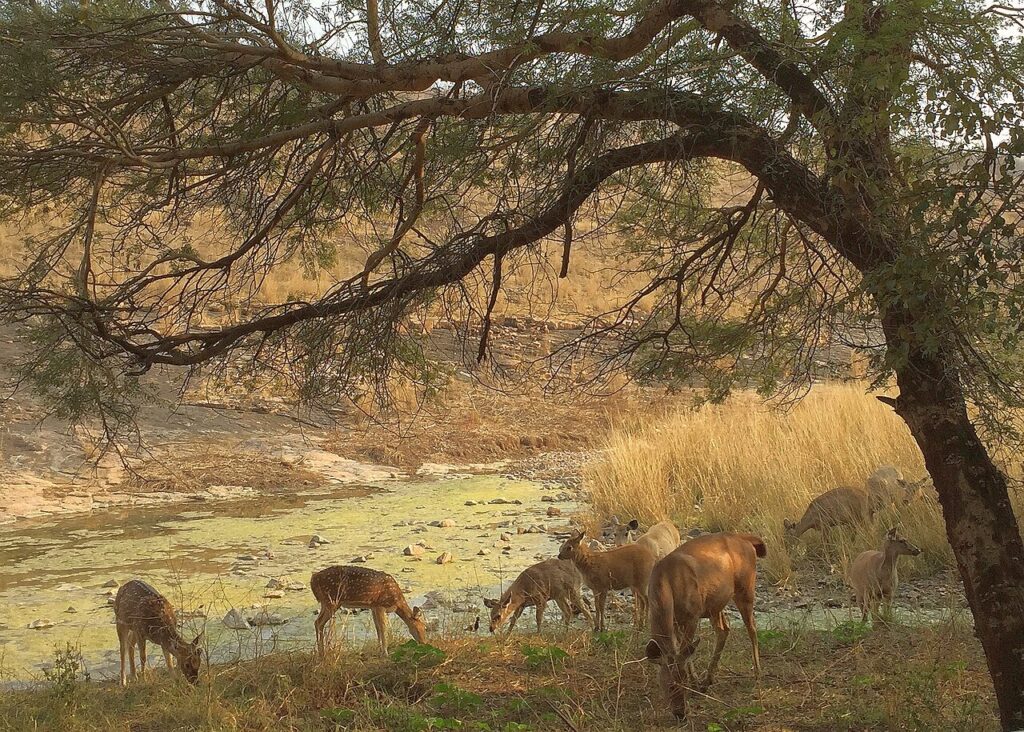
Ranthambhore National Park, India (2026)
In 1972, a young naturalist named Fateh Singh Rathore stood on the crumbling battlements of Ranthambhore Fort, watching a tigress drink from the same ancient stepwell that had quenched the thirst of Rajput queens five centuries earlier. He knew then what few believed—that wildlife and history did not compete here but coexisted in a fragile, electric harmony. That moment sparked one of India’s most extraordinary conservation stories, and today, you will discover why Ranthambhore remains the place where the past growls, not just whispers.
The Story Behind Ranthambhore National Park, India
Ranthambhore’s story begins not with tigers but with stone and blood. The formidable Ranthambhore Fort, perched on a 700-foot-high hill within the park, was built in 944 AD by the Chauhan Rajputs. For centuries, it served as a strategic stronghold, withstanding sieges from Alauddin Khilji in 1301 and later the Mughals. You’ll find its walls still standing, nine kilometers of weathered sandstone that have witnessed conquest, surrender, and the slow encroachment of forest. The fort’s name—Ranthambhore—means “the place of the thorny tree,” a reference to the dense dhau and ber thickets that have always surrounded it.
By the early 20th century, the forests belonged to the Maharajas of Jaipur, who used them as a private hunting preserve. Travelers often discover that it was here, in 1901, that a single hunter shot 107 tigers in a decade—a staggering number that seems almost mythical today. The turning point came in 1973, when Ranthambhore was declared one of India’s nine original Project Tiger reserves. At that time, you would have found fewer than 14 tigers remaining. Locals recall that Fateh Singh Rathore, the park’s first field director, personally fought poachers, built patrol camps, and forged relationships with surrounding villages. His work paid off: by the 1990s, Ranthambhore had become the world’s best place to see wild tigers, with a population that would eventually exceed 70 individuals.
The deeper truth, however, is that Ranthambhore has always been a place where human and animal lives intersect in complex ways. The park’s 1,334 square kilometers contain not just the fort but also ancient temples, tombs, and 30 villages that were relocated during the 1990s. You will feel this layered history as you drive through the park—every ruined chhatri and abandoned well speaks to a human presence that refuses to be erased. What makes Ranthambhore unique, locals will tell you, is that it is not a pristine wilderness but a cultural landscape where tigers have learned to live alongside ghosts.
Neighborhood by Neighborhood
Zone 1: The Core – Ranthambhore Fort Zone
This is the heart of the park, the zone that every traveler hopes to enter. You’ll access it through Gate No. 1, near the village of Sherpur, and immediately you will be surrounded by dry deciduous forest that smells of sunbaked earth and wild jasmine. The road winds past the Padam Talao, a man-made lake built by the Chauhan rulers, where you will often see sambar deer wading belly-deep in the water while crocodiles bask on the far bank. The fort itself looms above, its seven gates—each named after a Rajput clan—leading to a complex of palaces, step-wells, and the Ganesh Temple, where locals still offer prayers. Seasoned travelers recommend spending your first safari here, not just for the tiger sightings, but because the light at dawn turns the fort’s sandstone walls the color of honey, and you will understand why the Rajputs chose this impossible perch.
Zone 3: The Lakes – Padam Talao and Rajbagh
If the fort zone is the historical soul, this is the park’s watery lung. Zone 3, accessed through the Singh Dwar gate, encompasses the three main lakes—Padam Talao, Rajbagh Talao, and Malik Talao—that are the lifeblood of Ranthambhore. You will find that photographers flock here between November and February, when the migratory birds arrive: painted storks, grey herons, and the occasional red-necked falcon. The lakes are also your best bet for seeing tigers in the dry season, as the big cats come here to drink. There’s a specific spot near Rajbagh Lake, marked by an ancient banyan tree, where the tigress Krishna was famously photographed leading her cubs across the water at sunset. Locals say that if you sit here quietly for an hour, you will see nature choreograph a scene—monkeys parting ways, deer stepping cautiously, and then, if you are lucky, the striped shape emerging from the long grass.
Sawai Madhopur Town: The Gateway
Just outside the park’s eastern boundary lies the unassuming town of Sawai Madhopur, which serves as your base camp. This is not a picturesque Indian town—it is dusty, functional, and filled with the rumble of trucks on the main road. But you will learn to love its raw energy. The main street, Ranthambhore Road, is lined with tourist lodges, rooftop cafes, and shops selling everything from tiger-print T-shirts to handwoven tribal blankets. For a dose of local life, walk to the Azad Market near the railway station, where you can watch the vegetable vendors argue over prices and sip thick, sweet chai from a clay cup. Your best bet for a quiet evening is the area around the Ranthambhore School of Art, where a small community of artists and conservationists has created a pocket of calm. The town’s real charm, however, is that it makes you feel like an explorer—each morning you climb into an open jeep, cross the railway tracks, and leave the world behind.
The Local Table: What the Hadoti Denizens Actually Eat
The cuisine of Ranthambhore’s surrounding region is not the rich, butter-drenched fare you might associate with Rajasthan. Instead, travelers discover a simpler, more rustic tradition rooted in the scarcity of this dry landscape. The Hadoti people—the region’s indigenous community—cook with millet, lentils, and wild greens gathered from the forest edge. You will notice that the food is robustly spiced but never heavy, designed to sustain a day of labor under a punishing sun. The staple is bajra roti, a dark, coarse flatbread made from pearl millet, which you will eat with kadhi (a tangy yogurt gravy) or ker sangri, a local specialty of dried desert beans and berries that tastes like nothing you have ever tried.

India (Ranthambhore National Park) Mum nursing her new born baby, Ranthambhore National Park, India
For a proper local meal, skip the hotel buffets and head to the Dhaba 29 in Sawai Madhopur, a roadside eatery that has been serving travelers since 1995. You will find it near the bus stand, marked by a faded green awning and the smell of wood smoke. The owner, a woman named Ganga Devi, makes a dal baati churma that locals swear by—the dough balls are baked over cow dung coals, giving them an earthy smokiness you cannot replicate in an oven. She will serve it with a dollop of homemade ghee and a side of spicy, dried chili pickle. The cost? About 150 rupees for a full thali. What surprises most visitors is that the meal is eaten with your hands—your right hand, specifically—and that the act of tearing bread and scooping lentils becomes a meditative ritual. Plan to spend at least an hour here, watching the mixture of truck drivers, pilgrims, and wildlife guides who gather at her tables.
Another essential stop is the morning market at Purani Mandi, where you will find women from the Mogiya tribe selling wild honey, mahua flowers, and chironji seeds collected from the forest. These ingredients tell the story of Ranthambhore’s human-wildlife interface: the same mahua trees that tigers scratch against produce blooms that villagers ferment into a sweet, potent liquor. If you taste nothing else, try the khus khus halwa—a cold, fragrant pudding made from poppy seeds and rose water—which is sold by a single vendor near the railway station, a man known only as Chacha, who has been making it the same way since 1983.
Art, Music & Nightlife
Ranthambhore’s creative scene is quiet but deeply rooted. The Ranthambhore School of Art, founded in 2008 by wildlife photographer Aditya Singh, is the unlikely epicenter. You will find it in a converted farmhouse on the outskirts of Sawai Madhopur, a space where local artists, many from the Mogiya and Meena tribes, paint wildlife scenes using natural pigments made from flowers and bark. The school hosts an annual exhibition in November, the Ranthambhore Art Festival, where you can buy paintings that capture the park’s elusive beauty—often depicting tigers with a familiarity that only people who share a landscape with them can achieve. The school also runs evening photography workshops, and if you book ahead, you can spend an hour learning to read animal tracks from a former poacher-turned-guide, a man named Kalu, whose knowledge of the forest borders on the supernatural.
When night falls, you will not find clubs or bars in Sawai Madhopur. The nightlife here is of a different kind. At the open-air amphitheater near the park entrance, the Ranthambhore Foundation organizes cultural evenings during the peak season (October to March), where you can watch Kalbeliya dancers from Jaisalmer and Manganiyar musicians from Barmer perform under a canopy of stars. The performances start at 7 PM and cost 200 rupees. But the most memorable nights are quieter still—sitting on the rooftop of a lodge like the Tiger Den or the Khem Villas, listening to the call of a nightjar, and realizing that the real artistry of this place is the silence. Locals recommend that you arrive early for the evening shows, as the spotlights attract insects, which in turn attract bats, and the sight of hundreds of bats swooping overhead is a spectacle in itself.
Practical Guide
- Getting There: The nearest airport is Jaipur International Airport (JAI), about 180 kilometers away. Direct flights arrive from Delhi, Mumbai, and Udaipur. You can also take a direct train from Delhi to Sawai Madhopur Junction (SWM) on the Delhi-Mumbai route—several trains like the Sawai Madhopur Express take about 5 hours. Book at Skyscanner for flights or IRCTC for train tickets.
- Getting Around: The park is accessed only by authorized safari vehicles. You must book a jeep or canter (a larger open truck) through the official Ranthambhore Forest Department website or via your lodge. A morning safari (6 AM to 10 AM) costs about 1,800 rupees per person in a jeep, plus the park entry fee of 650 rupees for foreigners. For the town, auto-rickshaws are your best bet—negotiate a fare of 50-100 rupees for short trips.
- Where to Stay: For luxury, the Aman-i-Khas and Oberoi Vanyavilas offer tented suites near the park. Mid-range options like Tiger Den Resort (book on Booking.com) start at 4,000 rupees per night. Budget travelers should check Hotel Ranthambhore Regency near the railway station, with rooms from 1,200 rupees.
- Best Time: The park is open from October to June. The ideal window is November through March, when the weather is cool (15-25°C) and animals congregate near the lakes. April to June is brutally hot (45°C) but offers the best tiger sightings as animals come out to drink. The park is closed during the monsoon season (July-September).
- Budget: Plan for a minimum of 5,000 rupees per day if you book two safaris (morning and evening), including accommodation and meals. Luxury travelers should budget 20,000-50,000 rupees per day.

Reflections of white mosque on water, Ranthambhore National Park, India
What Surprises First-Time Visitors
The first surprise for many travelers is how small the park feels. You expect vast, endless wilderness, but Ranthambhore is a compact 1,334 square kilometers—roughly the size of Los Angeles—and you will constantly see the outskirts of villages, fields, and even a railway line that cuts through the reserve. The train that passes through at 7 AM is not a romantic touch; it is a daily reminder that the park is a patchwork of protected land and human habitation. Locals will tell you that the tigers have learned to cross the tracks at specific points, and that the train drivers know to slow down. This intimacy with the human world is both the park’s vulnerability and its charm.
The second surprise is the noise. You imagine safaris as silent, meditative affairs, but the reality is the constant crackle of walkie-talkies, the idling of jeep engines, and the excited chatter of other tourists when a tiger is spotted. A single sighting in Zone 1 can draw 15 jeeps within minutes, and the air fills with the click of cameras. What you learn quickly is that the real magic happens in the waiting—the hour you spend between sightings, watching a spotted deer flick its tail or a langur leap from a fig tree. Seasoned travelers say the secret is to choose a safari between 2 PM and 5 PM, when most tourists are eating lunch, and the forest falls quiet again.
The greatest surprise, though, is how deeply the place gets under your skin. You come to see a tiger; you remember the old banyan tree whose roots have consumed an abandoned temple. You come for adrenaline; you leave haunted by the sound of peacocks calling at dusk. The local guide will point out claw marks on a tree trunk—a tiger’s territorial scrape—and you will realize that you are not a visitor in this forest but a guest, tolerated at best. That is what stays with you: the humbling sense that Ranthambhore does not need you, but you need it.
Your Ranthambhore National Park, India Questions
How many safaris should I book to see a tiger? Statistically, the park has a sighting rate of about 70% during the dry season, but you should plan for three to four safaris to maximize your chances. The morning safari (6 AM to 10 AM) is the best for spotting tigers, as they are most active after sunrise. However, the evening safari (3 PM to 6 PM) often yields better photographic light. If you only have time for one, book an afternoon slot in Zone 3 or Zone 4, where the lakes attract both prey and predators. Your guide will also play a crucial role—tip him 300-500 rupees per safari for his efforts, and ask specifically for a guide who has worked in the park for more than ten years.

Brown concrete building under blue sky during daytime, Ranthambhore National Park, India
Is Ranthambhore safe for solo female travelers? Yes, but you should exercise the same caution you would in any Indian small town. The park itself is very safe—safaris are conducted in groups with armed guides, and you will always be in the company of other tourists. In Sawai Madhopur town, stick to the main roads after dark, and book a reputable lodge that provides transport from the railway station. Many mid-range and luxury resorts have female staff and security guards. For cultural reasons, dress modestly—cover your shoulders and knees—and avoid walking alone in isolated areas. Women travelers often find that the community of fellow wildlife enthusiasts is welcoming and respectful.
Can I visit the Ranthambhore Fort without a safari? Absolutely, and you should. The fort is accessible via a separate entrance near the village of Singh Dwar, and you do not need a safari booking to explore it. You can hire a local guide (400 rupees) to walk you through the seven gates, the palace ruins, and the Ganesh Temple, which is still active and attracts pilgrims during the annual fair in August. The fort is open from 9 AM to 5 PM daily, and the entry fee is 100 rupees for Indians and

