
Beyond the Calm: Unearthing Chicamba, Mozambique’s Reservoir Life (2026)
In 1955, Portuguese engineers completed the daunting Chicamba Dam, flooding the Revubué River valley and displacing 1,200 families who had farmed that rich red soil for generations. They called it progress. You will often hear elders in Chicamba today tell the story of the submerged baobab—its ghostly crown still visible when drought lowers the water. That tree is a quiet monument to the place that lives beneath the lake, and it sets the tone for everything you will find in this resilient, unpolished corner of Manica Province.
The Story Behind Chicamba, Mozambique
Chicamba’s history is inseparable from that dam. Before the concrete rose, this was a sleepy corridor of Portuguese cotton and maize estates, worked by local Chewa and Sena peoples. The colonial administration, eager to control water and boost agricultural exports, chose the narrow gorge near the present-day town for what would become the Cahora Bassa of small dams—a 60-meter-high wall holding back 74 square kilometers of water. The project, completed in 1955 under Governor-General Gabriel Maurício Teixeira, flooded not just farmland but entire hamlets and ancestral graves. Travelers today drive across the dam crest and see a placid lake, but locals will quietly tell you that on moonless nights, you can hear drums from below. That’s folklore, of course—yet the sentiment is real: the water runs deep with memory.
After independence in 1975, Chicamba stagnated. The dam’s hydroelectric turbines powered Beira and Chimoio, but the town itself remained a modest outpost. The sixteen-year civil war (1977–1994) turned the reservoir into a strategic zone, with RENAMO and FRELIMO forces skirmishing along its banks. Peace brought slow recovery. Fishing villages sprouted on the southern shore; a small tourism office opened in 2005. Today, savvy visitors discover that Chicamba is not a flashy destination but a quiet, authentic escape. You will find no luxury lodges here—only a raw, water-whispered existence that rewards patience.
Neighborhood by Neighborhood
Vila Chicamba (The Town Centre)
You arrive in Vila Chicamba along the EN6, a two-lane road that curves past a dusty petrol station and a cluster of single-story concrete shops. This is the administrative heart, such as it is. The main square, Praça dos Batalhadores, holds an iron statue of a soldier from the liberation struggle—painted in faded greens and reds. On Monday mornings, the market here overflows with buckets of tilapia, fresh from the lake, and piles of dark green matapa leaves. Travelers often notice the pace: slow, deliberate. The only café, Café Revúbuè on Avenida Central, serves strong Nescafé with condensed milk and a simple breakfast of pão with butter for 30 meticais (less than US$0.50). Your best bet is to sit on its plastic terrace at 7 a.m., watch fishermen carry their catch, and let the day warm up. The architecture is mostly 1960s Portuguese-style bungalows with peeling pastel paint and corrugated iron roofs—nothing grand, but the jacaranda trees that line the streets explode in purple each October, and that, you will agree, is a kind of beauty.
Margem Sul (South Bank)
Drive ten minutes south from the town centre, down a dirt road that hugs the reservoir’s edge, and you enter the realm of the water. Margem Sul is a loose string of fishing hamlets—Nhachengue, Matatuana, Nhacha—where life revolves around the lake. You’ll see women pounding maize in wooden mortars outside huts, children chasing goats along the shore, and pirogues (dugout canoes) pulled up on muddy banks. Locals recommend visiting the small fish-drying racks near Nhachengue; the smell is pungent, but the sight of silver tilapia glistening in the sun is pure Chicamba. There is a single guesthouse here, Pensão do Lago, a three-room affair with mosquito nets and a veranda that looks directly over the water. The owner, Dona Rosa, will cook you a dinner of fried fish with xima (maize porridge) and boiled cassava for 150 meticais. Plan to spend a full afternoon just sitting on that veranda, watching the light change—tourists rush too much, and this place punishes rushing.
Barragem (The Dam Wall Area)
The dam itself is a short walk from Vila Chicamba’s edge. A gated road leads to the crest, where you can walk across the 400-meter concrete arc. Security guards, usually young men in blue uniforms, will wave you through—they appreciate visitors. From the centre, you look east down the gorge where the Revubué River used to run; now it’s a thin spillway of white water. The view is stark and imposing. On the west side, the reservoir stretches like a blue mirror into the hills. Travelers often feel a strange contradiction: such massive engineering, yet such serene emptiness. There is a small monument at the dam’s base, a concrete plinth with a Portuguese inscription dated 1955: “Esta barragem foi construída para o progresso de Moçambique”—This dam was built for the progress of Mozambique. Locals will tell you it brought electricity, but it also drowned their grandmothers’ fields. Stand there long enough, and the silence tells both sides of the story.
The Local Table: What Denizens Actually Eat
Seafood dominates Chicamba’s table—not the ocean kind, but freshwater fish from the reservoir. You will discover that the locals’ daily diet revolves around tilapia (local name: nhemba). It’s caught by line and net, grilled over open coals, and served with xima, a stiff maize porridge that you roll into balls and use to scoop the fish. The essential dish you must seek out is matata de peixe, a stew of fish cooked in coconut milk, peanut paste, and matapa (cassava leaves). The combination is creamy, nutty, and slightly earthy. The best version is found at the market in Vila Chicamba, from a woman named Senhora Alice—she works under the big mango tree next to the bus stop. Her matata, served in a plastic bowl at 8 a.m. sharp, costs 40 meticais and draws a crowd of workers. She uses catfish caught overnight, and the coconut is freshly grated that morning. Her secret: a pinch of chili from the garden behind her house. You will not find this on any menu.
Meals in Chicamba are communal. Travelers are often surprised to be invited to share a bowl with a family, and if you are, accept—it’s rude to refuse. The eating rhythm is slow: breakfast early (tea or coffee and bread), a large lunch around noon (the main meal), and a light supper of leftovers or grilled fish at sunset. The only restaurant of note is Restaurante Nhamatanda on Avenida Central, which serves decent grilled chicken and chips for 200 meticais. But for the real Chicamba experience, head to the south bank on a Saturday afternoon, where fishermen grill their catch on the shore and sell it directly—a whole tilapia, charred and seasoned with salt and lemon, costs just 50 meticais. You eat with your fingers, the lake lapping at your feet.

Part of Chicamba Dam, Chicamba, Mozambique
Art, Music & Nightlife
Chicamba is not a nightlife capital—the only sounds after 9 p.m. are frogs and the distant hum of the dam’s turbines. But you will find creative expression in unexpected places. The community of matambals (traditional healers) in the surrounding hamlets hold occasional mapiko dance ceremonies, where men wear elaborate wooden masks and simulate ancestral spirits. These are not tourist shows—they happen for funerals, harvests, or healing rituals. If you befriend a local, you might be invited. Ask at the market for Nhama Momba, a respected curandeiro (traditional doctor) who sometimes allows respectful visitors. Music is mostly broadcast from tinny radios—marrabenta from Maputo, zouk from Angola, and the occasional melancholy ballad of mozambicano guitarist Mingau. There is one small bar, Bar da Lua near the dam gate, that plays music on a cracked speaker system. It has a pool table, a dusty jukebox, and a few plastic chairs under a thatched roof. Go on a Friday evening; you’ll find off-duty dam workers drinking 2M beer and playing matraquilhos (foosball). It’s not a scene—it’s a heartbeat.
The real art of Chicamba is its pottery. On the eastern outskirts, in the village of Moamba, women shape clay into water jugs and cooking pots, fired in open pits. You can visit the pottery cooperative at Estrada do Lago, a small shed with a wooden sign. A large cooking pot costs 150 meticais; a smaller jug is 50. The designs are simple—stripes of red and black—but they are the same patterns used for centuries. Travelers often say that watching the potters work, hands slick with wet mud, is more captivating than any gallery. And they’re right.
Practical Guide
- Getting There: The nearest airport is Chimoio Airport (VPY), served by LAM Mozambique Airlines from Maputo or Beira. From Chimoio, take a chapa (shared minibus) to Chicamba—they leave from the Mercado Central every hour from 6 a.m. to 4 p.m. The ride costs 150 meticais and takes 45 minutes. Book flights at Skyscanner.
- Getting Around: Within Chicamba, you walk or take a mototaxi (motorcycle taxi). Hail one from the main square—expect to pay 30–50 meticais for a ride to the dam or south bank. To visit Margem Sul villages, a mototaxi is your best bet; negotiate around 150 meticais for a return trip with waiting time. Alternatively, you can rent a bicycle from Senhor Joaquim’s shop near the church—costs 200 meticais per day.
- Where to Stay: For budget travelers, Pensão do Lago (Margem Sul) offers basic rooms with shared bath for 500 meticais/night. For slightly more comfort, Hotel Chicamba (Vila Chicamba) has private rooms with fan and mosquito net from 800 meticais. Book via Booking.com (though options are limited—book in advance).
- Best Time: Visit from May to September, the dry winter months. The reservoir is full, the skies are clear, and the heat is manageable (25–30°C days). Avoid December to March, the rainy season, when roads turn to mud and the lake level drops.
- Budget: A daily budget of US$30–40 per person covers basic accommodation, three meals from markets and small restaurants, and transport. If you want the occasional beer or pottery souvenir, budget US$50.

Stunning aerial view of Maputo, Chicamba, Mozambique
What Surprises First-Time Visitors
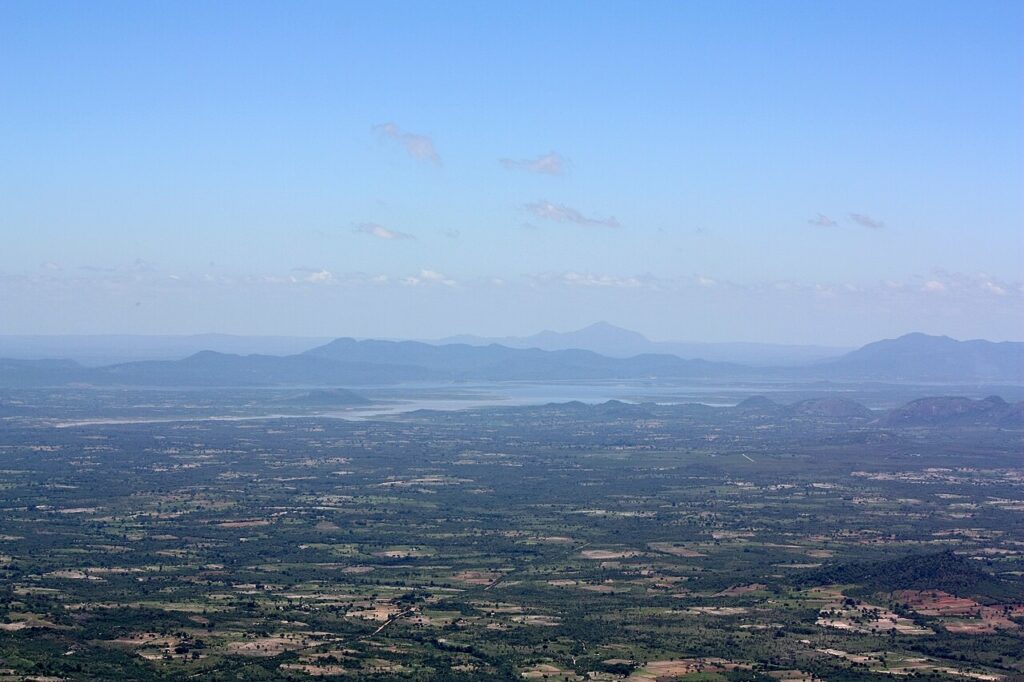
Travelers often arrive expecting a dusty sort of nowhere and are instead stunned by the lake’s beauty. The water is a deep teal, fringed by green hills and distant granite inselbergs. At sunrise, the mist rises like a veil, and the only sound is a fisherman calling to his companion across the water. You will be alone with it. That quiet—complete, unbroken by traffic or tourists—is the first surprise. The second: the hospitality. Strangers will greet you with “Bom dia” and ask where you are from. They will offer a seat in the shade, a cup of sweet tea, a mango from their tree. In a world of guarded cities, Chicamba is disarming.
The other shock is the absence of infrastructure for tourism. There are no ATMs in town—the nearest is in Chimoio. Many shops don’t accept card payments. You must bring meticais in cash, and enough to last your stay. Locals find this amusing; they expect visitors to be unprepared. Plan accordingly, and you’ll be rewarded. You will also be surprised by the stars. With zero light pollution, the night sky over the reservoir is a canopy of dense glitter—the Milky Way spills across it like a river. Visitors often stand on the dam at midnight, speechless. That is Chicamba’s gift.
Your Chicamba, Mozambique Questions
Is Chicamba safe for solo travelers? Yes, exceptionally so, especially compared to larger Mozambican cities. Violent crime is almost nonexistent; the biggest risks are petty theft if you leave valuables unattended. Locals are protective of visitors—if someone sees you looking lost, they will guide you. That said, exercise standard precautions: don’t walk alone at night in the outskirts, and keep your belongings secure. Female solo travelers report feeling comfortable, though the chapa rides can be crowded. Trust your instincts, and you’ll feel at home.
What exactly can you do in Chicamba if you don’t fish? Plenty. You can hike the hills around the dam—the trail up to Mount Muvurume (4 km east) offers panoramic views of the reservoir and takes about two hours. You can take a pirogue ride across the lake with a local fisherman; negotiate 300 meticais for an hour-long trip. There is also a small crocodile sanctuary near the spillway (free, but tip the caretaker) and a weekly market on Saturdays where you can buy woven baskets and dried fish. For most travelers, the real activity is simply being—reading a book on the dam, chatting with Dona Rosa, watching the sun set over water that holds a century of change.
How do I respect local customs in Chicamba? Dress modestly, especially in the villages—shorts are fine in town, but cover knees and shoulders when visiting homes. Greet everyone with “Bom dia” or “Boa tarde” before asking anything. Do not take photos of people without asking; many will refuse, but if they agree, offer a small coin or a piece of candy as thanks. When sharing a meal, always wash your hands before eating, never take food directly from the common bowl with your left hand, and wait to be told where to sit. Most importantly, be patient. Nothing happens quickly in Chicamba—a meal takes two hours, a conversation takes three. Embrace that pace, and you will leave with more than photographs.

Aerial view of Maputo, Chicamba, Mozambique

