
Where the Atlantic Meets the Iron Horse: Takoradi’s Resilient Soul (2026)
In 1928, the first locomotive chugged into Takoradi from the cocoa-rich hinterlands of Kumasi, and the city’s destiny shifted forever. That day, a young clerk named Kwame Nkrumah (then a student) watched from the platform as gold, timber, and cocoa began flowing toward a newly built deep-water harbour. The smell of salt air mixed with coal smoke, and the port became Ghana’s throat — swallowing produce from the interior and spitting out the world’s goods. You can still feel that rhythm today, in the grit and grace of Ghana’s third-largest city.
The Story Behind Takoradi, Ghana
Takoradi’s history is a tale of two sisters: Sekondi, the older colonial port founded by the British in the 1890s, and Takoradi, the purpose-built railway town that rose from coastal scrubland. After the Gold Coast’s governor, Sir Gordon Guggisberg, launched the Takoradi Harbour project in 1920, the city boomed. By 1928, the harbour opened, eclipsing Sekondi as the nation’s busiest port. The British built airstrips too — Takoradi Airfield later became a key staging post for Allied aircraft during World War II. Travelers often discover that this dual heritage — industrial port and military waypoint — left the city with a no-nonsense, workmanlike character.
When Ghana gained independence in 1957, Takoradi kept its role as the Western Region’s economic heartbeat. The gold mines of Tarkwa, the bauxite of Awaso, and the offshore oil discovered in 2007 all pass through these docks. Locals recommend walking along the Harbour Approach Road at dusk, when the container ships light up like floating cities and you hear the clang of crane hooks against steel. The city’s identity remains fused to movement — it’s a place that never stays still, where every worker carries a story of goods that travelled from the Cameroon Mountains to the Gulf of Guinea.
Neighborhood by Neighborhood
Airport Ridge
Your first encounter with Takoradi, if you fly in, is Airport Ridge — the elevated suburb that hugs the runway. This is where the money lives. Neat bungalows painted in pale yellows and sea-foam green line streets named after Ghanaian heroes. The air smells of jasmine and diesel from idling SUVs. You’ll find the city’s best hotels here: the cozy Best Western Plus Atlantic Hotel (where the barista pours real espresso) and the Golden Tulip Takoradi with its pool overlooking the airport. But what makes Airport Ridge special is its evening market at the junction near Papa’s Spot — a humble kiosk where you can buy grilled tilapia dusted with shito (spicy black pepper sauce) for just 25 cedis. Travelers often remark that the Ridge feels more like a quiet suburb in Accra than a port city — a place to sleep between adventures.
Market Circle (Adiembra)
Now, walk north toward the heart of Takoradi — Market Circle, the sprawling commercial district that locals call Adiembra. Prepare your senses for an assault of sound: women calling “fufu! fufu!” over bubbling pots, taxi horns bleating, and the rhythmic thwack of a machete splitting coconut husks. The main market, Takoradi Central Market, occupies a warren of concrete stalls under corrugated roofs. You’ll find everything from second-hand sneakers (“dead white man’s clothes,” as the joke goes) to heaps of cayenne peppers and dried fish. The smell of smoked catfish mixes with the sweetness of ripe plantains. Locals recommend starting your visit with a glass of fresh coconut water from one of the ladies at the southern entrance — she will slice the top off with one swing, and the cool liquid will revive you. You can buy a whole bag of pineapples for 10 cedis. But keep your wallet close — this is also where pickpockets work the crowds.
Takoradi Harbour and Chapel Hill
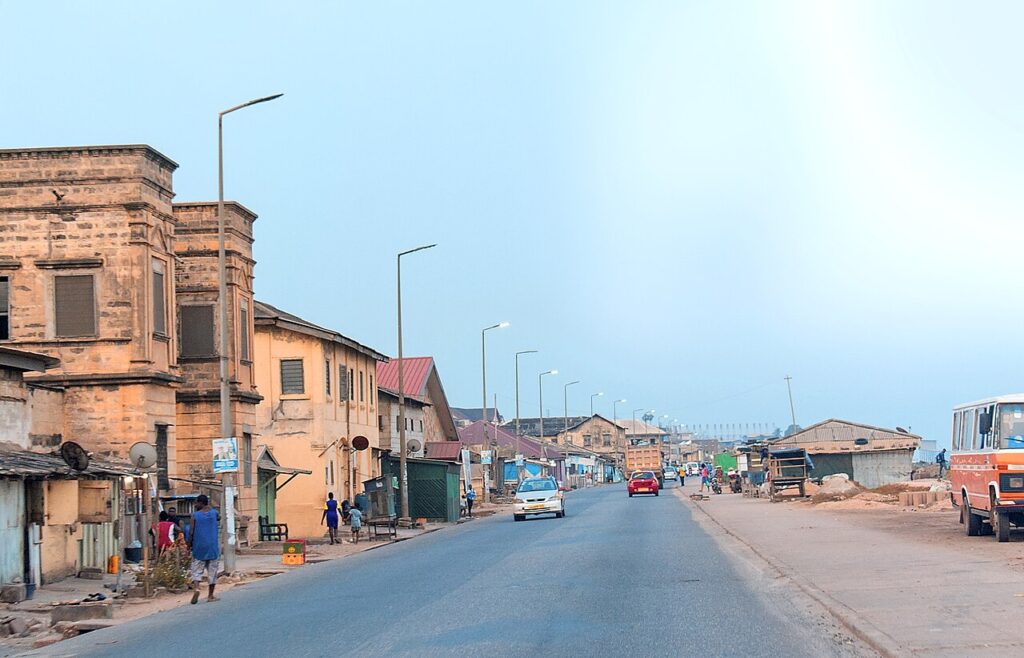
South of Market Circle, the landscape flattens toward the harbour. Chapel Hill is the old administrative district, where colonial-era buildings still stand: the crumbling Takoradi Post Office with its arched windows, and the Railway Staff Quarters in faded ochre. This is where the city’s history feels most tangible. Stroll down Liberation Road, and you’ll pass the Takoradi Railway Museum (open 9am–4pm; admission 5 cedis). Inside, a single steam locomotive sits rusting in the yard — the same type that carried Nkrumah’s cocoa. You can almost hear the whistles of the 1930s. A few blocks away, the Chapel Hill Methodist Church (built 1906) still holds Sunday services in Fante and English. The neighbourhood has a sleepy, melancholic air — old men play draughts under shade trees, and the salty breeze carries the distant grumble of ships. Savvy visitors know to come here for a quiet morning before the market frenzy takes over.
Sekondi — The Old Port
Don’t make the mistake of skipping Sekondi, Takoradi’s twin city just five kilometres east. This older settlement was the original British colonial port, founded in 1898 after the railway from Kumasi reached the coast. The streets are narrower, the buildings more dilapidated — and that’s exactly the charm. Wander Hospital Road past the Sekondi Methodist Cathedral (a striking white edifice from 1905) and down to the Fort Orange viewpoint (a Dutch trading post from the 17th century, though little remains). Here you’ll find the Sekondi Artisans’ Village, where craftsmen weave kente cloth on hand-built looms. The rhythmic thump of the shuttle is hypnotic. Locals recommend visiting on a Saturday morning, when the fish market at the beach is at its most frantic: women balancing basins of mackerel on their heads, children chasing stray dogs, and the aroma of smoked herring hanging thick in the air.
The Local Table: What Takoradi Natives Actually Eat
Forget the tourist restaurants serving “African salad” — what real Takoradians eat is fante kenkey: a sour, steamed cornmeal dumpling wrapped in plantain leaves. You’ll see women selling it from aluminium basins at street corners, or find it in the bustling Kojokrom Food Market (a 10-minute taxi from Market Circle; cost: 5 cedis). The proper way to eat kenkey is with fried fish (tilapia or mackerel), a dollop of shito (that spicy black pepper and dried shrimp paste), and a side of sliced avocado. Locals insist the best comes from Mama Abena’s Spot at the junction near the harbour, a rickety wooden stall that’s been serving since 1992. You’ll know it by the queue of dockworkers at lunchtime. She opens at 11am sharp; come before 11:45 or the fish runs out.
This is an image of “African people at work” from, Takoradi, Ghana
The city’s other staple is fufu and light soup. Fufu is a doughy mound of pounded cassava and plantain, eaten by pinching off a ball and dipping it into a thin, spicy broth of goat meat, tomatoes, and chilli. You’ll find excellent fufu at The Republic Restaurant (on Chapel Hill Road, open 10am–10pm; a full plate costs 40 cedis). But the real secret of Takoradi’s food scene is the night soup — vendors sell bowls of light soup with cow skin (wele) from mobile carts after 9pm. The soup is served in bright plastic bags tied with rubber bands, so you can sip it on the go. It’s smoky, spicy, and deeply satisfying after a humid day.
Art, Music & Nightlife
Takoradi is not Accra — you won’t find soulless nightclubs with VIP ropes. Instead, the city’s creative energy pulses through its highlife and gospel music scenes. Every November, the Takoradi Jazz Festival (started 2015) brings together Ghanaian and international musicians for three days at the Best Western Plus Atlantic Hotel and the Take 5 Jazz Bar (a small rooftop venue on Liberation Road). You’ll hear brass bands, afrobeat covers, and palm-wine guitar balladry. Locals recommend the Friday night gigs at Nana’s Pub in Chapel Hill — a dim, concrete-walled room where a live band plays old highlife classics (Yaa Amponsah, Sikyi) while old men in pressed shirts dance with stately elegance. Entry is free, but you buy a beer (Star or Club) for 8 cedis. The music starts at 9pm and goes until the last drunkard leaves.
For visual art, the Takoradi Craft Village (on the Accra–Takoradi Highway, open daily 8am–5pm) is a cluster of thatch-roofed huts where 20-odd artists sell batik textiles, carved wooden masks, and soapstone figurines. The secret is to look for the workshop of Master Kojo at the back — he makes intricate “adinkra” symbols using hand-carved stamps and natural black dye made from the bark of the badie tree. He’ll show you the process for free, and a small square of cloth costs 15 cedis. You can even commission a custom piece with your family name in adinkra symbols. For something more contemporary, the Gallery 1957 (inside the Golden Tulip Hotel) features rotating exhibitions by young Ghanaian photographers and painters — surprisingly sophisticated for a city that most tourists rush past.
Practical Guide
- Getting There: Fly into Takoradi Airport (TKD) from Accra (45 minutes, domestic flights operated by Passion Air and Africa World Airlines; round-trip fares from $120). Alternatively, take a VIP bus from Accra (STC or OA Travel; 4–5 hours; 80 cedis). Book flights at Skyscanner
- Getting Around: The cheapest way is tro-tro (shared minibuses) — routes 1 and 2 cover most of central Takoradi; cost 2–5 cedis per ride. Taxis are plentiful: 10–20 cedis for short trips within the city, negotiate before getting in.
- Where to Stay: For comfort on Airport Ridge, try Best Western Plus Atlantic Hotel (from $80/night). Mid-range: Hotel Capital Hill in Chapel Hill (from $45/night, clean but basic). Budget: Royalty Guest House near Market Circle (from $25/night, shared bathroom). Check Booking.com
- Best Time: November to February — the Harmattan winds blow in from the Sahara, cooling the air and keeping humidity low. Avoid March–June (long rains) and October–November (short rains).
- Budget: You can get by on $40–60 per day (mid-range meals, tro-tro transport, simple accommodation). Budget $80–120 for comfort (private taxis, better hotel, restaurant meals).

People gathering on green grass field during daytime, Takoradi, Ghana
What Surprises First-Time Visitors
Most travelers arrive expecting a gritty, industrial dump — and they find instead a city of surprising green. The coconut palms that line the beach at Bubuyeye (a 15-minute drive west) create a canopy of shade, and the Atlantic breakers roll in with a force that would terrify Mediterranean swimmers. You’ll discover that Takoradi is genuinely safe to walk at night (the streets are lively, not threatening), but that the humidity can feel like a wet blanket — you will sweat through your shirt by 9am, so pack cotton and linen. Another shock: the pace is slower than Accra. People stop to talk. Taxi drivers will want to chat about your family. This can feel disarming if you’re used to big-city anonymity.
The biggest surprise might be the oil wealth — since 2010, when oil from the Jubilee Field began flowing, new car dealerships, glass towers, and upscale supermarkets have sprouted. Yet the city still lacks a single proper bookstore or cinema. It’s a place where a luxury hotel sits a few blocks from a goat market. You’ll learn to love that contradiction — it’s the soul of West Africa in one city.
Your Takoradi, Ghana Questions
Is Takoradi safe for solo female travelers?
Yes, but with the usual precautions. Locals are respectful, and you’ll see women walking alone even after dark in areas like Airport Ridge and Chapel Hill. However, avoid the empty parts of the harbour after 7pm and keep your valuables hidden in the market. Use taxis at night — they cost little and drivers are generally trustworthy. Many solo women travelers recommend staying at the Best Western Plus, where the staff are helpful and the rooms have safety locks.

Green trees and plants under white clouds during daytime, Takoradi, Ghana
How do I handle the language barrier?
English is the official language, so you’ll have no trouble in hotels, taxis, and restaurants. But Fante is the dominant local tongue. Learn a few phrases: “M’asan” (thank you), “Enye dɛn?” (how are you?), and “Mɔma” (hello). Ghanaians love it when you try — expect a big grin and a detailed response you won’t understand.
What should I do if I get sick from food or the heat?
Your best bet is to visit the Takoradi Hospital (on Hospital Road in Sekondi) — it’s public but functional. For minor stomach issues, go to a pharmacy (ask for Oral Rehydration Salts and Imodium). But the real trick is prevention: drink only sealed bottled water (sold everywhere for 1 cedi), and eat cooked food from busy stalls. Avoid raw vegetables unless you peel them yourself. The heat can cause dehydration — carry a reusable water bottle and top up at the KFC on Liberation Road (they have a free water station near the restrooms).

